

Paper Covered Wire in Oil-Immersed Transformer Design
Introduction
Oil-immersed transformers, as core equipment in power systems, undertake the crucial functions of voltage transformation and power transmission. Paper-covered wire, as a traditional transformer winding material, occupies an irreplaceable position in the field of high-voltage, high-capacity transformers due to its excellent oil-paper insulation system with transformer oil.
I. Basic Principles and Structure of Oil-Immersed Transformers
1.1 Working Principle of Transformers
Transformers achieve voltage transformation based on the principle of electromagnetic induction. When an alternating current flows through the primary winding, an alternating magnetic flux is generated in the iron core. This magnetic flux passes through both the primary and secondary windings simultaneously, achieving voltage transformation according to the turns ratio.
Oil-immersed transformers house the core and windings in a tank filled with transformer oil. The transformer oil serves not only as an insulating medium but also plays a crucial role in heat dissipation and arc extinguishing.
1.2 Winding Structure Types
Layered Winding: Conductors are arranged in layers along the axial direction, mainly used for high-voltage windings.
Paper Disc Winding: Conductors are wound into disc-shaped coils, with insulating paper and oil channels between the coils; widely used in high-voltage power transformer windings.
Helical Winding: Conductors are wound in a helical shape, used for high-current, low-voltage windings.
1.3 Importance of Oil-Paper Insulation Systems
The advantages of oil-paper insulation systems are: high dielectric strength and good heat dissipation performance of transformer oil; high mechanical strength and excellent oil absorption performance of insulating paper; the combination of the two can withstand very high electric field strengths.
II. Technical Characteristics of Paper-Sheathed Conductors
2.1 Basic Properties of Insulating Paper
| Performance Indicators | Parameters |
|---|---|
| Tensile Strength | 50-100MPa |
| Elongation | 3-8% |
| Volume Resistivity | 10¹³-10¹⁴Ω·cm |
| Dielectric Strength | 40-80kV/mm |
| Operating Temperature | -40°C to +105°C |
2.2 Structural Forms of Paper-Sheathed Conductors
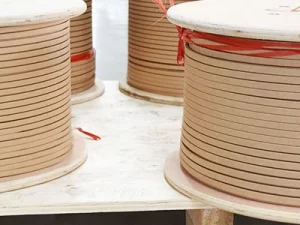
Cable Paper-Wrapped Conductors: Insulating paper tape is wrapped around the conductor in an overlapping manner. The width of the paper tape is usually 10-35mm.
Enameled Paper-Wrapped Conductors: The conductor surface is first coated with an insulating varnish layer, and then insulating paper is wrapped around it.
Semi-conductive Paper-Wrapped Conductors: Used to homogenize the electric field in high-voltage windings.
2.3 Compatibility of Paper-Sheathed Conductors and Transformer Oil
After transformer oil impregnates the insulating paper, the dielectric strength of the paper can be increased by 2-3 times. The capillary action of the insulating paper can adsorb the transformer oil inside the paper layers, ensuring long-term stability of insulation performance.
III. Typical Applications in Oil-Immersed Transformers
3.1 High-Voltage Winding Application
Application Form: High-voltage windings usually use enameled paper-wrapped conductors.
Technical Requirements: Corner rings, screens, and other reinforced insulation structures need to be installed at the winding ends.
3.2 Low-Voltage Winding Application
Application Form: Flat wire or foil winding structures can be used. Foil windings use alternating copper foil and insulating paper.
Technical Requirements: Special attention must be paid to the ability to withstand short-circuit electromagnetic forces.
3.3 Tap Changer Lead Application
When tap changer leads pass through the yoke or tank wall, insulating sleeves must be installed to ensure electrical isolation.
IV. Selection Technical Guidelines
4.1 Voltage Rating and Number of Sheath Layers
| Voltage Rating | Recommended Layers | Insulation Thickness |
|---|---|---|
| 6-10kV | 2-3 layers | 0.45-0.75mm |
| 35kV | 4-5 layers | 1.0-1.5mm |
| 66-110kV | 6-8 layers | 2.0-3.0mm |
| 220kV and above | 10+ layers | 3.0mm+ |
4.2 Conductor Selection
Copper conductor: High conductivity and good mechanical strength, the first choice for high-voltage, high-capacity transformers.
Aluminum conductor: Lightweight and low cost, suitable for small and medium-sized power distribution transformers.
4.3 Paper Sheathing Form Selection
Enameled paper-wrapped conductors: Suitable for voltage levels above 10kV.
Cable paper-wrapped conductors: Suitable for voltage levels of 6-10kV.
V. Typical Application Cases
Case 1: 110kV Power Transformer High-Voltage Winding
Application: Enameled paper-wrapped conductors are used.
Results: The transformer passed all factory tests and type tests, and operated stably after commissioning.
Case 2: 35kV Distribution Transformer Low-Voltage Winding
Application: Paper-wrapped flat wires are used based on short-circuit withstand capacity.
Results: After withstanding multiple short-circuit impacts, the windings showed no deformation or insulation damage.
Case 3: 220kV Transformer High-Voltage Leads
Application: Thickened insulating paper-insulated conductors with stress cones and anti-corona structures.
Results: Partial discharge was controlled within standard limits.
VI. Product Technical Specifications
| Technical Parameters | Specifications |
|---|---|
| Conductor Material | Copper/Aluminum |
| Insulation Material | Cable Paper/Enamel/Semi-conductive Paper |
| Paper Tape Width | 10-35mm |
| Rated Voltage | 6kV to 220kV |
| Standards | IEC 60250, GB/T 7674, NEMA MW 1000 |
| Product Certifications | ISO9001, UL, RoHS |
VII. Common Technical Questions
Q1: Why does paper-insulated conductor need to be impregnated with transformer oil?
After impregnation, the transformer oil penetrates into the fiber gaps, increasing the dielectric strength by 2-3 times.
Q2: What is the difference between paper-insulated wire and enameled wire?
Paper-insulated wire has thicker insulation and is suitable for high-voltage oil-immersed transformers; enameled wire has thinner insulation and is suitable for dry-type transformers.
Q3: What are the storage requirements for paper-insulated wire?
Store in a dry, well-ventilated environment. Temperature: -10°C to +40°C, relative humidity not exceeding 70%.
Q4: What factors affect the service life of paper-insulated wire?
Operating temperature, moisture content, electric field strength, and mechanical stress.
Conclusion
Paper-insulated wire holds an irreplaceable position in high-voltage, high-capacity transformers. The oil-paper insulation system combines excellent electrical performance with reliable mechanical strength, ensuring the long-term safe operation of transformers.
Our company has thirty years of experience in transformer conductor manufacturing and can provide paper-insulated conductor selection consultation and technical support services.
Contact Information
Email: office@cnlpzz.com
WhatsApp: 0086-19337889070
This article was compiled by Zhengzhou LP Industry Co., Ltd., specializing in the research and manufacturing of magnetic wires and special conductors for thirty years.