

Raw Material System:
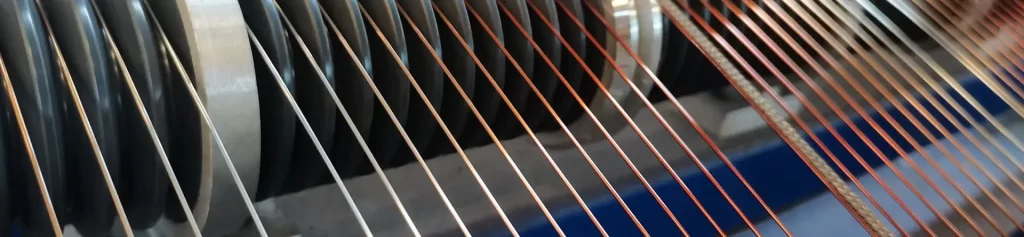
The core components of copper rods, aluminum rods, and enameled wire are essentially two things: a metal conductor and an insulation layer. Both are indispensable and must be properly matched. Conductor Materials Currently, two main types are used in industry—copper and aluminum. Copper’s conductivity (IACS 100%) is much higher than aluminum’s (IACS 61%), but aluminum is lighter and cheaper. Copper-clad aluminum (CCA) is a compromise; the outer copper layer provides conductivity and oxidation resistance, while the inner aluminum layer reduces weight. Generally, copper is preferred for motor windings, while aluminum or CCA is used in weight-sensitive applications (new energy vehicle drive motors, aerospace motors). Copper rods typically have a diameter of 8mm, and aluminum rods 9.5mm. Incoming materials must meet the requirements of GB/T 3952 (Electrical Round Copper Rods) or GB/T 3190 (Aluminum Wire Blanks), with a purity ≥99.95%. Excessive impurities will directly affect the subsequent wire breakage rate and the adhesion of the enameled coating. Insulating varnish is the soul of enameled wire. The base materials for the varnish are divided into seven main categories, corresponding to different thermal classes: – Polyvinyl alcohol acetal (PVF) – 105°C, the main type for oil-immersion transformers – Polyurethane (PU/UEW) – 130°C, good self-soldering properties, commonly used in high-frequency coils – Polyester (PEW) – 155°C, the main type for general motors – Polyester-imide (PEI/EIW) – 180°C, the most versatile – Polyamide-imide (PAI/AIW) – 200°C, automotive motors – Polyimide (PI) – 220°C, traction and aerospace – Composite coating (PAI+PI) – 240°C, the higher the grade of the high-end motor, the greater the processing difficulty. Polyimide varnish has high viscosity and high curing temperature, requiring a higher level of skill in oven and tension control than polyester varnish. The choice of varnish solvent is also crucial. Polyester paint commonly uses cresol and xylene, polyurethane paint uses N-methylpyrrolidone (NMP) and dimethylformamide (DMF), and polyimide paint can basically only use high-boiling-point NMP. The boiling point, evaporation rate, and toxicity of the solvent must be comprehensively considered—under environmental pressure, low-toxicity, low-VOC solvents are becoming increasingly popular. A certain enameled wire factory previously used xylene to dissolve polyester paint, but after environmental upgrades in 2023, it was forced to switch to all-water-based polyester paint. As a result, it was found that the leveling properties of the enameled coating decreased, and it was only by adding 5% propylene glycol ether as a co-solvent to the formula that the problem was solved.
Wire Drawing Process:
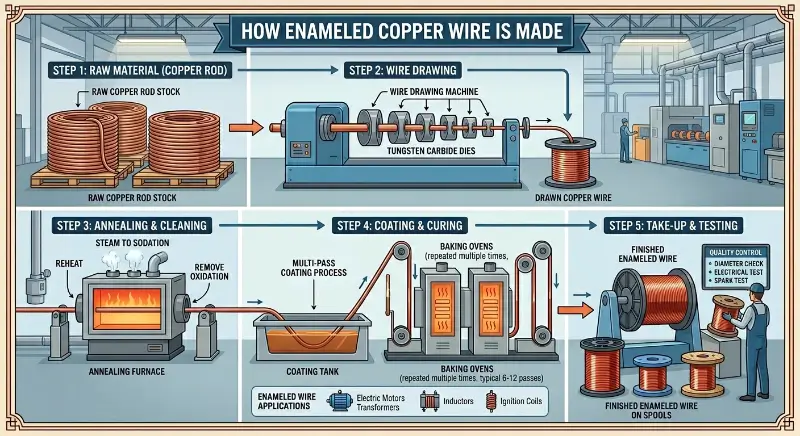
Drawing an 8mm copper rod to 0.05-2.0mm. Wire drawing is the first machining process in enameled wire production. An 8mm copper rod is transformed into a fine wire of 0.30mm or even 0.05mm, reducing its cross-sectional area to less than 1/700 of its original size—a remarkable deformation. The drawing dies are made of cemented carbide (WC-Co) or natural diamond. Diamond dies have a long lifespan (up to 1000km of drawing length) but are expensive and generally used in fine wire drawing. Carbide dies are more economical for coarse and intermediate drawing. Multi-pass continuous drawing is the industry standard. A high-speed drawing machine has 16-22 dies connected in series. The copper rod enters from the inlet, and the cross-section decreases by 15-25% with each die pass, gradually becoming thinner. Between each pass, a lubricant (soapy water or synthetic lubricant) is used for cooling and lubrication—this step is crucial; without lubrication, the copper wire surface will be scratched, ultimately affecting the quality of the enamel coating. Wire drawing speeds are now quite fast—800-1500 m/min for fine wires (0.10-0.50mm) and even 2000 m/min for ultra-fine wires (<0.10mm). Higher speeds result in higher production line efficiency, but also stricter requirements for tension and lubrication. In one instance, we communicated with a customer in Zhejiang who was using a fine wire drawing machine at 1800 m/min, resulting in frequent wire breakages—later discovered to be due to low lubricant concentration and inconsistent die wear. After switching to a diamond die and fully synthetic lubricant, the breakage rate dropped from 1.5 times/hour to 0.1 times/hour. Annealing is an integral part of the wire drawing process. Wire drawing distorts the copper’s crystal lattice, causing a sharp increase in hardness (from HV 50 in the annealed state to over HV 120), making it very brittle—necessary annealing is required for softening. Annealing temperature ranges from 450-650°C, with times varying from a few seconds to tens of seconds. The key is the protective atmosphere—nitrogen or a nitrogen-hydrogen mixture. If the atmosphere is not properly controlled, the copper wire surface will oxidize, directly causing the subsequent enamel coating adhesion to collapse. Elektrisola’s publicly available technical documents specifically emphasize this point: the oxygen content in the annealing furnace must be controlled below 10 ppm.
Tension Control in the Wire Drawing Process
Wire drawing tension is another hidden critical parameter. Too little tension causes the copper wire to slip in the die, resulting in uneven cross-sectional deformation; too much tension subjects the copper wire to additional tensile stress, making it prone to breakage. Industry experience suggests maintaining a tension reduction ratio of 1.20-1.30 for each die. For example, if the initial tension is 100g, it decreases to 80-85g after the first die, 65-70g after the second die, and so on. A typical symptom of unstable tension control is periodic wire breakage—each break is followed by recovery, occurring every few hours during continuous production. A certain enameled wire factory encountered this problem when debugging a new line. It was eventually discovered that the tension sensor calibration was drifting. Recalibration restored normal operation.
Engineering Details of Annealing Furnaces
There are several mainstream structures for annealing furnaces—resistance heating continuous furnaces, gas-fired catalytic combustion furnaces, and induction heating furnaces. Resistance furnaces offer uniform temperature but high energy consumption, gas-fired furnaces are efficient but have large temperature gradients, and induction furnaces are suitable for large-diameter copper rods but not for thin wires. The key indicators for annealing furnaces are three: maximum temperature, temperature uniformity, and oxygen content. Poor temperature uniformity (±10°C) results in inconsistent copper wire hardness; excessive oxygen content causes oxidation and discoloration of the copper wire surface. Both of these require online monitoring—temperature using a thermocouple array and oxygen content using a zirconia oxygen analyzer. Once, we inspected an annealing furnace at a factory and found an oxygen content as high as 50 ppm, far exceeding the 10 ppm standard—the investigation revealed a leak in the nitrogen pipeline interface. After repair, the oxygen content dropped below 5 ppm, and the adhesion of the enamel coating improved significantly.
Paint Preparation and Coating Methods:
Paint is not something you can just use off-the-shelf. The base resin must be dissolved in a solvent (NMP, xylene, cresol, etc.) according to the formula, and then hardeners, leveling agents, and toughening agents are added. Viscosity is a key parameter—50-150 cP for polyurethane paint and 200-400 cP for polyimide paint. Too high a viscosity results in uneven coating; too low a viscosity results in insufficient enamel coating thickness. There are two main coating methods: Die Application—The paint is applied to the wire through a precision die, the die aperture determining the enamel coating thickness. This method offers high precision and is suitable for fine wires and heavy-duty wires. The die material is stainless steel or ceramic; for ultra-fine wires (<0.05mm), a diamond die is required. The die application method also has a crucial accessory: a felt wiper—to scrape off excess paint, ensuring a uniform enamel coating thickness. Felt Applicator Method – This method involves wrapping the wire with enamel-impregnated felt, and rotating the felt to transfer the enamel coating onto the wire. This method is inexpensive and suitable for heavy-duty wires and medium-thickness wires (>0.50mm), but the enamel coating thickness control is not as precise as the die-applicator method. In actual production, fine wires (<0.50mm) are almost always produced using the die-applicator method, while the felt method is considered for heavy-duty wires. At our factory, all 0.10-0.50mm fine wires are coated using a diamond die and felt application, achieving a single-layer enamel coating thickness control within ±2μm. Coating speed is also a variable. Too high a speed will result in insufficient curing time for the enamel coating in the oven, leading to sagging; too low a speed results in low production line efficiency. Industry experience suggests a speed of 200-600 m/min, adjusted based on the type of enamel, temperature, and enamel coating thickness.
Precision Requirements of Coating Molds
The precision of the coating mold directly determines the uniformity of the enamel coating thickness. The mold aperture tolerance must be controlled within ±1μm—this is the limit of machining precision, requiring diamond grinding or wire cutting processes. For mold materials, diamond is used for ultra-fine wires, while carbide or ceramic is used for medium-weight wires. Mold wear is another engineering challenge. The paint contains hardeners and fillers, and long-term erosion of the mold’s inner wall can lead to aperture enlargement. The wear rate of diamond molds is approximately 0.5μm/100km, and the wear rate of carbide molds is approximately 2μm/100km. When the mold wears to a certain extent, the enamel coating thickness deviation exceeds ±5μm, requiring replacement or repair. In actual production, mold life management is a meticulous task—the usage time and enamel coating thickness changes of each mold must be recorded, and they must be rotated periodically.
Temperature Compensation for Paint Viscosity
Paint viscosity is extremely sensitive to temperature—a 10°C increase in temperature can cause a viscosity decrease of approximately 30-50%. This means that the coating environment temperature must be stably controlled. The enameled wire workshop generally requires a constant temperature of 25±2°C, with the paint storage tanks equipped with jacketed water cooling or electric heating to ensure viscosity fluctuations are within ±5%. In one enameled wire factory, because the workshop lacked air conditioning, the summer temperature rose to 35°C, causing the paint viscosity to drop from 200 cP to 130 cP, resulting in an overall 15% thinner enameled coating thickness and a spike in pinhole rate from 0.5 per 30 meters to 3. After installing a constant temperature air conditioner, the situation returned to normal.
Curing Oven:
A crucial step in enameled coating formation. Applying the paint only coats the copper wire; the actual formation of the insulating enameled coating relies on oven curing. The oven is the heart of the enameled wire production line, and both vertical and horizontal structures exist, with vertical being more common. Oven temperature is controlled in stages—preheating zone, main curing zone, and post-curing zone. A typical oven temperature profile for polyester coatings is: preheating 250°C → primary curing 380°C → post-curing 320°C, with a total length of approximately 6-8 meters. Polyimide coatings require higher temperatures, with the primary curing zone needing 450-550°C, and the oven also needing to be longer (10-12 meters). The curing reaction is a chemical reaction, not simply drying. Polyester coatings undergo esterification and crosslinking at 350°C; polyurethane coatings undergo urethane esterification; and polyimide coatings undergo imide cyclization. Each reaction requires a specific temperature and time window; insufficient temperature leads to incomplete reactions, resulting in a soft coating with poor solvent resistance; excessive temperature causes the coating to age and become brittle. The main heat sources for ovens are electric heating and natural gas catalytic combustion. Electric heating is clean but energy-intensive, while natural gas catalytic combustion (Krom Schöder system) is highly efficient but requires emissions treatment. More and more new factories are using a combination of infrared radiation tubes (‘S’-shaped radiation tubes) and catalytic combustion, resulting in significant energy savings. Waste gas treatment cannot be ignored. The volatile solvents (NMP, xylene) from paint curing must be treated by an RTO (Regenerative Thermal Oxidizer), and VOC emissions must meet local environmental standards. After 2023, many domestic enameled wire factories were subject to production restrictions due to VOC emission issues, a common pain point in the industry.
Oven Temperature Gradient Process Design
The oven temperature gradient is not simply “the hotter the better,” but is designed according to the kinetics of paint curing reaction. The preheating zone allows the solvent to evaporate first (avoiding bubbling in the main curing zone), the main curing zone allows the chemical reaction to proceed fully, and the post-curing zone allows the enameled coating stress to be released. Typical curing curves for polyester coatings: Preheat 220-260°C (1.5m length) → Main curing 360-400°C (3.5m length) → Post-curing 300-340°C (2m length). Curing curves for polyimide coatings: Preheat 280-320°C → Main curing 480-550°C → Post-curing 400-450°C. The key design consideration for temperature gradients is the heating rate—too fast and the coating surface will form a skin, trapping the internal solvent and causing bubbling; too slow and the production line efficiency will be low. The optimal heating rate for polyester coatings is approximately 80-120°C/second, and for polyimide coatings, approximately 50-80°C/second.
Oven Cleaning and Maintenance
The cleanliness of the oven interior directly affects the quality of the coating. Volatile substances from the paint will condense on the inner wall of the oven, forming paint residue. Paint residue falling onto the enamel coating surface can cause pinholes and orange peel texture. The oven interior should generally be cleaned weekly, and thoroughly cleaned monthly (including heating elements, thermocouples, and exhaust ducts). Cleaning methods include mechanical scraping, chemical solvent cleaning, and ultrasonic cleaning. One enameled wire factory experienced a pinhole rate in its enamel coating increase from 0.3 pinholes/30m to 1.5 pinholes/30m due to a lack of long-term cleaning of its ovens; the rate returned to normal after a production stoppage and cleaning.
Multi-layer coating and enamel coating grade:
The enamel coating on enameled wire is not applied in a single coat, but rather in 4-12 layers. Each layer of enamel coating is approximately 2-8μm thick, and multiple layers are needed to achieve the total thickness specified in IEC 60317 or NEMA MW 1000. Why multiple layers? A key reason is defect masking – a single enamel coating inevitably contains micro-defects such as pinholes and uneven thickness. With multi-layer coating, the upper enamel coating layer covers the defects in the lower layer. Statistically, the pinhole rate of a 4-layer coating is two orders of magnitude lower than that of a 1-layer coating. enamel coating grades are specified by IEC 60317, divided into three grades: Grade 1, Grade 2, and Grade 3: – Grade 1 (thin enamel coating) – approximately 6-12 μm thick per side, suitable for high-frequency coils and inductors. – Grade 2 (medium enamel coating) – 12-24 μm thick per side, most commonly used in general-purpose motors. – Grade 3 (thick enamel coating) – 24-40 μm thick per side, used in power transformers and high-voltage windings. The main differences in the process between different grades lie in the number of coating layers and the viscosity of the enamel. Grade 3 typically requires 8-12 coating layers, while Grade 1 only requires 4-6 layers.
Composite coatings are standard for high-end enameled wires. For example, a polyamide-imide (PAI) outer layer + a polyester (PE) inner layer provides high temperature resistance and chemical resistance, while the inner layer offers good adhesion. This structure is widely used in motors and new energy vehicle drive motors operating at temperatures above 200°C. While PAI is 3-5 times more expensive than PE, its overall performance is significantly superior.
Enameled Coating Thickness Tolerance Control
Enameled wire thickness tolerance is a core quality indicator. Grade 1 tolerance is ±2μm, Grade 2 ±3μm, and Grade 3 ±5μm. Controlling the thickness is crucial for the coordinated adjustment of paint viscosity, mold aperture, and coating speed. Higher paint viscosity results in a thicker coating; a larger mold aperture results in a thicker coating; and a faster coating speed results in a thicker coating. Three variables need to be adjusted in tandem—adjusting one variable to its limit often leads to the loss of control over another. Laser diameter gauges are used for online monitoring of enamel coating thickness, with an accuracy of ±0.5μm, providing real-time feedback to the coating system for closed-loop control. After introducing laser online diameter measurement, a certain enameled wire factory saw its enamel coating thickness pass rate increase from 92% to 99%.
Choosing the Right Enamel Coating for Different Applications
Choosing an enamel coating is essentially a balance between electrical performance, mechanical performance, thermal performance, and cost. High-frequency coils (switching power supply transformers, wireless charging coils) require thin enamel coatings to reduce eddy current losses, making Grade 1 the preferred choice; general-purpose motors require medium-thickness enamel coatings that balance electrical strength and winding process, making Grade 2 the mainstay; power transformers require thick enamel coatings to withstand high voltage stress, making Grade 3 essential. Thermal class is also crucial. For 105°C oil-immersed transformers, choose PVF enamel coating; for 155°C general-purpose motors, choose polyester enamel coating; for 180°C traction motors, choose polyester-imide enamel coating; for 200°C drive motors in new energy vehicles, choose polyamide-imide enamel coating.
Winding and Tension Control:
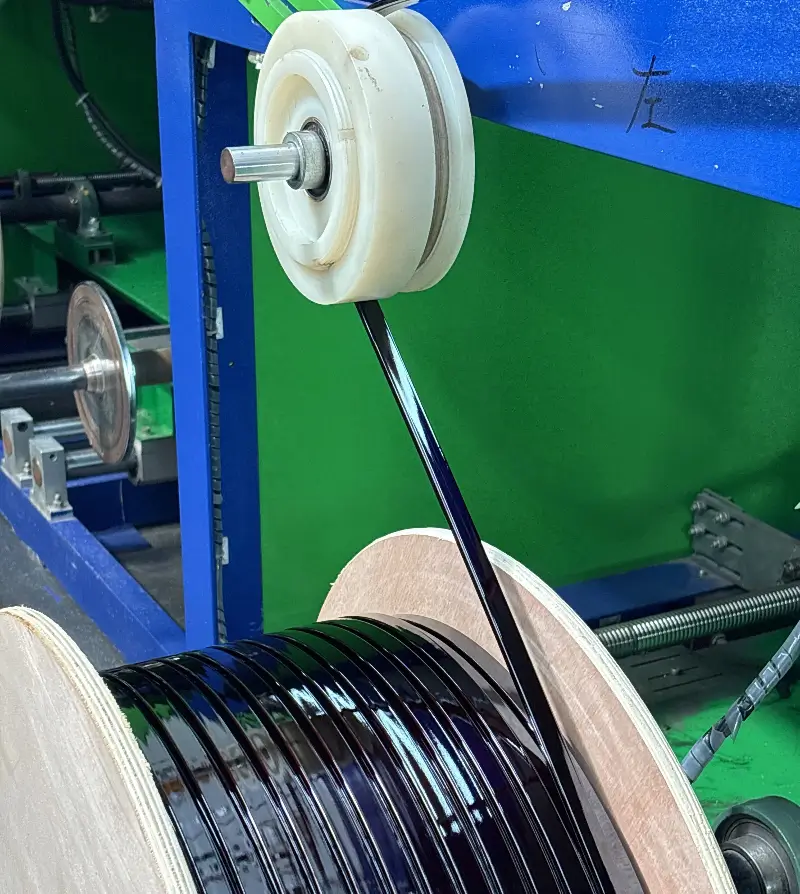
After curing, the enameled wire must be neatly wound onto the spool. Winding quality directly affects the user experience—untidy wiring and spool deformation will lead to frequent wire breakage during winding. Constant tension control is the core of winding. The finer the wire diameter, the more sensitive it is to tension fluctuations. The tension control accuracy for 0.10mm fine wire should reach ±5g, while for 0.50mm medium wire, this can be relaxed to ±30g. Large tension fluctuations will subject the enamel coating to alternating stress, which may cause micro-cracks over time. Automatic Traverse Winding ensures neat spool winding. The spacing between spools, left and right travel, and reversing speed all need to be optimized. Unevenly wound spools will cause wire jamming and twisting for customers. There are dozens of spool specifications, with common ones including PT-4, PT-10, PT-25, and PT-60. Different spools correspond to different wire diameters and customer requirements. The core size of the customer’s winding machine must match the spool; otherwise, it cannot be installed. After winding, labeling, inspection, and packaging are required. Each spool of enameled wire must be labeled with the wire diameter, enameled coating grade, batch number, and production date. Inspection items include appearance (color uniformity, no damage), wire diameter (measured with a micrometer), enameled coating thickness (outer diameter measured with a micrometer minus the conductor diameter), pinholes (using a pinhole tester), elongation, and breakdown voltage.
Calculation of Winding Tension
Winding tension is not arbitrary but calculated based on wire diameter and wire speed. The empirical formula is: Tension (g) = Wire Diameter (mm) × Wire Speed (m/min) × 0.5. For example, for 0.30mm enameled wire, taken up at 400 m/min, the tension = 0.30 × 400 × 0.5 = 60g. This formula only applies to general-purpose polyester enameled wire; for polyimide enameled wire, the tension needs to be increased by 30-50%. Too little tension results in loose spools, making the wire prone to tangling during transport; too much tension causes stress cracks in the enamel coating due to prolonged stretching. One enameled wire factory adjusted the tension of 0.20mm fine wire to 200g (it should be 40g), resulting in mass cracking of the enamel coating after three months.
The Limit of Take-up Speed
The take-up speed is limited by the coating speed—both must be synchronized. If the coating speed is 400 m/min, the take-up speed can only be 400 m/min. High-speed take-up also requires consideration of spool balance—eccentric rotation of the spool will cause vibration, affecting the quality of the enamel coating. Ultra-high-speed take-up (>800 m/min) requires specialized equipment; conventional spools are insufficient in weight. A certain enameled wire factory imported a high-speed take-up machine from Niehoff in Germany, with a maximum speed of 1500 m/min, but the spool must be made of a special aluminum alloy; ordinary plastic spools simply cannot withstand the load.
Quality Inspection and Defect Identification:
There are several key inspections for enameled wire quality, and none can be omitted. Pinhole Test—This is the most critical insulation indicator for enameled wire. IEC 60317 stipulates that Grade 1 enamel coating is allowed one pinhole every 30 meters, Grade 2 one every 15 meters, and Grade 3 one every 7.5 meters. The testing methods are the mercury electrode method or the brine method—immersing the enameled wire in an electrolyte solution and applying a DC voltage (6V DC for Grade 1). Any pinhole will be broken down and trigger an alarm. Enameled wire with excessive pinholes will cause inter-turn short circuits in the motor windings, a serious quality problem. Breakdown Voltage—tests the electrical strength of the enamel coating. Grade 1 is typically ≥1500V, Grade 2 ≥2500V, and Grade 3 ≥3500V. The voltage is gradually increased during testing until breakdown occurs. A failure to meet the breakdown voltage requirement indicates macroscopic defects or incomplete curing of the enamel coating. enamel Coating Adhesion—wrapping the enameled wire several times around a round rod of a specific diameter and observing whether the enamel coating cracks or peels off. Grade 1: no cracking after wrapping with a diameter of 1 × wire diameter; Grade 2: no cracking after wrapping with a diameter of 2 × wire diameter; Grade 3: no cracking after wrapping with a diameter of 3 × wire diameter. This simulates the actual working conditions of the winding process. Heat Shock—The enameled wire is placed at 175°C (polyester) or 200°C (PAI) for 30 minutes, then immediately wound, and the enamel coating is observed to see if it cracks. This simulates the thermal stress during motor overload operation. Cut-Through—Two enameled wires are cross-pressed and heated to a specified temperature to see if the enamel coating breaks down due to softening. Polyester enamel does not soften at 240°C, and polyimide enamel does not soften at 400°C. The six most common defects in actual production are: excessive pinholes, blistering, uneven enamel coating thickness, orange peel, conductor oxidation, and enamel coating peeling. The first three are caused by process parameter drift, while the latter three are often due to equipment or material problems. During a technical support visit to a factory in Jiangsu, we discovered that their enamel coating on the wire was constantly bubbling. It turned out the paint supplier had changed solvent batches, and the new solvent had excessive water content, causing water evaporation and bubble formation during curing. Switching to qualified NMP immediately eliminated the defect.
Rapid Defect Diagnosis Methods
There is a set procedure for rapid defect diagnosis of enamel coating. Excessive Pinholes: First check for wear on the coating mold, then check if the oven temperature profile is normal; Bubbling: First check the water content of the paint, then check if the preheating zone temperature is sufficient; Uneven Coating Thickness: First check for paint viscosity fluctuations, then check for tension stability; Orange Peel Texture: First check if the oven temperature is too high, then check if the paint leveling agent is ineffective; Conductor Oxidation: Check the oxygen content of the annealing furnace; Coating Peeling: Check the cleanliness of the conductor surface. This diagnostic procedure can quickly locate most common defects, but the real challenge is dealing with multiple defects occurring simultaneously. A certain enameled wire factory simultaneously experienced three problems: excessive pinholes, uneven enameled coating thickness, and blistering. The investigation revealed a combination of three issues: the paint supplier had changed raw materials, the painting molds were worn, and the oven thermocouples were drifting. After fixing all the problems, the defects completely disappeared.
Coordination of Online and Offline Inspection
Enameled wire quality inspection is divided into online inspection and offline inspection. Online inspection includes laser diameter measurement, enameled coating thickness detection, and pinhole detection, providing real-time feedback on process parameters. Offline inspection includes breakdown voltage, thermal shock, and softening breakdown, with sampling performed on each batch. The advantage of online inspection is real-time problem detection, reducing batch scrap; the advantage of offline inspection is its comprehensive coverage, encompassing electrical, thermal, and mechanical dimensions. Both types of inspection must be used in conjunction—online inspection alone may miss long-term performance issues such as thermal shock and softening breakdown; offline inspection alone may only detect problems when a large number of scrap products have already been generated.
Key Process Trade-offs in Enameled Wire Manufacturing:
Ultimately, the core of enameled wire manufacturing is the stability of the enamel coating quality. The enamel coating needs to be thin (good high-frequency characteristics), uniform (stable breakdown voltage), dense (low pinhole rate), adherent (no cracking during winding), and heat-resistant (long lifespan at high temperatures)—these requirements are mutually restrictive, with no optimal solution, only trade-offs. The enamel coating grade should be selected based on the application scenario: Grade 1 thin enamel coating for high-frequency electronic coils, Grade 2 medium enamel coating for general-purpose motors, and Grade 3 thick enamel coating for power transformers and high-voltage motors. The coating should also be selected based on the material system: polyurethane or polyester for low-cost applications below 130°C, polyester-imide for general-purpose motors at 155-180°C, and polyamide-imide or polyimide composite coating for high-end motors above 200°C. Choose the process route based on production capacity requirements: use low-speed horizontal lines (200-300 m/min) for small-batch customization, and high-speed vertical lines (500-800 m/min) for mass production. The biggest change in the enameled wire industry over the past 30 years has been the refinement of the enamel coating system—from a single polyester varnish to polyester-imide, polyamide-imide, and polyimide composite systems. Each new material is designed to address pain points in specific application scenarios. The 200°C temperature resistance requirements of new energy vehicle drive motors, the lightweight requirements of aerospace motors, and the high-frequency, low-loss requirements of 5G base stations are all driving the continuous iteration of enamel coating technology. For enameled wire buyers, understanding these 7 processes is crucial for knowing where the problem lies when issues arise. Enameled coating blistering indicates a problem with the varnish; excessive pinholes indicate a problem with the coating or curing process; conductor oxidation indicates an annealing problem; and enamel coating peeling indicates conductor surface contamination. Every type of problem has a corresponding technological step; precise identification is key to effective solutions. Another aspect of technological trade-offs is the balance between cost and quality. For the same enamel coating grade, domestic paints are 30-50% cheaper than imported ones, but their stability and batch consistency are significantly inferior. Similarly, for the same production line, European equipment is 2-3 times more expensive than domestic equipment, but its precision and reliability are an order of magnitude higher. What enamel wire manufacturers need to do is find the best cost-performance combination within their target customer group and price range. Blindly pursuing high-end products will lead to a loss of price competitiveness, while blindly cutting costs will result in a loss of quality reputation—there is no standard answer, only a dynamic balance.