

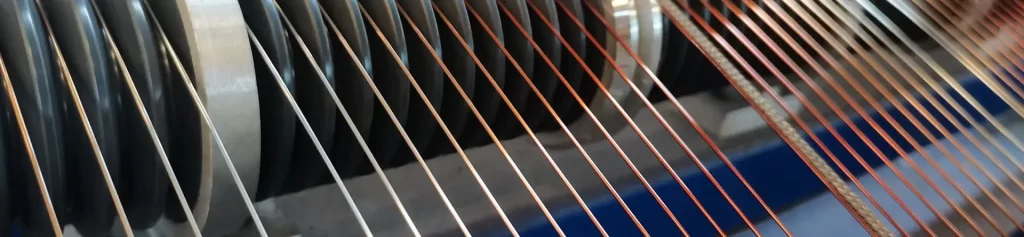
Enameled copper wire is the core winding material used in motors, transformers, household appliances, new-energy vehicles, and other fields. Its manufacturing process involves coating a liquid insulating varnish onto the surface of bare copper conductors, followed by high-temperature curing to form a dense, continuous, and strongly adherent insulating layer. The entire production chain is long, parameter-intensive, and highly interdependent—any deviation in a single variable can adversely affect the insulation film’s dielectric strength, thermal life, mechanical flexibility, and surface appearance quality.
The best way to understand this process is to follow the physical flow of the production line—from incoming copper rod to final enameled wire take-up and warehousing.
Overview of Enameled Copper Wire Manufacturing Process and Product Families
Enameled copper wire manufacturing is a continuous, precision coating process that can be divided into three physical stages.
Conductor Forming Stage: The objective is to process raw copper rod into round or rectangular flat wire of the target diameter while restoring the material’s ductility, thereby ensuring the conductor surface meets the quality requirements for subsequent coating. Key processes include coarse drawing, intermediate drawing, fine drawing, annealing, micro-etching, and cleaning.
Insulation Coating Stage: The objective is to uniformly apply an insulating varnish film of specified thickness onto the conductor surface, followed by multiple coating cycles to achieve insulation layers compliant with Grade 1/2/3 requirements. Key processes include varnish preparation, wire coating, curing, cooling, and repeated coating cycles.
Finished Product Forming Stage: The objective is to wind the enameled wire onto spools or into drums meeting customer specifications, while simultaneously performing in-line quality inspection and final outgoing inspection. Key processes include lubrication, winding, outer diameter measurement, spark testing, continuity testing, and CCD visual inspection.
By insulating varnish material, mainstream product families include polyvinyl acetal, polyester, polyurethane, polyester-imide, polyamide-imide, polyimide, and self-bonding enameled wires. By thermal class, corresponding classifications follow the IEC 60085 standard: E, B, F, H, N, R, and 250.
Raw Materials: Copper Rods and Enamel Resin Solutions
Copper Rods
Copper rods used as conductors for enameled wire are typically produced via the SCR (Semi-Continuous Casting and Rolling) or continuous casting and rolling process. The standard diameter is Φ8.0 mm, with a minimum copper content of 99.99% and a maximum resistivity of 0.017241 Ω·mm²/m (ASTM B193). Common grades include C11000 ETP (Electrolytic Tough Pitch copper), C10100 OFHC (Oxygen-Free High-Conductivity copper), C10200 OF (Oxygen-Free copper), and C12200 DHP (Phosphorus-Deoxidized High-Conductivity copper).
Oxygen content directly influences subsequent enamel film adhesion and high-temperature annealing behavior. ETP contains trace amounts of Cu₂O; under reducing-atmosphere annealing, it is prone to hydrogen embrittlement cracking. OFHC contains less than 10 ppm oxygen, making it better suited for high-frequency annealing and enameled wire requiring high elongation. DHP contains 0.015–0.040% phosphorus, offering a balanced combination of workability and weldability—making it a common choice for high-current rectangular enameled wire.
Enamel Resin Solutions
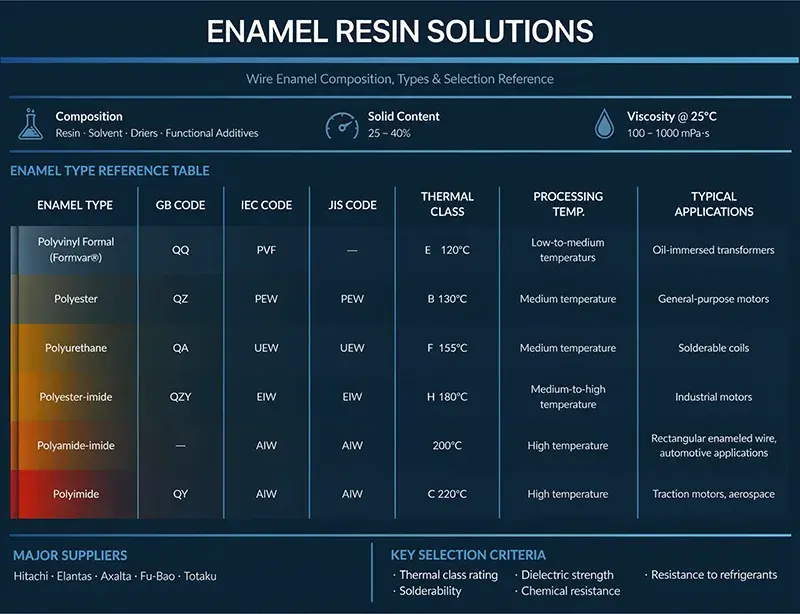
Enamel solutions consist of resin, solvent, driers (catalysts), and functional additives. Typical solid content ranges from 25–40%, with viscosity between 100–1000 mPa·s at 25°C.
| Enamel Type | GB Code | IEC Code | JIS Code | Thermal Class | Processing Temperature | Typical Applications |
|---|---|---|---|---|---|---|
| Polyvinyl Formal (Formvar®) | PVF | — | E (120°C) | Low-to-medium temperature | Oil-immersed transformers | |
| Polyester | QZ | PEW | PEW | B (130°C) | Medium temperature | General-purpose motors |
| Polyurethane | QA | UEW | UEW | F (155°C) | Medium temperature | Solderable coils |
| Polyester-imide | QZY | EIW | EIW | H (180°C) | Medium-to-high temperature | Industrial motors |
| Polyamide-imide | — | AIW | AIW | 200°C | High temperature | Rectangular enameled wire, automotive applications |
| Polyimide | QY | AIW | AIW | C (220°C) | High temperature | Traction motors, aerospace |
Major enamel solution suppliers include Hitachi, Elantas, Axalta, Fu-Bao, and Totaku. Key selection criteria for enamel films include thermal class rating, dielectric strength, solderability, resistance to refrigerants, and chemical resistance.
Conductor Pre-treatment: Wire Drawing, Annealing, and Micro-etching
Wire Drawing
Wire drawing is the core plastic deformation process for reducing copper rod diameter from Φ8.0 mm to the target diameter.
Large-diameter wire drawing machines employ multi-die continuous drawing (8–12 dies) to reduce the diameter from Φ8.0 mm to Φ1.0–3.0 mm, achieving a cumulative reduction ratio of 80–95%. Medium-drawing and fine-drawing processes further reduce the diameter to Φ0.05–1.0 mm, with up to 12–20 dies employed.
Die materials range from tungsten carbide (YG6) to polycrystalline diamond (PCD). PCD dies offer extended service life, excellent dimensional stability, and high surface finish—making them the standard choice for fine-drawing stages. Lubricants typically combine liquid lubricants with saponified solutions to dissipate deformation heat, minimize copper powder generation, and prevent copper wire adhesion to the die.
Annealing
Cold working induces work hardening in copper wire—elongating grains along the drawing direction, increasing dislocation density, raising tensile strength, and reducing elongation. Annealing aims to restore ductility via recrystallization.
Typical temperature ranges for online continuous annealing furnaces are 450–650 °C, utilizing SCR electric heating or induction heating under protective atmospheres of nitrogen or steam. Post-annealing elongation is typically restored to 28–40%, satisfying requirements for high-speed winding machines.
Micro-etching and Cleaning
Adhesion between the enamel coating and the copper conductor depends on the conductor’s surface micro-roughness and chemical reactivity. Micro-etching is commonly performed using dilute sulfuric acid (H₂SO₄) or persulfate solutions; resulting surface roughness (Ra) is controlled within 0.5–1.5 μm. The cleaning stage employs deionized water rinsing to remove residual acid, followed by hot-air drying.
Paint Solution Preparation and Viscosity Control
Paint solution viscosity is one of the most sensitive parameters in the painting process. Excessively high viscosity results in excessive coating thickness, a rough film surface, and poor leveling; excessively low viscosity leads to insufficient coating thickness, discontinuous films, and pinhole formation during curing.
Viscosity control is typically achieved via the following three methods:
- Temperature control: Maintaining the paint tank temperature stably within 25–40 °C; the viscosity temperature coefficient is approximately –2% to –3% per °C.
- Solid content replenishment: As solvent continuously evaporates during production, fresh paint solution must be added proportionally.
- Online viscometer feedback: Real-time viscosity measurement using falling-ball or rotational viscometers, with PID algorithm–based automatic dosing of fresh paint or solvent.
Cleanliness is equally critical. The paint solution must be filtered through 5–25 μm filters to remove gel particles and other contaminants. Painting facilities typically require a cleanroom classification of ISO 14644-1 Class 7 or higher.
Painting Process and Coating Die Design
Painting Methods
The mainstream painting method is die coating. In this process, the conductor is passed through a paint bath filled with varnish, then through a precision die that scrapes off excess varnish to form a uniform wet film. Die materials are typically cemented carbide or stainless steel.
An alternative method is felt application, in which varnish is absorbed by a felt pad and subsequently transferred onto the conductor surface. This method is suitable for ultra-fine wires (diameter < Φ0.05 mm) and specialty coatings, but offers lower precision and stability compared to die coating.
Electrostatic painting is employed for ultra-fine wires or specialty coatings; it utilizes a high-voltage electric field to atomize and spray varnish onto the conductor surface. This method achieves high varnish utilization efficiency, but entails significantly higher equipment costs.
Coating Die Design
The critical dimensional parameters of a coating die are the orifice diameter and orifice length. The orifice diameter determines the final cured coating thickness, whereas the orifice length governs coating stability and surface finish.
The die gap—the difference between the orifice diameter and the conductor diameter—is a key control parameter in the painting process. An excessively large gap results in overly thick coatings with poor leveling; an excessively small gap yields insufficiently thin coatings prone to mechanical damage (e.g., scratching). A typical die gap is 1.2–1.5 times the target dry-film thickness.
The die profile comprises four distinct zones: the entrance zone, compression zone, sizing (or calibration) zone, and exit zone. Their geometric design critically influences both coating process stability and the micro-topography of the coated surface. Surface polishing precision is typically controlled to Ra < 0.05 μm.
Painting Speed
Painting speed directly affects both the resulting coating thickness and the residence time within the curing furnace. Typical speeds range from 5 to 100 m/min. For fine wires (Φ0.05 mm), speeds up to 100 m/min are achievable; for coarse wires (Φ1.0 mm), speeds generally fall within the range of 5–20 m/min.
Curing Process and Oven Temperature Profile Control
Curing Principle
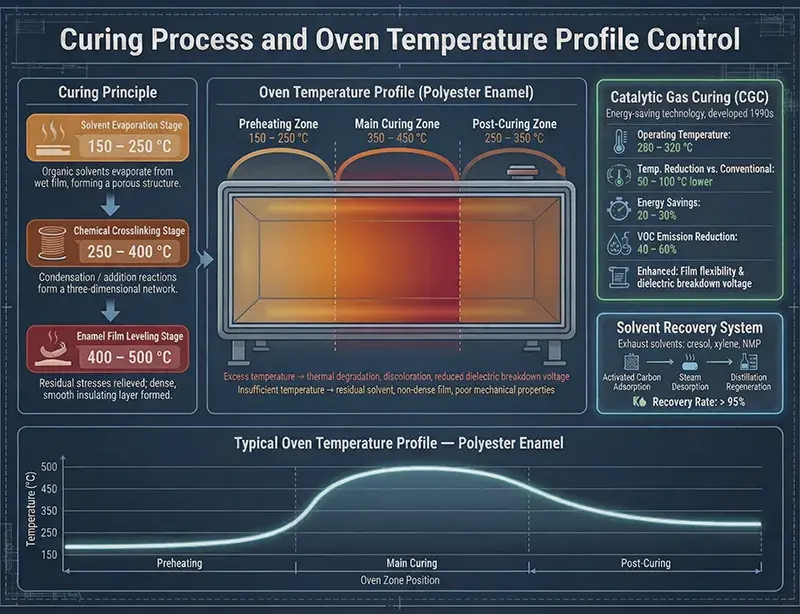
Curing is a critical process in winding wire manufacturing. After the varnish is applied to the conductor surface, it enters the curing oven and undergoes three sequential stages: solvent evaporation, chemical crosslinking, and enamel film leveling.
- Solvent evaporation stage (150–250 °C): Organic solvents evaporate from the wet film, forming a porous structure.
- Chemical crosslinking stage (250–400 °C): Condensation or addition reactions occur among resin molecules, generating a three-dimensional network structure.
- Enamel film leveling stage (400–500 °C): Residual stresses are relieved, yielding a dense, smooth insulating layer.
Oven Temperature Profile
Curing ovens are typically divided into three temperature zones: preheating zone, main curing zone, and post-curing zone. The temperature and length of each zone are dynamically adjusted based on enamel type, conductor diameter, and enameling line speed.
A typical oven temperature profile for polyester enamel:
- Preheating zone: 150–250 °C
- Main curing zone: 350–450 °C
- Post-curing zone: 250–350 °C
Excessively high curing temperatures cause thermal degradation, discoloration, and reduced dielectric breakdown voltage of the enamel film. Conversely, insufficient temperatures result in residual solvent, non-dense enamel films, and poor mechanical properties.
Catalytic Gas Curing (CGC)
Catalytic Gas Curing (CGC) is an energy-saving technology developed in the 1990s. It introduces heated gas containing catalysts into the curing oven, enabling resin crosslinking at significantly lower temperatures.
Typical CGC operating temperatures range from 280 to 320 °C—50–100 °C lower than conventional hot-air curing. This reduces energy consumption by 20–30%, cuts VOC emissions by 40–60%, and simultaneously enhances enamel film flexibility and dielectric breakdown voltage.
Solvent Recovery
Exhaust gases from the curing oven contain substantial quantities of organic solvents—including cresol, xylene, and N-methyl-2-pyrrolidone (NMP). Modern enameled wire production lines are equipped with solvent recovery systems; the predominant technology employs activated carbon adsorption, followed by steam desorption and distillation regeneration. Solvent recovery rates exceed 95%.
Coating Passes and Cumulative Film Thickness
Coating Passes
A single coating pass typically yields a dry film thickness (DFT) of only 5–15 μm. Target film thicknesses are categorized by Grade 1/2/3: Grade 1 denotes thin films, Grade 3 thick films. Specifically, Grade 1 DFT is typically 5–15 μm, Grade 2 is 15–40 μm, and Grade 3 is 40–80 μm.
Therefore, 4–12 coating passes are required to achieve the target thickness. After each pass, the conductor enters a curing oven, proceeds through a cooling section, and then re-enters the next coating bath.
Coating Pass Design
Coating pass design must balance several conflicting requirements: fewer passes result in poorer film uniformity and increased surface defects; more passes lead to longer process times, higher energy consumption, and greater internal film stress.
A typical design allocates 15–20% of the total film thickness to the first pass, with subsequent passes progressively decreasing in thickness. The initial passes primarily serve to cover the conductor surface, while later passes mainly enhance film density and compactness.
Eccentricity Control of the Insulating Film
Film eccentricity refers to circumferential non-uniformity in film thickness. Excessive eccentricity reduces dielectric breakdown voltage, promotes film delamination, and causes localized stress concentration during winding.
Eccentricity is primarily governed by die concentricity, coating angle, conductor tension, and stability of varnish flow. Core measures for controlling eccentricity include precision alignment of the die, stable tension profiling, and uniform varnish temperature.
Online Inspection and Quality Control
Spark Testing
Spark testing is the core online inspection step for enameled wire. It applies high-frequency, high-voltage (1.5–6 kV) across the enameled wire surface to detect pinholes and continuity defects in the enamel coating.
The spark test voltage for Grade 1 enamel is typically 1.5–2.5 kV; for Grade 2, 2.5–4.0 kV; and for Grade 3, 4.0–6.0 kV. Defect locations generate discharges within milliseconds; the spark detector captures these discharge signals and marks the defective positions.
Outer Diameter and Eccentricity Measurement
Laser micrometers perform online measurement of the enameled wire’s total outer diameter with an accuracy of ±0.001 mm. Eccentricity measurement commonly employs eddy-current or capacitive sensors.
Measurement data are monitored in real time via an SPC (Statistical Process Control) system. When outer diameter or eccentricity exceeds control limits, the system automatically triggers an alarm and marks the defective section.
Continuity Testing
Continuity testing is conducted per IEC 60851-5, Test 14: For ultra-fine wires with diameter ≤ 0.050 mm, low-voltage continuity testing is applied; for enameled wires with diameter 0.050–1.600 mm, high-voltage continuity testing is used. Since the 2008 edition, carbon-brush electrodes or V-groove guide-wheel electrodes may be employed to detect insulation defects.
CCD Visual Inspection
Modern enameled wire production lines are equipped with CCD-based visual inspection systems that automatically identify surface defects—including bubbles, scratches, inclusions, and enamel nodules. Detection resolution reaches 0.05 mm², and inspection speed reaches up to 100 m/min.
Dielectric Loss Factor Testing
The dielectric loss factor (tan δ) is measured per IEC 60851-5, Test 19. During testing, the enameled wire is immersed in a molten tin bath and heated from 40 °C in 10 °C increments. An LCR meter measures tan δ at various temperatures and frequencies. The temperature at which tan δ exhibits a sharp increase corresponds to the critical point of thermal aging of the enamel coating.
Lubrication, Winding, and Final Packaging
Lubrication
After enamel coating is completed, a lubricant must be applied to the surface of the magnet wire. This serves to reduce winding tension, improve subsequent winding performance, and protect the enamel film from mechanical damage.
Mainstream lubricants include paraffin-based, silicone oil–based, and synthetic ester–based lubricants. Paraffin-based lubricants are low-cost and exhibit excellent compatibility; silicone oil–based lubricants offer high-temperature resistance and are suitable for Class H/N applications; synthetic ester lubricants are ideal for high-speed winding.
Winding
Winding refers to the process of uniformly winding the enameled wire onto a spool (bobbin). Winding speed is synchronized with the enameling speed, typically ranging from 5 to 50 m/min.
Spool dimensions conform to DIN standards, spanning from DIN 250 to DIN 630, with capacities ranging from 5 kg to 100 kg. Dual-cone winding helps prevent tangling, while automatic outer-diameter control ensures neat, uniform coil appearance.
Final Packaging
The purpose of final packaging is to protect against moisture, dust, and mechanical damage. Common packaging methods include barrel packing, spool packing, and pallet packing. Export products are typically vacuum-packed or nitrogen-flushed, with desiccants included.
Process Defect Diagnosis and Common Issue Troubleshooting
Non-uniform Coating Film
Possible causes: Die wear, viscosity fluctuations, tension profile drift, non-uniform coating liquid temperature.
Troubleshooting actions: Replace die; recalibrate viscometer; inspect tension sensor; improve temperature control of the coating tank.
Pinholes
Possible causes: Contamination on conductor surface, micro-pores in conductor, excessively low coating temperature, impurities in coating liquid.
Troubleshooting actions: Enhance micro-etching; improve conductor cleaning quality; raise coating temperature; filter coating liquid.
Blistering
Possible causes: Solvent residue, excessive coating thickness, insufficient curing, coating liquid formulation drift.
Troubleshooting actions: Reduce coating viscosity; increase curing temperature; extend curing time; verify batch consistency with coating liquid supplier.
Scratches
Possible causes: Damaged guide rollers, damaged die, excessive tension.
Troubleshooting actions: Polish guide rollers; polish or replace die; adjust tension profile.
Conductor Oxidation
Possible causes: Improper cooling after annealing, prolonged storage time.
Troubleshooting actions: Implement nitrogen-purged cooling; reduce inventory holding time; adopt vacuum or nitrogen-filled packaging.
Low Dielectric Breakdown Voltage
Possible causes: Coating film defects, insufficient coating thickness, abnormal conductor surface roughness.
Troubleshooting actions: Perform spark testing by voltage grade; increase number of coating passes; strengthen control of micro-etching process.
Coating Film Aging
Possible causes: Inadequate curing, coating liquid formulation drift, extended coating liquid storage time.
Troubleshooting actions: Verify catalyst dosage; confirm formulation consistency with coating liquid supplier; switch to a fresh batch of coating liquid.
Standard Systems and Test Methods
International Standards
IEC 60851 series is the internationally recognized standard for testing enameled winding wires, covering dimensions (Part 2), mechanical properties (Part 3), chemical properties (Part 4), electrical properties (Part 5), and thermal properties (Part 6). The IEC 60317 series specifies product requirements, categorized by enamel type (Parts 0-1 through 0-51).
U.S. Standards
NEMA MW 1000-2023 is the comprehensive U.S. magnet wire standard, covering enamel types such as MW 1-C (PVF), MW 2-C (PEW), MW 15-C (UEW), MW 16-C (EIW), MW 24-C (AIW), and MW 28-C (PI). ASTM B49 specifies copper rod requirements; ASTM B193 specifies resistivity; ASTM B279 specifies packaging for enameled wires; and ASTM D1676 specifies test methods for enamel coatings.
Chinese Standards
GB/T 6109 is identical to the IEC 60317 series; GB/T 7095 is identical to the IEC 60851 series; and GB/T 4074 specifies test methods for enameled wires.
Japanese Standards
JIS C 3202 specifies polyester-enameled copper wire; JIS C 3210–3212 specify polyurethane-, polyester-imide-, and polyimide-enameled wires, respectively.
System Certifications
UL 1446 specifies certification requirements for insulation systems, covering temperature classes B, F, H, N, R, and 250. UL 1581 covers safety requirements for wires and cables. ISO 9001/14001/45001 pertain to quality, environmental, and occupational health and safety management systems, respectively. IATF 16949 is the automotive-grade quality management standard. RoHS 2.0, REACH, and ELV Directive 2000/53/EC govern EU environmental compliance.
Test Methods
Dielectric breakdown voltage is tested per IEC 60851-5, Test 13. Insulation continuity is tested per Test 14. Dielectric loss factor is tested per Test 19. Pinholes are detected per Test 23. Elongation, springback angle, softening breakdown, thermal shock, and thermal life are evaluated per IEC 60851-3/5/6 and IEC 60172.
Intelligent Manufacturing and Green Manufacturing Trends
Intelligent Manufacturing
MES (Manufacturing Execution System) digitizes process parameters, equipment status, and quality data throughout the entire production cycle. IoT sensors enable real-time monitoring of viscosity, temperature, tension, outer diameter, and defects. Digital twins are employed for process simulation and optimization—predicting enamel coating performance under various furnace temperature profiles. AI-powered vision systems replace manual QC inspections, achieving defect detection accuracy exceeding 99.5%.
Green Manufacturing
Catalytic Gas Curing (CGC) replaces conventional hot-air curing, reducing energy consumption by 20–30% and VOC emissions by 40–60%. Water-based enamel formulations substitute solvent-based ones, eliminating VOC emissions at the source. Solvent recovery systems achieve recovery rates above 95%. Environmentally friendly enamel formulations—free of lead, cadmium, and chromates—are emerging as an industry-wide trend.
Advanced Materials Development
PEEK-extruded magnet wire (single-layer PEEK), a novel process developed in the 2010s, directly extrudes polyetheretherketone (PEEK) onto conductor surfaces. PEEK enamel coatings exhibit significantly superior chemical stability and mechanical strength compared to conventional enamels; however, their cost is 3–5 times higher than that of traditional enameled wires, limiting current application to select high-performance scenarios.
Nanocomposite enamel coatings—modified with nanoscale fillers such as SiO₂ and Al₂O₃—enhance corona resistance, wear resistance, and thermal stability. These are primarily used in high-voltage motors, rail transit traction systems, and drive motors for new-energy vehicles.
“Smart” enamel coatings represent a cutting-edge research direction: by embedding nanoscale tracer particles, these coatings enable non-destructive, real-time assessment of aging status during service life. While not yet commercialized, this technology has advanced to the laboratory validation stage.
—
Although the manufacturing process of enameled copper wire appears complex, it fundamentally comprises three tightly coupled physical stages: conductor forming, insulation coating application, and final inspection. The key to understanding this process chain lies in establishing clear correlations between each operation’s critical parameters—temperature, line speed, tension, viscosity, and cleanliness—and the resulting enamel coating properties—including dielectric breakdown voltage, thermal life, elongation, and flexibility.
In practice, yield rate and product consistency depend heavily on the stability of process parameters and the capability for rapid defect root-cause analysis. This explains why modern enameled wire factories increasingly rely on SPC (Statistical Process Control), MES (Manufacturing Execution System), and inline visual inspection systems.
For procurement personnel, understanding this process chain helps evaluate suppliers’ true capabilities: manufacturers possessing full in-house process integration, independent enamel formulation development capacity, and stable inline inspection systems are far better positioned to ensure consistent quality in high-volume deliveries than those relying solely on externally sourced enamels and manual inspection methods.