

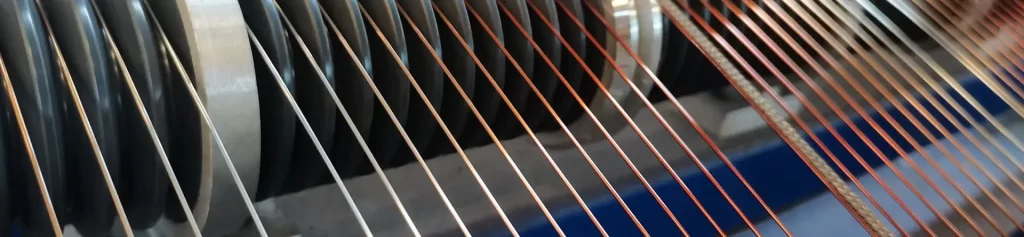
Electrical equipment operating in polar and high-latitude regions—from Arctic oil-and-gas drilling platforms to offshore wind farms in Northern Europe, from Russia’s subzero-temperature high-speed trains to outdoor current transformers in Northeast China’s power grid—endures prolonged operation at extreme low temperatures down to −40 °C, and even −60 °C. When the enamel coating temperature of magnet wire drops near its glass transition temperature (Tg), polymer chain segments freeze, causing the enamel film to transition from a rubbery state to a glassy state. As a result, elongation at break plummets from ~30 % to below 3 %. Under cold-start current surges, even minute strains induced in wound coils can initiate microcracks in the enamel film. These microcracks propagate along the copper conductor surface and, synergistically interacting with refrigerants, oil mist, and moisture, ultimately lead to turn-to-turn short circuits or ground breakdown. This article systematically addresses the chemical design, material system, critical manufacturing processes, application families, testing methodologies, and engineering selection criteria for low-temperature anti-condensation enameled copper wire.
Glass Transition and Low-Temperature Embrittlement Mechanisms
The glass transition temperature (Tg) is the critical temperature at which the polymer enamel film transitions from a highly elastic (flexible) state to a glassy (brittle) state. Below Tg, micro-Brownian motion of polymer chain segments is frozen, rendering the material brittle and glassy. The elastic modulus surges from approximately 10² MPa to 10³–10⁴ MPa, while elongation at break plummets from 100–300 % in the rubbery state to only 1–5 % in the glassy state. Given that enamel film thickness is merely 20–80 μm, differential thermal contraction between the copper conductor (coefficient of thermal expansion for electrolytic tough pitch copper ≈ 17×10⁻⁶ /°C) and the enamel during cold start-up induces interfacial shear stress. In the glassy state, the enamel cannot relax strain via chain-segment mobility, thereby initiating microcracks.
Significant differences exist in the Tg ranges among various enamel systems: polyester (PE) enamels exhibit Tg ≈ 60–80 °C; polyurethane (PU) enamels, Tg ≈ 50–90 °C; polyester-imide (PEI) enamels, Tg ≈ 130–150 °C; polyamide-imide (PAI) enamels, Tg ≈ 260–280 °C; and polyimide (PI) enamels, Tg ≈ 300–360 °C. Consequently, conventional Class F/H magnet wires operating at −40 °C function far below their respective Tg values—deep within the glassy state. The core principle of cold-resistant design is to ensure the enamel remains in the rubbery state at the lowest operational temperature; i.e., its Tg must be at least 20 °C lower than the minimum service temperature.
Low-temperature aging failure modes of enamel films fall into three categories:
- Mechanical failure: Upon vitrification, the enamel loses elasticity; assembly stresses, thermal cycling stresses, and vibration stresses can all induce enamel cracking.
- Electrical failure: In the glassy state, the enamel’s relative permittivity (εᵣ) decreases, its dielectric loss tangent (tan δ) increases, its breakdown voltage declines, and its partial discharge inception voltage (PDIV) drops significantly.
- Chemical failure: Microcracks propagate more readily in the glassy state, enabling ingress of corrosive species—including moisture, SO₂, H₂S, and Cl⁻—along crack paths to the copper conductor surface, triggering copper corrosion (verdigris formation) and enamel delamination.
These three failure modes are strongly coupled, forming a cascading failure pathway: “mechanical cracking → electrochemical corrosion → dielectric breakdown.”
Low-Temperature-Resistant Enamel Formulation Chemistry
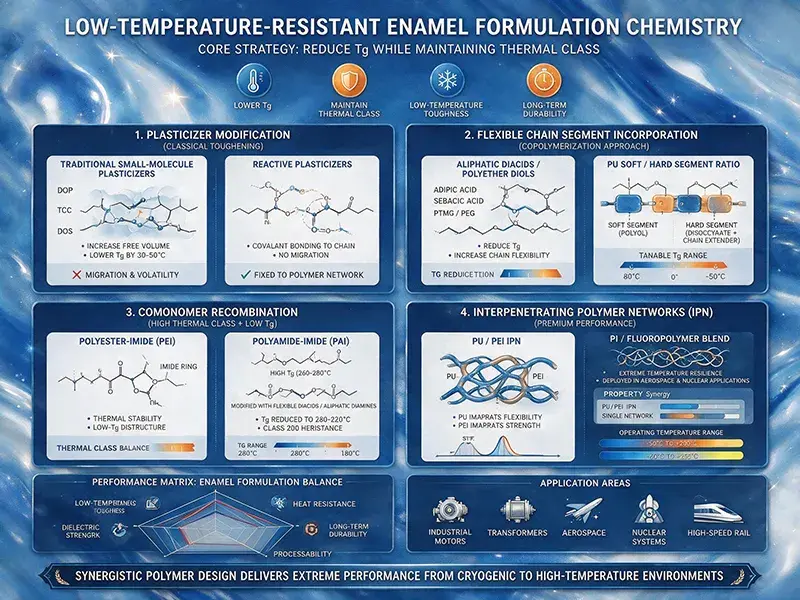
The core design strategy for low-temperature-resistant enamel coatings is to reduce the glass transition temperature (Tg) while maintaining the designated thermal class. Key technical approaches include plasticizer modification, incorporation of flexible chain segments, comonomer recombination, and interpenetrating polymer network (IPN) architecture.
Plasticizer modification is the most classical method for low-temperature toughening. Small-molecule plasticizers—such as dioctyl phthalate (DOP), tricresyl phosphate (TCP), and dioctyl sebacate (DOS)—intercalate between polymer chains, increasing free volume and lowering Tg by 30–50 °C. However, conventional plasticizers suffer from migration and volatility. During long-term operation (≥10 years), they gradually migrate to the enamel surface or are extracted by oil mist, resulting in embrittlement. Modern low-temperature-resistant formulations increasingly adopt reactive plasticizers, in which flexible segments are covalently bonded into the main chain to eliminate migration.
Incorporation of flexible chain segments is achieved via copolymerization. Aromatic polyester (PET) enamels exhibit high brittleness; substituting part of the aromatic diacid with aliphatic diacids (e.g., adipic acid or sebacic acid) or introducing polyether diols (e.g., PTMG or PEG) as soft segments significantly reduces Tg. Polyurethane (PU) enamels are inherently block copolymers composed of soft segments (polyols) and hard segments (diisocyanates + chain extenders). By precisely adjusting the soft/hard segment ratio, Tg can be tuned across a wide range—from 80 °C down to –50 °C—making PU one of the dominant systems for low-temperature-resistant magnet wire today.
Comonomer recombination is critical for high-thermal-class, low-temperature-resistant enamels. Polyester-imide (PEI) enamels retain the thermally stable aromatic polyester backbone while incorporating imide rings (–CO–N–CO–) to enhance thermal stability. Adjusting the diamine structure—for instance, using aliphatic diamines such as m-xylylenediamine (mXDA) or ether-containing diamines like diamino-diphenyl ether—enables simultaneous Tg reduction and thermal class retention. Polyamide-imide (PAI) enamels typically exhibit very high Tg values (260–280 °C); however, by incorporating flexible diacids or aliphatic diamines, “low-temperature-resistant PAI” variants with Tg values of ~180–220 °C can be formulated—achieving both Class 200 thermal endurance and embrittlement resistance down to –40 °C.
Interpenetrating polymer networks (IPNs) represent a cutting-edge direction for premium low-temperature-resistant enamels. When PU and PEI form an IPN, PU imparts low-temperature flexibility while PEI contributes high-temperature mechanical strength, enabling outstanding mechanical and dielectric performance across the full temperature range of –50 °C to +200 °C. Similarly, composite enamels formed by blending polyimide (PI) with fluoropolymers (e.g., FEP or ETFE) operate reliably under extreme conditions—from –60 °C to +255 °C—and are deployed in aerospace and nuclear applications.
Conductor Materials and Low-Temperature Performance
The performance of enameled wire conductors under low-temperature conditions changes primarily in four aspects: resistivity, thermal conductivity, mechanical properties, and corrosion resistance.
Electrolytic tough pitch (ETP) copper C11000 exhibits a resistivity of 1.724 × 10⁻⁸ Ω·m and an electrical conductivity of 100 % IACS at 20 °C. At −40 °C, its resistivity decreases to approximately 1.55 × 10⁻⁸ Ω·m, and its conductivity increases to about 111 % IACS—reducing conductor losses by roughly 10 %. Oxygen-free copper grades C10100 and C10200 display similar low-temperature resistivity trends as C11000; however, with oxygen content ≤ 5 ppm, they are significantly less susceptible to hydrogen embrittlement during repeated thermal cycling.
Phosphorus-deoxidized copper C12200 (DHP), containing 0.015–0.040 % phosphorus, eliminates Cu₂O by forming stable phosphorus–oxygen compounds, thereby markedly reducing hydrogen embrittlement susceptibility. It is especially suitable for extreme environments—including polar regions, marine applications, and low-temperature oil & gas drilling—where H₂S and moist H₂ are present. For enameled wire intended for outdoor cold-region applications, C12200 DHP is recommended over C11000 ETP to simultaneously ensure solderability, resistance to stress corrosion cracking (SCC), and resistance to hydrogen embrittlement.
Aluminum conductors exhibit a smaller reduction in resistivity at low temperatures (~10 %) compared to electrolytic tough pitch copper (10–15 %). However, aluminum’s coefficient of linear expansion (23 × 10⁻⁶ /°C) is substantially higher than that of copper, and aluminum alloys tend to undergo embrittlement and stress corrosion at low temperatures. Unless strict weight-reduction requirements apply (e.g., aerospace applications), copper—not aluminum—is the preferred conductor material for cold-region enameled wire.
The annealing condition significantly influences the low-temperature mechanical properties of conductors. Hard-drawn (H-temper) enameled wire exhibits elongation of only 1–3 %, making it highly prone to microcracking in the copper substrate during cold winding. In contrast, fully annealed (O-temper) enameled wire achieves ≥30 % elongation and can withstand winding stresses at −40 °C without substrate damage. Cold-resistant enameled wire must therefore employ O-temper annealed copper conductors, and winding operations shall be performed in a cleanroom environment meeting ISO 14644-1 Class 7 or higher to prevent surface contamination of copper, which could compromise enamel adhesion.
Key Processes and Coating Control
The low-temperature performance of enamel coatings depends not only on formulation design but also on coating process parameters, curing temperature, and enamel film thickness uniformity.
Regarding the enameling process: rectangular magnet wire employs either rectangular dies or slot dies, whereas round wire uses slot dies or felt dies. For cold-resistant magnet wire, die coating is recommended to precisely control enamel thickness; thickness uniformity must be maintained within ±10 % to prevent localized over-thickening, which could induce stress concentration near the glass transition temperature (Tg). The number of coating passes directly affects enamel density. For cold-resistant enamels, 4–8 coating passes are recommended, with each pass depositing 8–15 μm and a total final thickness of 30–80 μm.
With respect to curing: enamel curing is conducted across three temperature zones—(1) a pre-curing zone at 80–120 °C to remove solvents; (2) a main curing zone at 320–420 °C to complete polymer crosslinking; and (3) a post-curing zone at 200–280 °C to relieve internal stresses. Because cold-resistant enamels incorporate flexible chain segments or plasticizers, curing temperature must be precisely controlled: excessive temperature may degrade flexible segments and elevate Tg, while insufficient temperature results in inadequate crosslinking and compromised solvent resistance. Catalytic Gas Curing (CGC) technology—employing nitrogen purging to reduce residual O₂ to 50–500 ppm, combined with catalysts such as tetrabutyl titanate—enables full curing at 280–320 °C. This yields more uniform enamel structures and lower internal stress, making CGC especially suitable for cold-resistant enamel production.
For winding processes: windings intended for cold-region equipment must be performed in a temperature- and humidity-controlled environment (18–25 °C, 30–60 % RH) to prevent copper surface oxidation, which impairs enamel adhesion. Winding tension shall be maintained at 8–12 % of the conductor diameter; excessive tension risks stretching and damaging the enamel film, whereas insufficient tension leads to loose windings and impaired heat dissipation.
Application Sectors and Low-Temperature Operating Conditions
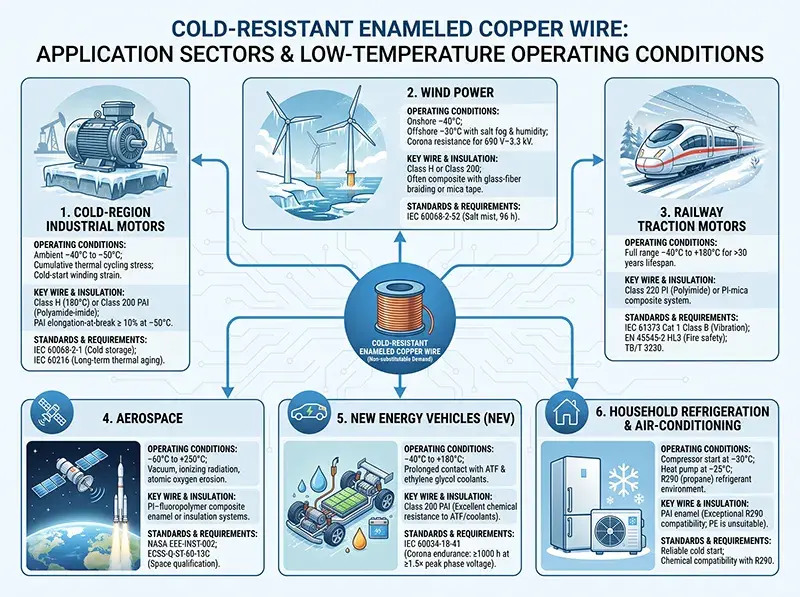
Cold-resistant enameled copper wire exhibits strong, non-substitutable demand across six major industrial sectors.
Cold-region industrial motors represent the largest application market. Motors used on Arctic oil & gas drilling platforms, Siberian mines in Russia, outdoor pump stations in Northern Europe, and polar research stations in Canada operate continuously at ambient temperatures ranging from –40 °C to –50 °C. Frequent start-stop cycles subject motor windings to cumulative thermal cycling stress; therefore, Class H (180 °C) or Class 200 polyamide-imide (PAI) enameled wire is required. Class 200 PAI maintains an elongation-at-break ≥ 10 % at –50 °C, enabling it to withstand cold-start winding strain. Mandatory qualification tests include IEC 60068-2-1 (cold storage test) and IEC 60216 (long-term thermal aging test).
The wind power sector constitutes another major market for cold-resistant enameled wire. Onshore wind turbines—deployed in Northeast China, Mongolia, Northern Europe, and North America—experience winter minimum temperatures down to –40 °C; offshore installations—in the North Sea and Baltic Sea—face winter lows of –30 °C combined with salt fog and high humidity. Main transformers, converters, and stator windings of generators require Class H or Class 200 enameled wire, often enhanced with glass-fiber braiding or mica tape wrapping to form a composite insulation system. Such systems must pass the IEC 60068-2-52 salt mist test (96 h). Offshore wind turbine ratings range from 6–15 MW, with operating voltages spanning 690 V to 3.3 kV—imposing heightened requirements for corona resistance of the enamel coating.
Railway traction motors constitute a traditional application domain for cold-resistant enameled wire. High-speed trains operating in extreme cold—such as Russian high-latitude EMUs, Nordic rail networks, and China’s CR400AF Fuxing high-cold variant—demand motor operation over the full temperature range of –40 °C to +180 °C for >30 years. Class 220 polyimide (PI) enameled wire—or PI combined with mica tape in a composite insulation system—is the preferred solution, validated per IEC 61373 Category 1 Class B vibration testing, EN 45545-2 HL3 fire safety testing, and China’s TB/T 3230 railway standard.
Aerospace applications impose the most stringent requirements for extreme-temperature resilience. Electrical systems aboard satellites, launch vehicles, high-altitude UAVs, and polar aircraft operate across –60 °C to +250 °C, under concurrent exposure to vacuum, ionizing radiation, and atomic oxygen erosion. PI–fluoropolymer composite enamel coatings—or PI–fluoropolymer composite insulation systems—are industry-standard, compliant with NASA EEE-INST-002 and ECSS-Q-ST-60-13C space qualification standards.
New energy vehicle (NEV) operation in cold climates presents unique challenges for enameled wire. Drive motors deployed in Nordic countries, North America, and Northeast China operate across –40 °C to +180 °C and remain in prolonged contact with automatic transmission fluid (ATF) and ethylene glycol–based coolants. Class 200 PAI enameled wire demonstrates excellent chemical resistance to both ATF and ethylene glycol. A critical qualification threshold is the IEC 60034-18-41 corona endurance test: ≥1000 h at ≥1.5× peak phase voltage.
Household refrigeration and air-conditioning systems also rely heavily on cold-resistant enameled wire. Refrigerator and freezer compressors must start reliably at –30 °C; heat pumps must deliver heating capacity at ambient temperatures as low as –25 °C. R290 (propane, GWP = 3) is increasingly replacing R22 and R410A as the refrigerant of choice. PAI enamel exhibits exceptional compatibility with R290—no chemical reaction occurs—whereas polyethylene (PE) enamel may swell in R290 environments and is therefore unsuitable.
Test Methods and Standard System
The testing system for cold-resistant enameled wires is categorized into three major types: basic performance testing, low-temperature-specific testing, and accelerated aging testing.
Basic performance testing follows the IEC 60851 series standards. IEC 60851-3 specifies mechanical properties, including elongation (≥ 30 % for round wire), springback angle (≤ 5°), and scratch resistance (≥ 5 N); IEC 60851-5 specifies electrical properties, including dielectric breakdown voltage (≥ 1.5 kV at room temperature) and insulation resistance; IEC 60851-6 specifies thermal properties, including thermal shock (30 min at 175 °C / 200 °C / 220 °C) and softening breakdown temperature (≥ 300 °C). Equivalent ASTM standards—including ASTM D149, D1389, and D2307—are applied in parallel.
Low-temperature-specific testing constitutes the core verification for cold-resistant enameled wires. Per IEC 60068-2-1, low-temperature storage tests are conducted at specified temperature levels of –40 °C, –55 °C, and –65 °C for durations of 16–96 h; low-temperature operational testing requires energized operation of samples under specified low-temperature conditions for 1,000 h. ASTM D2137—rubber brittleness testing—employs an impact method to determine the brittle point temperature; cold-resistant enameled wires must exhibit a brittle point temperature ≤ –50 °C. Differential scanning calorimetry (DSC), conducted per ASTM D3418 with a heating rate of 10 °C/min, is used to precisely determine the glass transition temperature (Tg) of the enamel coating, taking the midpoint temperature as the Tg value.
Accelerated aging testing is based on the Arrhenius model. Per IEC 60216, three to four elevated temperature points—typically 20–40 °C above the intended service temperature—are selected for long-term thermal exposure. Specimens are removed every 7–14 days to measure breakdown voltage or elongation. A plot of the logarithm of lifetime versus the reciprocal of absolute temperature is generated, and the temperature index (TI) is extrapolated to correspond to a 20,000-h lifetime. In addition, cold-resistant enamel coatings must undergo thermal cycling between low temperature (–40 °C) and high temperature (155 °C), with a minimum of 1,000 cycles and a dwell time of ≥ 30 min per cycle.
At the standard-system level, international standards are anchored by the IEC 60317 series (product specifications), IEC 60851 series (test methods), IEC 60085 (definition of thermal classes), and IEC 60172 (specialized standard for enameled wires); U.S. standards are represented primarily by NEMA MW 1000–2023 (including MW 5, MW 9, MW 15, MW 16, MW 18, MW 24-C, MW 28-C, MW 35-C, MW 41–44, MW 46, MW 48, MW 50, MW 53-C, MW 72–76, MW 79, MW 80, MW 81, MW 83, and MW 8359); Chinese standards are built upon the GB/T 6109 series (enameled round wires, comprising 22 parts), GB/T 7095 series (enameled rectangular wires), GB/T 4074 series (test methods), GB/T 1408, and GB/T 10579; Japanese standards include JIS C 3202, C 3210, C 3211, C 3212, C 3059, and C 3053; UL 1446 (insulation systems), UL 1581 (electrical safety); ASTM B49, B193, B279, D1676, and D2303; ISO 9001, ISO 14001, and ISO 45001 (quality, environmental, and occupational health & safety management systems); IATF 16949 (automotive quality management system); EN 45545-2 HL3 (fire protection for railway applications); and regulatory directives RoHS 2.0, REACH, and ELV 2000/53/EC collectively form a comprehensive standard matrix.
Selection and Engineering Application Guide
Selection of cold-resistant enameled wires requires comprehensive consideration of five key factors: operating temperature, insulation thermal class, mechanical stress, electrical stress, and chemical exposure.
Operating Temperature Matching:
The minimum operating temperature determines the requirement for the enamel film’s glass transition temperature (Tg), while the maximum operating temperature dictates the required thermal class. A dual safety margin is recommended: select an enamel film with a Tg at least 20 °C lower than the minimum operating temperature and a thermal index at least 20 °C higher than the maximum operating temperature. For example, for outdoor motors in Nordic regions—where the minimum ambient temperature is –40 °C and the maximum operating temperature reaches 155 °C—the selected wire should feature a cold-resistant polyurethane (PU)-modified polyetherimide (PEI) or polyamide-imide (PAI) enamel with Tg ≤ –60 °C and a thermal index ≥ 175 °C, conforming to Class H.
Insulation Thermal Class vs. Temperature Rise Matching:
Conventional design principles pair Class F (155 °C) insulation with B-class (130 °C) temperature rise, Class H (180 °C) insulation with F-class (155 °C) temperature rise, and Class 200 (200 °C) insulation with H-class (180 °C) temperature rise. For equipment deployed in cold regions, Class H insulation paired with F-class temperature rise is recommended, providing a 25 °C safety margin to accommodate thermal cycling and short-term overload conditions.
Mechanical Stress Considerations:
In extreme environments such as polar wind power generation, rail traction, and aerospace applications—where vibration and impact stresses are exceptionally high—polyamide-imide (PAI) or polyimide (PI) enamel films are preferred due to their superior mechanical strength and adhesion. For general industrial motors in cold regions, polyetherimide (PEI) or PEI/PAI composite enamel films offer an optimal balance between cost and performance.
Electrical Stress Considerations:
High-frequency inverters and new-energy traction motors operate at peak voltages up to 800 V or even 1200 V, with voltage slew rates (dv/dt) reaching 5–20 kV/μs. In such cases, corona-resistant enameled wire (certified per IEC 60034-18-41) or thick-film wire (enamel thickness ≥ Grade 3, i.e., ≥ 70 μm) is required.
Chemical Exposure Considerations:
In outdoor, humid environments, hydrolysis-sensitive enamel systems—such as PEI/polyamide (PA) composites under sealed conditions—should be avoided. Instead, PAI or PI-based enamels are recommended. For applications involving automatic transmission fluid (ATF) or ethylene glycol-based coolants, PAI enamel is strongly recommended. In refrigerant environments utilizing next-generation refrigerants such as R290 (propane) or R744 (CO₂), chemical compatibility of the enamel must be rigorously validated; PAI has passed such validation, whereas polyethylene (PE) has not.
Copper Conductor Grade Selection:
C12200 DHP (phosphorus-deoxidized copper) is the preferred conductor material for outdoor equipment in cold regions, offering superior solderability, resistance to hydrogen embrittlement, and resistance to stress corrosion cracking compared to C11000 ETP (electrolytic-tough-pitch copper). The copper must be fully annealed to the O-temper condition (elongation ≥ 30 %); H-temper (hard-drawn) conductors are unsuitable.
Rectangular vs. Round Wire Selection:
For high-voltage motors, wind turbine converters, and energy storage power conversion systems (PCS) deployed in cold regions, rectangular enameled wire (thickness: 1.5–3.0 mm × width: 4.0–8.0 mm) is recommended. Its slot fill factor reaches 0.65–0.78—significantly higher than that of round wire (0.45–0.55)—resulting in superior heat dissipation efficiency and power density. Round wire remains suitable for precision instruments, sensors, and household appliance motors.
Development Trends
The development of cold-resistant enameled wires is progressing along four major directions.
Integrated Composite Insulation Systems represent the high-end direction. The dual-layer insulation system—enamel coating combined with fiber braiding (NEMA MW 41–44)—has matured commercially. Dual-layer enamel systems based on polyetherimide (PEI) and polyamide-imide (PAI) are advancing toward Class 250 (240 °C) thermal endurance ratings. Hybrid solutions—including aluminum-clad copper (AIW) + glass-fiber composites, varnish-impregnated glass-fiber (VFG) wrapping, and mica tape composites—are being deployed at scale in rail transit, nuclear power, and offshore wind power applications.
Low-Dielectric-Constant Enamel Coatings constitute an emerging direction. High-frequency power electronics using SiC/GaN devices and 5G telecommunications base stations demand enamel coatings exhibiting low dielectric loss (tan δ ≤ 0.005) at frequencies above 100 kHz. Fluorinated enamels, modified polyimides, polybenzimidazole (PBI), and polyarylethersulfone (PES) are novel polymers transitioning from aerospace to industrial applications.
Smart Enamel Coatings represent the cutting-edge frontier. Nanoscale tracer particles—such as quantum dots or rare-earth fluorescent nanoparticles—are embedded into enamel coatings to enable real-time monitoring of coating degradation via fluorescence spectroscopy or electrical parameter analysis, thereby facilitating predictive maintenance of enameled wire service life. This technology holds significant value for high-capital-value equipment in offshore wind power, nuclear power, and rail transit sectors.
Bio-Based Enamel Coatings embody the sustainability-driven direction. Bio-based polymers—including polylactic acid (PLA), castor oil–based polyurethane (PU), and itaconic acid–derived polyimide (PI)—are under development for cold-resistant enameled wire coatings, balancing environmental sustainability with low-temperature performance to align with the European Green Deal and global carbon neutrality strategies.
Conclusion
Cold-resistant, anti-condensation enameled copper wire serves as the “nervous fiber” for equipment deployed in polar regions, high-latitude zones, and frigid outdoor environments. Its design centers on three key synergies: matching the enamel film’s glass transition temperature (Tg) with the minimum operating temperature; coordinating chemical formulation with mechanical stress resistance; and unifying conductor material properties with winding process requirements. From Arctic drilling operations to offshore wind turbines, from high-speed trains operating in subarctic climates to polar-orbiting satellites, cold-resistant enameled wire ensures reliable electromagnetic energy conversion across an extreme temperature range of -60 °C to +250 °C. With technological breakthroughs in PI/PAI composite enamel coatings, nanoscale tracer particles, and bio-based polymers, cold-resistant enameled wire is evolving beyond single-dimensional thermal endurance toward multidimensional adaptability to extreme environments-providing critical material support for humanity’s electrification initiatives in polar exploration and cold-climate engineering.