


When procuring ECCA enameled copper-clad aluminum wire, identifying a truly reliable manufacturing facility is critical to ensuring product quality, consistent delivery, and long-term collaboration. ECCA wire is a three-layer composite conductor material comprising an aluminum core substrate, a thin copper layer metallurgically bonded to the outer surface of the aluminum core, and an insulating enamel coating applied over the copper layer. This structure combines the superior electrical performance of copper with the cost advantages of aluminum. ECCA wire is widely used in high-frequency transformers, communication coils, motor windings, household appliances, LED drivers, and solar inverters. However, manufacturers in the ECCA industry vary significantly in scale and technical capability. Consequently, selecting a supplier that demonstrably possesses stable production and supply capacity remains the central challenge for procurement decision-makers.
ECCA Enameled Wire Core Structure and Grades
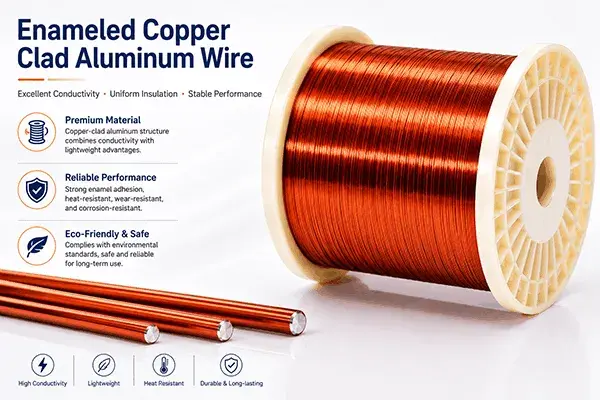
A reliable manufacturer must first possess a clear understanding of the product structure of ECCA enameled wire. A complete ECCA enameled wire comprises three functional layers: an inner aluminum core providing advantages in low density and cost; an intermediate copper-clad layer delivering electrical conductivity and solderability; and an outer insulating enamel coating ensuring electrical insulation. The volumetric proportion of the copper cladding determines the electrical and mechanical performance grade of the ECCA wire. The industry widely adopts a three-tier grading system—Grade 1, Grade 2, and Grade 3:
- Grade 1 features a copper layer volume ratio of 10–15%, achieving approximately 40–55% of the conductivity of pure copper, making it suitable for cost-sensitive, low-frequency applications;
- Grade 2 features a copper layer volume ratio of 25–30%, achieving approximately 60–70% of the conductivity of pure copper, representing a balanced, commonly used grade offering comprehensive performance;
- Grade 3 features a copper layer volume ratio of 36–40%, achieving up to 75–85% of the conductivity of pure copper—delivering performance closest to that of pure copper wire while remaining more economical.
Regarding the enamel coating, a reliable manufacturer should be capable of supplying the full range of thermal classes—Class 130, 155, 180, 200, and 220—covering various resin systems including polyester, polyurethane, polyester-imide, and polyamide-imide enamels, thereby meeting diversified application requirements—from household appliances and industrial transformers to automotive motors. Understanding these technical details constitutes the first critical threshold for evaluating a manufacturer’s professional competence.
Factory Compliance Qualification Baseline Review
Compliance qualifications constitute the first hard threshold for assessing the reliability of an ECCA factory. A legitimate factory must, at a minimum, hold the following foundational certifications: Business License; Organization Code Certificate and Tax Registration Certificate (replaced by the Unified Social Credit Code Certificate following the “Three-in-One” integration); Record-filing Form for Foreign Trade Operators; and Customs Registration for Import/Export Consignors and Consignees. Regarding quality management system certification, ISO 9001 Quality Management System Certification represents the fundamental requirement; ISO 14001 Environmental Management System Certification reflects the factory’s commitment to environmental compliance; and ISO 45001 Occupational Health and Safety Management System Certification demonstrates its emphasis on employee safety. Notably, many purchasers—especially during initial supplier engagement—are easily misled by the sheer number of certificates presented. In reality, the authenticity, validity period, scope of certification, and accreditation status of the issuing body are far more critical than the quantity of certificates. Purchasers must verify certificate authenticity via the official website of the China National Certification and Accreditation Administration (CNCA) or a reputable third-party platform; confirm that the certified scope explicitly covers ECCA winding wire products; and ensure that all certificates remain within their valid periods.
Industry-Specific Certification Requirements
Beyond basic management system certification, industry-specific certification requirements for ECCA (Electrolytic Copper-Clad Aluminum) factories vary significantly across different application sectors. Automotive supply chain purchasers should prioritize factories certified to IATF 16949, a quality management system standard specifically tailored to the automotive industry. This standard emphasizes the process approach, risk-based thinking, and product safety. Purchasers targeting the North American market must verify whether the factory holds UL certification—specifically UL 1446 (for electrical insulation systems) and UL 1581 (for electrical wires and cables). Purchasers serving the European Union market must confirm compliance with the REACH Regulation on chemicals and the RoHS 2.0 Directive restricting hazardous substances; RoHS 2.0 restricts the use of ten hazardous substances, including lead, mercury, cadmium, and hexavalent chromium. Additionally, in Europe’s premium market segment, there exists a specialized certification for copper-clad aluminum products: the ECCA Premium® certification. Authorized by the European Copper-Clad Aluminum Association and administered by third-party bodies such as TÜV Rheinland, this certification involves factory audits and ongoing surveillance. During the three-year certification period, certified factories are subject to one or two unannounced “surprise” audits. ECCA Premium® serves as a recognized and authoritative endorsement for accessing Europe’s high-end copper-clad aluminum market.
Core Elements of the Quality Management System
A reliable factory’s quality management system (QMS) must cover critical areas including incoming material inspection, in-process inspection, final product inspection, equipment calibration, traceability systems, nonconforming product control, corrective actions, and continual improvement.
Regarding incoming material inspection, the factory shall establish incoming specifications and inspection records for key raw materials—such as the chemical composition of aluminum rod, the purity of copper strip, and the solvent content of enamel coating materials.
In-process inspection constitutes the core of ECCA (Enamel-Coated Copper Aluminum) magnet wire quality control. A reliable factory shall be equipped with an online enamel film thickness monitoring system, a high-voltage pinhole detector for enamel film continuity, and an automated springback angle tester to enable real-time quality monitoring of the enameling process.
Final product inspection shall include key performance indicators such as solderability testing, dielectric strength testing, conductor DC resistance testing, and elongation testing.
For equipment calibration, critical measuring instruments—including thickness gauges, high-voltage testers, DC resistance bridges, and tensile testing machines—shall be subject to an annual calibration schedule and interim verification records.
The traceability system serves as the “nervous system” of quality management. A reliable factory must achieve full two-way traceability across raw material batches, production lots, and customer lots—ensuring rapid identification of the scope of impact for any quality issue.
Comprehensive Assessment of Production Capacity
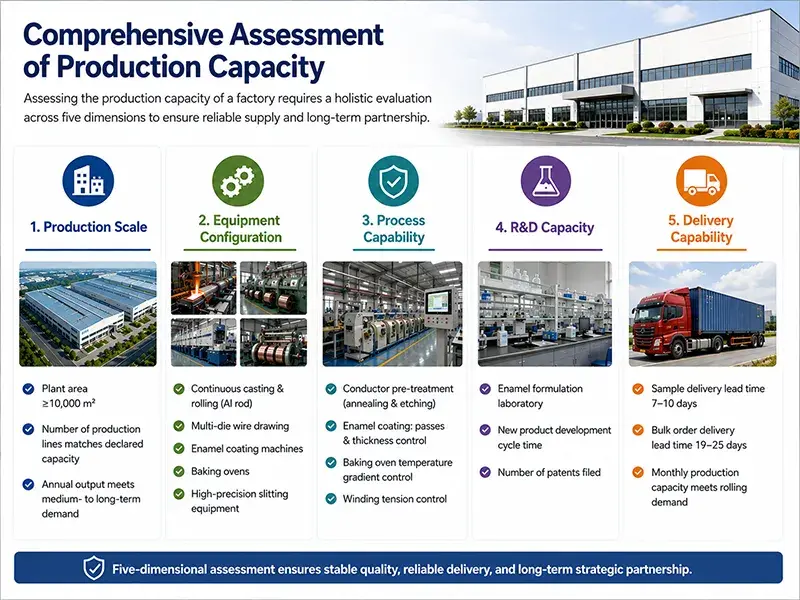
Assessing the production capacity of an ECCA factory requires a holistic evaluation across five dimensions: production scale, equipment configuration, process capability, R&D capacity, and delivery capability.
Regarding production scale, the plant area should be no less than 10,000 m²; the number of production lines must align with the declared production capacity; and the annual output must satisfy the purchaser’s medium- to long-term demand.
In terms of equipment configuration, a reliable factory must possess a complete production line comprising: continuous casting and rolling equipment for aluminum rod production; multi-die wire drawing machines for precise wire diameter control; horizontal or vertical enamel coating machines for insulation layer application; baking ovens for enamel film curing; and high-precision slitting equipment for final cut-to-length processing.
Process capability is reflected in the stability of critical process parameters, including conductor pre-treatment (annealing and micro-etching processes), enamel coating (number of coating passes and precision of enamel film thickness control), temperature gradient control in the baking oven, and winding tension control.
For R&D capacity, key indicators of a factory’s technological sustainability include the presence of an enamel formulation laboratory, new product development cycle time, and the number of patents filed.
With respect to delivery capability, typical sample delivery lead time is 7–10 days; bulk order delivery lead time is generally 19–25 days; and monthly production capacity must consistently meet the purchaser’s rolling demand.
Key On-Site Observations During Factory Audits
Regardless of how comprehensive the certificates and documentation may be, on-site factory audits remain an irreplaceable step for verifying the actual capabilities of an ECCA-certified factory. The following ten aspects should be the primary focus during such audits:
- Overall site cleanliness, which reflects the factory’s on-site management standards;
- Dust control, oil contamination, and waste disposal practices, which constitute fundamental observation items;
- Actual operational status of production lines, which is more credible than promotional materials—attention should be paid to equipment age, operational stability, staffing levels, and shift scheduling;
- Laboratory capabilities, reflecting the factory’s technical competence—verification should cover the availability and calibration status of chemical analysis, physical testing, and dielectric testing equipment;
- Warehouse management, indicating the factory’s material control proficiency—observation should include physical segregation and clarity of labeling in raw material, semi-finished goods, finished goods, and non-conforming product storage areas;
- Employee training and qualifications, reflecting human resource management effectiveness—verification should include employment certificates (certificates of competency) for key positions, skill matrices, and training records;
- Occupational safety and environmental compliance, increasingly emphasized by international buyers—inspection should cover fire protection systems, emergency exits, personal protective equipment (PPE), exhaust gas and wastewater treatment facilities, environmental impact assessment (EIA) approval documents, and pollutant discharge permits.
In addition, in-depth interviews should be conducted with the General Manager, Sales Director, QC Manager, Production Manager, and R&D Lead to gain insights into the factory’s strategic positioning, quality philosophy, and long-term development plans.
Commercial Terms Risk Control
A reliable factory should maintain transparency and standardization in its commercial terms.
Regarding payment methods:
- Telegraphic Transfer (T/T) — 30% advance deposit plus 70% balance paid prior to shipment — is the most widely adopted payment method in the ECA industry; the 30/70 split balances financial risk between buyer and seller.
- Letter of Credit at Sight (L/C at sight) is suitable for large-volume orders or during the initial phase of new business relationships, serving as a risk-mitigation measure.
- Usance Letters of Credit carry higher risk and are therefore recommended only with caution.
Concerning Incoterms®:
- FOB (Free On Board) is the most commonly quoted term by Chinese export factories, granting the buyer full control over ocean freight logistics.
- CIF (Cost, Insurance, and Freight) is appropriate when the buyer seeks to simplify procurement procedures.
- EXW (Ex Works) is suitable when the buyer has established logistics partners at its own location.
Regarding Minimum Order Quantity (MOQ):
A reputable factory typically accepts initial orders ranging from 100–500 kg and offers tiered pricing discounts for larger volumes.
Regarding sample policy:
A legitimate factory generally provides free samples (with freight charges borne by the buyer), and sample costs may be credited against subsequent bulk orders.
Regarding packaging standards:
Common packaging configurations include wooden pallets + shrink wrap + corrugated cartons, or plastic cores + moisture-proof bags + desiccants. Packaging specifications and marking (shipping mark) requirements must be explicitly stipulated in the contract.
Common Procurement Pitfalls and Prevention Guidelines
Several common pitfalls exist in ECCA enameled wire procurement, and buyers must remain vigilant.
First pitfall: Abnormally low pricing. When a supplier’s quotation is significantly below the market average (e.g., more than 20% lower), it may indicate substandard practices—such as misrepresenting Grade 1 wire as Grade 3, insufficient enamel coating thickness, or elevated conductor resistance due to material or process shortcuts.
Second pitfall: Expired or scope-inappropriate certifications. Some manufacturers continue using expired ISO 9001 certificates, or their certified scope does not actually cover ECCA enameled wire products.
Third pitfall: Trading companies posing as manufacturers. Certain shell companies rent small workshops or use video footage from other factories to falsely demonstrate in-house production capacity. Buyers should insist on visiting the actual production facility, verifying equipment lists, and probing into specific process details.
Fourth pitfall: Abnormal payment accounts. A reputable manufacturer’s receiving bank account name must exactly match its business license registration name. Payments to personal accounts or accounts bearing names inconsistent with the registered company name must not be accepted.
Fifth pitfall: Unrealistic delivery lead-time commitments. Buyers should verify the supplier’s historical on-time delivery rate (OTD Rate); an OTD rate below 90% warrants caution, as it may signal inflated capacity claims or disorganized production scheduling.
Long-term Partnership Health Indicators
After establishing a long-term cooperative relationship with a reliable ECCA-certified factory, a scientific performance monitoring mechanism should be implemented to continuously assess the supplier’s health status. Key performance indicators (KPIs) include:
- Product defect rate (PPM, Parts Per Million),
- Incoming material batch acceptance rate,
- On-time delivery (OTD) rate,
- Customer complaint response time,
- Corrective action completion rate,
- Average unit price fluctuation magnitude,
- Production consistency deviation, etc.
A reliable factory shall provide monthly quality data reports, conduct quarterly performance review meetings, and implement a continuous improvement mechanism (e.g., PDCA cycle) to drive progressive optimization of quality metrics. The buyer shall also conduct periodic unannounced “fly-in” audits to verify the factory’s actual management capability under routine operational conditions—not merely during pre-announced audit preparations. For high-performing suppliers, strategic partnership status shall be established, granting preferential support in areas such as order allocation, pricing adjustments, and new product development. For suppliers exhibiting performance deterioration, timely corrective action notices must be issued; where necessary, the alternate supplier activation mechanism shall be triggered.
Four Directions for Factory Capability Upgrading
In response to increasingly stringent global compliance requirements and continuously rising customer expectations, reliable ECCA factories should proactively advance capability upgrading across the following four dimensions:
Smart Manufacturing: Introduce an Industrial Internet of Things (IIoT) platform to enable real-time data acquisition from production equipment and adaptive control of process parameters—thereby enhancing the process capability index (Cpk) for paint film thickness control and coating continuity.
Green Manufacturing: Implement process upgrades to replace solvent-based coatings with water-based coatings, and construct VOC (Volatile Organic Compound) recovery and treatment facilities to reduce energy consumption per unit product and carbon emissions.
Digital Traceability: Establish a full-batch traceability system—using either QR codes or blockchain technology—from aluminum rod receipt through to finished-product dispatch, thereby accelerating product recall response times and improving quality analysis efficiency.
Global Compliance: Proactively monitor and comply with emerging international trade barriers, including RoHS 3.0, REACH Substances of Very High Concern (SVHC) Candidate List, conflict minerals (3TG) reporting requirements, and the EU Carbon Border Adjustment Mechanism (CBAM), to build a future-ready compliance framework.
Conclusion
Identifying a reliable ECCA enameled wire manufacturer is a systematic endeavor, requiring procurement professionals to develop sound professional judgment across multiple stages—including qualification review, capability assessment, on-site factory audits, commercial negotiations, and risk control. Starting with a thorough understanding of the ECCA’s three-layer composite structure and its Grade 1/2/3 classification system, buyers should adopt compliance certifications and industry-recognized accreditations as mandatory screening criteria; employ comprehensive evaluations of the supplier’s quality management system and production capacity as the core basis for decision-making; conduct on-site factory audits as the final verification step; and establish scientifically formulated commercial terms and long-term performance monitoring mechanisms to safeguard the partnership. Only through this rigorous, multi-layered approach can buyers effectively identify suppliers truly capable of delivering consistent, high-quality ECCA enameled wire. The reliability of ECCA enameled wire depends not only on the intrinsic physical and chemical properties of the materials themselves, but—more critically—on the manufacturer’s end-to-end quality control capabilities throughout the entire production process. Establishing a long-term strategic partnership with a dependable manufacturer thus lays a solid foundation for ensuring product quality stability and enhancing market competitiveness of the end products.