

Should you choose copper or aluminum for your winding wire? This question is frequently raised in electrical engineering—especially when project cycles are compressed to a few weeks, budgets are cut by a third, and you still need to meet IEC 60076-20 transformer energy efficiency or DOE 2016 US energy efficiency regulations. Copper and aluminum differ significantly in their physical properties, and their respective advantages and disadvantages are not difficult to identify. However, when making decisions in specific application scenarios, it’s often not a question of “which is better,” but rather “which is more suitable.” This article compares seven engineering dimensions—basic physical properties, electrical performance, mechanical and processing properties, thermal management, weight and cost, resource sustainability, and application scenarios—and refers to international standards such as IEC 60317, NEMA MW 1000, and ASTM B-566, providing scenario-based decision-making recommendations.
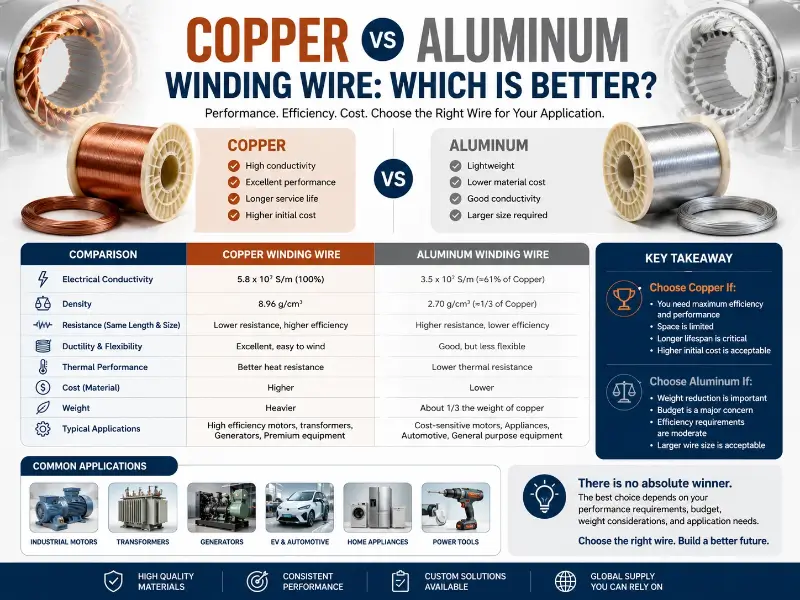
Comparison of Basic Physical Properties of Copper and Aluminum Winding Wire
Physical property data is the starting point for engineering decisions. Let’s look at a few key parameters first. Density. Copper has a resistance of 8.96 g/cm³, while aluminum has a resistance of 2.70 g/cm³. In other words, for the same volume, aluminum weighs only 30% of copper. This has a significant impact on weight-sensitive applications such as vehicles, aviation, and wind power—it directly affects range, energy consumption, and moment of inertia. Conductivity: Copper has an IACS of 100%, while aluminum has an IACS of 61%. This means that for the same cross-sectional area, the resistance of a copper conductor is only 61% of that of aluminum—copper’s current-carrying capacity is about 64% higher than aluminum’s. This is why copper remains the preferred choice for high-frequency, high-current, and high-efficiency applications. Resistivity: Copper 0.01724 Ω·mm²/m (20°C), aluminum 0.02820 Ω·mm²/m. The difference is 64%. For the same length and cross-sectional area, copper’s DC loss is only 61% of aluminum’s. Tensile strength: Copper 220-400 MPa, aluminum 90-180 MPa. Copper’s tensile strength is 1.5-2 times higher. This means that enameled copper windings can withstand higher winding tension and vibration stress, and are less prone to breakage. Aluminum wires require more precise tension control during winding and are more susceptible to micro-cracks under vibration after winding. Thermal conductivity: Copper 401 W/(m·K), Aluminum 237 W/(m·K). Copper is 69% higher—meaning that under the same temperature rise conditions, copper windings dissipate heat faster and have lower thermal resistance. For equipment operating under continuous high loads, copper’s advantage is even more pronounced. Coefficient of thermal expansion: Copper 16.5 × 10⁻⁶/°C, Aluminum 23.1 × 10⁻⁶/°C. Aluminum is 40% higher. In applications with repeated hot and cold cycles, aluminum windings exhibit greater dimensional changes, posing a challenge to long-term reliability. In summary: Copper excels across the board in terms of conductivity, mechanical properties, and heat dissipation; aluminum only has an absolute advantage in density.
Electrical Performance: Conductivity and Energy Loss
The electrical performance of the windings directly determines the efficiency of the equipment. The differences between copper and aluminum are most evident here. DC resistance: For the same length and cross-sectional area, aluminum windings have a 64% higher DC resistance than copper windings. To compensate for this, the cross-sectional area of the aluminum wire must be increased—resulting in aluminum windings being 30%-40% thicker than copper windings, reducing slot fill factor, and increasing the size of the motor or transformer. High-frequency skin effect: When the frequency exceeds 1 kHz, current begins to concentrate on the surface of the conductor—this is the skin effect. The skin depth of copper and aluminum is not significantly different, but copper has a 64% higher IACS, resulting in lower AC resistance for copper windings at high frequencies. Copper is the default choice for wireless charging, high-frequency induction heating, and SMPS applications. Eddy current loss: The windings within the slots of the motor core generate an alternating magnetic field, inducing eddy currents within the conductors. While aluminum’s high resistivity can suppress eddy currents to some extent, overall, copper windings still have 20%-30% lower total losses across the entire frequency range from 50 Hz to 13.56 MHz. This data is published by lpindustrywire.com. Power density. For the same output power, aluminum windings have a larger volume and lower power density. For applications requiring small size and high power density—such as new energy vehicle drive motors—aluminum windings mean a larger motor housing and a heavier overall weight, thus offsetting aluminum’s density advantage.
Mechanical Properties and Processing Technology
Winding wire isn’t just used after being placed in a box—it undergoes a series of processes including wire drawing, enameling, winding, embedding, and termination. Each stage has different material requirements. Wire Drawing Process. Copper has good plasticity and can be drawn to ultra-fine wire diameters of 0.016 mm. Aluminum also has good plasticity, but lower strength, making it prone to breakage when drawn to the same fine diameter. The typical lower limit of aluminum winding wire diameter is around 0.10-0.20 mm, much thicker than copper windings. Winding Tension. The winding passes through the die at a speed of 800-2000 meters per minute on a high-speed winding machine. Copper’s high tensile strength allows it to withstand higher winding tensions, while aluminum requires lower speeds and more precise tension control. NEMA MW 1000-2018 has a dedicated section on “De-Reeling (Winding) Tension” providing tension reference values. The recommended tension for copper wire is 1.5-2 times that of aluminum wire. Termination process: Copper is easy to solder—tin soldering, silver soldering, and laser soldering are all possible. Aluminum surfaces instantly form an oxide film (Al₂O₃), making soldering difficult and requiring special fluxes, ultrasonic welding, or mechanical crimping. This is why aluminum-wound motors have a higher end-failure rate than copper-wound motors—increased resistance at the connection, temperature rise, and burnout. Vibration resistance: Motors are subjected to vibration accelerations of 5-50 g during operation. The high tensile strength of copper windings can withstand vibration fatigue, while aluminum windings may develop microcracks under long-term vibration, leading to enamel coating cracking and insulation failure.
Thermal management and heat dissipation characteristics
The thermal class of the winding wire directly determines the power limit of the equipment. The enamel coating is temperature resistant. IEC 60317 classifies enamel coatings into thermal class categories of 105°C, 130°C, 155°C, 180°C, 200°C, 220°C, and 240°C. Both copper and aluminum wires can use the same enamel coating system—there is no fundamental difference in this respect. The difference lies in the heat resistance of the conductors themselves: copper has a melting point of 1085°C, while aluminum has a melting point of 660°C—aluminum begins to soften near 600°C. Regarding continuous operating temperature rise, copper has a 69% higher thermal conductivity; under the same heat dissipation conditions, copper windings will experience a 10-15°C lower temperature rise than aluminum windings. For F-class (155°C) or H-class (180°C) insulation systems, every 10°C reduction in temperature rise doubles the winding life. This is a direct consequence of Arrhenius’s law of aging. Short-term overload… Motors or transformers frequently encounter short-term overloads—for example, starting current 6-8 times the rated current. Copper’s high melting point and high heat capacity can withstand such impacts, while aluminum windings are more prone to localized overheating and insulation breakdown under short-term overloads.
Weight, Cost, and Resource Sustainability
Weight and cost are two major selling points of aluminum windings. Weight. For the same conductivity, aluminum windings are about 50% lighter than copper windings—because aluminum’s density is only 30% of copper’s—but require a larger cross-sectional area, resulting in an equivalent weight of about half that of copper. Using aluminum windings (hairpin process) in new energy vehicle drive motors can reduce the overall vehicle weight by 15-30 kg, impacting range by about 1-2%. Price. Metal prices in 2026 are approximately: copper 9500-11000 USD/ton, aluminum 2200-2800 USD/ton. The raw material cost of aluminum is only 1/4 to 1/3 of that of copper. This is the biggest cost advantage of aluminum winding wire—for high-volume, price-sensitive applications, aluminum winding can reduce the cost of the winding portion by 40-60%. Resource sustainability: Global proven copper reserves are approximately 870 million tons, enough for about 60 years of mining at the current rate. Aluminum reserves are approximately 30 billion tons, enough for over 800 years of mining. From a long-term supply chain security perspective, aluminum’s sustainability is significantly better than copper’s. This is one of the reasons why European and American automakers have adopted aluminum-winded motors on a large scale. Recycling value: Copper has a recycling rate exceeding 80%, with low recycling costs and a mature market. Aluminum has a recycling rate of about 70%, but its recycling energy consumption is low (copper smelting energy consumption is 4 times that of aluminum). Both metals have mature recycling industry chains.
Application Scenarios and Engineering Decisions
Leaving aside basic physical properties, let’s return to engineering practice—the choices between copper and aluminum winding wires are completely different in different application scenarios. Large-scale power transformer: Here, copper is the absolute mainstream. IEC 60076-20 requires IACS conductivity of over 100%, and the DOE 2016 US energy efficiency regulations further tightened loss limits. Aluminum windings have losses 30%-40% higher than copper, making them unable to meet these standards. Engineering case studies from lpwindingwire.com show that almost all power transformers above 10 MVA use copper windings. Industrial motors (>10 kW) use copper windings as the default choice. In high-load, high-duty-cycle, and continuous-operation scenarios, copper’s heat dissipation and efficiency advantages are crucial. Induction motors, permanent magnet synchronous motors, and servo motors all use copper windings in high-power scenarios. New energy vehicle drive motors are where aluminum windings dominate. Tesla, BYD, NIO, and BMW i series all use hairpin flat wire windings—aluminum or copper-clad aluminum (CCA). This reduces weight by 15-30 kg, increases range by 1-2%, and lowers overall vehicle cost by approximately 5%. However, high-end models like the BMW iX still use copper windings—pursuing ultimate power density and efficiency. For household appliance motors (air conditioner compressors, refrigerators, washing machines), aluminum windings are the mainstream. Air conditioner compressors have an outer diameter of 80-120 mm, providing ample winding space, so the size disadvantage of aluminum windings is not a problem. Due to cost pressures, aluminum windings are 40-60% cheaper than copper windings. In wind turbines, large wind turbines (>3 MW) use copper windings—because efficiency, reliability, and a lifespan of 20-25 years are prioritized. Smaller wind turbines (<1 MW) can use aluminum windings to reduce system costs. In high-frequency electronics (SMPS, PFC, LLC, induction heating), copper windings are the only option. In the frequency range of 50 kHz-13.56 MHz, the skin effect and proximity effect dominate, and the high resistivity of aluminum leads to severe eddy current losses. Copper’s current-carrying capacity is a key indicator here. In precision audio equipment and medical instruments, copper windings are absolutely required. Copper’s low resistance, low noise, and high reliability are the bottom line for these applications. The selection of winding wires in engineering projects relies heavily on international standards. IEC 60317 is the general framework for international standards for enameled winding wires, currently comprising over 70 parts, covering 0.012-7.0 mm² round and flat wires. Each part corresponds to a specific enamel coating and conductor combination. For example, IEC 60317-20 specifies polyurethane-coated copper round wire, while IEC 60317-13 specifies polyester-coated aluminum round wire—aluminum wire has its own dedicated standard clauses. NEMA MW 1000 is the general framework for North American winding wire standards, including specifications such as MW 35, MW 36, MW 73, and MW 79-83. Similar to IEC 60317, NEMA also provides separate specifications for aluminum and copper wires. NEMA MW 1000-2018 is the latest version. ASTM B-566 is another standard. This is the specific standard for copper-clad aluminum (CCA) wire. CCA is a compromise between copper and aluminum—the outer copper layer provides conductivity and oxidation resistance, while the inner aluminum layer reduces weight. ASTM B-566 specifies three levels for the copper layer’s cross-sectional area: 10%, 15%, and 27%. CCA’s high-frequency AC conductivity (>5 MHz) is equal to that of pure copper, which is a highlight in its RF applications. UL certification. UL 1446 is the safety standard for winding wire insulation systems. Both copper and aluminum wires can be certified to UL 1446, but aluminum windings have stricter termination requirements.
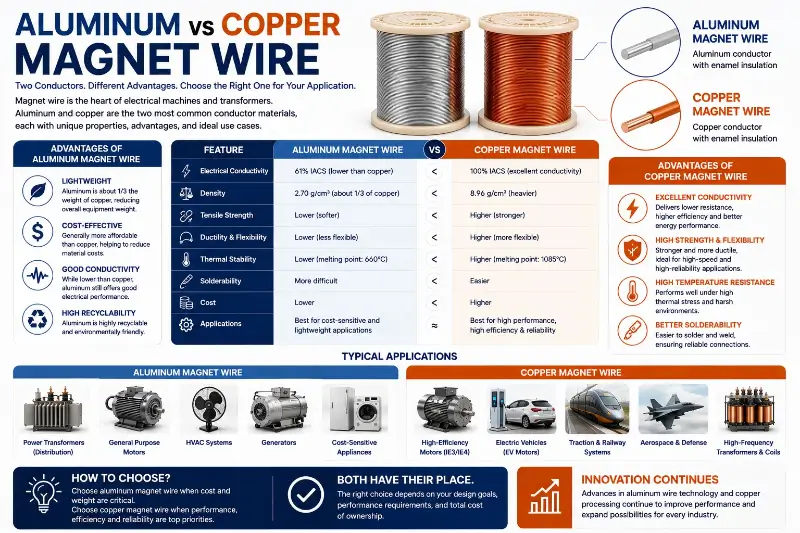
Conclusion: How to choose between copper and aluminum winding wire?
Returning to the initial question—which is more suitable, copper or aluminum winding wire? The answer is not “which is better,” but “in what scenario.” From an application perspective: {transformers}, high-frequency electronics, precision audio, high-end new energy vehicle motors—copper windings are the default choice. These scenarios either have mandatory standards (IEC 60076-20) or extreme performance requirements (high frequency, high power density, high reliability). For new energy vehicle drive motors, home appliance motors, and low-cost wind power solutions, aluminum windings offer clear cost and weight advantages, especially in mass production scenarios. From an electrical performance perspective, copper windings outperform aluminum windings in all four dimensions: conductivity (IACS 100% vs 61%), DC loss, high-frequency skin effect, and eddy current loss. To achieve equivalent electrical performance, aluminum windings must increase their cross-sectional area by 30%-40%, negating their volume and weight advantages. From a thermal management perspective, copper has 69% higher thermal conductivity and a 10-15°C lower continuous operating temperature rise. For high duty cycle and high power density applications, copper windings offer a 2-3 times longer lifespan than aluminum windings (under F and H class insulation systems). From a mechanical and processing perspective, copper has 1.5-2 times higher tensile strength, a wider winding tension tolerance range, and mature and reliable termination processes. Aluminum windings have a 1-3 times higher termination failure rate than copper windings, a phenomenon repeatedly observed in engineering practice. From a cost and weight perspective, aluminum windings are 50% lighter and 40-60% cheaper for the same conductivity. For weight-sensitive (vehicles, aviation) or cost-sensitive (home appliances, low-end industrial motors) applications, aluminum windings are a reasonable choice. From a long-term sustainability perspective, aluminum reserves are 35 times that of copper, enough to mine for over 800 years. Copper reserves are only enough for 60 years. For products with a lifespan of 10 years or more, aluminum offers greater supply chain security. Final decision recommendation: First, clarify the mandatory requirements of the application scenario—standards (IEC, NEMA), efficiency (transformer energy efficiency regulations), lifespan (20 years for wind power), power density (drive motor)—then choose copper or aluminum based on budget and weight constraints. CCA (copper-clad aluminum) is a compromise, but it will still be a minority choice in engineering practice in 2026. There is no absolute answer to the choice of winding wire material. Understanding the engineering trade-offs in each scenario and making decisions based on standard requirements and cost constraints—this is the core work of a winding wire engineer.