

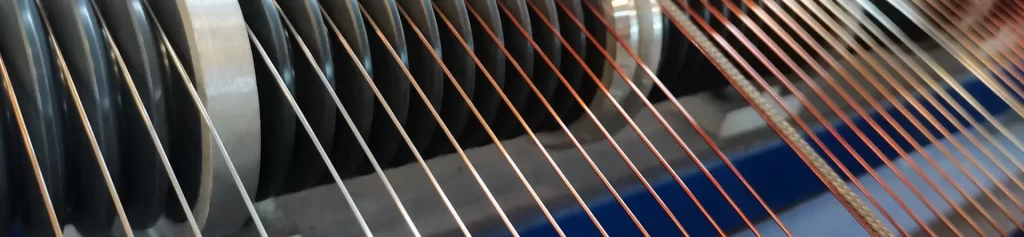
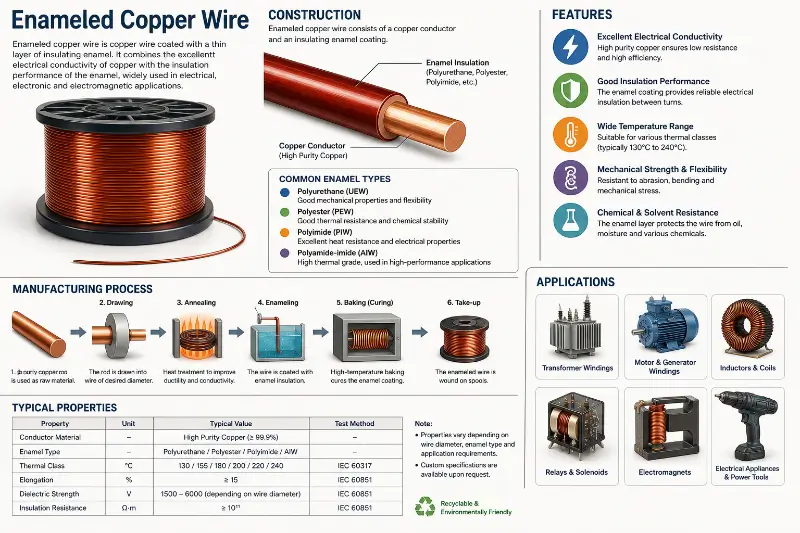
Enameled copper wire is a winding conductor with one or more layers of insulating enamel coating on its surface. Its core function can be summarized in one sentence: to insulate hundreds or thousands of turns of wire from short circuits in the smallest possible space. Modern enamel coating is not glass enamel, but a heat-resistant, abrasion-resistant, and chemical-resistant polymer film.
Enameled copper wire is often used interchangeably with “magnet wire” and “winding wire.” Strictly speaking, “magnet wire” is a general term for insulated wire used in electromagnetic windings, and enameled copper wire is just one of the most common types. If a procurement document specifies “magnet wire,” six items must be checked before receiving the goods: conductor material, wire shape, insulation system, thermal class, size range, and applicable standards. Missing even one item will cause disputes at the acceptance and claims stage.
This article will not repeat the basic principles of “what enameled copper wire is.” It goes straight to how to buy it.
First, Three Easily Confused Terms
The most common communication failures in procurement come from mixing up three sets of concepts that have nothing to do with each other.
Set 1: Thermal class vs. working temperature. The thermal class of an enameled copper wire (such as 155 or 180) expresses the heat resistance rating of the insulation material. In standards it corresponds to the “maximum working temperature that no part of the winding may exceed.” But how hot the wire can actually run depends on ambient temperature, its own temperature rise, and the cooling conditions. You cannot use thermal class directly as a continuous working temperature.
Set 2: Thermal class vs. thermal shock temperature. These are two independent indicators. A 155-class enameled copper wire has a thermal shock temperature of 175°C, a 180-class wire is 200°C, a 200-class wire is 220°C, and a 240-class wire can reach 260°C. Thermal shock describes resistance to cracking under a short, sudden temperature change (for example, being dipped into a molten solder bath and pulled out immediately). That is a completely different property from thermal aging resistance during long-term continuous operation.
Set 3: Thermal class vs. coating grade. These two systems are orthogonal. Thermal class describes heat resistance, while Grade 1/2/3 describes enamel film thickness, which directly affects slot fill factor and breakdown voltage. A single-layer Grade 1 enameled copper wire has a minimum breakdown voltage of 1350 V; Grade 2 reaches 2350 V. That is nearly double the voltage for a film thickness that does not differ very much — but pick the wrong one and the insulation design of the whole device has to be redone.
A Nine-Step Selection Path: Follow the Order, Do Not Skip Steps
Buying the wrong enameled copper wire is a skipped-step problem 90% of the time. You ask about price first, then try to backfill the technical conditions afterwards. The correct sequence starts with the application and narrows down one layer at a time.
Step 1: Define the application. A relay coil, an EV drive motor, a power transformer, a high-frequency inductor, and a compressor motor may all use enameled copper wire, yet their voltage stress, temperature rise, winding method, and reliability requirements are completely different. Motors need thermal stability and abrasion resistance. Transformers need suitable resistance, insulation build, and impregnation compatibility. High-frequency work may call for Litz wire to suppress the skin effect. Inverter-fed motor windings need corona-resistant enameled wire.
Step 2: Select the conductor material. Copper has high conductivity, good mechanical strength, stable processing behavior, and reliable termination, which makes it the default choice in most cases. Aluminum is lighter and cheaper, but its resistivity is noticeably higher than copper, so the same resistance demands a larger cross-section, and oxidation, connection methods, and mechanical strength all need extra handling. Aluminum only makes sense when weight or cost dominates and the design allows a larger conductor.
Step 3: Determine the wire shape. Round wire is the default for most coils because it winds easily, is versatile, and is readily available. Flat wire (rectangular wire) is chosen when a higher slot fill factor, a more compact build, or better space utilization is required, but it needs significantly greater investment in winding equipment and much tighter process control.
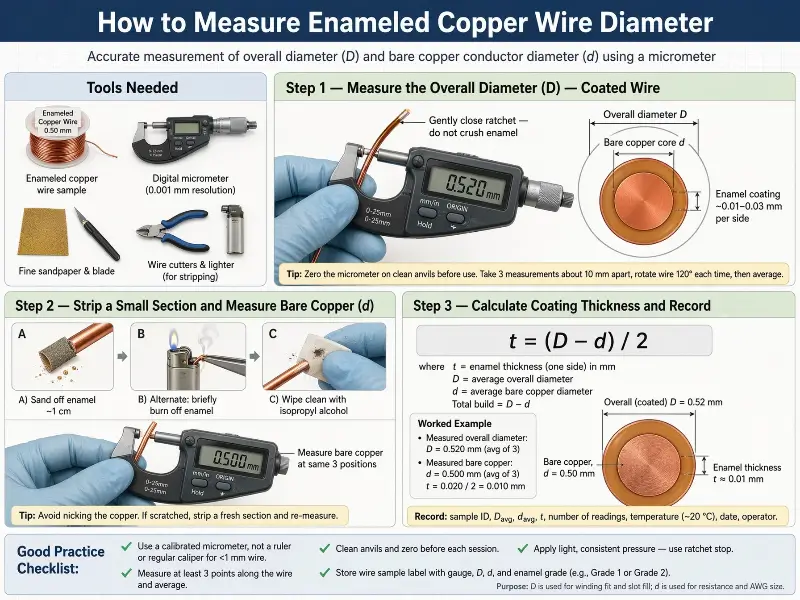
Step 4: Confirm the size. Round enameled copper wire is specified by conductor diameter or AWG gauge; flat wire requires width, thickness, and corner radius. Size directly affects resistance, current capacity, winding space, temperature rise, and mechanical behavior. Get this step wrong and everything downstream is wasted.
Step 5: Select the insulation system (enamel film). This step decides solderability, thermal performance, dielectric strength, and abrasion resistance of the enameled copper wire. The common film systems are polyurethane (UEW), polyester (PEW), polyesterimide (EIW), polyamide-imide (AIW), and polyimide (PI).
The defining feature of polyurethane is solderability — that is why it dominates B2B trade and motor manufacturing. Terminations need no stripping; the wire simply goes into the tin bath. Its chemical resistance, however, is comparatively weak.
Polyester and polyesterimide are the most widely used systems and offer excellent thermal performance, with thermoplastic temperatures of 150°C and 270°C respectively. Polyesterimide is the mainstay at Class 180 and above.
When polyamide-imide is applied as an outer coat, the film is hard and smooth, with abrasion and tensile adhesion performance far beyond ordinary polyester and polyesterimide, along with outstanding heat and chemical resistance. It is normally combined over a polyester or polyesterimide base coat.
Step 6: Set the thermal class. Choose it from operating temperature, temperature rise, cooling conditions, and expected lifetime — not by picking “the higher the better.” Common classes include 105, 130, 155, 180, 200, and 220.
Step 7: Write the test requirements clearly. Breakdown voltage, pinhole, elongation, thermal shock, springback, solderability, and conductor resistance must appear explicitly in the specification or purchase order. They cannot be covered by a single line of “complies with the relevant standard.”
Step 8: Confirm standards and documents. IEC, NEMA, JIS, GB/T, UL, or a customer corporate standard, depending on the target market and the enameled copper wire grade ordered. Where required, ask the supplier for datasheets, test reports, and certificates.
Step 9: Check packaging and production fit. Spool type, wire traversing, surface quality, winding tension, and transport protection all look minor. Yet enameled copper wire with perfectly correct technical parameters that will not run on your winding machine is still scrap.
How to Write a Purchase Specification That Will Not Cause Arguments
Unclear specifications are the single largest source of disputes. A qualified enameled copper wire purchase specification carries at least eight items:
Conductor material. Copper, with the nominal conductor grade and resistivity requirement stated.
Wire shape and size. For round wire, the nominal conductor diameter and tolerance; for flat wire, the width, thickness, and corner radius.
Insulation system. Film type and manufacturer designation (for example EIW, EI/AIW, UEW), specifying base coat and top coat where needed.
Thermal class. Such as 155, 180, 200, or 220, together with the relevant standard part number.
Coating grade. Grade 1 / 2 / 3.
Applicable standards. Such as IEC 60317-0-1 with the corresponding product part, or NEMA MW 1000, including the edition year.
Testing and acceptance. Each test method, its acceptance limit, and the sampling plan, listed item by item.
Packaging. Spool type, net weight, and traversing arrangement.
We see far too many purchase orders that read nothing more than “enameled copper wire 0.5 mm Class 180.” Then at acceptance, which standard measures the breakdown voltage? How is the enamel film thickness defined? How many samples are drawn? None of it is written down. Such an order looks convenient, but it leaves the risk with you.
Eight Questions to Ask a Supplier
Once you have a quotation, clarifying these eight questions is more useful than collecting eight samples.
What conductor material and tolerance is being supplied? Saying “copper” is not enough for enameled copper wire. Ask whether it is electrolytic copper, what the oxidation class is, and what the upper limit of conductor resistance is.
What are the insulation system and thermal class of the enameled copper wire? Is the coating dual-layer? What is the top coat made of?
Which standard does it meet? Which part of IEC 60317, or NEMA MW 1000, or both?
What are the specific breakdown voltage and pinhole test requirements? Is acceptance judged at rated temperature or in the condition after thermal shock?
Is it solderable? Does it require stripping, or can it go straight into the tin bath?
What documents accompany the shipment? Datasheet, test report, RoHS/REACH declaration, UL certificate.
What spool and packaging options exist? Are small-batch trial spools available?
Can it be run on my winding machine? This is the most valuable question of the eight. A trial run immediately exposes problems with traversing, flying wire, tension, and surface quality.
Three Acceptance Items That Are Most Easily Overlooked
Pinholes. The enamel film is applied layer by layer and then baked, so any microscopic defect may run all the way through. This is the classic early failure mode for enameled copper wire: the coil is wound, impregnated, assembled, and only breaks down once it is energized. That is exactly what the elevated-temperature pinhole test is there to catch.
Solderability and peel strength. A solderable enameled copper wire must not shed its film in the tin bath; a non-solderable wire has to be stripped mechanically or chemically. This must be stated in the purchase order, otherwise the yield loss at the termination station gets charged to the wire.
Breakdown retention after thermal shock. Enameled copper wire that passes thermal aging can still crack after a thermal shock. Standards require the breakdown voltage to remain at no less than 75% of the minimum specified value at rated temperature. This single item filters out a great deal of cheap film.
Common Pitfalls
Looking only at thermal class, not the film. Two suppliers both quote Class 180 enameled copper wire, but one is plain EIW and the other is EIW with an AIW overcoat. Thermal stability and abrasion resistance are completely different things, and so is the price.
Ignoring grade. Dropping enameled copper wire from Grade 2 to Grade 1 to save money cuts breakdown voltage by roughly half.
Treating thermal class as a continuous working temperature. Class 180 does not mean it will run continuously at 180°C. The real design temperature has to leave a safety margin.
Leaving test items out. “Complies with IEC 60317” does not mean every single requirement passed. Acceptance limits and the sampling plan must be stated.
Discovering the wrong wire diameter after the coil no longer fits. Changing the diameter of enameled copper wire changes the slot fill factor, the temperature rise, and the series/parallel turn count. That change is extremely expensive and has to be locked down during design.
Ordering in bulk without verifying solderability. A small trial run with actual tinning proves more than any sample report.
What We Can Offer
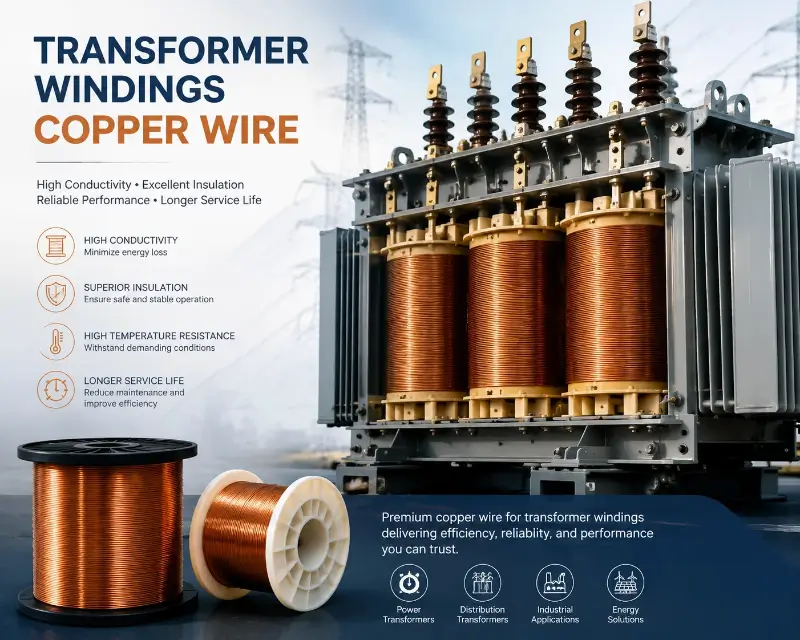
We have been making enameled copper wire for thirty years, mainly for export. We supply direct from the factory on a 60-acre production base, hold ISO 9001 / ISO 14001 / ISO 45001 certification audited by SGS, and our products carry UL / REACH / RoHS approval, with shipments going to more than 50 countries.
On specification, our round enameled copper wire covers a nominal diameter of 0.016–7.0 mm, and flat wire a thickness of 0.8–10 mm with a width of 2–25 mm. Film systems include UEW(QA), PEW(QZ), EIW(QZXY), and EI/AIW(QZY), with thermal classes of 155, 180, 200, 220, and 240.
Wrapping Up
Enameled copper wire is not complicated. The hard part is writing the requirement down properly. Thermal class, insulation system, coating grade, size, standards, and test items — once those six are aligned, what remains is price negotiation.
Final specifications should follow the latest edition of the applicable standard and the technical agreement signed by both parties.