

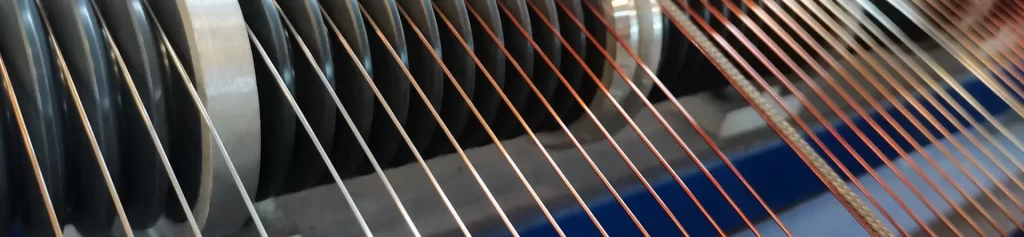
In the insulation design of transformer windings, traction motors, high-frequency inductors, and aerospace electrical equipment, engineers often encounter two distinct insulation solutions: the long-established paper-covered wire (or paper-insulated magnet wire) and the Kapton polyimide film-insulated wire (or Kapton insulated wire) introduced by DuPont in the 1960s. These two solutions differ significantly in their chemical composition, manufacturing process, thermal class, dielectric strength, mechanical properties, and cost structure, making them the two most frequently compared solutions in magnet wire selection.
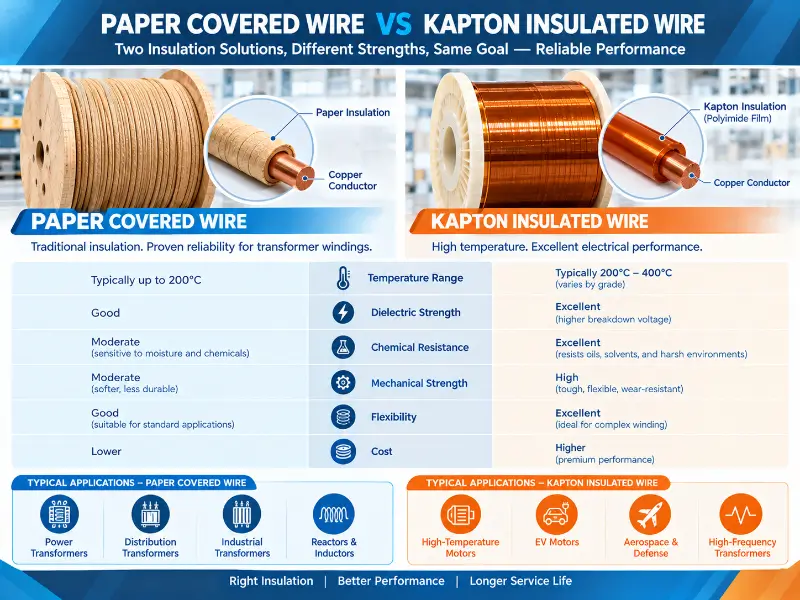
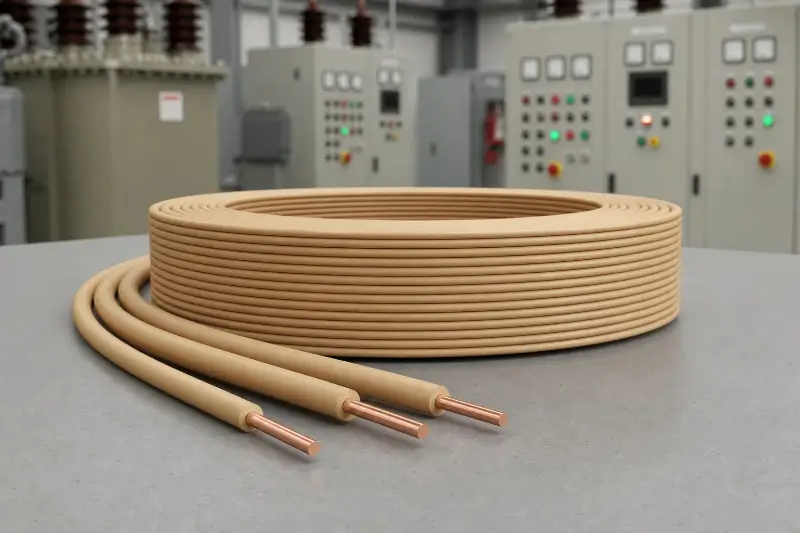
Paper-sheathed wires use cable paper, Kraft wood pulp paper, polyester fiber paper (Dacron/Mylar), or aromatic polyamide paper (Nomex/Aramid) as the outer covering material, spirally wound around the enameled copper/enameled aluminum conductor with an overlap rate of over 40%. Depending on the type of covering paper, the NEMA MW 1000-2018 standard classifies it into three thermal classes: 105°C ordinary cable paper (MW 31-C/MW 33-C), 155°C wood pulp paper and polyester fiber paper (MW 60-A high-temperature paper-sheathed aluminum is 220°C, but traditional Kraft paper-sheathed is 155°C), and 220°C aromatic polyamide paper (Nomex, MW 60-A/MW 61-C). The advantages of paper-insulated wire are high breakdown voltage, good oil compatibility, and low material cost, making it particularly suitable for oil-immersed transformers, mining transformers, and medium to large low-voltage motors.
Kapton insulated wire represents another technological approach. It uses polyimide film (PI) as the primary insulation layer and was introduced by DuPont in the 1960s under the trade name Kapton. This film is typically 0.025 mm to 0.10 mm thick, wound in a single or double layer (50% overlap), and can be directly wrapped around bare copper, bare aluminum, or conductors already coated with enamel. NEMA MW 1000-2018 classifies it as MW 64-A (aluminum conductor) and MW 65-C (copper conductor), with a thermal class of 240°C, making it one of the highest temperature-resistant options in the magnetic wire field. The advantages of Kapton insulated wire include extreme high temperature resistance, radiation resistance, chemical resistance, solvent resistance, and the ability to operate in vacuum and oil. However, the material cost is significantly higher than paper-insulated wire, and the termination process is more complex.
Understanding the differences between these two insulation schemes is a prerequisite for winding engineers to make correct selections in various application scenarios such as transformers, traction motors, aerospace electrical systems, induction heating, and high-frequency inductors. This article systematically compares the two from six dimensions: material structure, performance parameters, standard system, application scenarios, cost structure, and selection process, and provides engineering selection decision-making suggestions.
Comparison of material structure and insulation system
The difference in material structure between paper-insulated wire and Kapton insulated wire is essentially a difference in two insulation philosophies: natural organic fibers (paper) and synthetic polymer films (polyimide). Understanding this difference is fundamental to all subsequent comparisons of engineering parameters.
Insulation material composition of paper-insulated wire
Paper-insulated wire typically consists of two layers from the inside out: the inner layer is the enamel coating, which provides basic inter-turn insulation; the outer layer is the paper covering, which provides additional dielectric strength and mechanical protection.
The inner layer of paper-insulated yarn typically uses an enamel coating at 130°C (Grade B), 155°C (Grade F), or 180°C (Grade H). Common enamel coating systems include polyester (PEW), polyester imide (PEI), polyamide-imide (PAI/AIW), and polyurethane (UEW, solderable). For oil-immersed transformer applications, polyester imide enamel coating (155°C) or polyamide-imide enamel coating (200°C) are most commonly used because these two enamel coatings have good chemical compatibility with transformer oils.
The outer covering paper is the most crucial difference between paper-insulated wire and enameled wire. According to thermal class, NEMA MW 1000-2018 specifies three main paper types: 105°C cable paper (kraft paper/wood pulp paper, MW 31-C/MW 33-C), 155°C polyester fiber paper/polyester film paper composite (Dacron/Mylar paper, MW 60-C system), and 220°C aromatic polyamide paper (Nomex/Aramid paper, MW 60-A/MW 61-C). Each type of paper differs significantly in thickness, density, breakdown strength, and moisture absorption. Nomex paper with a thickness of 0.05 mm has a breakdown voltage of approximately 600-800 V, while Kraft paper of the same thickness has approximately 300-400 V.
The overlay process for paper-insulated wires requires the paper tape to be spirally wound onto the enameled conductor with at least 40% overlap, typically requiring two or more layers. NEMA MW 60-A specifies that the overlay layer for aromatic polyamide paper-insulated aluminum wires must contain at least two layers of paper tape with a 40% overlap, and be heat-set immediately after winding. Winding tension, paper tape width, winding angle, and heat-setting temperature all affect the final overlay integrity and breakdown voltage.
Material composition of Kapton insulated wire
At the heart of Kapton insulated wire is DuPont Kapton polyimide film, a polymer material formed by the condensation polymerization of pyromellitic dianhydride (PMDA) and diaminodiphenyl ether (ODA).
Kapton films are typically available in four thicknesses: 0.025 mm (1 mil), 0.050 mm (2 mil), 0.075 mm (3 mil), and 0.10 mm (4 mil). Chemically, PMDA-ODA type polyimides possess a rigid aromatic ring backbone, which endows them with an extremely high glass transition temperature (>360°C) and excellent thermal stability. Commercial Kapton films maintain their flexibility and dielectric properties over a temperature range of -269°C to +400°C.
Kapton film insulated wires have three typical structures: the first is a bare conductor with Kapton film directly wound (suitable for fine wires with a diameter of less than 0.5 mm); the second is an enameled conductor with an outer Kapton film coating (the most common, where the enamel coating provides inter-turn insulation and Kapton provides inter-layer and high-temperature resistance protection); and the third is double-layer Kapton winding (50% overlap, equivalent to twice the film thickness, used for extremely high dielectric requirements). NEMA MW 64-A / MW 65-C typically uses the second structure: an inner layer of polyester imide or polyamide-imide enamel coating + an outer layer of Kapton film.
The end treatment of Kapton film is completely different from that of enameled wire. Enameled wire can have its enamel coating removed by thermal stripping, laser stripping, mechanical scraping, or chemical dissolution; Kapton film can only be removed by mechanical scraping, laser ablation, or plasma etching, and cannot be thermally stripped. This introduces additional processing costs to the winding termination of Kapton insulated wire.
Conductor compatibility
Both paper-insulated wire and Kapton insulated wire are suitable for both copper and aluminum conductors. NEMA MW 33-C (paper-insulated copper rectangular wire), MW 31-C (paper-insulated copper round wire), MW 60-A (aromatic polyamide paper-insulated aluminum rectangular wire), MW 64-A (polyimide film-insulated aluminum rectangular wire), and MW 65-C (polyimide film-insulated copper rectangular wire) cover complete conductor-insulation combinations. It is important to note that the interfacial reaction between aluminum conductors and Kapton film at high temperatures is more complex than that with copper conductors. Long-term operation at temperatures above 200°C may lead to chemical aging of the aluminum-polyimide interface, which is one of the main reasons limiting the application of Kapton insulated wire with aluminum conductors.
Performance parameter comparison
Performance parameters are the core basis for selection decisions. Below, we provide a quantitative comparison of paper-insulated wire and Kapton insulated wire from five dimensions: thermal class, dielectric strength, mechanical properties, moisture absorption rate, and chemical compatibility.
thermal class and thermal aging
The most obvious difference between the two options is the thermal class. NEMA MW 1000-2018 specifies a maximum thermal class of 220°C for paper-insulated wire (MW 60-A / MW 61-C, aromatic polyamide paper), while Kapton insulated wire is rated at 240°C (MW 64-A / MW 65-C). However, these are just material temperature ratings. The actual temperature resistance of the winding wire in the insulation system depends on the UL 1446 system rating. Paper-insulated wire is typically used in Class A (105°C) to Class H (180°C) systems, while Kapton can be used in Class C (220°C) and even 240°C systems.
Kapton polyimide has an instantaneous temperature resistance of up to 400°C (DuPont Kapton HN datasheet), far exceeding the 250°C instantaneous temperature resistance of paper-insulated wire. This means that Kapton insulated wire can provide a greater safety margin under transient conditions such as short circuits and overloads.
According to the IEC 60216 Arrhenius extrapolation method, Kapton’s design life at 240°C is approximately 20,000 hours (this is a predicted value when the thermal life end is determined by the breakdown voltage dropping to 50% of the initial value); aromatic polyamide paper-wrapped wire has a design life of approximately 10,000-15,000 hours at 220°C. The difference mainly stems from the fact that polyimide has much higher chemical stability than cellulose-based paper.
Dielectric strength
Dielectric strength is one of the most important parameters of winding wire, directly determining the voltage rating and inter-turn insulation margin of the transformer.
The breakdown voltage of paper-insulated wire (multiple paper tape covers, 2 layers × 0.10 mm) is typically between 2000-5000 V. NEMA MW 60-A specifies that the dielectric breakdown voltage of aromatic polyamide paper-insulated aluminum wire should not be less than 300 V/mil (approximately 11800 V/mm, calculated based on the minimum thickness of a single-sided cover layer). The breakdown voltage of Kapton insulated wire (single layer 0.05 mm film + enamel coating) is approximately 5000-10000 V, and the bulk breakdown voltage of DuPont Kapton HN 0.025 mm film is 7000 V/0.025 mm.
The dielectric constant (Dk) of Kapton film is approximately 3.5 at 1 kHz, and its loss tangent (Df) is approximately 0.003. The dielectric constant of paper-insulated wire depends on the type of paper and the impregnation medium; dry paper has a dielectric constant of approximately 2.5-3.5, while oil-impregnated paper has a dielectric constant of approximately 3.5-4.5, with a slightly higher loss tangent than Kapton. In high-frequency applications, Kapton’s low-loss advantage is more pronounced.
Mechanical properties
Paper-insulated wires have a thicker overlay (typically 0.10-0.30 mm overlay increment), making them prone to wrinkling, breakage, or delamination at bends, especially with Kraft paper-based solutions. Aromatic polyamide paper (Nomex) offers better flexibility than regular Kraft paper due to its high fiber strength, but still falls short of Kapton. Kapton film offers excellent flexibility, withstanding a bending radius of one wire diameter (DuPont datasheet), making it a preferred choice for high-frequency coils (litz wire/close winding).
Kapton film exhibits significantly better abrasion resistance than paper. Under conditions of vibration, impact, or end friction, Kapton maintains a longer mechanical life. Paper-wrapped yarn is brittle in a dry state and its strength decreases when exposed to moisture.
Moisture absorption and moisture resistance
Moisture absorption is the biggest drawback of paper-wrapped yarn. Kraft paper has a moisture absorption rate of 8-12% (at 95% relative humidity), while Nomex aromatic polyamide paper has a rate of approximately 3-5%. This means that in humid environments, the insulation performance of the paper-wrapped yarn will significantly decrease, requiring oil impregnation or vacuum pressure impregnation (VPI) to compensate. Kapton polyimide film has a moisture absorption rate of <1%, almost unaffected by humid environments, making it the preferred choice for aviation, marine, and high-humidity environments.
Chemical compatibility
Paper-insulated wire exhibits excellent compatibility with transformer oil, which is the fundamental reason for its dominance in oil-immersed transformer insulation. Paper fibers absorb oil molecules, forming an oil-paper composite insulation system that enhances dielectric strength and heat dissipation. Kapton polyimide also shows good compatibility with transformer oil, but the breakdown characteristics at the oil-film interface differ from those at the oil-paper interface, requiring re-evaluation.
Kapton paper exhibits excellent resistance to most acids, alkalis, and organic solvents (except strong alkalis). Nomex paper also demonstrates good chemical stability. Kraft paper degrades under strong acids and alkalis and is unsuitable for chemical environments.
Comparison of Standard Systems
Paper-insulated wire and Kapton insulated wire have clear specifications under the three major standard systems: NEMA MW 1000, IEC 60317, and UL 1446.
NEMA MW 1000-2018 Standard
NEMA MW 1000 is the most authoritative collection of standards for magnetic wire in North America, with specific regulations for both paper-insulated wire and polyimide film-insulated wire.
MW 31-C (round copper wire, paper-wrapped, 105°C, fiber-covered), MW 33-C (rectangular/square copper wire, paper-wrapped, 105°C), MW 60-A (rectangular/square aluminum wire, aromatic polyamide paper-wrapped, 220°C), MW 61-C (rectangular/square copper wire, aromatic polyamide paper-wrapped, 220°C), MW 55-C (200°C glass fiber wrapped rectangular/square copper wire, as a temperature resistance comparison for paper-wrapped wire).
MW 20-C (polyimide film insulated rectangular/square copper wire, Class 240), MW 64-A (aromatic polyimide film tape-covered rectangular/square aluminum wire), and MW 65-C (aromatic polyimide film tape-covered rectangular/square copper wire, Class 240). Note that MW 20-C is a simple polyimide film insulated rectangular copper wire, while the MW 64/65 series has an aromatic polyimide tape-covered structure. Both belong to the same polyimide family but have slightly different structures.
NEMA MW 60-A specifies that the dielectric breakdown of the aromatic polyamide paper-wrapped aluminum wire cover layer must be no less than 300 V/mil (approximately 11800 V/mm, calculated based on the minimum cover thickness on one side). The cover layer must consist of at least two paper tapes with a 40% overlap. Adhesion testing requires that the cover layer not crack or expose copper after bending. MW 64-A / MW 65-C have similar specifications for the cover layer thickness, overlap ratio, and breakdown voltage of polyimide film tapes.
IEC 60317 International Standard
IEC 60317 is a series of standards from the International Electrotechnical Commission for winding wires, which roughly corresponds to but are not entirely equivalent to NEMA MW 1000.
IEC 60317-15 (Nomex paper-insulated rectangular and square copper wire, 220°C), IEC 60317-26 (polyamide fiber paper-insulated copper wire, 220°C), IEC 60317-27 (polyester fiber paper-insulated copper wire, 155°C), IEC 60317-36 (polyester fiber paper-insulated rectangular aluminum wire, 155°C).
IEC 60317-46 (Aromatic polyamide paper-wrapped rectangular copper wire, 220°C, close to NEMA MW 60-C), IEC 60317-47 (Aromatic polyamide paper-wrapped rectangular aluminum wire, 220°C, close to NEMA MW 60-A), IEC 60317-48 (Polyimide film-wrapped round copper wire, 240°C), IEC 60317-49 (Polyimide film-wrapped rectangular/square copper wire, 240°C).
Standard Code Comparison
| NEMA MW | IEC 60317 | Insulation Type | thermal class | Conductor |
|---|---|---|---|---|
| MW 31-C | 60317-15 Partial | Kraft Paper-Wrapped Round Copper | 105°C | Round Copper |
| MW 33-C | 60317-15 Partial | Kraft Paper-Wrapped Rectangular Coated Steel | 105°C | Rectangular Coated Steel |
| MW 60-A | 60317-47 | Aromatic polyamide paper-wrapped rectangular aluminum | 220°C | Rectangular aluminum |
| MW 61-C | 60317-46 | Aromatic polyamide paper-wrapped rectangular copper plate | 220°C | Rectangular copper plate |
| MW 64-A | 60317-49 Partial | Polyimide-encased rectangular aluminum | 240°C | Rectangular aluminum |
| MW 65-C | 60317-49 Partial | Polyimide-encased rectangular copper | 240°C | Rectangular copper |
Regional standard differences
The North American market primarily uses NEMA MW 1000, while the European and Asian markets tend to favor IEC 60317. Chinese national standards GB/T 7673 series, JIS C3202 (Japan), and IS 13730 (India) also largely correspond to IEC 60317. When conducting cross-border procurement and compliance certification, special attention should be paid to the slight differences in the definition of thermal class between NEMA and IEC: NEMA provides the thermal rating of a single magnetic wire, while IEC provides the design temperature of the winding wire. Both must be evaluated together with UL 1446 / IEC 60085 in different application systems.
Application scenario comparison
Paper-insulated wire and Kapton insulated wire have highly complementary applications, and understanding this is key to engineering selection.
Oil-immersed power transformer
Oil-immersed transformers are the most traditional and advantageous application area for paper-insulated wires. Oil-paper composite insulation systems utilize transformers impregnated with oil to create multiple layers of paper insulation, resulting in an insulation structure with high dielectric strength, high heat dissipation, and high reliability.
Oil-immersed power transformers typically use Kraft paper-insulated copper rectangular wire (MW 33-C) or aromatic polyamide paper-insulated copper rectangular wire (MW 61-C). The former is used for voltage levels of 110 kV and below, while the latter is used for high-voltage transformers of 220 kV and above. In ultra-high-voltage transformers of 500 kV and above, a combination of multi-layer cable paper and insulating paperboard is also used for insulation, but this falls under the category of inter-turn/inter-layer insulation and is not considered magnetic wire insulation.
Kapton insulated wire is rarely used in oil-immersed transformers, mainly because the dielectric properties of the oil-film interface differ from those of the oil-paper interface, requiring recalculation of the electric field distribution during winding design. However, Kapton insulated wire is used in some special applications (such as dry-type transformers, high-frequency power transformers, and high-temperature areas of oil-immersed reactors).
Dry-type transformers and dry-type reactors
Dry-type transformers and dry-type reactors do not have transformer oil protection, so the insulation material itself must have excellent temperature resistance, moisture resistance, and corona resistance.
Paper-insulated wires (especially Nomex paper-insulated wires MW 60-A / MW 61-C) can be used in Class H (180°C) and Class C (220°C) dry-type transformers. The low moisture absorption (3-5%) and excellent thermal stability of Nomex paper make it suitable for dry-type insulation systems.
For dry-type transformers operating at higher temperatures (above 240°C) or in more demanding environments (aerospace, marine, chemical), Kapton insulated wires (MW 64-A / MW 65-C) are the preferred choice. Kapton’s near-zero moisture absorption, extremely low dielectric loss, and extreme temperature range of -269°C to +400°C make it the ideal choice for high-end dry-type transformer applications.
traction motor and transformer
Railway traction motors, high-speed train traction systems, and subway traction systems have stringent requirements for the temperature resistance, vibration resistance, and oil resistance of insulation materials.
Traditional electric locomotive traction transformers extensively use Kraft paper-insulated copper rectangular wire (MW 33-C). Paper-oil composite insulation exhibits stable performance at a 25 kV contact network voltage level and is a mature solution that has been in use for over a century.
In the extreme high-temperature zones of high-speed trains (such as the CRH380 and Fuxing bullet trains) including the traction transformer, auxiliary transformer, and traction motor, Kapton film-insulated wire (MW 65-C) or polyimide-glass fiber composite insulation (MW 43-C) is being used to meet the design goals of miniaturization, lightweighting, and high power density. The long-term stability of Kapton insulation at 240°C is crucial for the high power density operation of the traction system.
Aerospace Electrical
Aircraft generators, aircraft transformers, spacecraft power systems, and satellite solar panel interconnects are Kapton insulated wires’ most advantageous applications.
Aerospace electrical equipment faces extreme conditions such as temperature cycling from -55°C to +200°C, ultraviolet radiation, vacuum environments, atomic oxygen corrosion, and strong vibrations. Paper-insulated wires release moisture in a vacuum, contaminating optical components; they also degrade rapidly in atomic oxygen environments. Kapton polyimide’s vacuum stability, radiation resistance, and ability to resist atomic oxygen make it the de facto standard for aerospace insulation wires.
Commercial aircraft (such as the Boeing 787 and Airbus A350) extensively use Kapton polyimide enameled wire (AIW, 240°C) or Kapton film-insulated rectangular wire (MW 65-C) in their generator windings, APU starter generators, and IDG integrated drive generators. High-frequency transformers, magnetic storage devices, and magnetic components in spacecraft power systems almost exclusively use Kapton insulated wire.
High-frequency coils and inductors
High-frequency inductors, induction heating coils, and wireless charging coils (especially for high-frequency applications >1 MHz) have strict requirements on the dielectric constant and loss tangent of the insulating materials.
Kapton films exhibit Dk ≈ 3.4 and Df ≈ 0.005 at 1 MHz, and Dk ≈ 3.0 and Df ≈ 0.008 at 1 GHz. These are exceptional high-frequency dielectric properties, making Kapton insulated wires the preferred choice for high-frequency transformers.
Due to the polar hygroscopic properties of paper fibers, the dielectric constant (Df) of paper-insulated wire increases significantly at high frequencies, typically making it suitable only for 50 Hz/60 Hz power frequency and low-to-mid frequency (< 20 kHz) applications. Nomex paper-insulated wire can be used in some induction heating applications (10 kHz-100 kHz), but Kapton insulated wire or polyimide enameled wire (AIW) is generally preferred for high-frequency applications > 100 kHz.
Medium and large low voltage motors
Medium and large low-voltage motors (< 1000 V) typically use enameled round copper wire or enameled rectangular copper wire, and do not use paper-insulated wire or Kapton insulated wire. However, for special applications (such as submersible motors, mining motors, and high-voltage motors), paper-insulated wire remains an important option.
Submersible motors require watertight insulation, and the classic solution is paper-insulated wire with vacuum pressure impregnation (VPI). Kapton insulated wire is also used in submersible motors, but its cost is much higher than that of paper-insulated wire.
Stator windings of 3 kV, 6 kV, and 10 kV high-voltage motors require high dielectric strength inter-turn insulation. Nomex paper-clad copper rectangular wire (MW 61-C) or Kapton film-clad copper rectangular wire (MW 65-C) can be used for this purpose, with Kapton being more common in motors above 10 kV.
Cost and Procurement Comparison
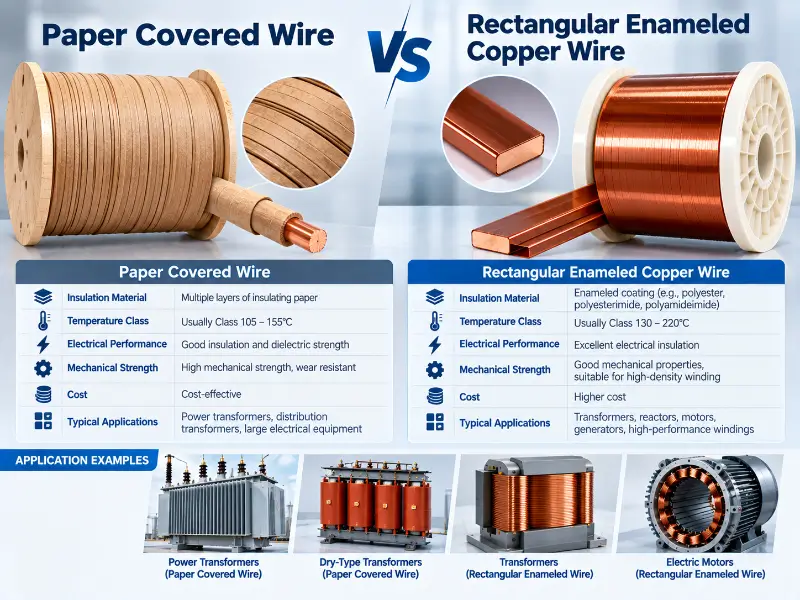
Cost is an unavoidable factor in project selection. Paper-insulated wire and Kapton insulated wire differ significantly in material cost, processing cost, procurement cycle, and supply chain.
Material costs
Kapton polyimide film is a patented product of DuPont, and only a few manufacturers worldwide, such as DuPont, Kaneka Chemicals of Japan, and SKC of South Korea, can produce high-purity polyimide film. The price of 1 kg of Kapton film is approximately $200-$400, which is 50-100 times the price of Kraft paper and 5-10 times the price of Nomex paper.
The manufacturing cost of paper-insulated wire mainly includes the cost of the enameled conductor (approximately 50%), the cost of the paper tape covering process (approximately 30%), and labor and energy (approximately 20%). In the manufacturing cost of Kapton insulated wire, the Kapton film itself accounts for 60-70%, the enameled conductor for 15-20%, and the film winding process for 15-20%. Overall, under the same specifications, the cost of Kapton insulated wire is 3-5 times that of Nomex paper-insulated wire and 5-8 times that of Kraft paper-insulated wire.
Processing costs
Termination of paper-insulated wire is relatively simple: it can be soldered after removing the enamel coating (thermal stripping or mechanical scraping). Termination of Kapton insulated wire requires mechanical scraping or laser ablation, which is more difficult, requires more equipment investment, and is more time-consuming.
Paper-insulated wires are well-suited for impregnation processes (VPI/immersion), and the dielectric strength is significantly improved after the paper fibers absorb the impregnation varnish. Kapton insulated wires have poor impregnation performance, as the impregnation varnish has difficulty penetrating the dense structure of the polyimide film. Therefore, Kapton insulated wires are more often used in dry or oil-immersion systems.
Procurement cycle and supply ecosystem
There are numerous paper-wrapping thread suppliers, with hundreds of manufacturers worldwide producing them. These range from international brands like Liyuan, Luvata, and Elektrisola to domestic Chinese manufacturers such as Jinbei, Great Wall, Guancheng, and Luxiao, all offering mature products. Delivery time is typically 2-4 weeks, and standard specifications are available in stock.
Kapton insulation wire suppliers are relatively concentrated, mainly in the United States, Japan, and Germany. DuPont is a core supplier of Kapton film, while winding wire manufacturers (such as MWS Wire, Rubadue Wire, and Elektrisola) are responsible for the final insulation wire production. Delivery time is typically 6-12 weeks, with some special specifications requiring customization. Purchasers also need to establish direct relationships with DuPont or its agents to ensure Kapton film supply.
Long-term maintenance and life cycle costs
Although the initial investment for Kapton insulated wire is 3-8 times that of paper-insulated wire, in applications requiring long-term operation at 240°C, harsh environments, and where reliability is paramount, the life cycle cost of Kapton insulated wire may actually be lower.
Based on IEC 60216 Arrhenius extrapolation, Kapton’s design life is approximately 20,000 hours at 240°C, while Nomex paper-insulated wire has a design life of approximately 10,000-15,000 hours at 220°C. At 180°C, Kapton’s design life can reach over 100,000 hours, while Nomex’s is approximately 50,000 hours. This means that, within the same thermal class, Kapton equipment may have lower maintenance cycles and replacement frequencies.
In critical applications such as aviation, aerospace, medical, and nuclear power, insulation failure can lead to catastrophic consequences, making differences in initial investment secondary to life safety and environmental risks. Kapton insulated wire is a necessary, not optional, solution in these scenarios.
Selection Decision Process
The selection of paper-insulated wire and Kapton insulated wire requires systematic thinking. The following is a six-step selection process.
Step 1: Define the application scenario and thermal class
Confirm the insulation system class according to UL 1446 or IEC 60085. For Class A (below 105°C), only Kraft paper-insulated wire is available; for Class B (130°C), paper-insulated wire or polyester/enameled wire is available; for Class F (155°C), paper-insulated wire or aromatic polyamide paper-insulated wire is available; for Class H (180°C), Nomex paper-insulated wire is preferred; for Class C (220°C), Nomex paper-insulated wire or Kapton insulated wire is available; for Class 240 / C+, Kapton insulated wire is required.
Different optimal solutions are needed for dry environments, oil-impregnated environments, humid environments, vacuum environments, radiation environments, and strong vibration environments. For oil immersion, choose paper-insulated wire; for vacuum or radiation environments, choose Kapton; for strong vibration environments, choose Kapton + glass fiber composite; for humid environments, choose Kapton or Nomex.
Step 2: Determine the conductor material and cross-sectional area
Copper conductors are perfectly compatible with both options; however, with aluminum conductors in Kapton insulated wires, attention should be paid to interface aging issues, and paper-insulated wire options (especially MW 60-A) should be preferred.
For small cross-sectional areas (< 5 mm²), round wire is preferred, while enameled wire is preferred. For larger cross-sectional areas (> 10 mm²), rectangular wire can be considered with paper wrapping or Kapton insulation to improve slot fill factor and dielectric strength.
Step 3: Assess dielectric strength requirements
For low-voltage applications of < 1 kV, both solutions can be met; for medium-voltage applications of 1-10 kV, paper-insulated wire + multi-layer impregnation or Kapton insulated wire is required; for high-voltage applications of > 10 kV, the electric field distribution must be evaluated, and Kapton film insulation + oil impregnation or SF6 gas insulation is preferred.
High-frequency PWM drivers and IGBT modules can withstand dv/dt of 10-20 kV/μs, resulting in extremely high inter-turn transient voltage stress. Both Nomex paper-insulated wire and Kapton insulated wire can meet these requirements, but Kapton is superior in terms of dv/dt tolerance.
Step 4: Consider the mechanical and chemical environment
For compact windings with small bending radii (e.g., < 5 times the wire diameter), Kapton insulated wire or enameled wire is preferred to avoid cracking of the sheath at bends.
Applications involving media such as transformer oil, silicone oil, ester oil, and fluorinated liquids require evaluation of the material’s chemical compatibility. Paper-insulated yarn has excellent oil compatibility; Kapton is compatible with most oils and solvents, but caution should be exercised as some fluorinated liquids may cause polyimide swelling.
Step 5: Verify Standards Compliance and Certification
The project must adhere to the following standards: NEMA MW 1000 (North America), IEC 60317 (International), GB/T 7673 (China), and JIS C3202 (Japan). Incompatibility with these standards may result in certification failure.
Third-party certification
Third-party certifications such as UL, CE, CSA, and CCC have strict requirements for material systems. Kapton insulated wires typically correspond to Class C (220°C) or higher in the UL 1446 system rating, while paper-insulated wires correspond to Class A to Class H.
Step 6: Cost and Availability Assessment
For short-term projects (< 5 years), paper-insulated wire can be preferred to reduce initial investment; for long-term projects (> 10 years) or critical equipment, Kapton insulated wire can be preferred to reduce total life-cycle costs.
Assess the number of suppliers, delivery time, and technical support capabilities. Having only one supplier or a long delivery time increases project risk. For critical projects, it is recommended to select 2-3 qualified suppliers each for paper-insulated wire and Kapton insulated wire as backup options.
Summarize
Paper-insulated wire and Kapton insulated wire are two classic solutions in the winding wire field, each with its own advantages and applicable scenarios. Paper-insulated wire is the most cost-effective solution in oil-immersed transformers, dry transformers (Class A to Class H), traditional traction systems, and low-voltage motors, with low material costs, mature technology, a complete standard system, and an abundant supply chain. Kapton insulated wire is an essential solution in aerospace, high-frequency power electronics, dry systems above Class C (220°C), harsh chemical environments, and high-reliability critical equipment. Although the material cost is higher, its advantages in total life-cycle cost and reliability are significant.
When making selection decisions, engineers should comprehensively evaluate six dimensions: thermal class, dielectric strength, mechanical characteristics, environmental compatibility, cost structure, and supply ecosystem. They should follow the six-step selection process outlined in this article, avoiding decisions based solely on price or a single indicator. The two options are not mutually exclusive but complementary: the high-voltage winding of the same large transformer may simultaneously use paper-insulated wire (main insulation) and Kapton-insulated wire (for special high-temperature areas). A reasonable combination of the two options can achieve the optimal balance between cost and performance.