

Engineers working with motors inevitably face the same question: how do you get a wire that survives long-term high-temperature operation while still accepting direct tinning at the terminals? It sounds simple, but it is actually a contradiction.
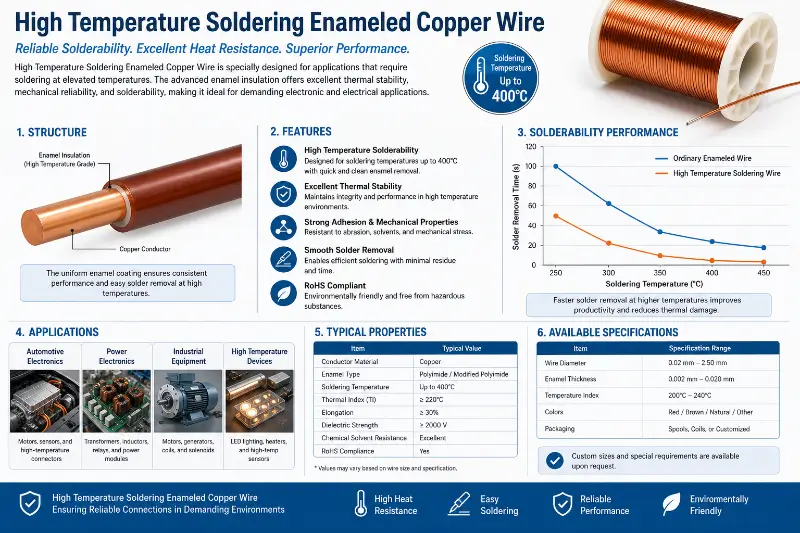
Let me start with the definition. High temperature soldering enameled copper wire — that is, high temperature solderable enameled copper wire — refers to round copper wire that uses a direct-soldering enamel system, retains the enameled-wire insulation structure, and allows the enamel to thermally decompose at soldering temperatures of 375–420°C so that molten tin wets the copper conductor directly, with no mechanical or chemical stripping. Its thermal class tops out at 180 (thermal shock ≥200°C).
That definition carries two layers that have to be kept apart — the “decomposability” of the enamel during the soldering moment, and the “thermal stability” of the enamel during long-term energized service, are two entirely different things. That is the core of this article: heat resistance and solderability in enameled wire are inherently mutually exclusive, and Class 180 is the industry ceiling.
The Physical Mechanism of Solderability: Why the Enamel Has to Sacrifice Itself
The direct-soldering characteristic of solderable polyurethane (UEW) is essentially a controlled thermal decomposition, and it is the defining mechanism behind every high temperature soldering enameled copper wire product.
Polyurethane resin begins to break down near 380°C, releasing gases composed primarily of carbon monoxide and amines. This is what makes high temperature soldering enameled copper wire work without any stripping step. These gases blow the enamel residue off the copper surface and expose fresh metal, which molten solder then wets. That is why pure polyurethane wires such as 1UEW/130 and 1UEW/155 can be tinned straight with a soldering iron — no wire stripper, no chemical stripping, and the conductor survives even if the operator’s hand slips.
Here is the interesting part: this “advantage” is also its “disadvantage.” Because the resin starts decomposing at 375–420°C, it cannot hold up under prolonged high-temperature service. The long-term thermal class of pure polyurethane enameled wire is therefore effectively capped at 155.
To go higher, you need a different resin system — and changing the system usually means the wire stops being solderable. Put the other way around, the reason enamels above Class 200 (polyester-imide EIW, polyamide-imide AIW, polyimide PAI) cannot be soldered is precisely that their molecular structure does not decompose at soldering temperature. If the enamel does not decompose, tin cannot wet the copper.
So: you cannot ask an enamel to decompose at 400°C and simultaneously ask it to serve undamaged at 180°C for the long haul. Materials science draws a hard line right here, and that line is exactly what high temperature soldering enameled copper wire is designed around.
Standard Systems: Which Coating Maps to Which Specification
The correspondence between solderable enamels and the major standard systems has to be nailed down before you select any high temperature soldering enameled copper wire.
| Thermal Class | Enamel Coating System | NEMA MW 1000 | IEC 60317 | JIS | Solderable |
|---|---|---|---|---|---|
| 130 | Solderable polyurethane | MW 75-C | — | 1UEW/130 | Yes |
| 155 | Solderable polyurethane | MW 79-C | 60317-20 | 1UEW/155 | Yes |
| 155 | Solderable polyurethane overcoated with polyamide | MW 80-A / MW 80-C | 60317-21 | — | Yes |
| 180 | Solderable polyurethane | MW 82-C | 60317-51 | 2UEW/180 | Yes |
| 180 | Solderable polyurethane overcoated with polyamide | MW 83-C | 60317-55 | — | Yes |
| 180 | Solderable polyester-imide | MW 77-C | 60317-23 | — | Yes |
| 180 | Solderable polyester-imide overcoated with polyamide | MW 78-C | 60317-55 | — | Yes |
| 180 | Fully insulated solderable polyurethane (FIW) | MW 85-C | — | — | Yes |
| 200 | Polyester-imide | MW 74-A | 60317-42 | — | No |
| 220 | Polyester-imide overcoated with polyamide-imide | MW 73-A | — | — | No |
| 220 | Polyamide-imide | MW 81-C | — | — | No |
One thing jumps out of that table: the highest solderable system stops at Class 180. Every enamel above 200 is non-solderable. That is not manufacturers being conservative — it follows directly from the material mechanism, and it is the single most important constraint for anyone specifying high temperature soldering enameled copper wire.
Worth adding on the Chinese standards side: for Class 180 direct-weld polyurethane enameled copper round wire there is GB/T 6109.23-2008 (repealed on May 1, 2026, so always verify the current version when publishing new documentation) and T/SOECC 005-9-2022 (the copper-clad-aluminum counterpart); flat wire also has T/JXTX 0013-2025. Internationally, the most common designation is JIS C 3202 2UEW/180.
One point deserves special attention: the difference between IEC 60317-20 and IEC 60317-51 lies in thermal class, not in solderability — both 155 and 180 are solderable. Some people see “60317-51” and assume it denotes a higher-grade insulation system, when it actually corresponds to Class H at 180°C.
How Class 180 Solderable Wire Is Actually Built
This is the most worthwhile technical point in the whole article.
Class 180 solderable polyurethane (2UEW/180) wire, the mainstream high temperature soldering enameled copper wire on the market, does not use pure polyurethane. Pure PU cannot survive long-term service at 180°C. The real approach is a composite coating:
- Inner base coat: built around polyester or polyester-imide, with good thermal stability, carrying the 180°C temperature index (thermal class 180 corresponds to a minimum temperature index of 180, and a design life of 20,000 hours under IEC 60172) and providing the primary electrical insulation;
- Outer top coat: chemically modified polyurethane, which raises its own thermal stability while preserving decomposition-driven solderability at a defined soldering temperature.
In other words, the heat resistance comes from the inner layer and the solderability comes from the outer layer. This is a textbook compromise in materials engineering — a high-performance substrate carries the temperature, a functionalized top coat carries the weld.
Looking at published supplier specifications, typical parameters for Class 180 solderable wire are: soldering temperature 390°C (IEC 60317-51 system), thermal shock 200°C, and enamel grade 1 / grade 2. These are the numbers that define a high temperature soldering enameled copper wire order. Diameters run from very fine wire around 0.10 mm up to roughly 0.80 mm, with copper conductor purity commonly required at ≥99.99% electrolytic copper.
Self-bonding (adhesive) polyurethane is a separate line: MW 130-C / 131-C / 132-C / 135-C / 136-C cover 130, 155 and 180 and are likewise solderable. They add a self-adhesive layer into the enamel for applications that require the winding to be bonded in place.
Welding Process: Parameters Matter More Than Material
The same high temperature soldering enameled copper wire with different welding parameters can produce dramatically different results.
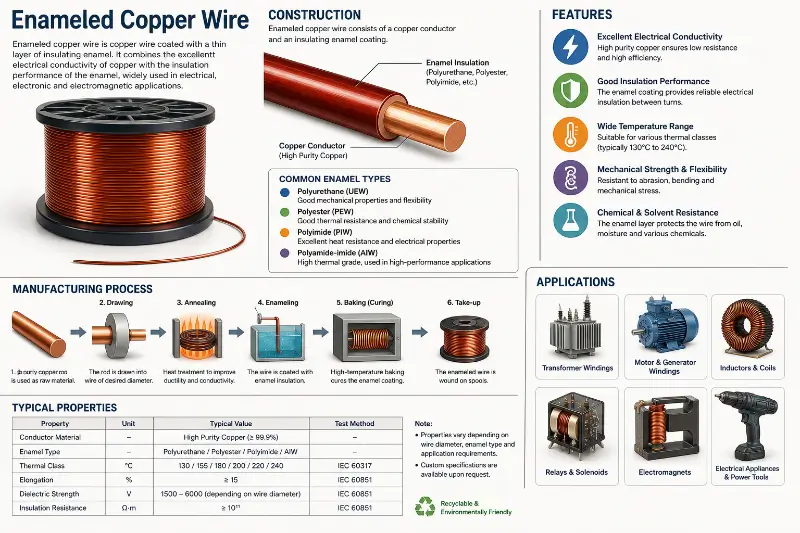
Temperature and time. Referencing the solderability test method in IEC 60851-6, typical soldering temperatures fall in the 375–420°C range with a dwell time of roughly 2–5 seconds. In industry, 180-class wire commonly runs a solder bath around 390°C.
Temperature too low → the enamel does not decompose completely and carbon residue stays on the copper → tin can only “spot” onto the residue, forming a cold joint with inflated contact resistance that opens up after vibration. Temperature too high or dwell too long → the copper surface overheats, grains coarsen, and the conductor turns brittle; in severe cases the joint breaks on a light tug and the enamel edge may be damaged.
Solder and flux. Silver-bearing solder has better oxidation resistance and is the better choice for hot conditions; lead-containing solder paste wets well but carries environmental restrictions. Choose a moderately active flux and clean the residue thoroughly — acidic residue sitting at 180°C will keep corroding the copper, which is another hidden failure source.
Solder joint mechanical strength. The strength of a solderable enameled wire joint comes from the tin-to-copper bond, not from an enamel-to-copper bond. At the same cross-section, the joint therefore usually pulls weaker than a conventional stripped-and-soldered termination, where copper is fused directly to copper.
If the coil end has to survive repeated mechanical pull, vibration or frequent mating cycles, do not treat a solderable wire joint as though it were an ordinary copper lug. Insulation restoration. The area where the enamel was destroyed during soldering must be re-insulated, and FIW (fully insulated enameled wire) exists for exactly this purpose — it is not “wire without enamel,” but wire carrying a heat-fusible or curable full-insulation layer so the assembly stays insulated after soldering. NEMA designates this as MW 85-C.
Common Failure Modes and Troubleshooting
When something goes wrong on the line with high temperature soldering enameled copper wire, work through these in order.
Symptom 1: the solder will not take; tin pulls back into a ball on contact. Almost always enamel residue. Check whether the soldering temperature actually reaches and holds near 390°C, whether the dwell time is too short, whether the iron tip has aged and is running cooler than its setpoint, and whether the conductor carries an oxide layer or adhesive residue. Scraping or mechanically stripping a sample before soldering usually separates “not hot enough” from “this enamel system will not decompose at this temperature” in seconds.
Symptom 2: it solders, but the joint comes out blackened with high contact resistance. Classic overheating or cold joint. Check whether the temperature ran too high or the time too long, whether the solder contains enough anti-oxidation content, and whether an overly corrosive flux was used.
Symptom 3: the joint looks fine, then the circuit opens after some time in service. Look hard at solder fatigue. A coil working through thermal cycling and vibration develops fatigue cracks at the tin-copper interface. This one cannot be fixed by changing solder; you have to attack the stress source — reduce end-winding load, improve the lead-out geometry, and where necessary move to cold-press terminals or a winding post for mechanical support.
Symptom 4: no soldering problem at all, but the motor’s insulation drops out under heat. That is a selection problem, not a process problem. Class 180 solderable wire at 180°C means continuous service capability in the temperature-index sense; it does not mean the winding can sit at 180°C at full load with no margin. Leave hot-spot margin in the machine design.
Symptom 5: pinholes in the enamel that lead to breakdown after varnish impregnation. Pinholes are directly tied to solderability — a pinhole means a discontinuous coating, so thermal decomposition produces uneven venting and uneven residue. Solderable wire generally holds much tighter pinhole control than ordinary enameled wire.
The standard practice is a pinhole test per IEC 60317-0-1, with the requirement of zero pinholes across the batch; double-layer or heavy-coated constructions also help lower the pinhole rate.
Application Scenarios: Where Direct Soldering Really Pays Off
High temperature soldering enameled copper wire is not a universal replacement, and its value shows up only in the right places.
Relays and solenoid valves. This is the textbook case. Many coil ends, a fast assembly cadence, plenty of solder points — the yield loss and labor hours burned on manual stripping will not fly, and direct soldering simply deletes a whole process step.
Micro motors and small transformers. Fine windings in a cramped end space, where stripping would nick the conductor.
Sensors and precision instruments. Current sensors, Hall effect sensors and encoders, where the coils are fine and consistency matters.
Voice coils. Voice coils need extremely fine diameters and fast, reliable termination, and 179-class solderable polyurethane is a common industry choice there.
Communications equipment and filters. Anywhere winding consistency and assembly efficiency come first.
Against that, solderable wire is not recommended for: continuous operating temperatures above 180°C (certain high-temperature motors, heating equipment windings), aggressive chemical environments, and any application with very demanding solder joint mechanical strength. In those cases move to 200/220/240-class polyester-imide or polyamide-imide systems and accept mechanical stripping or cold-press termination.
Custom Parameters and Supplier Evaluation
If your operating conditions fall outside standard product families and you need to negotiate a custom specification, these parameters belong in the technical agreement up front for any high temperature soldering enameled copper wire order.
Geometry and structure: round wire typically 0.19–4.0 mm, with finer or heavier gauges negotiable; flat wire from 0.8–10 mm thick and 2–25 mm wide; enamel build selectable by grade 1 / grade 2 / grade 3, or single, double and triple layer.
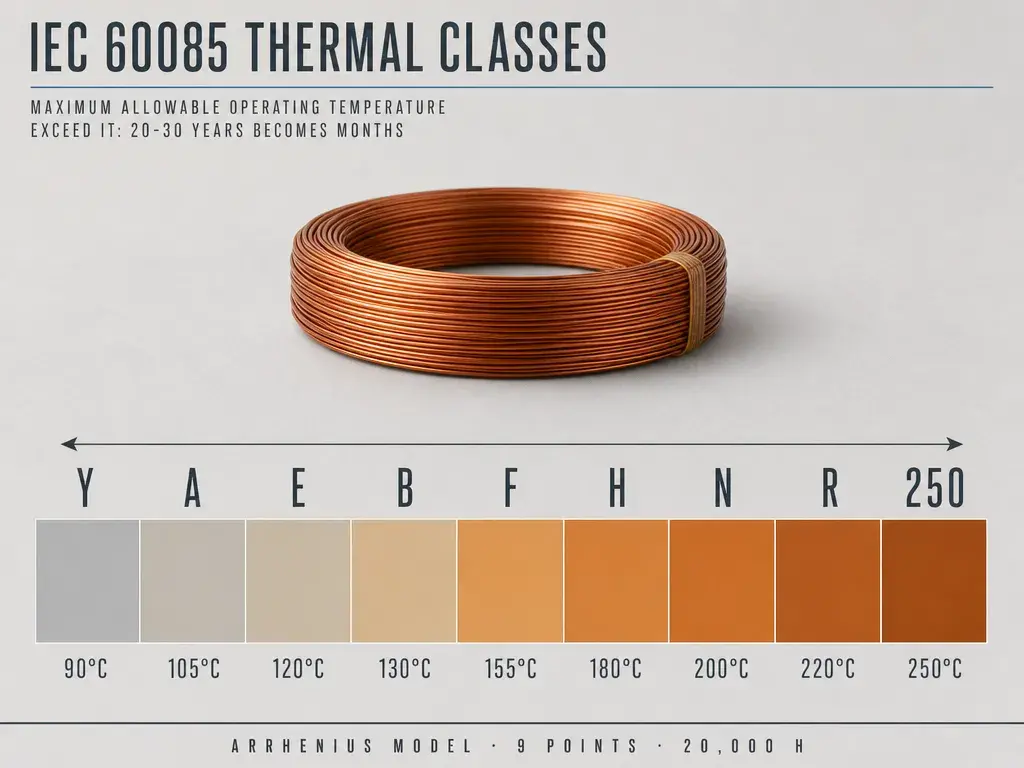
Thermal class: 130 / 155 / 180 / 200 / 220 / 240 available. Just keep one thing clear — if the wire is labeled solderable, the ceiling is Class 180.
Standards and certifications: IEC 60317-20 (155-class solderable polyurethane), IEC 60317-51 (180-class solderable polyurethane), NEMA MW 79-C / MW 82-C, JIS C 3202 and the GB/T 6109 series; for export programs also check UL, REACH and RoHS.
Packaging: single or double layer winding spools, 30–150 kg common, wood or wood-plastic composite spools (250×500 / 250×600 / 250×730 and similar), customizable to fit a customer’s line.
When evaluating suppliers, three questions buy you more than ten parameters: Is the solderability test run on every batch or only sampled? Can the report be traced by lot? Is there measured data behind the soldering temperature window?
The biggest hidden cost in solderable enameled wire is joint rework rate. A supplier who sells you the word “solderable” but hands over no pinhole data and no soldering verification records leaves the entire yield risk sitting on your shoulders.
A Practical Selection Path
Back to the original question: how do you choose between heat resistance and solderability for high temperature soldering enameled copper wire? Here is a clear path.
Step 1: establish the highest continuous working temperature. Look at the winding hot spot, not the ambient. Where continuous operation stays at or below 130°C and there is no real thermal demand, UEW/130 is enough — there is no reason to stack a heavier grade on top.
Step 2: confirm whether solderability is genuinely required. Where joint count is low and stripping or cold-press termination is acceptable, a 200/220-class enamel with mechanical stripping is often the more dependable combination — real thermal margin, and no fighting the material over solderability.
Step 3: if you need both, lock in Class 180. Specify a modified polyurethane composite wire (2UEW/180) to the IEC 60317-51 / MW 82-C system, and run the solder pot at 390°C.
Step 4: write the process parameters into the work instructions. Solder temperature, dwell time, solder grade, flux type and cleaning method — if those five are not spelled out, the same batch will produce very different joint quality on different lines.
Step 5: run the verification early. Pinhole tests and solder pull tests on first-article samples cost a fraction of tearing down a motor after mass production has started.
Put bluntly, high temperature soldering enameled copper wire is a “good enough and genuinely useful” choice, not the “best” one. What it buys you is the elimination of one stripping process; what it costs is capping your thermal class at 180. Keep that straight and the selection does not go wrong.