

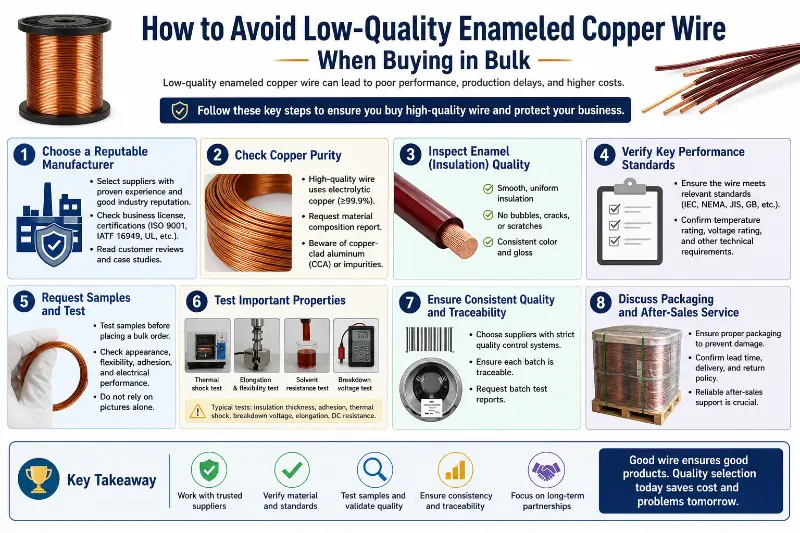
In industries such as motors, transformers, home appliances, and new energy drives, enameled copper wire is a core material for windings, and its quality directly determines the electrical performance, mechanical life, and safety level of the end product. However, in bulk procurement scenarios, the market has long been plagued by irregularities such as “non-standard wire,” “insufficient square wire,” “recycled copper,” and “aluminum-doped wire.”
Slight negligence can lead to batch rework, order defaults, claims from OEMs, and even major accidents such as equipment burnout and electrical fires. This article uses international standards (IEC 60851 / IEC 60317 / NEMA MW 1000 / GB/T 6109) and quality systems (ISO 9001, IATF 16949, UL) as a framework to systematically outline the low-quality risk profile, typical defect identification methods, 7-dimensional incoming inspection standards, supplier qualification review elements, contract clause control points, and long-term cooperation improvement mechanisms throughout the entire bulk procurement process. It provides procurement engineers, QC engineers, and project managers with a practical engineering guide.
Overview of 6 Major Risks in Bulk Purchasing of Low-Quality Enameled Copper Wire
Conductor and Process Risks
The conductor is the core of the electrical performance of enameled copper wire. Common risks include three categories: “under-squared” (nominal 2.5 mm² but actual only 2.0 mm², leading to excessive resistance and temperature rise), “doping” (adding aluminum, iron, or recycled copper to copper, characterized by dark color, magnetic attraction, and grayish-white granular cross-section), and “copper-clad aluminum” (appearing similar to pure copper but with a silvery-white aluminum core in the cross-section, prone to oxidation and breakage with long-term use). Enamel coating risks are equally serious: pinholes (more than 8 per 6 meters is considered unacceptable), blistering (enamel coating separating from the conductor), uneven thickness (leading to substandard breakdown voltage), peeling (poor adhesion causing detachment during winding), and incomplete curing (drastically reduced solvent resistance). These defects are rapidly amplified under high-speed automatic winding, high-frequency switching, and high-temperature cycling conditions, ultimately leading to inter-turn short circuits, interlayer breakdown, insulation carbonization, and even complete burnout.
Storage, Vouchers, and Business Anomaly Risks
The coating and curing process of enameled copper wire involves more than ten core parameters, including multiple temperature stages (preheating/curing/post-curing), paint viscosity, linear velocity, and tension. Fluctuations in any of these parameters can directly lead to batch defects. Storage and transportation are often overlooked: high temperature and humidity environments cause the enameled coating to absorb moisture, extrusion deformation leads to coating damage, and unclear labeling (no batch number, no production date, no specifications/models) poses significant difficulties for subsequent traceability and quality analysis. Commercial documentation risks include: missing factory inspection reports, incomplete certificates of origin, expired third-party test reports, and invalid ISO 9001/IATF16949 certifications. Commercial anomaly risks are even more direct: when the price of enameled copper wire is significantly lower than 1.2 times the Shanghai Metals Exchange (SMM) spot price of electrolytic copper (the cost benchmark for reasonable copper content in compliant enameled copper wire), it highly likely indicates losses, adulteration, or process downgrading. Overly stringent payment terms, abnormally short delivery times, and lack of warranty commitments may also indicate unsustainable supplier quality capabilities.
Eight Typical Defects and Failure Modes of Low-Quality Enameled Copper Wire
Conductor and Enamel Coating Underlying Defects
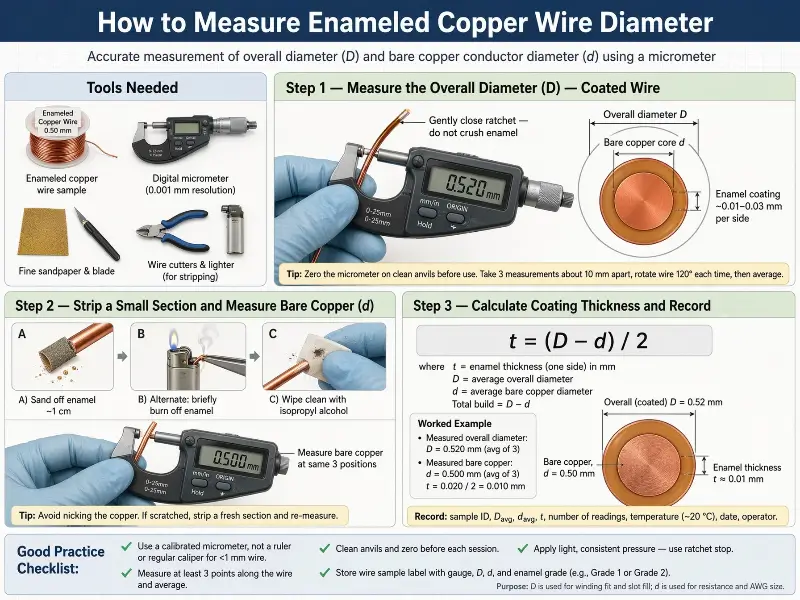
Residual lubricant, oil, oxides, or microparticles on the conductor surface can directly reduce the adhesion of the enamel coating, leading to substandard breakdown voltage. During winding, enamel coating peeling and localized copper exposure are likely to occur, creating inter-turn discharge channels during operation. The thickness of the enamel coating directly affects electrical and mechanical performance: too thin (<90% of the nominal lower limit) results in substandard breakdown voltage, while too thick (>110% of the nominal upper limit) reduces slot fill factor and increases winding volume. Sampling inspection is commonly performed using the IEC 60851-2 micrometer method or a laser diameter gauge (±0.001 mm). Grades 1, 2, and 3 correspond to different thickness increments. Pinholes are one of the most concealed and dangerous defects, with an industry standard of ≤8 pinholes/6m. They are usually caused by paint contamination, excessive humidity, or insufficient baking temperature, requiring comprehensive management through paint filtration, workshop humidity control, and baking curve optimization.
Enamel Coating Peeling, Mechanical Damage and Thermochemical Defects
Blistering manifests as localized separation of the enamel coating from the conductor, caused by insufficient preheating, excessive linear speed, or low enamel viscosity. Peeling manifests as poor overall adhesion of the enamel coating, caused by conductor contamination, improper enamel formulation, or over-baking. Both can lead to enamel coating damage during winding processing and insulation failure during operation. Mechanical damage includes scratches, indentations, and burrs, often caused by excessive winding tension, wear of the guide rollers, and burrs on the take-up reel. It requires establishing closed-loop tension control (accuracy ±5%), regularly replacing the guide rollers, and using CCD vision for online inspection. Thermal and chemical defects include: excessively high baking temperatures causing the enamel coating to scorch and discolor (changing from transparent golden yellow to brownish-black), and insufficient curing leading to substandard solvent resistance (rapid swelling in the impregnating varnish). These can be identified through thermal aging tests (IEC 60851-6) and solvent wiping tests (no peeling after 10 wipings with alcohol/toluene).
Storage, Transportation and Batch Inconsistency Defects
Excessive storage temperature (>30°C), excessive humidity (>70% RH), and excessively long storage period (>12 months) can lead to moisture absorption, slow aging, and surface contamination of the enamel coating. Controlling storage conditions (5-30°C / 30-70% RH), adhering to the first-in, first-out (FIFO) principle, and retesting breakdown voltage and pinholes after 6 months of storage are crucial. Even if all sampled items pass inspection, significant performance fluctuations (conductor diameter fluctuation > ±0.002 mm, breakdown voltage fluctuation > 10%) between different coils within the same batch constitute batch consistency defects. This directly reflects the supplier’s process control capabilities (CPK index) and can be identified through SPC statistical process control charts and on-site supplier audits.
Seven Standard Testing Methods for Factory Acceptance Inspection
Appearance, Dimensions and Electrical Testing
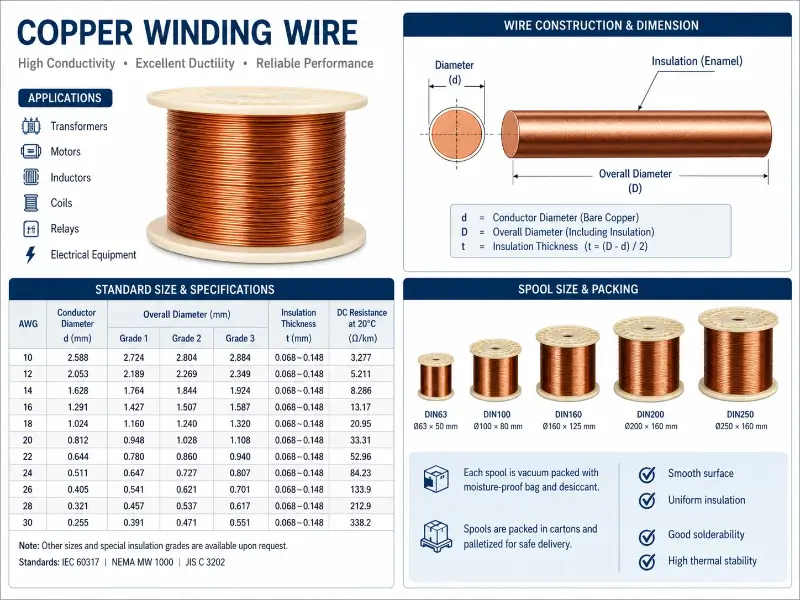
Visual inspection is the first line of defense, quickly eliminating obviously defective products within 5 minutes: the enamel coating surface should be smooth and uniform, free from scratches, bubbles, exposed copper, and contamination; the conductor color should be a purplish-red luster, without oxidation or blackening; the markings should be clear and complete (manufacturer’s name, specifications, batch number, production date, certification mark); the packaging should be intact and undamaged, with adequate moisture-proof measures. Dimensional measurements include conductor diameter (bare copper), enamel coating outer diameter, enamel coating thickness increment, roundness, and out-of-roundness. Rough inspection is commonly performed using a micrometer (±0.001 mm), and fine inspection is performed using a laser scanning diameter gauge (±0.3 μm). The criteria should conform to the IEC 60317 tolerance table (Grade 1 ±0.003 mm / Grade 2 ±0.005 mm). Electrical testing is the most critical step: breakdown voltage (IEC 60851-3, normal condition ≥1.5 kV), pinhole continuity (IEC 60851-5, ≤8 pinholes/6m), insulation resistance (≥500 MΩ·km), and DC resistance (compliant with IEC 60317 tolerance table at 20°C). It is recommended that the purchaser equip themselves with basic equipment such as a breakdown voltage tester, a high-voltage continuity tester, and a DC resistance bridge.
Mechanical, Thermal and Chemical Testing
Mechanical performance tests include: tensile strength and elongation at break (IEC 60851-3, elongation of pure copper conductor ≥25%), peel/winding test (enamel coating adhesion), and enamel coating flexibility (no cracking after rapid stretching); failure to meet any of these standards renders the enameled copper wire unsuitable for automatic winding processes. Thermal tests include: thermal shock (IEC 60851-6, different test temperatures corresponding to thermal grades 130/155/180/200/220°C), thermal aging (IEC 60172 for assessing thermal life), and softening breakdown (cutting temperature, typically ≥300°C); the purchaser should select the thermal grade based on the actual operating temperature plus a margin (recommended +20°C) to avoid premature failure due to insufficient thermal grade. Chemical tests include: solvent resistance (no peeling after wiping with alcohol/toluene/xylene), paint resistance (no swelling or peeling after paint immersion), and refrigerant resistance (air conditioning compressor scenario). General motor scenarios can be used as type tests, while special scenarios such as automotive air conditioning and home appliance compressors are mandatory test items.
Certificate and Document Verification
Each batch of goods entering the factory must be verified against the following: factory inspection report (values for each indicator), certificate of origin, third-party testing report (UL/IEC/NEMA system certification), quality management system certificate (ISO 9001/IATF16949), and batch traceability information (paint batch number, conductor batch number, production process parameters). The completeness of these documents directly reflects the supplier’s quality management level. Any missing document or expired certification means the purchaser will lose crucial evidence and be unable to claim compensation in the event of a quality dispute.
5 Core Elements of Supplier Qualification Assessment
Quality System and Production Capacity
Qualified enameled copper wire suppliers must hold: ISO 9001 (basic quality management system), IATF 16949 (mandatory requirement for automotive applications, if products are used in automotive motors), ISO 14001 (environmental management, required by some customers), and UL certification (North American market access). The purchaser should verify the original certificates and their validity before initial cooperation and re-verify them during the annual review. Production capacity audit includes: production line scale (annual capacity), key equipment configuration (enameled coating continuity tester, thermal level tester, laser diameter gauge, breakdown voltage tester, etc.), and process control level (CPK index ≥ 1.33). It is recommended that the purchaser conduct an on-site audit before initial cooperation, focusing on four key areas: raw material warehouse, coating workshop, testing laboratory, and finished product warehouse.
Process Control, Traceability, and Business Reputation
Suppliers should establish a complete SPC (Statistical Process Control) system: plotting Xbar-R control charts for key indicators such as conductor diameter, enamel coating thickness, breakdown voltage, and pinhole count; setting ±3σ control limits; and automatically alarming and initiating corrective and preventative actions (CAPA) when limits are exceeded. The purchaser may request suppliers to provide SPC data for the most recent 6 months as a core basis for evaluating supplier capabilities. Qualified suppliers should be able to: independently number each reel of enameled copper wire; independently archive test data (≥5 years traceability); provide bidirectional traceability between enamel batch number and conductor batch number; and initiate a recall mechanism for abnormal batches within 24 hours. Traceability is crucial for quickly locating the root cause and preventing further losses after quality issues occur. Business reputation assessment includes: years of operation (recommended ≥5 years), industry reputation, customer structure (whether they have served well-known motor/home appliance/automotive customers), financial health, and intellectual property compliance (no infringement litigation). This information can be obtained through third-party credit platforms (Qichacha, Tianyancha) and peer interviews.
Key Control Points of Procurement Technology Agreements and Contract Terms
Technical Specifications and Testing Report Terms
The contract should clearly specify: enameled copper wire specifications (conductor diameter, enamel coating grade, heat rating, color), acceptance criteria (referencing specific clauses in IEC 60851 / IEC 60317 / NEMA MW 1000 / GB/T 6109), sampling plan (GB/T 2828.1 normal inspection single sampling plan, AQL recommended 0.65-1.0), and handling of non-conformities (return/downgrading/rework/claim). Each batch must provide: a factory inspection report (values for each indicator and acceptance criteria), certificate of origin, third-party testing report (quarterly or every 10 batches), and batch numbers for the enamel and conductor; the report must bear the supplier’s quality inspection seal or electronic signature, and the purchaser has the right to conduct a third-party verification of the report’s authenticity (cost borne by the responsible party).
Warranty, Claims and Confidentiality Clauses
The contract should clearly specify: the quality guarantee period (recommended ≥12 months, calculated from the date of delivery), the maximum non-conformance rate (PPM level, recommended ≤1000 PPM), the batch non-conformance trigger mechanism (a single batch non-conformance rate >2% triggers a return of the entire batch), the claim calculation method (direct losses + indirect losses + customer claim sharing), and the dispute resolution method (arbitration by a third-party testing agency). Although enameled copper wire is a general industrial product, specific specifications, thermal grade combinations, and special process parameters may involve the purchaser’s confidential product information; the contract should clearly specify: the technical specifications confidentiality obligation, the supplier’s prohibition on disclosing the purchaser’s specifications to third parties, and the amount of liquidated damages (recommended not less than 30% of the order amount).
Risk Control in the 4 Stages of the Whole Process of Bulk Procurement
Prevention and In-Process Control
The pre-contract stage is the most critical and cost-effective part of risk control: establishing a list of qualified suppliers (3-5 candidates recommended), on-site audits before initial cooperation, small-batch sample trials (within 500 kg), full-item type testing during the trial production stage (covering all indicators of GB/T 6109 / IEC 60317), and inclusion in the qualified supplier list after successful small-batch trials. The in-contract stage focuses on strict adherence to contract terms and standardized acceptance upon delivery: establishing a batch ledger (specifications, quantity, order number, delivery date) after contract signing, notifying the purchaser to prepare for acceptance 24 hours before delivery, completing appearance and label inspection within 24 hours of delivery, completing sampling and laboratory testing within 48 hours, and issuing a written disposal decision for non-conforming batches within 72 hours.
Post-Event Review and Continuous Improvement
The post-contamination phase focuses on quickly identifying the root cause and preventing recurrence: non-conforming batches are immediately isolated and labeled (red “Non-conforming” tags); suppliers submit a non-conformance root cause analysis report (8D report) within 48 hours; both parties jointly develop corrective and preventive actions (CAPAs) within 7 days; CAPA effectiveness is tracked and verified within 1 month; serious non-conformities trigger on-site supplier audits or suspension of supply. Continuous improvement is the highest stage of batch procurement quality management: quarterly supplier quality meetings are held (reporting quality trends and discussing improvement plans); annual comprehensive supplier evaluations are conducted (quality 30% + delivery 25% + price 20% + service 15% + technology 10%); excellent suppliers receive preferential order allocation (10-20% increase); and suppliers with two consecutive years of excellent performance are included in strategic partnerships (annual agreements, long-term orders).
Long-Term Cooperation Quality Improvement Mechanism
Data Sharing and Collaborative Development
Purchasers and suppliers should establish a quality data sharing mechanism: exchanging key quality indicators (batch pass rate, key performance trends, anomalies) monthly, jointly analyzing quality trends (rising/falling/stable) quarterly, identifying systemic improvement opportunities (process optimization, new material application), and jointly investing in improvement projects (cost-sharing mechanism); this data transparency mechanism can significantly reduce trust costs and quality fluctuations caused by information asymmetry. For high-end application scenarios (automotive motors, wind power transformers, new energy drives), purchasers and suppliers should establish a joint development mechanism: jointly developing new paint formulations (higher thermal rating, lower loss), jointly developing new enamel coating structures (double-layer/triple-layer composite), jointly conducting research on new material applications (high-purity oxygen-free copper, copper-clad aluminum alternatives), and jointly applying for patents and standards (enhancing the technological barriers of both parties); this deep cooperation can upgrade ordinary buyer-seller relationships into strategic technological alliances.
Emergency Response Mechanisms and Continuing Education
To address unforeseen events (supplier quality incidents, insufficient production capacity, rising raw material prices), the purchaser should establish an emergency response mechanism: maintain at least two qualified suppliers for each type of critical enameled copper wire (to avoid the risk of exclusive supply), establish safety stock (≥30 days’ worth of critical specifications), sign emergency supply agreements (72-hour response to major failures), and conduct regular emergency drills (every six months). These mechanisms can minimize losses in the event of large-scale quality incidents or supply disruptions. The purchaser and suppliers should establish a continuous education mechanism: organize annual technical exchange meetings (standard updates, new processes, new materials), conduct regular quality management training (IATF 16949, ISO 9001, QC tools, SPC), exchange technical personnel for learning (process, testing, equipment maintenance), and jointly participate in industry conferences and exhibitions (to understand the latest industry trends); capacity building is the most fundamental driving force for quality improvement.
Summary
Core Conclusions
The low-quality risk in bulk procurement of enameled copper wire is essentially a product of both “information asymmetry” and “an inadequate quality management system.” By establishing a comprehensive management system encompassing “risk identification—factory acceptance—supplier evaluation—contract control—continuous improvement,” the procuring party can shift from passively responding to proactively preventing bulk quality risks. This not only reduces the rate of quality incidents and procurement costs but also significantly enhances supply chain resilience.
Three-Tiered Prevention System
First Layer (Technical Layer)—Based on international standards such as IEC 60851, IEC 60317, NEMA MW 1000, and GB/T 6109, a 7-dimensional incoming inspection system is established to achieve “early detection and early isolation” of quality issues. Second Layer (Management Layer)—With quality systems such as ISO 9001, IATF 16949, and UL as the framework, a 5-element supplier evaluation and 4-stage process control system is established to achieve “early prevention and early improvement” of quality issues. Third Layer (Strategic Layer)—Based on the concept of long-term cooperation and joint development, three strategic mechanisms—data sharing, emergency response, and continuous education—are established to achieve a “high-quality, highly resilient, and sustainable” supply chain.
Engineering Practice Recommendations
Engineering practice has proven that the cost of “prevention” in bulk procurement of enameled copper wire is far lower than the cost of “remediation”—a single batch of non-conforming products can lead to direct losses of hundreds of thousands to millions of yuan (returns, rework, claims) and incalculable indirect losses (damage to customer relationships, impact on brand reputation, lost orders). It is recommended that the purchasing party clearly define specifications, acceptance criteria, sampling plans, non-conformity handling, and claims mechanisms in the bulk procurement technical agreement, and establish a secure supply network of 3-5 qualified suppliers to fundamentally mitigate the risk of low quality. For new suppliers with whom they are cooperating for the first time, it is recommended to conduct small-batch trials (≤500 kg) and increase the sampling ratio (≥10 reels/batch). After passing complete type testing and process verification, they should be included in the list of qualified suppliers and the procurement share should be gradually increased.