

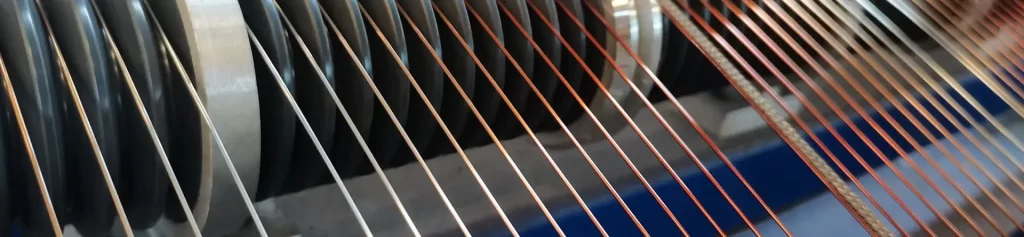
The terms “fiberglass covered wire” and “magnet wire” are often confused in the field of electrical engineering. Many engineers encounter this problem when selecting wires: should they use fiberglass covered wire or magnet wire? Both appear to be insulated wires, and their applications overlap, but their engineering characteristics and applicable boundaries are completely different. Ultimately, the core difference between these two types of wire lies in their insulation structure.
Magnet wire uses an insulating enamel coating as an insulation layer, a single-layer structure; fiberglass covered wire uses fiberglass yarn wrapped around and impregnated with insulating varnish, a multi-layer composite structure. This difference determines comprehensive differences between the two in terms of thermal class, mechanical strength, insulation strength, weight, cost, and other dimensions. For 30 years, our company has supplied customers in over 50 countries worldwide.
We’ve found that the selection decisions for fiberglass-coated conductors and magnetic wires often occur in the following scenarios: traction motors, home appliances, high-frequency transformers, and heavy-duty industrial equipment. This article will break down these two types of conductors from several dimensions, including material structure, performance parameters, standard systems, and application scenarios.
Material Structure and Insulation System
The insulation structure of magnet wire
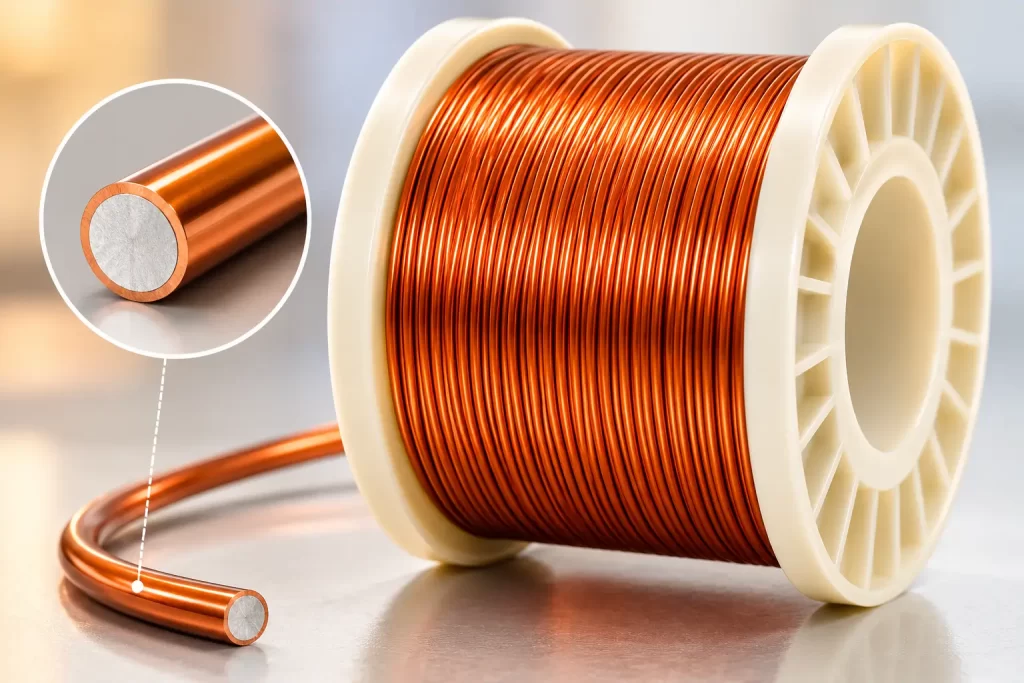
The insulation layer of magnetic wire is an enamel coating. One or more layers of insulating varnish are coated on the surface of the conductor (copper or aluminum), which are then baked and cured to form a continuous insulation layer. Based on the chemical composition of the insulating varnish, magnetic wires can be classified as polyurethane-enameled wire (UEW), polyester-enameled wire (PEW), polyester imide-enameled wire (EIW), polyamide-imide-enameled wire (AIW), and polyimide-enameled wire (PIW), etc. The thickness of enamel coating is generally in the range of 0.02-0.10 mm. The NEMA MW 1000 standard classifies enamel coating thickness into three grades: Grade 1 (thin), Grade 2 (medium), and Grade 3 (thick). Grade 1 is suitable for general small coils, Grade 2 is suitable for most motors and transformers, and Grade 3 is suitable for high-voltage or special applications. The advantages of enamel coating are its thinness, good flexibility, and ease of winding, making it suitable for high-speed automated winding processes. However, the thermal class of enamel coating is limited by the chemical composition of the varnish. The most common thermal classes for enamel coating are 130°C (Grade B), 155°C (Grade F), 180°C (Grade H), 200°C (Grade N), 220°C (Grade R), and 240°C (Grade C).
Insulation Structure of Fiberglass Covered Wire
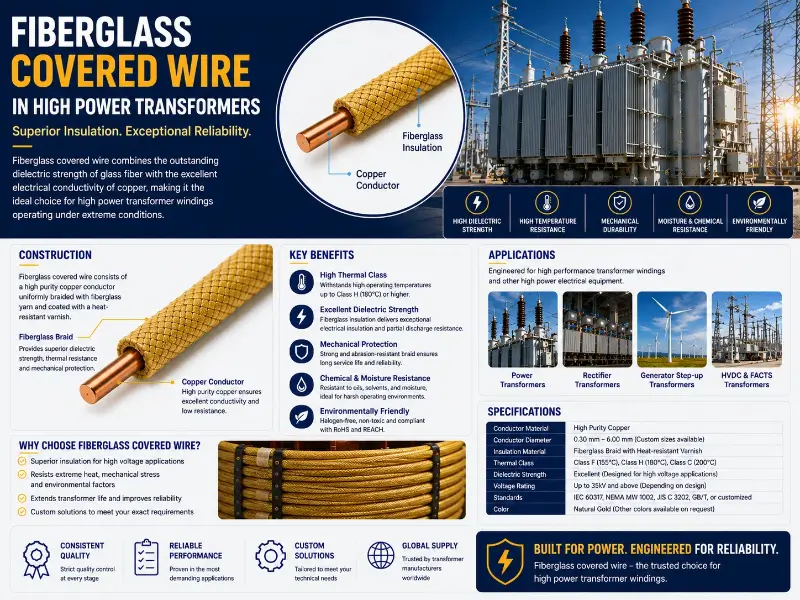
The insulation structure of fiberglass covered wire is composite. The most common form is to wrap one or more layers of fiberglass yarn around the conductor surface, and then impregnate and cure it with insulating varnish. Fiberglass yarn is continuous long filament glass fiber, and the wrapping direction is generally helical. Based on the different base insulation, fiberglass covered wires can be divided into two categories: The first category is bare copper/bare aluminum + fiberglass covering: the conductor surface has no enamel coating; fiberglass yarn is directly wrapped around it, and then impregnated with insulating varnish. This structure generally has 1-3 layers of fiberglass, with the impregnating varnish filling the gaps between the fibers. The second category is enameled wire + fiberglass covering: fiberglass yarn and impregnating varnish are wrapped around the surface of the enameled wire (magnet wire). This is a double insulation structure; the enamel coating provides base insulation, and the fiberglass layers provide additional mechanical protection and heat resistance enhancement. NEMA MW 1000 standard MW 41-C is a typical standard for fiberglass-coated conductors, corresponding to the IEC 60317-48 international standard. According to MW 41-C, fiberglass-coated conductors are divided into two structures based on the number of fiberglass layers: Single and Double.
Structural Comparison of Fiberglass and Magnet Wire
| Dimensions | Magnet Wire | Fiberglass-coated Conductor |
|---|---|---|
| Number of Insulation Layers | Single Layer (enamel coating) | Composite Layer (enamel coating + fiberglass + impregnating varnish) |
| Conductor | Copper/Aluminum (round/flat) | Copper/Aluminum (round/flat) |
| Insulation Material | Insulating Varnish (organic polymer) | Fiberglass (inorganic) + Impregnating Varnish |
| Typical Temperature Resistance | 130-240°C | 155-220°C (depending on the enamel coating + fiberglass combination) |
| Flexibility | Excellent (thin enamel coating) | Moderate (fiberglass limits bending radius) |
Performance Parameter Comparison
Thermal Class Comparison
The thermal class of a magnetic wire is determined by the chemical composition of its enamel coating. Polyurethane-coated wire (UEW) is typically 130°C or 155°C, polyester-coated wire (PEW) is 155°C, polyester imide-coated wire (EIW) is 180°C, polyamide-imide-coated wire (AIW) is 200°C, and polyimide-coated wire (PIW) is 220-240°C. The thermal class can be increased to 200°C or even higher through double coatings (such as PEW + AIW). The thermal class of fiberglass-coated wires is determined by the combination of the base enamel coating and the fiberglass layer. According to the NEMA MW 41-C standard, the basic temperature resistance of fiberglass-coated conductors is 155°C (based on the fiberglass itself), but with different enamel coatings, it can reach 180°C, 200°C, or even 220°C. Common combinations are PEW + fiberglass (180°C, Class H) and EIW + fiberglass (200°C, Class N). In high-temperature applications above 180°C, fiberglass-coated conductors have a significant advantage over plain enameled wire. Fiberglass itself is an inorganic material, and its long-term temperature resistance can reach over 400°C; only the enamel coating limits the overall thermal class. Even so, the 180-200°C combination of fiberglass-coated conductors performs stably in high-temperature environments such as industrial motors and traction motors.
Insulation Strength Comparison
The insulation strength of magnetic wire is determined by the thickness and quality of the enamel coating. According to IEC 60851-5 Test 13 standard, the breakdown voltage of Grade 1 enamel coating is approximately 1.5-3.5 kV (1.0 mm diameter), Grade 2 is approximately 4.0-6.0 kV, and Grade 3 is approximately 6.5-8.5 kV. A thicker enamel coating results in higher insulation strength, but also occupies more winding space. The insulation strength of fiberglass-coated conductors is determined by the number of fiberglass layers and the quality of the impregnation. The breakdown voltage requirements for the MW 41-C standard are as follows: | AWG specifications | Single (minimum) | Double (minimum) |
|—|—|—|
| 4/0-9.5 | 170 V | 315 V |
| 10-23.5 | 360 V | 540 V |
| 24-30 | 225 V | 400 V | For double-layer enameled wire (such as PEW + AIW), the breakdown voltage of the bottom enameled coating needs to be superimposed on the fiberglass layer. Therefore, the actual breakdown voltage of fiberglass-coated enameled wire is 30-50% higher than that of bare copper fiberglass-coated wire.
Mechanical Strength Comparison
The mechanical strength of magnet wire is mainly affected by the conductor and the enameled coating. The enameled coating provides some abrasion protection, but the overall mechanical strength is limited. Improper tension control during high-speed winding can easily damage the enameled coating. Fiberglass-coated conductors have significantly superior mechanical strength compared to magnetic wire. The fiberglass layer acts like an “armor” for the conductor, greatly improving its tensile strength, impact resistance, and abrasion resistance. In vibration and impact scenarios such as traction motors and lifting electromagnets, fiberglass-coated conductors are a more reliable choice. However, fiberglass-coated conductors have poor flexibility. The fiberglass limits the conductor’s bending radius, with the minimum bending radius typically being 5-10 times the conductor diameter (compared to 1-3 times for magnetic wire). Therefore, fiberglass-coated conductors are not suitable for winding complex coil shapes.
Moisture Resistance Comparison
The moisture resistance of magnetic wire depends on the integrity of its enamel coating. A complete enamel coating provides good protection against moisture, but if pinholes or microcracks appear, moisture can seep in along the defects, leading to decreased insulation performance. The moisture resistance of fiberglass-coated conductors is more complex than that of magnetic wire. Fiberglass itself is hygroscopic (a water molecule adsorption layer forms on the surface of the fiberglass), and if impregnation is insufficient, moisture may seep in along the gaps between the fibers. However, after impregnation with high-quality insulating varnish, the gaps between the fibers are completely filled, resulting in better moisture resistance than magnet wire. In humid environments (such as water pump motors and offshore wind power), the quality of the impregnation process for the fiberglass-coated conductors must be verified.
Comparison of Standards Systems
The international standards system for magnet wire is relatively complete, mainly including
- IEC 60317 series: European-led magnet wire standards, covering all enamel coating types and specifications – NEMA MW 1000: North American-led magnet wire standards, corresponding to most IEC 60317 standards – GB/T 6109: Chinese national standard, basically equivalent to IEC 60317 – JIS C 3202: Japanese industrial standard, highly coordinated with IEC 60317 The IEC 60317 series standards are divided into enamel coating types: – IEC 60317-0-1: General requirements (round wire) – IEC 60317-1: UEW enameled round copper wire – IEC 60317-8: PEW enameled round copper wire – IEC 60317-13: EIW Enameled Round Copper Wire – IEC 60317-26: AIW Enameled Round Copper Wire – IEC 60317-46: AIW Enameled Round Copper Wire (New Version) – IEC 60317-56: PIW Enameled Round Copper Wire
Main Standards for Fiberglass-Coated Conductors
Fiberglass-coated conductors also have their own international standards: – NEMA MW 1000 Part 2 MW 41-C: North American standard, corresponding to IEC 60317-48 – IEC 60317-48: International standard, fiberglass-coated enameled round copper wire – GB/T 7672: Chinese national standard, fiberglass-coated enameled wire series It should be noted that the standard coverage of fiberglass-coated conductors is much narrower than that of magnet wire. The category of “magnet wire” has dozens of sub-standards covering various combinations of “enamel coating” and “specifications.” Fiberglass-coated conductors primarily correspond to the MW 41-C (round wire) and “flat wire” standards.
Standard Compatibility
Many customers ask: Can fiberglass-coated conductors and “magnet wire” be interchanged? From a standards perspective, they cannot be directly interchanged. This is because their insulation structures are completely different, and the test methods for breakdown voltage, temperature resistance, and mechanical strength are also different. However, in certain application scenarios, the IEC 60317 standard corresponding to the base “enamel coating” can be referenced (e.g., if the base “enamel coating” of the fiberglass-coated “enameled wire” is PEW, then refer to the IEC 60317-8 PEW standard).
Application Scenarios Comparison
Typical Applications of Magnet Wire
Magnet wire has extremely wide applications, covering almost all electrical manufacturing scenarios: Small Motors and Transformers: Household appliance motors (air conditioners, refrigerators, washing machines), small transformers, chargers, etc., mainly using UEW/PEW/EIW enameled wire, specifications AWG 24-38. Medium Motors and Transformers: Industrial motors, power distribution transformers, servo motors, stepper motors, mainly using PEW/EIW enameled wire, specifications AWG 14-30. Large Motors and Transformers: Traction motors, generators, power transformers, mainly using EIW/AIW/PIW enameled wire, specifications AWG 4-26, requiring double-coated or multi-coated structures.
Typical Applications of Fiberglass-Coated Conductors
Fiberglass-coated conductors are suitable for applications requiring higher mechanical strength or temperature resistance: Traction Motors: Traction motors in subways, light rail, and electric vehicles need to withstand strong vibrations and impacts, making fiberglass-coated conductors standard equipment. Our company supplies multiple domestic traction motor manufacturers annually, with AWG 14-22 fiberglass-coated enameled round copper wire being the mainstream specification. High-Temperature Components in Household Appliances: Coils near heating elements in induction cookers, IH rice cookers, and electric water heaters require temperature resistance above 180°C, making fiberglass-coated enameled wire (PEW + fiberglass, 180°C, H-class) an economical choice. Industrial Heavy-Duty Motors: The high mechanical strength of fiberglass-coated conductors is a key advantage in hoisting motors, metallurgical motors, and mining motors. High-Frequency Transformers: For switching power supplies and high-frequency inverters, fiberglass-coated conductors offer high insulation strength and can withstand high-frequency voltage stress. Special Applications: In fields with extremely high reliability requirements, such as aerospace, military, and nuclear industries, fiberglass-coated conductors combined with special impregnation processes can meet the requirements of extreme environments. #
Application Scenarios Comparison Table
Table
| Application Scenarios | Preferred Magnet Wire Type | Preferred Fiberglass-coated Conductor Structure | Reasons for Selection |
|—|—|—|—|
| Air Conditioner Compressor Motor | PEW/EIW (155-180°C) | Not Recommended | Cost Sensitive, Moderate Temperature |
| Traction Motor | EIW/AIW (180-200°C) | PEW + Fiberglass (180°C) | High Vibration and Shock, High Mechanical Strength Requirements |
| Heavy-Duty Industrial Motor | EIW (180°C) | PEW + Fiberglass (180°C) | High Mechanical Strength Requirements |
| High-Frequency Switching Power Supply Transformer | UEW (155°C) | PEW + Fiberglass (155-180°C) | High Insulation Strength Requirements | Household IH Rice Cooker | Not Applicable | PEW + Fiberglass (180°C) | High Temperature Environment, High Cost-Effectiveness of Fiberglass Coating | Wind Turbine Generator | EIW/AIW (enameled wire) (180-200°C) | PEW + Fiberglass (180°C) | High Moisture-Proofing Requirements for Offshore Wind Power |
Cost and Procurement Comparison
Unit Price Comparison
Fiberglass-coated wire is 30-80% more expensive than magnet wire, the specific multiple depends on the specifications and structure: round wire: Magnet wire (PEW Grade 2) unit price is about 50-80 yuan/kg; Fiberglass-coated round wire (MW 41-C Single) is about 80-120 yuan/kg; Fiberglass-coated enameled round wire (PEW + Fiberglass 180°C) is about 100-150 yuan/kg. Flat Wire: Magnetic wire (PEW Grade 2 flat wire) costs approximately 60-90 RMB/kg; fiberglass-coated enameled flat wire costs approximately 120-200 RMB/kg.
Cost Drivers
The main reasons for the high cost of fiberglass-coated conductors are: Multiple Processes: Magnetic wire requires 1-2 coating and baking processes, while fiberglass-coated conductors require 1 coating + 1-2 fiberglass wrapping + 1-2 impregnation and curing processes, making the labor time 2-3 times that of magnetic wire. Fiberglass Material: Electrical-grade continuous filament fiberglass yarn itself is more expensive, and the impregnation varnish (usually modified polyester or epoxy system) is also more expensive than ordinary insulating varnish. Equipment Investment: Fiberglass coating requires specialized wrapping machines and impregnation equipment; the production line investment is 3-5 times that of ordinary enameling machines.
Procurement Strategy
For cost-sensitive applications (such as home appliances and small transformers), magnetic wire is the preferred choice. For applications with high reliability requirements (such as traction motors and heavy-duty industrial applications), even though fiberglass-coated wire is 30-50% more expensive, it is still a more economical choice considering lifespan and failure costs. In bulk purchases, the price elasticity of fiberglass-coated wire is less than that of magnetic wire. Generally, bulk purchases of magnetic wire can be negotiated at 80-90% off, while fiberglass-coated wire can generally only be negotiated at 90-95% off, because there are fewer suppliers.
Selection Decision Process
Step 1: Evaluate Operating Temperature
Measure or estimate the highest operating temperature of the coil (hot spot temperature). Consider ambient temperature, copper loss heating, and overload conditions. If the hot spot temperature ≤ 155°C: magnetic wire is sufficient (PEW Grade 2 is the first choice for cost-effectiveness). If the hot spot temperature is 155-180°C: Magnet wire (EIW 180°C) or fiberglass-coated enameled wire (PEW + fiberglass 180°C) are both acceptable. If the hot spot temperature is ≥ 180°C: Fiberglass-coated enameled wire (PEW/EIW + fiberglass 200°C) is recommended.
Step 2: Assess mechanical strength requirements.
If the coil’s operating environment has low vibration/impact (e.g., ordinary household appliances): Magnet wire is sufficient. If vibration/impact is high (e.g., traction motors, heavy industrial loads): Fiberglass-coated wire is a better choice.
Step 3: Assess insulation strength requirements.
Calculate the required breakdown voltage based on the operating voltage. Generally, Grade 2 is selected for 220V systems, Grade 2 or Grade 3 for 380V systems, and fiberglass-coated or double-layered enameled wire is considered for >1kV systems.
Step 4: Assess cost.
Select the lowest cost option while meeting performance requirements. If both fiberglass-coated conductors and magnetic wires meet the requirements, prioritize magnetic wires (unless mechanical strength is a critical consideration).
Step 5: Verification and Material Preparation
Small-batch sample testing: Test breakdown voltage, temperature resistance, and mechanical strength. Confirm supplier qualifications: ISO 9001, NEMA certification, third-party testing reports. Bulk procurement: Sign a technical agreement, clarifying specifications, tolerances, and testing methods.
The relationship between fiberglass-coated conductors and magnetic wires is not one of substitution, but rather complementarity. Magnetic wires are the preferred choice for the vast majority of electrical applications, while fiberglass-coated conductors are a supplementary option for high-temperature, heavy-load, and high-insulation requirements. From a materials perspective, the composite insulation structure of fiberglass-coated conductors (fiberglass + enamel coating + impregnation varnish) provides higher mechanical and insulation strength than simple enamel coating, but sacrifices flexibility and increases cost. From an application perspective, magnetic wire covers over 90% of coil manufacturing scenarios (home appliances, small motors, transformers, electronic components); fiberglass-coated conductors cover the remaining 10% of high-end scenarios (traction motors, heavy-duty industrial applications, high-frequency transformers). From a quality control perspective, fiberglass-coated conductors require more stringent supplier qualifications than magnetic wires. It is recommended to choose manufacturers with over 10 years of experience in producing fiberglass-coated conductors, requiring NEMA MW 41-C or IEC 60317-48 standard certification and third-party breakdown voltage test reports.