

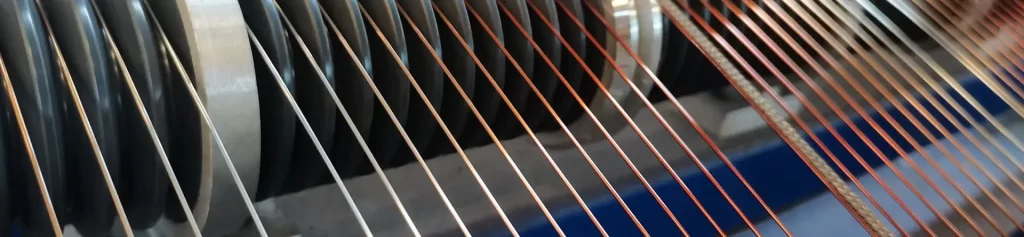
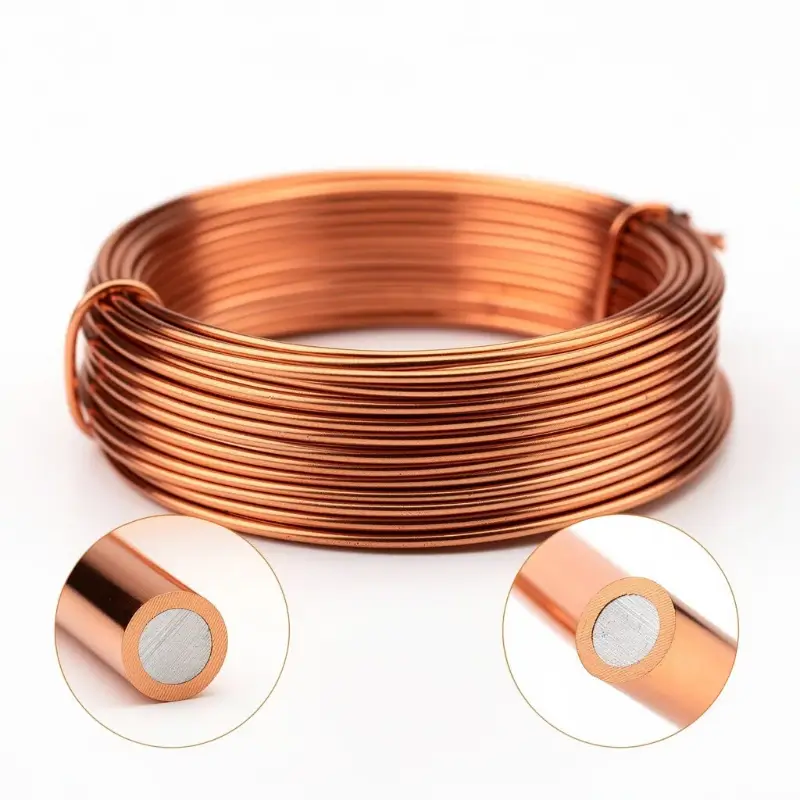
Copper clad aluminum wire (CCA or CCAW) is a bimetallic composite conductor with an aluminum core and an outer layer of oxygen-free copper metallurgically coated. It retains the excellent conductivity and solderability of copper while significantly reducing weight and cost thanks to the aluminum core, making it an engineering conductor solution for lightweight and high-frequency applications. While CCA wire cannot completely replace pure copper, its unique physical and electrical properties have secured it a stable market position in audio, telecommunications, consumer electronics, new energy vehicles, aerospace, home appliances, and other fields.
Based on engineering practice, this article systematically outlines the engineering application boundaries and selection logic of CCA wire from seven dimensions: definition, manufacturing process, physical properties, application scenarios, enamel system, applicable boundaries, and selection process.
Basic Understanding of CCA Wire: Definition, Structure, and Copper Content Ratio
Basic Definition of CCA
While CCA wire cannot completely replace pure copper, its unique physical and electrical properties have secured it a stable market position in various fields such as audio, telecommunications, consumer electronics, new energy vehicles, aerospace, and home appliances.
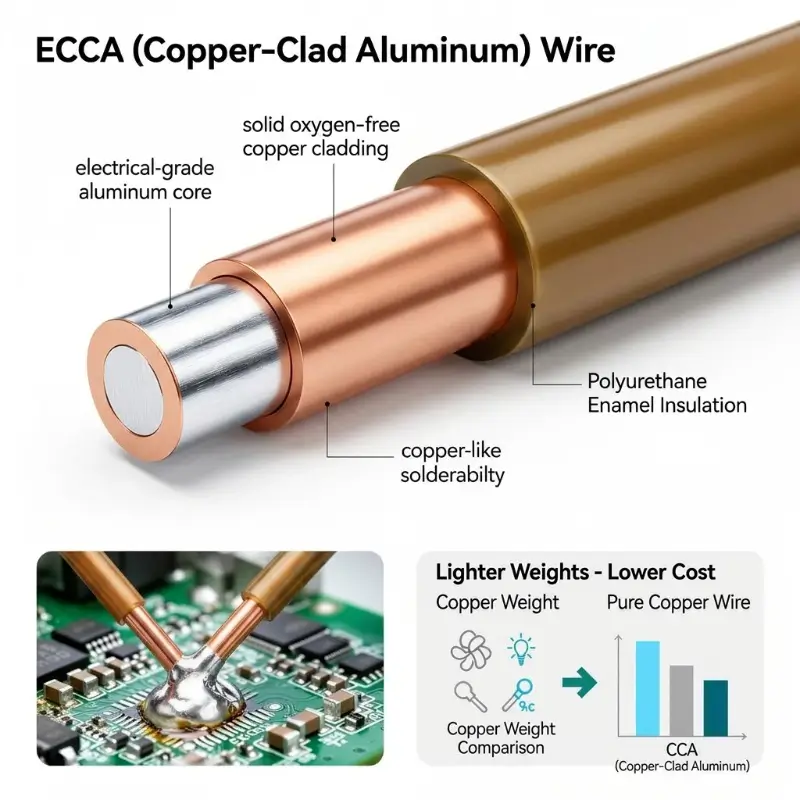
Three-Layer Structure Model
Based on engineering practice, this article systematically outlines the engineering application boundaries and selection logic of CCA wire from seven dimensions: definition, manufacturing process, physical characteristics, application scenarios, enamel coating system, applicable decision-making, and selection process. Wire Basics: Definition, Structure, and Copper Ratio # Definition of CCA CCA is an abbreviation for Copper Clad Aluminum, referring to a composite conductor with electrical grade aluminum (1350 aluminum alloy) as the core material, coated with a layer of oxygen-free copper (OFC, C10200) through a metallurgical bonding process.
Engineering Significance of Copper Content Ratio
A permanent metallurgical bond is formed between the two metal layers, preventing delamination during use.
CCA Manufacturing Process and ASTM B-566 Standard
Three Mainstream Manufacturing Processes
CCA and Copper Clad Steel (CCS) belong to the bimetallic composite conductor family, but their copper ratios and applications are completely different: CCS is mainly used in high-strength applications (such as the center conductor of coaxial cables and grounding rods), with a copper ratio typically only 20–40%; CCA is used in electrical conduction scenarios, with a copper ratio typically 10% or 15% (volume percentage). # Structure Model In engineering practice, CCA wires are modeled with the following three-layer structure: 1. Aluminum Core: The main part of the cross-section (85% or 90%), providing lightweight and cost advantages. 2. Copper Cladding: The outer continuous coating of copper metal, providing conductivity, solderability, and corrosion resistance. 3. Enamemel Coating (Optional): Used for enameled wires, typically polyester (PEW), polyurethane (UEW), polyester imide (EIW), or polyamide imide (AIW). # Significance of Copper Ratio A copper ratio of 10% and 15% are two typical specifications defined by ASTM B-566: – 10% Copper Ratio (Class 10A / 10H): Lightweight priority, cost-sensitive scenarios, such as consumer electronics, home appliances, and auxiliary coils. – 15% Copper Content (Class 15A / 15H): Offers superior conductivity, better solderability, and higher connection reliability, suitable for critical applications such as audio speakers and telecommunications RF connections.
ASTM B-566 Standard Detailed Explanation
The difference between the annealed (A) and hard-drawn (H) states lies in their mechanical properties: the A state is soft and flexible, suitable for fine winding; the H state has high strength and tensile strength, suitable for mechanical stress scenarios. Manufacturing Process and ASTM B-566 Standard # Mainstream Manufacturing Processes ## Welding: This method metallurgically bonds aluminum rods and copper strips under pressure using a specialized die.
Other Related Standards
It is the most traditional method for CCA manufacturing, producing good copper layer uniformity, but the process speed is relatively slow. ## Extrusion: Using Conform continuous extrusion equipment, aluminum rods are extruded into wire while simultaneously being coated with a copper layer.
| Class | Copper Volume Ratio | State | Typical Applications |
|---|---|---|---|
| Class 10A | 10% | Annealed | Consumer electronics, home appliances |
| Class 10H | 10% | Hard-drawn | Mechanical strength demanding scenarios |
| Class 15A | 15% | Annealed | Audio, telecommunications |
| Class 15H | 15% | Hard-drawn | Industrial auxiliary components |
CCA Physical and Electrical Properties Comparison (Core Engineering Trade-offs)
Physical Property Comparison of Three Materials
| Physical Parameter | Pure Copper (C11000) | CCA (Class 15A) | Pure Aluminum (1350) |
|---|---|---|---|
| Density (g/cm³) | 8.89 | 3.63 | 2.70 |
| DC Conductivity (% IACS) | 100% | 63–65% | 61% |
| Resistivity (Ω·m @ 20°C) | 1.724 × 10⁻⁸ | 2.74 × 10⁻⁸ | 2.83 × 10⁻⁸ |
| Tensile Strength (MPa, annealed) | 220 | 90–130 | 70–95 |
| Thermal Conductivity (W/m·K) | 391 | 220 | 237 |
| Linear Expansion (×10⁻⁶/°C) | 17 | 23 | 23 |
| 2026 Price Index | 100 (baseline) | 40–60 | 25–35 |
Suitable for long-length continuous production, this is one of the mainstream processes in modern CCA manufacturing. ## Extrusion uses liquid pressure to bond the aluminum core to the copper layer, achieving higher bonding strength.
Key Engineering Trade-offs
However, the equipment is expensive and is mainly used in high-end applications such as aerospace. # B-566 Standard Explained ASTM B-566 is the core international standard for CCA wire, defining four product categories: | Category | Copper Volume Ratio | Temper | Typical Applications | ||-||-| | Class 10A | 10% | Annealed | Consumer Electronics, Home Appliances | | Class 10H | 10% | Hardened | Mechanical Strength Requirements | | Class 15A | 15% | Annealed | Audio, Telecommunications | | Class 15H | 15% | Hardened | Industrial Accessories | Standard Requirements: – Tensile Strength: A Temper 90–130 MPa, H Temper ≥ 170 MPa – Elongation: A Temper ≥ 15%, H Temper ≥ 1.5% – Resistivity: ≤ 2.74 × 10⁻⁸ Ω·m (equivalent to 63% IACS) – Density: 3.63 g/cm³ (reference value, used for weight calculation) – Appearance Requirements: No joints, no splicing, copper layer must not be delaminated # relevant standards – IEC 60317: General standard for enameled wire (applicable to enameled CCA wire) – GB/T 32499: Chinese national standard, referring to ASTM B-566 – UL 1446: Insulation systems (including CCA enameled wire) of physical and electrical properties of CCA (core engineering trade-offs) # of physical properties of the three major materials | Physical property parameters | Pure copper (C11000) | CCA (Class 15A) | Pure aluminum (1350) | |-|-||–| | Density (g/cm³) | 8.89 | 3.63 | 2.70 | | DC Conductivity (% IACS) | 100% | 63–65% | 61% | | Resistivity (Ω·m @ 20°C) | 1.724 × 10⁻⁸ | 2.74 × 10⁻⁸ | 2.83 × 10⁻⁸ | | Tensile Strength (MPa, Annealed) | 220 | 90–130 | 70–95 | | Thermal Conductivity (W/m·K) | 391 | 220 | 237 | | Coefficient of Linear Expansion (×10⁻⁶/°C) | 17 | 23 | 23 | | 2026 Price Index | Baseline 100 | 40–60 | 25–35 | # Engineering Trade-offs **1.
Scenario 1: Audio and Speaker Voice Coils
Weight Advantage (Core Selling Point) For the same length and diameter, CCA wire is approximately 50–60% lighter than pure copper wire**.
Eight Major Typical Application Scenarios of CCA
Scenario 2: Telecommunications and RF High-Frequency Transmission
For example, the weight per kilometer of AWG 18 (1.024 mm diameter) is: pure copper 7.3 kg → CCA 3.0 kg → pure aluminum 2.2 kg. **2.
Scenario 3: Consumer Electronics Internal Wiring
High-Frequency Conductivity (Skin Effect)** When the current frequency is > 5 MHz, the current mainly flows within a depth of 0.5–1 μm on the conductor’s surface (skin effect).
Scenario 4: New Energy Vehicle Auxiliary Coils
The copper cladding of CCA wire is perfectly suited for high-frequency current conduction, therefore: – DC conductivity: CCA is only 63% of pure copper – AC high-frequency (>5 MHz) conductivity: CCA ≈ pure copper (when the copper layer is thick enough) This is the core engineering value of CCA in high-frequency applications such as RF coaxial cables, wireless charging, and voice coils. **3.
Scenario 5: Aerospace and Special Equipment
Cost Advantage With high copper prices expected in 2026, the cost of CCA wire is typically 40–60%** of that of pure copper wire.
Scenario 6: Home Appliances and Fan Motors
For the cost-sensitive consumer electronics, home appliance, and accessory coil markets, CCA is a significant TCO (Total Cost of Ownership) optimization solution. **4.
Scenario 7: Inductors and Small Transformers
Solderability** The copper layer of CCA wire provides excellent solderability, compatible with standard tin-lead/lead-free soldering processes.
Scenario 8: Power Transmission (Restricted Scenarios)
Note: Soldering time should be controlled within 2–3 seconds to avoid prolonged high temperatures that could cause diffusion at the copper-aluminum interface. **5.
Four Mainstream Enamel Insulation Systems
Mechanical Properties** CCA has tensile strength between pure copper and pure aluminum, and good bending performance, but microcracks may appear in the copper layer after repeated bending.
CCA Enamel Insulation System
Double-Coating Composite Solution
Careful evaluation is required in high-vibration scenarios. Explanation of Eight Typical Application Scenarios of CCA
# 1: Audio and Speaker Voice Coils Typical Applications: Home stereo systems, car audio systems, headphone voice coils, portable Bluetooth speakers. Why Use CCA?: – Voice coil operating frequencies are typically 20 Hz–20 kHz, with some high-frequency units reaching 40 kHz. – Lightweight voice coils → higher transient response speed and lower distortion – CCA’s high-frequency conductivity is close to that of pure copper, ensuring no attenuation of high-frequency signals. Typical Specifications: AWG 22–28 (0.32–0.64 mm), Class 15A preferred (superior conductivity).
# 2: Telecommunications and RF High-Frequency Transmission Typical Applications: Coaxial cable center conductor, 5G base station feeder, RF connectors, wireless charging coils. Why Use CCA: – The skin effect allows high-frequency current to flow only in the copper layer, making CCA comparable in performance to pure copper. – 50%+ weight reduction for equivalent performance, facilitating long-distance installation. – Significant cost advantage in high-volume projects. Typical specifications: AWG 14–20 (0.81–1.63 mm), Class 15A.
# 3: Internal Wiring in Consumer Electronics Typical Applications: TVs, laptops, tablets, smart speakers, TWS earphones. Why Use CCA: – Compact internal wiring space, lightweight design directly reduces overall weight. – For DC or low-frequency applications, the DC conductivity disadvantage of CCA has limited impact. – Intense competition in the cost-sensitive consumer market. Typical specifications: AWG 24–32 (0.20–0.51 mm), Class 10A is sufficient.
# 4: Auxiliary Coils for New Energy Vehicles Typical Applications: Vehicle air conditioning compressors, seat heaters, electric water pumps, sensor coils, BMS equalization coils. Why Use CCA: – For new energy vehicles, every 100 kg reduction in curb weight increases range by 5–8 km, demonstrating significant lightweighting value. – Auxiliary coils (non-main drive) have moderate power density requirements. – Vibration environment needs assessment (CCA repeated bending fatigue needs attention). Typical specifications: AWG 20–28 (0.32–0.81 mm), Class 10H preferred (higher tensile strength).
# 5: Aerospace and Special Equipment Typical Applications: Spacecraft internal wiring, UAV motor windings, portable radar, lightweight military communications. Why Use CCA: – Extreme lightweight requirements: Every gram of weight is crucial. – High-frequency performance comparable to pure copper. – Relatively insensitive to cost (weight > cost in aerospace projects). Typical specifications: AWG 22–30 (0.25–0.64 mm), Class 15A, must comply with AS9100 / MIL-STD standards.
# 6: Home Appliances and Fan Motors Typical Applications: Floor fans, air conditioner outdoor units, range hoods, washing machine auxiliary motors, refrigerator compressors (some models). Why Use CCA: – Low- to mid-range home appliances are extremely cost-sensitive. – CCA performance fully meets the requirements for 50/60 Hz operation. – Weight reduction reduces motor starting inertia. Typical Specifications: AWG 18–26 (0.40–1.02 mm), Class 10A.
# 7: Inductors and Small Transformers Typical Applications: Low-power inductors in switching power supplies (SMPS), LED driver transformers, chokes. Why Use CCA: – Small inductors/transformers are weight-sensitive. – Frequency range is typically 20 kHz–500 kHz, and the skin effect has begun to take effect. – Cost-sensitive. Typical specifications: AWG 22–30 (0.25–0.64 mm), Class 10A.
# 8: Power Transmission (Restricted Scenario) Typical Applications: Building distribution branch lines (permitted in some countries), grounding wires, temporary power cabling. Why Use CCA (Restricted): – Significant cost advantages in long-length projects. – However, strictly limited by NEC (National Electrical Code): CCA is only permitted in specific scenarios (such as residential service access lines of 6/3 AWG or higher specifications; some models require explicit labeling). Note: China and the EU have stricter restrictions on CCA mainlines in residential buildings; local electrical codes must be consulted. selection of the enamel coating for CCA (enamel-coated) wires requires consideration of the compatibility between the enamel coating and the aluminum core.
Enamel Thickness Grade
This is a key difference from pure copper enamel-coated wires. # Mainstream Enamell Coating Systems ## (UEW, Polyurethane) – thermal class: Grade B (130°C) / Grade F (155°C) – Features: Good solderability (no scraping required), excellent high-frequency performance – Applications: High-frequency coils, RF windings, consumer electronics – Aluminum core compatibility: ✅ Good (Acidic formulations should avoid direct contact with aluminum) ## (PEW, Polyester) – thermal class: Grade F (155°C) – Features: Balanced heat resistance and solvent resistance – Applications: General motors, home appliances, transformers – Aluminum core compatibility: ✅ Good ## Imide (EIW, Polyesterimide) – thermal class: Grade H (180°C) – Features: High temperature resistance, overload resistance – Applications: H High-end motors, new energy vehicle drive motors, thermal protection scenarios – Aluminum core compatibility: ✅ Good ## (AIW) – thermal class: Class C (200°C+) – Features: Highest temperature resistance, excellent chemical stability – Applications: Extreme high temperature scenarios, aerospace – Aluminum core compatibility: ✅ Good # composite solution High-end scenarios commonly use dual-coating structures: – Base layer: PEW (good adhesion) + Top layer: AIW (high temperature protection) – Overall temperature resistance up to 180–200°C – Suitable for new energy vehicle drive motors, aerospace motors # coating thickness grades according to IEC 60317-0-1: – Grade 1: Thin enamel (suitable for high frequency, low voltage) – Grade 2: Standard enamel (general purpose) – Grade 3: Thick enamel (high voltage, high insulation strength) CCA (enameled wire) recommends at least Grade 2 (The outer diameter of the aluminum core is relatively larger than that of the copper wire; standard enamel coating ensures electrical clearance). Applicable vs.
Applicable Scenarios for CCA
Inapplicable Scenarios Decision (Critical Engineering Boundaries) ### ✅ CCA Applicable Scenarios | Scenario Type | Key Characteristics | Representative Applications | |-|-|-| | Lightweight Priority | Weight > Cost | Aviation, New Energy Vehicles, Portable Devices | | Cost Sensitive | High Volume, Low Unit Price | Consumer Electronics, Home Appliances | | High Frequency Applications | > 5 MHz, Skin Effect Dominant | RF, Voice Coil, Wireless Charging | | Medium to Low Power | Current Density < 5 A/mm² | Auxiliary Coils, Sensors | | Large Bending Radius | Static Wiring, > 10 × Diameter | Internal Wiring, Grounding Wire | ### ❌ CCA Inapplicable Scenarios | Scenario Type | Reasons for Inapplicability | Alternative Solution | |-||-| | High-Power Main Transmission | DC resistivity is 60% higher than pure copper, increasing energy consumption with long-term use | Pure Copper | | Sustained High Temperature (>180°C) | Copper-aluminum interface diffusion, decreased mechanical strength | Pure Copper or Nickel Alloy | | Medical Implantable Devices | Extremely high requirements for long-term reliability and safety | Pure Copper, Platinum-Iridium Alloy | | Nuclear Industry/Radiation Environment | Aluminum core performance degradation under neutron radiation | Pure Copper | | High-Speed Rail Main Traction | High Current + High Vibration + Safety Redundancy | Pure Copper | | Long-Term Vibration Fatigue | Risk of copper layer microcrack propagation | Pure Copper or Copper-Clad Steel | | Critical Safety Components | Serious consequences of failure | Pure Copper | # Line Judgment Process Before selecting CCA for any project, answer the following 4 questions: 1. Is it subject to sustained high temperature (>180°C for a long time)? Yes → Not Applicable 2. Is it a high-power main line (>50 A continuous)? Yes → Not Applicable 3. Is it a critical safety component (failure means accident)? Yes → Not Applicable 4. Is it subject to long-term high-frequency vibration (>1000 Hz, >10⁷ cycles)?** Yes → Special evaluation required.
Non-Applicable Scenarios for CCA
CCA Applicable vs Non-Applicable Scenario Decision (Critical Engineering Boundary)
Red Line Judgment Process
All four questions “No” → CCA can be used with confidence; any “Yes” → needs to be switched to pure copper or other solutions. Selection 5-Step Method (Project-Driven) # 1: Scene Determination Clarify the role of CCA in the project: – Main conduction vs. auxiliary coil? – High frequency vs. low frequency? – Static vs. dynamic? – Indoor vs. outdoor? Key: CCA is best suited as an auxiliary coil or a preferred solution for high-frequency/lightweight scenarios, and is not suitable as a high-power main transmission. # 2: Current Density and Current Carrying Capacity Calculation Calculate the required cross-sectional area based on the target current, ensuring the CCA wire diameter meets the following requirements: – Recommended Current Density: Continuous operation ≤ 4 A/mm², Short-term operation ≤ 8 A/mm² – Derating Factor: Multiply by 0.7–0.8 for high-temperature scenarios – Current Carrying Capacity Reference: AWG 18 CCA approximately 7–8 A (free air, 30°C temperature rise) # 3: Standard and enamel coating Matching – Conductor Standard: ASTM B-566 (Class 10A/15A/10H/15H) – enamel coating Standard: IEC 60317 (UEW/PEW/EIW/AIW) – enamel coating Grade: Grade 1/2/3 – thermal class: 130/155/180/200°C # 4: Supplier Evaluation – ISO 9001 Basic System – IATF 16949 (e.g., automotive applications) – AS9100 (e.g., aerospace) – Provides third-party testing reports for ASTM B-566 + IEC 60317 – Batch Stability: Resistivity, Copper Ratio, Enamelled Coating Thickness # 5: Batch Sampling and Warehousing Sampling Items (per batch): – Resistivity (≤ 2.74 × 10⁻⁸ Ω·m) – Copper Ratio (10% ± 2% or 15% ± 2%) – Enamelled Coating Thickness (according to Grade requirements) – Enamelled Coating Continuity (pinhole test, according to IEC 60851) – Tensile Strength (A state ≥ 90 MPa / H state ≥ 170 MPa) – Appearance (no joints, no delamination, uniform enamel coating) Project Application Summary CCA CCA (Composite Conductor) is a type of composite conductor with distinct engineering characteristics.
Step 1: Scenario Determination
It is not a “cheap alternative” to pure copper, but rather a specialized solution that demonstrates unique advantages in specific scenarios. Lightweight design and high-frequency conductivity are the two core value anchors of CCA, and its cost advantage is the commercial foundation for its widespread adoption in large-scale applications.
Step 2: Current Density and Ampacity Calculation
Understanding the engineering boundaries of CCA—knowing in which scenarios it is preferred and in which it is contraindicated—demonstrates an engineer’s judgment more effectively than simply comparing prices.
CCA Selection 5-Step Method (Project-Driven)
Step 3: Standards and Enamel Matching
From an engineering application perspective, audio speaker voice coils, RF high-frequency transmission, and internal wiring in consumer electronics are the most mature and large-scale application areas for CCA; auxiliary coils for new energy vehicles, secondary circuitry in aerospace, and motors in home appliances are rapidly growing markets where CCA is penetrating; while high-power main transmission, critical safety components, and continuous high-temperature scenarios should insist on using pure copper or other high-reliability solutions.
Step 4: Supplier Evaluation
Finally, the core of CCA line project-based applications lies in establishing a systematic decision-making process of “scenario → physical characteristics → boundary conditions”: first, clarify the current, frequency, temperature, vibration, and safety level of the application scenario; then, match the engineering characteristics of the CCA; and finally, ensure long-term reliability through rigorous batch sampling and standard compliance verification.
Step 5: Batch Sampling and Warehousing
Discussing whether “CCA can replace pure copper” without considering the specific application scenario is meaningless—only by placing CCA in the correct engineering context can it truly realize its comprehensive advantages in weight, cost, and high-frequency performance.
CCA Project Application Summary
CCA wire is a composite conductor with distinctive engineering characteristics. It is not a cheap substitute for pure copper, but rather a dedicated solution that demonstrates unique advantages in specific scenarios. The lightweight and high-frequency conductivity are the two core value anchors of CCA, with cost advantages being the commercial foundation for its widespread adoption in mass applications. Understanding the engineering boundaries of CCA—clearly identifying the scenarios where it is preferred and where it is contraindicated—reflects an engineer’s judgment better than simple price comparison.
From an engineering application perspective, audio speaker voice coils, RF high-frequency transmission, and consumer electronics internal wiring are the most mature and largest-scale application areas for CCA. New energy vehicle auxiliary coils, aerospace secondary wiring, and home appliance motors are growth markets where CCA is rapidly penetrating. For high-power main transmission, critical safety components, and continuous high-temperature scenarios, pure copper or other high-reliability solutions should be insisted upon.
Finally, the core of project-based application of CCA wire lies in establishing a systematic decision-making process of scenario to physical properties to boundary conditions: first clarify the current, frequency, temperature, vibration, and safety level of the use scenario, then match the engineering characteristics of CCA, and finally ensure long-term reliability through strict batch sampling inspection and standards compliance verification. Discussing whether CCA can replace pure copper out of context is meaningless—only by placing CCA in the correct engineering position can it truly leverage its combined advantages of weight, cost, and high-frequency performance.