

If you’re searching for the enameled wire used on the compressor of refrigerating, this article may help you to explore some time. To be honest, this is a complicated field. Even though they bear the same name of “high temperature resistance enameled wire”, the needs on refrigerator compressor and industrial refrigeration can be completely different. I have seen several customers buy cheap wire, only to find that the insulation layer becomes snappy within 2 years. So, today let us discuss what kinds of enameled wire used on refrigeration compressors should be.
First, Understand: How Harsh Is the Working Environment of a Refrigeration Compressor?
You might ask, compressor is ‘low temperature’. How can it be ‘harsh’? Here is a misunderstanding. The compressor is not a ‘low temperature’ in its inside during operation (the compressor). It will still gather some special problems:
Firstly, the corrosiveness of the refrigerant. A certain number of refrigerants (including R134a, R410A and R290) around some material insulation can have a decomposition effect. Fridge with mineral oil refrigerants, the longer the contact and glazing all glaze coated with ordinary oven will swell, softening and stripping.
Secondly, the effects of low-temp start. The compressor is electrically switched on and off many times. When started there is a high transient of rising current in the compressor windings that shocks the coils electrodynamically. The coating of the coils will develop slowly in microscopic cracks.
Thirdly, effects of oil and moisture. Compressor is never totally dry inside refrigerant oil flows through from seals into the windings, moisture would deposits at low temperature, these lead to accelerate the insulation deteriorate.
Last, Heat dissipation. The heat inside the seal compressor cavity is conducted by the copper pipes. The thermal class in the enamel wire should be higher than what is needed.
In other words, it is trying to balance the “resistance to low-temperature embrittlement” with the “resistance to high-temperature aging” when choosing the enameled wire for refrigeration compressor.
Core Parameters of Enameled Wire: How to Determine the Thermal Rating?
When buying enameled wire, the first thing to look at is the thermal rating. This indicator directly determines the lifespan of your product.
The internationally accepted standards are IEC 60317 and NEMA MW 1000. The following are the temperature resistance ratings from lowest to highest:
| Rating | Maximum Operating Temperature |
|---|---|
| Rating E | 120°C |
| Rating B | 130°C |
| Rating F | 155°C |
| Rating H | 180°C |
| Rating C | 200°C |
| Rating C+ | 220°C |
Must it sound as though the higher the number the better? Not always, a higher heat rating will add to the cost of the item. Items with a too high heat rating can cause problems such as the enamelling being too hard and thus giving the potential for it to crack during winding.
My suggestion: for household refrigerators the compressor, an E or B is OK, for the industrial refrigeration equipment, H or F is OK.
Here is an example: The roof will always have the same “Rating F 155 degreesC”; however the structure of the enamel coating will be different on each unit. Some manufacturers will use one coat of polyester enamel, others will use a polyestermide layer. The polyestermide will normally have a better resistance to refrigerants, but at a higher cost.
Enameled Coating Type: Polyurethane or Polyester? This Depends on the Welding Process
The next thing you should look at when choosing enameled wire is the type of enamel coating used. This is directly related to your processing technology.
The greatest benefit of the Polyurethane enameled wire (UEW) is the possibility of directly soldering it. No need to remove coating, just dip them in the tin. This is very friendly to automation winding, and can greatly raise the efficiency of production.
Polyester enameled wire(PEW) provides increased heat resistance, but you should scrape the coating off before soldering. If your compressor production line is equipped with ultrasonic welding equipment, polyester wire is most preferable.
Polyester imide enameled wire (EIW) is heat resistant to above 200 degreesC with good overall performance. It is, however, the most difficult wire type to solder and is used in special refrigeration equipment.
Question: Is there any reason you can not use polyurethane wire with refrigerants such as R410A?
Yes, but practice should be discussed. It is advised to opt for 200grade polyamide-imide composite wire rather than ordinary polyurethane wire. The latter might result in long-term contact issues with R410A.
Conductor Material: Copper or Aluminum?
This is something I am often asked by clients.
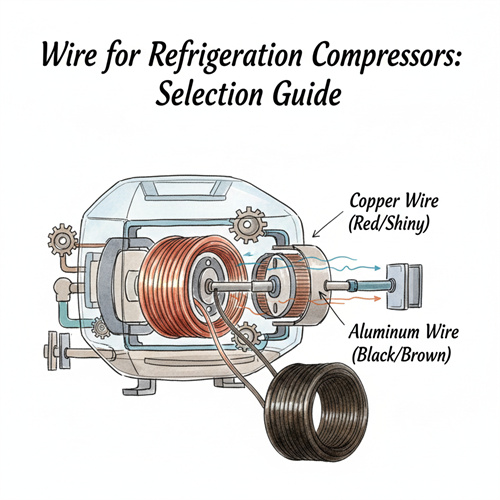
Copper conductor enameled wire: Excellent conductivity, low resistance, and fatigue resistance of the good. It is refrigeration compressor‘s first choice now, particularly for the high-capacity commercial machine.
Aluminium conductor enameled wire: Light-weight and low-cost. Its resistance is around 67% higher than CU which gives a much larger cross-sectional area for same power. Also coefficient of thermal expansion of aluminum is different from that of copper which causes poor contact at the joint after long term thermal cycling.
Conclusion: If you are manufacturing household refrigerators or small freezers, aluminum wire is a financially viable solution. If you plan to manufacture commercial or industrial refrigeration units, then copper wire is a must.
We have capacity in our factory for both types. Aluminum round wire as well as copper round wire specifications from 0.016mm to 7.0mm. We supply whatever our customer‘s require.
International Standards: Certifications You Must Know for Exporting to Overseas Markets
If you want to sell your compressors in the international market, enameled wire certification is essential. Several key certifications:
UL certification—The threshold for the North American market. Without the UL mark, compressors cannot enter the US and Canada.
RoHS compliance—EU market requirement. Restricts hazardous substances such as lead, mercury, and cadmium. This certification is now basically a global trend.
REACH compliance—EU chemical regulations. Requirements for coupling agents and plasticizers in insulating materials.
IEC 60317—International Electrotechnical Commission standard. This is a globally recognized technical specification, indicating parameters such as dimensions, insulation thickness, and withstand voltage.
Our factory’s products have passed UL, REACH, and RoHS compliance, and are fully certified under ISO9001, ISO14001, and ISO45001 standards. A customer last year exported a batch of refrigeration units to South Korea using our F-grade polyester imide enameled wire, which successfully passed local inspection.
Selection Checklist: Check These Points Before Ordering
I’ve compiled a simple checklist for your reference:
- Is the heat rating correct? Choose E/B grade for residential use, and F/H grade for industrial use.
- Is the enameled coating type suitable for your process? Do you need direct welding? Do you have ultrasonic equipment?
- Has the refrigerant type been confirmed? R134a, R410A, or R290? Different refrigerants have different requirements for enameled coating.
- Should the conductor material be copper or aluminum? What is the power rating? Are there any lightweight requirements?
- Are the certifications complete? Does the target market require UL, RoHS, and REACH?
- Are the specifications suitable? Round wire diameter range: 0.016-7.0mm; Flat wire thickness: 0.8-10mm; Width: 2-25mm.