

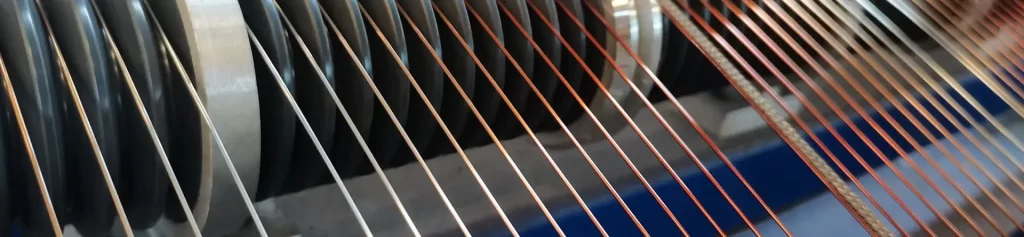
High Frequency Transformer (HFT) is a magnetic core component widely adopted in power electronic devices nowadays. Power electronic application such as switching power supply (SMPS), Photovoltaic inverter, on board charger (OBC) for new energy vehicle, communication power supply, LED driver etc., are HFTs. Compared to general traditional power frequency transformer (50/60Hz), the working frequency of HFTs is generally from dozens of KHz to several MHz, thus demands special considerations in the choosing of the winding wire due to the markedly higher operating frequency.
When the operating frequency is high, the proximity effect and the skin effect may cause the effective cross-section of the wire to decrease sharply and AC resistance to increase largely, and AC losses and the temperature to rise. Choosing the wire used scientifically and making rational design of the winding structure are a couple of important technical issues in high-frequency transformer design. This article is a systematic technical guiding book for high-frequency transformers design and purchasing decision making from the following eight dimensions: product definition, application scenario analysis, high frequency effect treatment, wire type decision, insulation system, manufacturing process, quality control, selection rule.
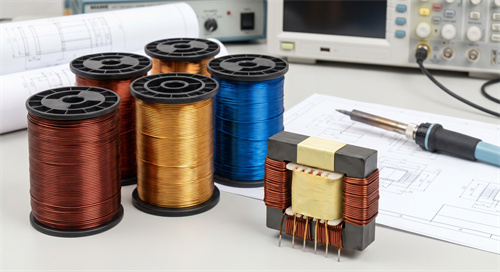
I. Product Definition of High-Frequency Transformer Winding Wire
High frequency transformer winding wire:electromagnetic wire for transformer winding working in hundred kHz and several MHz band, mainly include: enameled round wire, Litz wire, copper/aluminum foil and self-adhesive wire, etc.
Special Requirements for High-Frequency Transformer Windings:
- High-Frequency Low-Loss: Effective control of AC losses caused by skin effect and proximity effect
- Good Heat Dissipation Performance: High high-frequency losses make temperature rise control crucial
- Insulation Reliability: Partial discharge and insulation aging under high-frequency pulse voltage
- Manufacturability: Suitable for automated winding processes
II. Application Scenarios Analysis
2.1 Switching Power Supplies (SMPS)
Switching power supplies are the largest application market for high-frequency transformers:
Technical Requirements:
- Operating Frequency: 20kHz-500kHz
- Insulation Class: Class F/B
- Power Range: Several watts to tens of kilowatts
- Efficiency Requirement: ≥90%
2.2 Photovoltaic Inverters
High-frequency transformers in photovoltaic inverters are used for DC-DC conversion:
Technical Requirements:
- Operating Frequency: 20kHz-100kHz
- Insulation Class: Class F/H
- Outdoor Environment: Weather Resistance
- Long Lifespan: 25 years+
2.3 On-Board Charger (OBC)
On-board chargers for new energy vehicles:
Technical Requirements:
- Operating Frequency: 50kHz-200kHz
- Insulation Class: Class H
- High Power Density
- Automotive-Grade Reliability
2.4 Communication Power Supply
High-frequency switching power supply for communication equipment:
Technical Requirements:
- Operating Frequency: 100kHz-1MHz
- Insulation Class: Class F
- High Efficiency, Low Noise
2.5 LED Driver
LED lighting driver power supply:
Technical Requirements:
- Operating Frequency: 30kHz-150kHz
- Insulation Class: Class B/F
- Low Cost, Miniaturization
III. High-Frequency Effect Analysis
3.1 Skin Effect
High-frequency current tends to flow on the surface of the conductor, leading to a decrease in the utilization rate of the conductor’s central portion:
Impact:
- Reduced effective conductive cross-sectional area
- Increased AC resistance
- Increased losses, higher temperature rise
Skin Depth Formula:
δ = 66.1 / √f (mm), where f is the frequency (kHz)
Skin Depth at Different Frequencies:
| Frequency | Skin Depth (Copper) | Recommended Max Wire Diameter |
|---|---|---|
| 20kHz | 0.467mm | ≤0.9mm |
| 50kHz | 0.296mm | ≤0.6mm |
| 100kHz | 0.209mm | ≤0.4mm |
| 200kHz | 0.148mm | ≤0.3mm |
| 500kHz | 0.093mm | ≤0.18mm |
| 1MHz | 0.066mm | ≤0.13mm |
3.2 Proximity Effect
The magnetic fields generated by alternating currents in adjacent conductors influence each other, leading to uneven current distribution:
Impact:
- Increased additional AC losses
- Particularly severe in multilayer windings
- Closely related to winding arrangement
3.3 High-Frequency Loss Composition
Total losses of a high-frequency transformer = DC losses + Skin effect losses + Proximity effect losses
IV. Winding Wire Type Selection
4.1 Enameled Round Wire
The most commonly used high-frequency transformer winding wire:
Advantages:
- Low cost
- Mature winding technology
- Suitable for low-to-medium frequency applications (≤50kHz)
Limitations:
- Significant skin effect at high frequencies
- Requires smaller wire diameter
Applicable Scenarios: 20kHz-100kHz, low-power applications
4.2 Litz Wire
A special conductor made of multiple strands of insulated fine wires twisted together:
Advantages:
- Effectively overcomes skin effect and proximity effect
- Low high-frequency losses
- Suitable for high-frequency, high-power applications
Structural Types:
- Standard Litz Wire: Multiple strands of equal diameter twisted together
- Composite Litz Wire: Multi-layer twisted structure
- Self-Adhesive Litz Wire: With self-adhesive layer, easy to shape
Strand Diameter Selection:
| Operating Frequency | Recommended Single Strand Diameter |
|---|---|
| 20kHz-50kHz | 0.1mm-0.2mm |
| 50kHz-100kHz | 0.05mm-0.1mm |
| 100kHz-500kHz | 0.03mm-0.07mm |
| 500kHz-1MHz | 0.02mm-0.05mm |
Applicable Scenarios: 50kHz-1MHz, medium to high power applications
4.3 Copper/Aluminum Foil
Using foil instead of round wire as winding:
Advantages:
- Fully utilizes the window height direction
- Good heat dissipation performance
- Suitable for high current, low turn count applications
Limitations:
- Edge effect
- Complex winding process
Applicable Scenarios: High current, low turn count, low voltage output
4.4 Wire Type Selection Comparison
| Considerations | Enameled Round Wire | Litz Wire | Copper/Aluminum Foil |
|---|---|---|---|
| Applicable Frequency | ≤100kHz | 50kHz-1MHz | ≤200kHz |
| High Frequency Loss | Medium | Low | Low |
| Cost | Low | High | Medium |
| Winding Process | Simple | Medium | Complex |
| Heat Dissipation | Average | Average | Good |
| Applicable Power | Small-Medium | Medium-Large | Large |
V. Insulation System
5.1 Insulation Classes
Commonly used insulation classes for high-frequency transformer winding wires:
| Insulation Class | Maximum Operating Temperature | Typical Applications |
|---|---|---|
| Class B (130°C) | 130°C | Consumer Electronics, LED Drivers |
| Class F (155°C) | 155°C | Industrial Power Supplies, Communication Power Supplies |
| Class H (180°C) | 180°C | New Energy Vehicles, Photovoltaic Inverters |
5.2 Insulation Material Types
Polyurethane (PU) Enameled Wire:
- Thermal Class: Class B
- Direct solderable (no stripping required)
- Suitable for small high-frequency transformers
Polyester Imide (PEI) Enameled Wire:
- Thermal Class: Class F
- Electrical and mechanical properties good in electrical and mechanical characteristics.
Polyamide-Imide (PAI) Enameled Wire:
- Thermal Class: Class H
- Excellent heat and chemical resistance
- Suitable for new energy vehicles, photovoltaic inverters
5.3 High-Frequency Insulation Characteristics
Special insulation requirements under high-frequency pulse voltage:
Partial Discharge:
- High-frequency pulse voltage easily induces partial discharge
- Accelerates insulation aging
- Requires selection of insulating varnish resistant to partial discharge
Interlayer Insulation:
- Large interlayer voltage differences in multilayer windings
- Requires sufficient interlayer insulation thickness
VI. Key Manufacturing Processes
6.1 Conductor Preparation
Enameled Round Wire:
- Wire diameter accuracy: ±0.002mm
- Smooth surface, free of scratches
Litz Wire:
- Consistent single strand diameter
- Uniform strand pitch
- Intact insulation on each strand
6.2 Winding Process
Tight Winding:
- Reduces winding gaps
- Reduces leakage inductance
- Improves space utilization
Layered Winding:
- Controls interlayer insulation
- Optimizes winding arrangement
- Reduces proximity effect
6.3 Impregnation Treatment
Impregnation Process:
- Fills winding gaps
- Improves insulation strength
- Improves heat dissipation
- Reduces noise
VII. Quality Control
7.1 Raw Material Inspection
Conductor Inspection:
- Purity, conductivity
- Wire diameter tolerance: ±0.002mm
- Litz Wire: Number of strands, single strand diameter
Insulating Varnish Inspection:
- Breakdown Voltage
- Flexibility
- Enamel coating continuity (spark test)
- Heat Resistance
- Partial Discharge Resistance
7.2 Production Process Inspection
| Process | Control Points | Inspection Items |
|---|---|---|
| Wire Drawing | Compression Ratio, Die Condition | Wire Diameter Accuracy, Surface Quality |
| Annealing | Temperature Profile, Protective Atmosphere | Conductivity, Flexibility |
| Coating | Enamel Coating Thickness, Uniformity | Breakdown Voltage, Appearance |
| Baking | Temperature Profile, Time | Enamel Coating Curing Degree, Flexibility |
| Litz Wire Stranding | Number of Strands, Pitch | Stranding Uniformity, Insulation Integrity |
7.3 Factory Inspection
High-frequency transformer winding wires must undergo strict inspection before leaving the factory:
| Inspection Items | Requirements |
|---|---|
| Conductor Dimensions | Meets tolerance requirements |
| Breakdown Voltage | ≥ Specified Value |
| Flexibility | Passes Bending Test |
| Enamel Coating Continuity | Spark Test: No Breakdown |
| Heat Resistance | Passes Thermal Aging Test |
| High-Frequency AC Resistance Ratio | ≤ Specified Value |
VIII. Selection Guide
8.1 Operating Frequency Confirmation
Select wire type according to operating frequency:
- ≤50kHz: Enameled round wire (wire diameter ≤0.9mm)
- 50kHz-100kHz: Enameled round wire (wire diameter ≤0.6mm) or Litz wire
- 100kHz-500kHz: Litz wire (single strand diameter 0.03mm-0.1mm)
- 500kHz-1MHz: Litz wire (single strand diameter 0.02mm-0.05mm)
8.2 Power Rating Confirmation
Select according to power rating:
- Low Power (≤100W): Enameled round wire
- Medium Power (100W-1kW): Enameled round wire or Litz wire
- High Power (≥1kW): Litz wire or copper foil
8.3 Insulation Class Selection
Choose according to operating temperature and environmental conditions:
- Class B (130°C): Consumer electronics, LED drivers
- Class F (155°C): Industrial power supplies, communication power supplies
- Class H (180°C): New energy vehicles, photovoltaic inverters
8.4 Certification Requirements
Ensure products meet relevant certification requirements:
- UL: North American market
- IEC: International standards
- TÜV: European market
- RoHS: Environmental requirements
- AEC-Q200: Automotive-grade certification
Conclusion
Deciding the high frequency transformer winding wire has a great impact on the transformer efficiency, temperature rise, power density, and reliability. According to operating frequency, power level, application required, a scientific selection for winding wire types (enameled round wire, Litz wire, copper/ aluminum foil), insulation class, special performance (partial discharge resistance, direct solderability) etc.
The way to find quality high-frequency transformer is to cooperate with professional winding wire manufactures, and choose proper products according to requirement. Particularly for high frequency high power cases, proper Litz wire is capable of effectively reducing high frequency losses.