

What is Transformer Winding Wire
Introduction
Transformers are indispensable key equipment in the power system, undertaking the important tasks of voltage conversion and power transmission. The transformer winding wire, as the core component of the transformer, directly determines the electrical performance and service life of the transformer.
For technicians, procurement engineers, and related practitioners in the power industry, a deep understanding of the basics of transformer winding conductors is an important foundation for selection, procurement, and operation and maintenance work. This article will systematically introduce the basic definition, main types, core characteristics, and selection points of transformer winding conductors to help readers establish a complete knowledge system.
What is Transformer Winding Wire
Basic Definition
Transformer winding wire is a special conductive material used for winding transformer coils, usually with copper or aluminum as the conductor and an outer insulating layer. It plays a key role in carrying current, generating magnetic flux, and achieving voltage conversion in the transformer.
Structurally, transformer winding wire is mainly composed of two parts: conductor and insulating layer. The conductor is responsible for conducting current, while the insulating layer provides electrical isolation and protection, preventing short circuits between conductors at different potentials.
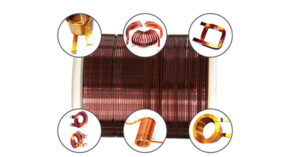
From a functional perspective, winding wires together with the iron core constitute the magnetic circuit and electrical circuit of the transformer, serving as the core carrier for power conversion. Without high-quality winding conductors, reliable transformers cannot be manufactured.
Core Functions
Carrying Load Current: The winding conductor needs to carry the transformer’s rated load current while maintaining stable conductive performance during continuous operation. The size of the load current determines the selection of conductor cross-sectional area.
Generating Magnetic Flux: When current passes through the winding, alternating magnetic flux is generated in the iron core, achieving electromagnetic induction. This is the fundamental principle of transformer operation and the essential purpose of winding wires.
Voltage Transformation: Voltage is increased or decreased through combinations of windings with different numbers of turns. More turns result in higher output voltage. This principle makes transformers key equipment in power systems.
Heat Dissipation: Winding conductors generate heat when carrying current, which must be effectively dissipated through the insulation and cooling systems. Good thermal conductivity is essential for ensuring long-term safe transformer operation.
Main Types of Transformer Winding Wire
Classification by Conductor Material
Copper Winding Wire
Copper is currently the most commonly used conductor material for transformer windings, dominating the power transformer field. Copper wire has excellent electrical conductivity, low resistivity, and high current-carrying capacity, meeting the requirements of various transformers.
The advantages of copper wire include: high conductivity, approximately 1.6 times that of aluminum, meaning copper wire can carry larger current at the same cross-sectional area; high mechanical strength, easy to wind and process, suitable for automated production line requirements; good corrosion resistance, providing very long service life under normal operating environments.
Copper wire is widely used in various power transformers, special transformers, and applications requiring high reliability. Copper wire is almost the only choice for high-voltage and ultra-high-voltage transformers.
Aluminum wire, with its cost advantages and lightweight characteristics, is widely used in some transformers, especially in distribution transformers and high-current transformers.
The characteristics of aluminum wire include: light weight, approximately 30% that of copper, which can significantly reduce the overall weight of large transformers; low cost, good economy, with obvious cost advantages in large-scale applications; electrical conductivity approximately 60% that of copper, so larger cross-sectional area is required for the same current.
Aluminum wire is typically used in distribution transformers, high-current transformers, and cost-sensitive application scenarios. Aluminum wire also has applications in some lightweight requirement areas such as furnace transformers.
Classification by Insulation Method
Enameled Wire
Enameled wire is a winding wire formed by coating and baking insulating paint on the conductor surface. It is one of the most widely used winding materials in motors and transformers.
The characteristics of enameled wire include: thin insulation layer, high slot fill rate, enabling more turns in limited space; heat resistance rating depends on the type of paint, commonly 130, 155, and 180 class; commonly used in dry-type transformers, small transformers, and various motor windings.
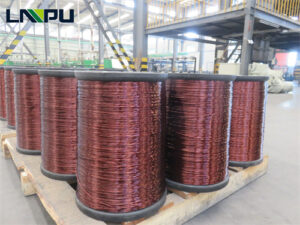
Enameled wire has mature manufacturing technology, stable product quality, and complete specifications, meeting the needs of different applications.
Paper Covered Wire
Paper covered wire is a winding wire with insulating paper wound around the conductor, typically requiring oil immersion treatment for optimal performance.
The characteristics of paper covered wire include: reliable insulation performance, with significantly improved insulation performance after oil immersion with transformer oil; heat resistance rating can reach Class A to Class H, meeting requirements of different temperature environments; widely used in oil-immersed power transformers, the most important transformer type in power systems.
The number of insulating paper layers for paper covered wire can be flexibly adjusted according to voltage level, from several layers for low voltage to dozens for high voltage, forming a complete insulation system.
Fiberglass Wire
Fiberglass wire has a fiberglass braid or wrapping on the outside, offering excellent high-temperature resistance and mechanical properties.
The characteristics of fiberglass wire include: heat resistance rating up to 550°C, far exceeding organic insulation materials; high mechanical strength, excellent vibration resistance, suitable for harsh operating environments; commonly used in high-temperature environments or special transformers such as furnace transformers and traction transformers.
Fiberglass wire also has excellent weather resistance and chemical corrosion resistance, providing irreplaceable advantages in special environments.
Core Performance Indicators
Electrical Performance
Resistivity: Resistivity is a key parameter for measuring conductor conductivity. Copper’s resistivity is approximately 0.01724 Ω·mm²/m (at 20°C), while aluminum’s resistivity is approximately 0.0282 Ω·mm²/m. Lower resistivity means better conductivity and lower energy loss.
Current Carrying Capacity: The amount of current a conductor can carry per unit cross-sectional area. Current carrying capacity is closely related to conductor cross-sectional area, heat dissipation conditions, insulation class, and ambient temperature. Appropriate margins must be reserved in design to ensure safe long-term operation.
Insulation Performance
Dielectric Strength: The maximum electric field intensity that insulating material can withstand, usually expressed in kV/mm. Higher dielectric strength means better insulation performance. When paper covered wire is used with transformer oil, dielectric strength can be significantly improved.
Heat Resistance Class: The maximum operating temperature that insulating material can withstand for extended periods. Common heat resistance classes include Class A (105°C), Class B (130°C), Class F (155°C), and Class H (180°C). Selecting the appropriate heat resistance class is key to ensuring transformer life.
Dielectric Loss: The energy consumed by insulating material in an alternating electric field, usually expressed as tanδ. Lower dielectric loss means higher insulation efficiency and more energy-efficient operation.
Mechanical Performance
Tensile Strength: The maximum stress a conductor can withstand under tension. Tensile strength affects winding process feasibility and short-circuit withstand capability. Power transformer windings must withstand tremendous electromagnetic force during short circuits, so high tensile strength is required.
Elongation: The plastic deformation ability of a conductor before breaking. Appropriate elongation facilitates winding formation while ensuring certain flexibility.
Bending Performance: The bending ability of a conductor, usually expressed as the minimum bending radius. Bending performance affects the design of winding processes and the quality of coil formation.
Selection Guidelines
Selection by Voltage Level
Low Voltage Transformers (below 1000V): Enameled wire or paper covered wire can be selected, with relatively thin insulation, simple manufacturing process, and economical cost.
Medium Voltage Transformers (3-35kV): Paper covered wire or composite insulated wire is recommended. Insulation thickness must meet dielectric strength requirements for the corresponding voltage level, typically requiring 2-5 layers of insulating paper.
High Voltage Transformers (66kV and above): Multi-layer paper insulated or other high-grade insulation forms must be adopted, with special insulation design including end reinforcement and oil duct arrangement.
Selection by Capacity
Small Capacity Transformers: Enameled wire or thin-insulation paper covered wire can be selected, economical cost and simple manufacturing process, suitable for batch production.
Medium Capacity Transformers: Paper covered round wire or flat wire is recommended, offering good overall performance balance of electrical, mechanical properties and cost.
Large Capacity Transformers: Large cross-section paper covered flat wire must be selected, with heat dissipation duct design considered to ensure temperature rise stays within allowable limits.
Selection by Operating Environment
Indoor Environment: Standard insulation class meets requirements without special protective measures.
Outdoor or Humid Environments: Enhanced moisture-proof design is needed. Moisture-proof insulated structures can be selected, or pre-drying measures can be taken.
High Temperature Environments: High heat resistance class insulating materials such as Class F or Class H insulation, and fiberglass wire, must be selected.
Salt Fog or Corrosive Environments: Special anti-corrosion measures must be taken, such as adding protective coatings or selecting corrosion-resistant materials.
Manufacturing Process
Conductor Manufacturing
Wire Drawing Process: Metal ingots are processed into wires of required diameter through multiple wire drawing dies. During the wire drawing process, dimensional accuracy and surface quality must be strictly controlled to ensure uniformity of conductor diameter.
Annealing Treatment: After wire drawing, conductors must undergo annealing treatment to eliminate work hardening and restore softness, facilitating subsequent winding. Annealing process parameters must be precisely controlled according to material and specifications.
Insulation Manufacturing
Enameling Process: The conductor passes through an insulating paint tank and forms a uniform paint film in a drying oven. The enameling process requires control of paint film thickness and uniformity, as well as curing degree.
Paper Wrapping Process: Insulating paper tape is wound around the conductor through paper wrapping equipment. Paper tension, overlap rate, and number of layers must be controlled. The quality of the paper wrapping process directly affects insulation performance and reliability.
Fiberglass Braiding Process: Fiberglass yarn is braided on the outer layer of the conductor through a special braiding machine to form a braided protective layer. Braiding density and uniformity are the main quality control points.
Quality Testing
Dimensional Testing: Precise measurement of conductor diameter, insulation thickness, wire outer diameter, and other geometric dimensions to ensure compliance with specifications.
Electrical Performance Testing: Resistivity testing, dielectric strength testing, insulation resistance testing, etc., to verify that electrical performance meets standards.
Mechanical Performance Testing: Tensile strength testing, elongation testing, bending testing, etc., to ensure mechanical performance meets process and application requirements.
Appearance Testing: Visual inspection of surface quality and insulation layer continuity, as well as necessary microscopic inspection.
Application Cases
Power Transformers
In power transformers, winding wire must withstand high voltage, high current, and short-circuit electromagnetic forces. Paper covered flat wire is typically selected for high-voltage windings, while paper covered round or flat wire is selected for low-voltage windings. Wire cross-section is determined based on load current and current density calculations.
Distribution Transformers
Distribution transformers are produced in large quantities and are cost-sensitive. Aluminum winding wire is often selected to reduce costs, or copper winding wire is selected to ensure long-term reliability. In recent years, aluminum foil wire for wound-core transformers has also been widely used.
Special Transformers
Special transformers include furnace transformers, rectifier transformers, phase-shifting transformers, etc., which have special requirements for winding wire. Appropriate wire types and specifications must be selected according to specific applications. For example, furnace transformers require high-temperature resistant fiberglass wire.
FAQ
Q1: What are the advantages and disadvantages of copper vs. aluminum winding wire?
The advantages of copper wire are: good electrical conductivity, low resistance, and low energy loss; high mechanical strength, suitable for high current and short-circuit stress; good corrosion resistance and long service life. The disadvantages are higher cost and greater weight. The advantages of aluminum wire are lower cost and light weight; the disadvantage is poorer electrical conductivity, requiring larger cross-sectional area. When selecting, consider performance requirements, budget, and weight constraints comprehensively.
Q2: Why does paper covered wire require oil immersion treatment?
After paper covered wire is immersed in oil, the oil fills the pores of the insulating paper and gaps between insulation layers, greatly improving insulation performance and heat dissipation. Transformer oil has excellent electrical insulation performance and thermal conductivity, making it an indispensable part of the oil-immersed transformer insulation system. Oil immersion treatment also effectively prevents insulating paper from absorbing moisture, extending insulation life.
Q3: How to determine the heat resistance class of winding wire?
The heat resistance class can be confirmed by checking product technical documentation, test reports, or standard specifications. Common heat resistance class markings are: Class A (105°C), Class B (130°C), Class F (155°C), Class H (180°C). The heat resistance class indicates the temperature at which the insulating material can operate stably for extended periods without significant performance degradation.
Q4: What should be noted when storing winding wire?
Winding wire should be stored in a dry, ventilated environment free from corrosive gases. Avoid moisture, rain, or direct sunlight. Insulating materials absorb moisture in humid environments, affecting insulation performance. Store in original packaging when possible, and check that the insulation layer is intact before use. Storage temperature and humidity should meet the requirements of the product technical documentation.
Conclusion
As the core material of transformers, the quality and performance of transformer winding wire is directly related to the safe operation and service life of transformers. In actual selection and application, factors such as voltage level, capacity requirements, operating environment, and cost must be comprehensively considered to select the most suitable winding wire type and specifications.
With the development of the power industry and increasing requirements for energy efficiency, winding wire is also continuously evolving toward high performance, high reliability, and environmental friendliness. A thorough understanding of the basics of winding wire is helpful for better equipment selection and technical decision-making.
Contact Information
Email: office@cnlpzz.com
WhatsApp: 0086-19337889070
This article was compiled by Zhengzhou LP Industry Co., Ltd., which has focused on the research and manufacturing of electrical magnet wire and special conductors for thirty years.