

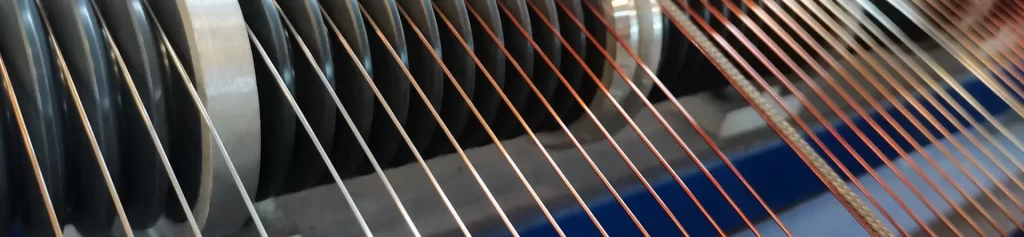
The short answer: enameled aluminum wire and enameled copper wire wear almost identical enamel coatings — the difference lies entirely in the conductor. Copper conducts about 40% better than aluminum, while aluminum is only 30% as dense. Behind that one sentence sits a whole chain reaction: winding dimensions, slot fill factor, end-winding heat, soldering process, and cost structure.
If you are selecting wire for a motor, a transformer, or a power supply, this guide will help you work out the actual answer to “aluminum or copper.”
Basic Definitions of Enameled Aluminum Wire and Enameled Copper Wire
Enameled wire (also called magnet wire or winding wire) is a conductor coated with multiple layers of insulating enamel. The enamel provides electrical insulation, resistance to chemical media, and mechanical strength to survive winding and insertion into slots.
Enameled copper wire uses electrolytic copper or oxygen-free copper as the conductor, while enameled aluminum wire uses electrical-grade aluminum rod. The comparison below covers the two materials as finished products, since a buyer selects complete enameled aluminum wire against complete enameled copper wire rather than bare conductor. The coating on the outside can be the same one — polyester enameled wire (PEW/QZ), polyurethane enameled wire (UEW/QA), polyester-imide (EIW/QZXY), and polyamide-imide (AIW/QZY) are all readily available on both aluminum and copper conductors.
Under the IEC 60317 system, enamelled aluminum round wire follows the general requirements of IEC 60317-0-3, with test methods performed according to IEC 60851. North America corresponds to NEMA MW 1000, and Japan corresponds to JIS C 3202. The insulation classes are shared: Class E 120°C, Class B 130°C, Class F 155°C, Class H 180°C, Class 200 200°C, Class 220 220°C.
This is the first and most important realization: the enamel coating is not the point of difference between enameled aluminum wire and enameled copper wire. On the same Class H motor, PEW enameled aluminum wire and PEW enameled copper wire can have an identical insulation system, thermal class, and breakdown voltage requirement. What actually needs to be calculated lives on the conductor side.
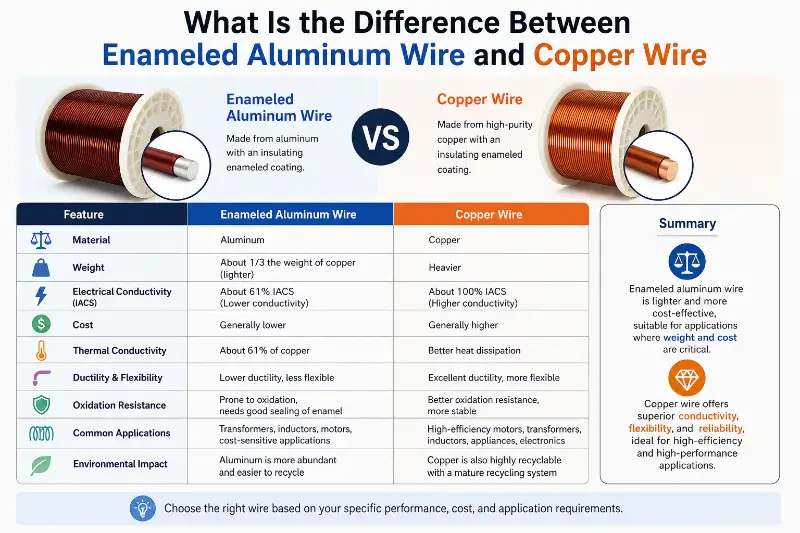
Core Physical Parameter Comparison of Enameled Aluminum Wire and Copper
Put the two conductors’ basic data side by side. This table is the starting point for every derivation that follows, and it is the single most useful page to print when comparing enameled aluminum wire and enameled copper wire.
| Parameter | Enameled Copper Wire | Enameled Aluminum Wire | Practical Effect |
|---|---|---|---|
| Density | 8.89 g/cm³ | 2.70 g/cm³ | At equal resistance, aluminum weighs about 61% of copper |
| Resistivity (20°C) | 0.0172 Ω·mm²/m | 0.0283 Ω·mm²/m | Aluminum has roughly 64% higher DC resistance |
| Conductivity (IACS) | 58% | 61% | Aluminum’s conductivity per unit area is marginally lower |
| Elastic modulus | 110–130 GPa | 69–72 GPa | Aluminum deforms permanently more easily during winding |
| Tensile strength (annealed) | approx. 200–250 MPa | approx. 70–110 MPa | Aluminum has a much smaller mechanical margin |
| Coefficient of linear expansion | 17 × 10⁻⁶ /K | 23 × 10⁻⁶ /K | Aluminum expands more noticeably with temperature |
| Thermal conductivity | 385 W/(m·K) | 235 W/(m·K) | Aluminum dissipates heat slightly less well |
| Maximum continuous operating temperature | Set by enamel thermal class | Set by enamel thermal class | Identical — no difference |
Look at the conductivity row. Aluminum at 61% IACS is actually slightly higher than copper at 58% IACS — that is the theoretical limit of the pure metals. But enamelled copper wire is normally calculated at 58% IACS and aluminum wire at 61%. The real gap comes from resistivity (resistance at a given cross-section) and density (weight at a given resistance).
The 1.6x Cross-Section Rule for Enameled Aluminum Wire
This is the single most useful rule in the entire comparison.
Aluminum’s resistivity is 1.64 times that of copper, and this single fact governs how enameled aluminum wire is specified against enameled copper wire in every drawing. To reach the same DC resistance, the aluminum conductor cross-section must be 1.6 times that of the copper conductor. Converted to diameter, aluminum wire is about 1.26 times the diameter of copper wire.
The Magnet wire entry on Wikipedia states exactly this: aluminum wire requires a 1.6-times larger cross-sectional area than copper wire to achieve comparable DC resistance. This is not vendor marketing — it falls straight out of the two resistivity numbers above.
The Chain Reaction of a 1.6x Diameter in Enameled Aluminum Wire
Cross-sectional area doubles, but diameter only grows 26%. That sounds manageable, yet it triggers a series of consequences in real products:
- Slot fill factor drops. In the same stator slot, 1.0 mm copper wire has to become 1.26 mm aluminum wire. The finished outside diameter is larger, so more slot volume is consumed. Maintaining the same fill factor forces a larger slot profile or fewer winding layers.
- End winding grows. A conductor 26% thicker changes the end-winding spread dimensions, insulation supports, and banding strength. The end winding must be redesigned.
- Heat concentrates at the ends. Aluminum’s higher resistivity means more heat in the same current. The end region is where heat is already densest, and how it is handled directly determines motor life.
- Insertion tooling changes. Slot openings, wedges, and forming tools all need to match the new outside diameter.
Set against this, aluminum saves close to 40% in weight. For traction motors, power tools, and portable equipment, that number is extremely attractive — battery energy, overall machine weight, and handling cost all benefit.
Winding Dimensions and Efficiency: Enameled Aluminum Wire vs Copper
Take a typical 7.5 kW three-phase induction motor. At equal rated output and equal copper-loss target, the design differences between an enameled aluminum wire winding and an enameled copper wire winding are very direct.
| Design Item | Copper Winding | Aluminum Winding | Note |
|---|---|---|---|
| Conductor cross-section (relative) | 1.00 | 1.64 | Aluminum needs the larger cross-section |
| Conductor diameter (relative) | 1.00 | 1.26 | Square root of 1.6 |
| Winding weight (relative) | 1.00 | 0.60 | Aluminum saves about 40% |
| Slot fill factor (same slot) | 100% | approx. 87% | Aluminum wire occupies more space |
| Inductance L (same turns) | 1.00 | 0.61 | Driven by turns squared and geometry |
| Reactance | Baseline | Lower | Inductance falls, reactance follows |
| Full-load efficiency (typical) | Baseline | 0.5–1.5 percentage points lower | Additional iron and stray losses offset part of the weight saving |
| Power density | Baseline | Lower | Copper delivers more output in the same volume |
The inductance drop is routinely overlooked. An aluminum winding has roughly 61% of the inductance of a copper winding, which affects magnetizing current, starting behavior, and harmonic performance under variable-frequency drive. If the motor is inverter-driven, the lower inductance increases current ripple and demands a more demanding control strategy from the drive.
The efficiency gap is smaller than most people expect. Aluminum windings have higher DC resistance, but they also dissipate the same heat over a longer conductor, while end-winding leakage and harmonic losses may increase. Engineering practice generally puts aluminum-wound motor efficiency 0.5–1.5 percentage points below copper, with a weight reduction of 35–40%.
That is the real value proposition of an aluminum winding: not cheaper electricity, but a lighter machine.
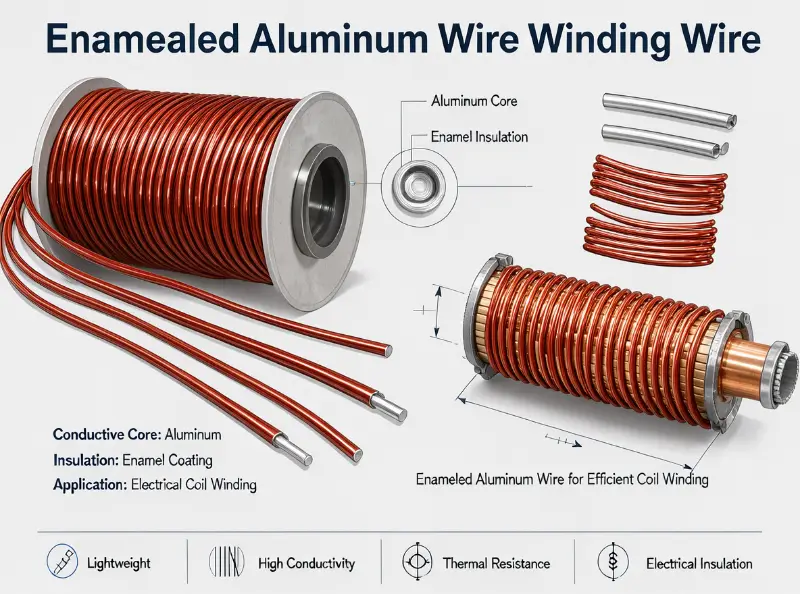
Cost Structure Comparison of Enameled Aluminum Wire and Copper
The cost gap between enameled aluminum wire and enameled copper wire comes from three parts, and understanding which one dominates is what makes a credible enameled aluminum wire quotation.
Raw material price. Aluminum typically costs only 30–40% of copper per ton, and this is the largest single factor separating enameled aluminum wire from enameled copper wire on a quotation. Copper prices fluctuated sharply between 2024 and 2026, and the advantage widens at the peaks.
Cost per unit of resistance. This is where people miscalculate. Producing 1 ohm of resistance in aluminum requires 0.61 times the material weight that copper needs, and aluminum costs less per kilogram. Multiply those two together and aluminum typically holds a 60–75% advantage in cost per unit resistance.
Processing and yield. Aluminum is more ductile and draws more easily, but aluminum wire is scrapped more often during winding and soldering — oxide film, breakage, and jointing problems all add rework. This eats into the raw material advantage.
Combined, at equal DC resistance, enameled aluminum wire typically comes out 35–60% cheaper overall than enameled copper wire. The higher the copper price, the wider that gap.
Mechanical Properties and the Winding Process of Enameled Aluminum Wire
Aluminum’s elastic modulus is about 55% of copper’s, and its tensile strength is about 40%. Understanding this is what separates a workable enameled aluminum wire winding from a failed one. Two direct consequences follow.
Less springback, easier to form. A tightly wound aluminum winding springs back less, which helps slot positioning. The flip side is that aluminum also has a lower threshold for permanent deformation — excessive winding tension will simply flatten the conductor, damage the internal crystal lattice, and reduce the effective conductive cross-section.
A smaller tensile allowance. Copper wire sees roughly twice the tensile stress during winding and still has that much margin. Aluminum wire runs much closer to its limit. Tension control precision on the winding machine therefore has to be higher, and the tension feedback on the bobbin and guide rollers needs finer adjustment.
Jointing is the real headache. The oxide layer that naturally forms on aluminum has a melting point of about 2050°C, far above ordinary solder. Conventional soldering will always fail. Industry has three mature solutions:
- Mechanically scraping off the oxide film and soldering immediately, using a dedicated aluminum flux
- Aluminum solder paste containing active ingredients that break down the oxide layer
- Cold crimping plus bolt fastening, or aluminum-copper transition terminals
This has a significant effect on the production line. If the workshop only has soldering equipment and ordinary solder, switching to enameled aluminum wire means rebuilding the soldering station, adding aluminum-specific consumables, and rewriting the process documentation. Many people underestimate this hidden cost.
Solderability and Termination of Enameled Aluminum Wire
The solderability of enameled aluminum wire depends on both the enamel coating and the conductor, and this is where enameled aluminum wire diverges most sharply from enameled copper wire on the shop floor. Solderable polyurethane enameled wire (UEW/QA) is designed so that the underlying enamel vaporizes at around 470°C, leaving only the bare metal solderable surface.
- Enameled copper wire: strip the outer enamel and copper can be soldered directly.
- Enameled aluminum wire: after stripping, the aluminum oxide film still has to be dealt with, using aluminum solder paste or a scraping treatment.
If a non-solderable coating such as polyester-imide or polyamide-imide (EIW/QZXY, AIW/QZY) is used, the enamel must be mechanically removed with strippers for both copper and aluminum. In that case the aluminum oxidation problem becomes more prominent — mechanical stripping scratches the aluminum surface and exposes fresh metal, but the residual oxide layer still interferes with the joint.
Conclusion: where termination is mainly hand soldering, enameled copper wire is clearly easier. In high-volume automatic terminal crimping or cold crimping, the difference between aluminum and copper is small.
Thermal Class and Enamel Coating Systems for Enameled Aluminum Wire
The thermal class of enameled aluminum wire and enameled copper wire is set entirely by the enamel coating. On this point there is no difference at all.
| Enamel System | Designation | Common Thermal Classes | Aluminum Conductor | Copper Conductor |
|---|---|---|---|---|
| Polyurethane | UEW / QA | 130, 155, 180 | Available | Available |
| Polyester | PEW / QZ | 155, 180 | Available | Available |
| Polyester-imide | EIW / QZXY | 180, 200 | Available | Available |
| Polyamide-imide | AIW / QZY | 200, 220 | Available | Available |
| Polyester/polyester-imide over polyamide-imide | — | 200, 220, 240 | Available | Available |
Take Class 200 polyester/polyester-imide over polyamide-imide aluminum round wire as an example: the thermal class requires a minimum temperature index of 200 and a thermal shock temperature of at least 220°C, extractable material content not exceeding 0.5%, and a post-thermal-shock breakdown voltage of at least 75% of the specified value. The softening breakdown temperature of polyamide-imide enamel is typically above 330–350°C, so even though the official rating is 220°C, the internal enamel stress stays extremely low under thermal shock above 200°C and the film never cracks.
These same performance figures hold on an aluminum conductor. Choosing aluminum means making no compromise on thermal class.
Winding Fill Factor and Slot Design with Enameled Aluminum Wire
This is the item that has to be recalculated most carefully in an aluminum winding design.
Fill factor = total insulated conductor cross-section / effective slot cross-section. This is the number that decides whether enameled aluminum wire or enameled copper wire fits the slot you already have.
A copper wire design typically lands at 75–85% fill factor with round wire. Because aluminum wire has a 26% larger outside diameter, the same slot drops to 65–75%. There are two engineering routes:
Route one: enlarge the slot. Slot area increases by roughly 25–30%, and the core diameter or length grows accordingly. That partially cancels the weight saving from the lighter conductor — the core eats back part of what the conductor saved. The design has to add it up properly.
Route two: optimize the insulation structure. Use a thinner film grade (Grade 1 rather than Grade 2 or 3) to compress the outside diameter, or switch to rectangular wire for better packing. Rectangular wire achieves width-to-thickness ratios from 2:1 to 9:1, and aluminum rectangular wire packs noticeably more efficiently in the slot than round wire.
Film grade (Grade 1/2/3) describes enamel thickness and is an orthogonal concept to thermal class. Grade 1 is the thinnest with a lower breakdown voltage requirement; Grade 3 is the thickest with the strongest breakdown performance. Selecting Grade 1 on an aluminum conductor recovers part of the fill factor, but you must re-verify that the breakdown voltage and the post-thermal-shock retention rate still meet requirements.
Application Scenario Selection for Enameled Aluminum Wire
The trade-off logic between enameled aluminum wire and enameled copper wire is completely different in each application.
Traction motors and EV drive motors — aluminum wins most clearly. Weight directly determines range and energy consumption, but aluminum wire demands a hairpin winding, rectangular conductor construction, reinforced end-winding retention, and waterproof plus vibration-resistant treatment on the end windings.
Large motors and generators — aluminum windings are already very common above several hundred kilowatts, where the weight saving and cost control pay off. Aluminum in the stator winding is a mature solution.
Oil-immersed transformers — aluminum is the classic choice. Class 120 enamelled aluminum wire is used extensively in oil-immersed transformers for weight and cost reasons, and the transformer oil mitigates both the oxidation and the connection problems of aluminum.
High-frequency transformers, inductors, and chokes — copper is clearly better here. The higher the frequency, the more severe the skin effect and proximity effect, the more aluminum’s conductivity advantage erodes, and the more winding loss rises. Specify copper for high-frequency work.
Household appliance motors (air conditioner compressors, refrigerators, washing machines, fans) — aluminum wire is extremely widespread in compressors and appliance motors. These designs are cost-sensitive and weight-insensitive, which makes this the highest-penetration territory for aluminum.
Variable-frequency drive motors — proceed with care. Aluminum winding inductance falls by about 39%, current ripple increases, and the drive’s vector control and harmonic suppression have to work harder to compensate.
Small and miniature motors — use copper. The cross-section is small and the current is low, so aluminum’s weakness in strength is amplified and the reliability risk at the joint is higher.
Power tools and handheld devices — use aluminum. The weight saving converts directly into product competitiveness.
Commonly Confused Concepts About Enameled Aluminum Wire
This section matters because procurement conversations about enameled aluminum wire are often led astray by sales language.
Enameled aluminum wire is not the same product as copper-clad aluminum wire (CCA), and the distinction matters for anyone specifying enameled aluminum wire against a copper-clad alternative. CCA is an aluminum core with a thin copper skin applied by electroplating or metallurgical bonding, where copper typically makes up only 10–15%. That low copper content means overall conductivity far below pure copper, limited cost savings, and connection reliability close to aluminum. ASTM B566 defines only four classes: 10A (10% copper, annealed), 15A (15% copper, annealed), 10H (10% copper, hard drawn), and 15H (15% copper, hard drawn). Products on the market claiming 20%–40% copper content fall outside those four standard classes and must be agreed separately in the technical protocol.
Enameled aluminum wire is not bare aluminum with paint applied afterwards. Enameled wire is a continuous process formed in one pass with multiple applied and baked coats, under strict control of film thickness and adhesion. When buying “painted aluminum wire,” confirm whether it is factory enameled or post-processed.
Enameled copper wire is not the same as oxygen-free copper. Oxygen-free copper (OFC) has oxygen content ≤0.03%, slightly better conductivity and ductility, and costs about 10–20% more, so it is used where requirements are high. Ordinary electrolytic copper enameled wire is entirely adequate for motor windings.
Thermal class is not film grade. Thermal class (Class 155/180/200/220) describes the temperature index. Film grade (Grade 1/2/3) describes enamel thickness. They are orthogonal — do not mix them up in a conversation.
Supplier Evaluation and Specification Checklist for Enameled Aluminum Wire
To get enameled aluminum wire that can actually go into production, the specification has to state at least the following items.
Conductor and geometry
– Conductor material: electrical aluminum or electrical copper, with the alloy designation stated (E51461 or equivalent for aluminum)
– Nominal conductor diameter and tolerance (round wire typically 0.016–7.0 mm)
– Finished outside diameter range after enameling
– Rectangular wire thickness and width (0.8–10 mm thick, 2–25 mm wide) and the width-to-thickness ratio
– Film grade 1, 2, or 3
Insulation system
– Enamel type (PEW / UEW / EIW / AIW and so on)
– Thermal class and temperature index
– Breakdown voltage requirement
– Thermal shock temperature and post-thermal-shock breakdown retention (not less than 75% of the specified value)
– Pinhole test method and acceptance criteria
Governing standards
– IEC 60317-0-3 / IEC 60851 / NEMA MW 1000 / JIS C 3202 / GB/T 6109
– Test methods and acceptance procedure
Supplier support
– Solderability verification method (particularly critical for aluminum)
– Documents supplied with the shipment: material certification, test reports, RoHS and REACH declarations
– Packaging: spool format, weight per spool, moisture protection
– Whether winding machine trial runs are available
When requesting a quotation, asking directly “which terminals are these soldered to, and with what soldering process” is far more valuable than asking “can you make enameled aluminum wire.”
Conclusion: How to Choose Enameled Aluminum Wire or Copper Wire
Sort the decision by current density requirement, weight sensitivity, and cost weighting. The following applies equally to enameled aluminum wire and enameled copper wire enquiries.
Choose copper when: you need high power density or a compact structure (the slot cannot be enlarged); the application is high-frequency (high-frequency transformers, inductors, chokes, switch-mode power supplies); the motor is inverter-driven and of small-to-medium size; the cross-section is small and the current low, as in miniature motors; termination is mainly hand soldering; or the design needs very low resistance or very low inductance.
Choose aluminum when: weight is the first priority (traction motors, power tools, generators); cost dominates on large motors and oil-immersed transformers; the application is compressor or appliance motors; the stator line needs a large-volume cost reduction; or the slot has room to grow.
Either works for: medium and large industrial motors, winding lines that already have aluminum soldering capability, and prototype stages where a fast side-by-side comparison is needed.
One last warning: if you select aluminum, recompute the end-winding design, the soldering process, and the slot. Do not swap the conductor material and go straight into production. Those three areas are the real risk points of an aluminum winding project. We at Zhengzhou LP Industry Co.,Ltd. — 30 years of magnet wire export experience, a 60-acre self-owned plant, and SGS-audited ISO 9001, ISO 14001, and ISO 45001 systems — can provide comparative sample testing and winding trial support on both copper and aluminum conductors. Our range covers round wire 0.016–7.0 mm, rectangular wire 0.8–10 mm × 2–25 mm, and thermal classes 155, 180, 200, 220, and 240. If you have a selection question, talk to us directly — technical email office@cnlpzz.com, WhatsApp 0086-19337889070.