

Introduction
Magnet wire serves as an irreplaceable foundational material in electrical applications and constitutes the core link connecting electrical engineering, magnetic components, power electronics, and new-energy equipment. As the electromagnetic winding carrier for magnetic components, enameled wire is applied across virtually all electrical fields involving electromagnetic energy conversion and signal processing. Its applications range from small motors in household appliances to large motors in industrial equipment, from power transformers in power systems to high-frequency transformers in switch-mode power supplies, from traction motors for new-energy vehicles to traction motors for rail transit systems, and from servo systems in industrial robots to specialized equipment for aerospace applications. In electrical applications, enameled wire fulfills critical functions including electromagnetic energy conversion, signal transmission, electrical isolation, and mechanical protection.
From the perspective of electrical engineering practice, the engineering value of magnet wire extends far beyond its function as a simple conductor. Magnet wire not only conducts electric current but also fulfills multiple engineering functions—including electrical insulation, electromagnetic coupling, mechanical protection, and resistance to environmental stresses. The conductor material, enamel system, thermal class rating, and dimensional accuracy of magnet wire collectively define the performance boundaries of electrical applications. Understanding the core applications and application domains of magnet wire in electrical systems is essential knowledge for electrical engineers, procurement managers for magnetic components, new-energy-vehicle engineers, power supply engineers, and transformer/motor manufacturers.
The Applications of Magnet Wire in Electrical Applications are systematically elaborated from eight perspectives: core functionality of magnet wire, motor applications, transformer applications, inductor and magnetic component applications, household appliance applications, new energy and rail transit applications, aerospace and special applications, and fundamental selection criteria for magnet wire applications. This article serves as a systematic engineering reference for electrical engineers, procurement managers of magnetic components, new energy vehicle engineers, power supply engineers, transformer/motor manufacturers, and industry newcomers.
Core Functions of Magnet Wire
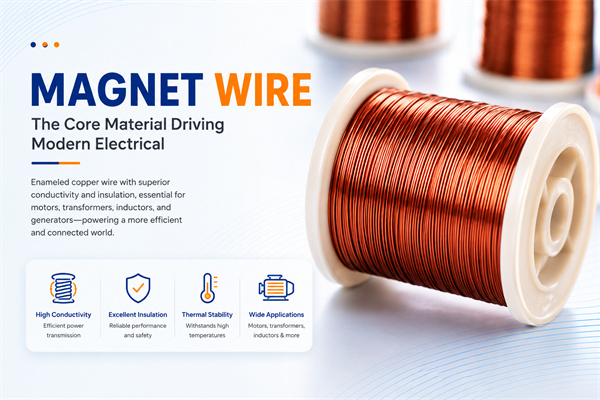
Enameled wire performs multiple core functions in electrical applications, and understanding these functions forms the foundation for comprehending enameled wire applications.
Electromagnetic Induction and Electromagnetic Conversion
The primary function of magnet wire is to enable electromagnetic induction and electromagnetic conversion. When current flows through a coil wound with magnet wire, a magnetic field is generated; the magnetic field strength is determined by the magnitude of the current, the number of coil turns, and the coil’s geometric configuration. A time-varying magnetic field induces an electromotive force (EMF) in adjacent coils, thereby enabling electromagnetic energy transfer from the primary to the secondary side. Motors utilize magnet wire windings to convert electrical energy into mechanical energy; transformers employ magnet wire windings to achieve voltage transformation and electrical isolation; and inductors use magnet wire windings for magnetic energy storage.
Electromagnetic induction and electromagnetic conversion constitute the fundamental basis for magnet wire applications. Virtually all magnetic components—including motors, transformers, inductors, relays, sensors, and solenoids—rely on the electromagnetic induction and electromagnetic conversion capabilities of magnet wire. The electromagnetic conversion efficiency of magnet wire directly affects the performance and efficiency of magnetic components.
Insulation Protection
The second core function of magnet wire is insulation protection. The enamel coating on magnet wire forms a continuous insulating layer on the conductor surface, providing electrical isolation between windings. This insulation protection function prevents winding short circuits, electrical breakdown, and energy losses, serving as the fundamental safeguard for the safe operation of magnetic components.
The insulation protection capability of magnet wire is jointly determined by the dielectric strength, film thickness, film continuity, and film uniformity of the enamel coating. The dielectric strength of the enamel coating must satisfy the operating voltage requirements of magnetic components; the enamel film thickness must meet the clearance requirements specified in the insulation design; and the enamel film continuity must ensure the absence of defects such as pinholes or thin spots. Insulation protection requirements for magnet wire vary across different application fields: low-voltage applications impose lower requirements on enamel film thickness, whereas high-voltage applications demand higher enamel film thickness.
Fill Factor Optimization
The third core function of magnet wire is fill factor optimization. The window fill efficiency (fill factor) of magnetic components is determined by the conductor cross-sectional area, insulation film thickness, and winding arrangement of the magnet wire. A thinner insulation film results in higher window fill efficiency and thus higher power density and efficiency of the magnetic component. A thicker insulation film provides higher insulation reliability but lower window fill efficiency.
Optimizing the fill factor is a critical engineering issue in magnet wire applications. Magnetic component design requires balancing insulation reliability against fill factor. Selection of enamel coating thickness grades—single-build, heavy-build, and triple-heavy-build—must comprehensively consider the magnetic component’s voltage rating, efficiency requirements, and reliability requirements.
Mechanical Protection
The fourth core function of magnet wire is mechanical protection. The enamel coating forms a mechanical protective layer on the conductor surface, safeguarding the conductor against mechanical damage, chemical medium corrosion, and environmental stress degradation. This mechanical protection function of magnet wire provides conductor protection during winding, coil insertion, shaping, and assembly processes, and delivers insulation protection during long-term operation.
The mechanical protection capability of magnet wire is determined by the abrasion resistance, impact resistance, tensile strength, and flexibility of the enamel coating. High-speed winding and coil insertion processes impose high requirements on the abrasion resistance of magnet wire. Long-term vibration and thermal cycling impose high requirements on the impact resistance and tensile strength of magnet wire.
Environmental Stress Resistance
The fifth core function of magnet wire is environmental stress resistance. During long-term operation, magnet wire is subjected to various environmental stresses, including temperature, humidity, chemical media, ultraviolet (UV) radiation, and salt mist. The environmental stress resistance of magnet wire is jointly determined by the enamel coating’s thermal class, resistance to damp heat, resistance to chemical media, and UV resistance.
Environmental stress resistance requirements for magnet wire vary across different application environments. Magnet wire for household appliances must withstand humid and hot conditions. Magnet wire for outdoor applications must resist ultraviolet radiation and salt fog. Magnet wire for new-energy vehicles must resist automatic transmission fluid (ATF), antifreeze, and thermal cycling. Magnet wire for aerospace applications must withstand extreme temperatures and vacuum environments.
Motor Applications
Motors represent the largest application segment for magnet wire, where magnet wire is used to wind the stator and rotor windings to fulfill electromagnetic functions.
General Industrial Motors
General-purpose industrial motors represent one of the primary application areas for magnet wire. These motors include various types such as induction motors, DC motors, brushed motors, and brushless motors, and are widely used in industrial equipment, machine tools, fans, pumps, compressors, and other applications. Magnet wire for general-purpose industrial motors typically employs enamel systems rated Class 130 to Class 155, with copper as the predominant conductor material and conductor diameters covering medium and small gauges.
Traction Motors for New Energy Vehicles
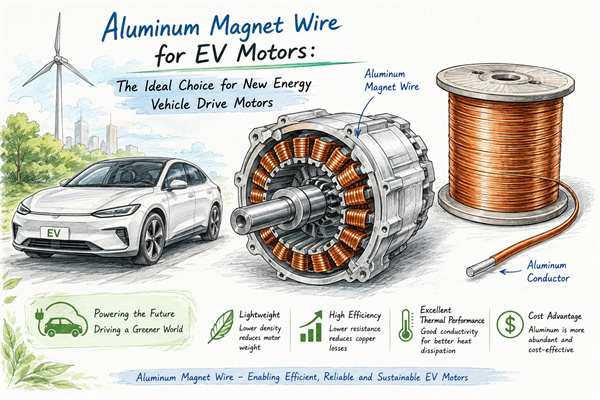
The traction motors for new-energy vehicles represent a rapidly growing application segment for magnet wire. These traction motors employ either permanent-magnet synchronous motor or induction motor configurations, operating at high frequencies, high power densities, and elevated temperatures—imposing stringent requirements on the magnet wire’s temperature class, dielectric strength, and mechanical reliability. Magnet wire for new-energy vehicle traction motors typically utilizes enamel systems rated Class 180 to Class 200, with conductor material predominantly high-purity oxygen-free copper.
Traction Motors
Traction motors are the core power components of rail transit vehicles, including metro traction motors, EMU (Electric Multiple Unit) traction motors, and maglev traction motors. Traction motors impose extremely stringent requirements on enameled wire regarding temperature rating, dielectric strength, vibration resistance, and mechanical reliability. Enameled wire for traction motors typically employs a Class 200 or higher insulation system and must pass rigorous vibration testing, thermal cycling testing, and long-term aging testing.
Special Motors
Special-purpose motors include wind turbine generators, aerospace motors, marine motors, and mining motors. These motors impose extremely high requirements on enameled wire regarding weather resistance, corrosion resistance, and long-term reliability. Enameled wire for special-purpose motors typically employs high-temperature-resistant enamel systems rated Class 180 to Class 220.
Household Appliance Motors
Home appliance motors include washing machine motors, air conditioning motors, refrigerator motors, range hood motors, etc. Home appliance motors impose stringent cost control requirements on magnet wire, typically employing Class 130 to Class 155 enamel systems. However, certain high-end appliances (e.g., inverter-type air conditioners and inverter-type washing machines) demand higher performance from magnet wire, necessitating Class 155 to Class 180 enamel systems.
Transformer Applications
Transformers represent another major application area for magnet wire, where the magnet wire is used to wind the primary and secondary windings.
Power Transformers
Power transformers are core equipment in power systems, including step-up transformers, step-down transformers, and distribution transformers. Power transformers impose extremely high requirements on magnet wire regarding temperature index, dielectric strength, and long-term reliability. Magnet wire for power transformers typically employs enamel systems rated Class 105 to Class 130, with conductor materials primarily copper or aluminum, and conductor cross-sections predominantly round or rectangular.
Dry-Type Transformers
Dry-type transformers are transformers that do not use insulating oil and are primarily employed in indoor power distribution, rail transit, and commercial buildings. Dry-type transformers impose stringent requirements on magnet wire regarding temperature index, flame retardancy, and environmental resistance. Magnet wire for dry-type transformers typically employs enamel systems rated Class 155 to Class 180.
Electronic Transformers
Electronic transformers are small-sized transformers used in electronic equipment, including power transformers, isolation transformers, audio transformers, and pulse transformers. Electronic transformers impose high requirements on magnet wire with respect to dielectric strength, solderability without pre-stripping, and dimensional accuracy. Magnet wire for electronic transformers typically employs polyurethane enamel film rated Class 130 to Class 155, with copper as the primary conductor material.
High-Frequency Transformers
High-frequency transformers are one of the core components of switching power supplies, typically operating at frequencies ranging from tens of kilohertz to several megahertz. High-frequency transformers impose stringent requirements on the high-frequency performance, skin effect losses, and proximity effect losses of magnet wire. Magnet wire for high-frequency transformers commonly employs Litz wire windings with insulation systems rated Class 180 to Class 200.
New Energy Transformers
New-energy transformers include new-energy vehicle transformers, wind-power generation transformers, and photovoltaic inverter transformers. New-energy transformers impose high requirements on enameled wire regarding temperature class, high-frequency performance, and long-term reliability. Enameled wire for new-energy transformers typically employs a Class 200 high-temperature enamel system, with oxygen-free copper as the primary conductor material.
Inductor and Magnetic Component Applications
Magnet wire serves functions including coil winding, magnetic field energy storage, and signal transmission in inductors and magnetic components.
Power Inductors
Power inductors are core components in switching power supplies and power electronic equipment. They impose stringent requirements on magnet wire regarding temperature class, DC bias capability, and loss characteristics. Magnet wire for power inductors typically employs Class 180 to Class 200 insulation systems; some high-frequency power inductors use Litz wire windings.
Common-Mode Inductors and Differential-Mode Inductors
Common-mode and differential-mode inductors are core components of electromagnetic compatibility (EMC) filters, used to suppress common-mode and differential-mode interference. Common-mode and differential-mode inductors impose stringent requirements on magnet wire with respect to dielectric strength, enamel film uniformity, and impedance characteristics. Magnet wire for common-mode inductors typically employs a bifilar winding configuration and utilizes an enamel system rated Class 130 to Class 155.
Energy Storage Inductors
Energy storage inductors are used for energy storage and release in power electronic systems, including pulse power inductors and superconducting magnetic energy storage systems. Energy storage inductors impose high requirements on enameled wire regarding pulse current resistance, insulation strength, and mechanical stability. Enameled wire for energy storage inductors typically employs Class 180 to Class 200 insulation systems, with conductor cross-sections primarily round or rectangular (flat) wire.
RF Inductors
RF inductors are used in high-frequency applications such as wireless communication, radio-frequency identification (RFID), and induction heating. RF inductors impose stringent requirements on magnet wire regarding skin effect, proximity effect, and dielectric loss. RF inductors typically employ specially designed Litz wire or air-core windings.
Current Transformers and Voltage Transformers
Current transformers and voltage transformers are measurement and protection components in power systems. Current and voltage transformers impose high requirements on the dielectric strength, measurement accuracy, and long-term stability of magnet wire. Magnet wire for transformers typically employs enamel systems rated Class 130 to Class 155.
Household Appliance Applications
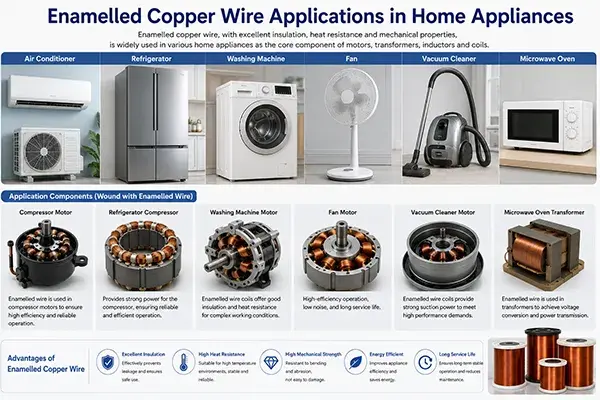
Magnet wire is widely used in household appliances, covering virtually all categories—including air conditioners, washing machines, refrigerators, water heaters, microwave ovens, induction cooktops, rice cookers, televisions, and audio systems.
Air Conditioning Applications
Air conditioning is the largest application segment for magnet wire in household appliances. Magnet wire is used in air conditioner compressor motors, indoor fan motors, outdoor fan motors, and four-way valve coils. Magnet wire for air conditioners requires high temperature resistance classes, flame-retardant properties, and long-term reliability. Fixed-frequency air conditioners typically use Class 130 to Class 155 magnet wire, while inverter-type air conditioners typically use Class 155 to Class 180 magnet wire.
Washing Machine Applications
Washing machine motors include wash motors and spin-dry motors; some high-end washing machines employ inverter-driven or direct-drive motors. Magnet wire for washing machines requires high resistance to humid heat, detergent resistance, and mechanical reliability. Magnet wire for washing machines typically employs enamel systems rated Class 130 to Class 155.
Refrigerator Applications
Refrigerator compressor motors use magnet wire as electromagnetic windings. Refrigerator compressors impose high requirements on magnet wire regarding refrigerant resistance, thermal cycling resistance, and long-term reliability. Magnet wire for refrigerator compressors typically employs Class 130 to Class 155 insulation systems.
Applications in Microwave Ovens and Induction Cooktops
Microwave ovens and induction cooktops utilize high-frequency coils as energy conversion components. Enamelled wire for microwave ovens and induction cooktops demands high-frequency performance, dielectric strength, and long-term reliability. Enamelled wire for microwave ovens and induction cooktops typically employs Class 180 to Class 200 insulation systems.
Applications in Television and Audio Equipment
Enamel wire is used as electromagnetic winding in speakers, voice coils, and transformers for televisions and audio equipment. Enamel wire for televisions and audio equipment demands high audio performance, impedance accuracy, and long-term stability. Enamel wire for televisions and audio equipment typically employs Class 130 to Class 155 enamel systems.
Applications in New Energy and Rail Transit
New energy and rail transit are emerging high-growth application areas for magnet wire, imposing new technical requirements on magnet wire.
New Energy Vehicle Applications
New energy vehicle applications encompass numerous enameled wire use cases, including traction motors, auxiliary motors, battery management systems, charging systems, DC-DC converters, and on-board chargers. Enameled wire for new energy vehicles imposes extremely high requirements on temperature class, efficiency, mechanical reliability, and chemical resistance. Enameled wire for new energy vehicles typically employs high-temperature enamel systems rated Class 180 to Class 200, with oxygen-free copper as the primary conductor material.
Wind Power Generation Applications
Wind power generation applications encompass numerous magnet wire use cases, including nacelle transformers, tower transformers, substation transformers, yaw motors, pitch motors, and generator windings. Magnet wire for wind power generation demands exceptional weather resistance, salt fog resistance, and long-term reliability. Such magnet wire typically employs high-temperature enamel systems rated Class 180 to Class 200.
Photovoltaic Power Generation Applications
Photovoltaic (PV) power generation applications include magnet wire used in PV inverter transformers, combiner box inductors, step-up transformers, and string inverters. Magnet wire for PV power generation demands high-frequency performance, high efficiency, and long-term reliability. PV magnet wire typically employs enamel systems rated Class 180 to Class 200.
Energy Storage System Applications
Applications of enameled wire in energy storage systems include energy storage transformers, energy storage inductors, and battery management systems. Enameled wire for energy storage systems demands exceptionally high efficiency, long-term reliability, and safety.
Rail Transit Applications
Rail transit applications encompass numerous magnet wire use cases, including traction transformers, auxiliary transformers, traction motors, auxiliary motors, air conditioning systems, and control systems. Magnet wire for rail transit imposes extremely stringent requirements on temperature class, vibration resistance, and long-term reliability. Rail transit magnet wire typically employs a Class 200 or higher insulation system, with a design service life requirement exceeding 30 years.
EV Charging Pile Applications
Applications for electric vehicle (EV) charging stations include magnet wire used in charging station transformers, inductors, and filters. Magnet wire for EV charging stations demands high efficiency, long-term reliability, and safety. Such magnet wire typically employs enamel systems rated Class 180 to Class 200.
Aerospace and Special Applications
Aerospace and special applications represent the high-end application segments for magnet wire, imposing the most stringent technical requirements on magnet wire.
Aerospace Applications
Aerospace applications encompass magnet wire use in aircraft generators, motors, transformers, control systems, radar systems, and communication systems. Aerospace-grade magnet wire imposes extremely high requirements on temperature rating, weight reduction, vibration resistance, and long-term reliability. Aerospace magnet wire typically employs polyimide insulation systems rated Class 220 to Class 240, with oxygen-free copper as the primary conductor material; aluminum or copper-clad aluminum conductors are used in certain applications.
Marine Applications
Marine applications encompass magnet wire used in marine motors, marine transformers, and marine control systems. Marine-grade magnet wire must exhibit exceptional resistance to salt fog, humidity, and vibration, as well as long-term reliability. Marine-grade magnet wire typically employs enamel systems rated Class 180 to Class 200.
Mining and Oilfield Applications
Mine and petroleum applications cover magnet wire use cases in mining motors, mining transformers, and explosion-proof motors. Magnet wire for mine and petroleum applications demands extremely high explosion-proof performance, abrasion resistance, and long-term reliability. Such magnet wire typically employs Class 155 to Class 180 enamel systems and is certified for explosion-proof compliance.
Medical Device Applications
Magnet wire applications in medical devices include medical motors, medical sensors, and medical transformers. Magnet wire for medical devices imposes extremely high requirements on biocompatibility, long-term reliability, and safety. Magnet wire for medical devices typically employs enamel systems rated Class 130 to Class 155.
Defense and Military Applications
Defense and military applications include magnet wire used in military motors, military transformers, military radar systems, and military communication equipment. Magnet wire for defense and military applications must exhibit exceptional resistance to extreme environments, shock resistance, vibration resistance, and long-term reliability. Such magnet wire typically employs Class 200 to Class 240 high-temperature-resistant enamel coating systems.
Fundamentals of Magnet Wire Application Selection
Selection of magnet wire must comprehensively consider multidimensional factors including application scenario, performance requirements, environmental conditions, service life requirements, and cost constraints.
Selection by Application Scenario
For motor applications, enameled wire must prioritize electromagnetic design requirements, winding processing technology, and operating temperature. For transformer applications, enameled wire must prioritize dielectric strength, fill factor, and insulation design. For inductor applications, enameled wire must prioritize high-frequency characteristics, DC bias capability, and loss characteristics. For household appliance applications, enameled wire must prioritize cost control, flame retardancy, and long-term reliability. For new-energy vehicle applications, enameled wire must prioritize temperature rating, mechanical reliability, and chemical resistance.
Selection by Performance Requirements
Applications requiring high dielectric strength (e.g., high-voltage transformers, high-voltage motors) require thick or triple-thick enamel coating systems. High-frequency applications (e.g., switch-mode power supplies, RF inductors) require low-dielectric-loss enamel coating systems combined with Litz wire windings. High-temperature applications (e.g., traction motors, new-energy vehicles) require Class 180 to Class 200 high-temperature enamel coating systems. Applications subject to high mechanical stress (e.g., vibration environments) require enamel-coated wire with high abrasion resistance and high impact resistance.
Selection by Environmental Conditions
For outdoor applications, weather-resistant enameled wire shall be selected (UV-resistant, moisture-resistant, salt fog-resistant). For oil-immersed applications, oil-resistant enameled wire shall be selected (transformer oil-resistant, hot oil-resistant). For high-humidity applications, humidity- and heat-resistant enameled wire shall be selected (hydrolysis-resistant, moisture-resistant). For vibration-prone applications, mechanically stable enameled wire shall be selected (high abrasion resistance, high vibration resistance). For chemical media environments, chemically resistant enameled wire shall be selected (oil-resistant, acid- and alkali-resistant, solvent-resistant).
Selection Based on Service Life Requirements
Long-life applications (power transformers, traction transformers) require enamel systems rated Class 180 or higher. Ultra-long-life applications (nuclear power, special equipment) require enamel systems rated Class 200 or higher. Short-life applications (disposable equipment) may use enamel systems rated Class 130.
Selection Based on Cost Constraints
Cost-sensitive applications (e.g., household appliances, consumer electronics) require Class 130 to Class 155 standard enamel systems. Performance-critical applications (e.g., aerospace, medical devices) require Class 180 to Class 240 high-performance enamel systems. Applications balancing performance and cost (e.g., industrial equipment, new-energy vehicles) require enamel systems selected from Class 155 to Class 200 based on specific performance requirements.
Conclusion
Applications of Magnet Wire in Electrical Applications cover eight core engineering dimensions: fundamental functions of magnet wire (electromagnetic induction and electromagnetic conversion, electrical insulation protection, fill factor optimization, mechanical protection, environmental stress resistance); motor applications (general industrial motors, new-energy vehicle traction motors, rail traction motors, specialty motors, household appliance motors); transformer applications (power transformers, dry-type transformers, electronic transformers, high-frequency transformers, new-energy transformers); inductor and magnetic component applications (power inductors, common-mode chokes, energy-storage inductors, RF inductors, current transformers); household appliance applications (air conditioners, washing machines, refrigerators, microwave ovens, induction cooktops, televisions and audio systems); new-energy and rail transit applications (new-energy vehicles, wind power generation, photovoltaic power generation, energy storage systems, rail transit, EV charging stations); aerospace and specialty applications (aerospace, marine vessels, mining and petroleum, medical devices, national defense and military); and magnet wire selection fundamentals (selection based on application scenario, performance requirements, environmental conditions, service life requirements, and cost constraints).
Magnet wire is a fundamental material in electrical engineering, linking numerous industrial sectors including power systems, power electronics, magnetic components, and new-energy equipment. Magnet wire selection must comprehensively consider multiple dimensions—such as application scenario, performance requirements, environmental conditions, service life requirements, and cost constraints—to achieve an optimal balance among performance, cost, and reliability.
With the continuous advancement of electrical engineering technologies, the rapid development of emerging application fields, and the deepening green and low-carbon transformation, demand for enameled wire in electrical applications will continue to grow. Enameled wire manufacturers shall continuously enhance product performance, deepen application research, expand product specification portfolios, and improve quality assurance systems to supply the global electrical industry with high-quality, high-performance, and highly reliable enameled wire products.
About the Author
Zhengzhou Lanpu Industry Co., Ltd. is a source manufacturer of magnet wire with 30 years of export experience, operating a modern production base spanning 60 mu. The company specializes in manufacturing enameled round wire, flat wire, and square wire made of copper, aluminum, and copper-clad aluminum, covering the full range of thermal classes. Its products are certified to ISO 9001/14001/45001, UL, REACH, and RoHS standards and exported to more than 50 countries.
Contact Information:
- 📧 Email: <office@cnlpzz.com>
- 📱 WhatsApp: 0086-19337889070
- 🌐 Website: <https://lpenamelwire.com/>