

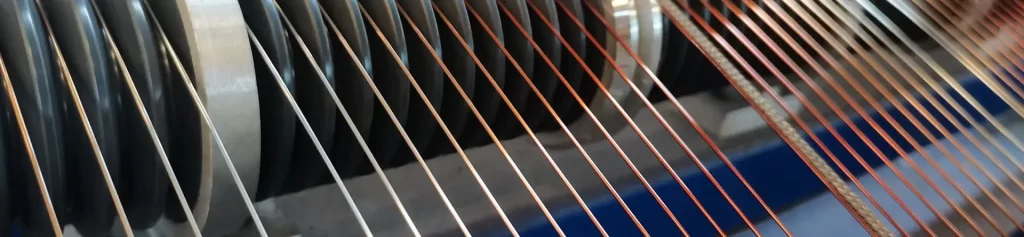
Magnet wire is the secret hero of modern electrical industry.
Throughout modern life, you may have seen it used in everything from home appliances to spaceships, but you might not be sure actually what it is.
Now today, let‘s get a close-up look at: Where do we actually use the magnet wire?
What Is Magnet Wire?
Magnet Wire, (also called Enamelled Wire, or Winding Wire) is a metal wire coated with an insulating film of enamel.
Core Features:
- Conductor: copper or aluminum wire
- Insulation: coated insulating enamel film
- Application: windings for various electrical equipment
Core Principle of Magnet Wire Applications
Regardless of where magnet wire is used, its core working principle is electromagnetic induction:
Magnetic field is created when the current passes through the coils, the wire being wound with magnet wire.
When the magnetic field is changing, the coil induces thea electromotive force
Magnet wire is famous for its insulating enamel film. It is functions to block inter-turn short circuit, will not affect its energy conversion.
According to this principle, the magnet wire is used in a large number of equipment which required electromagnetic conversion.
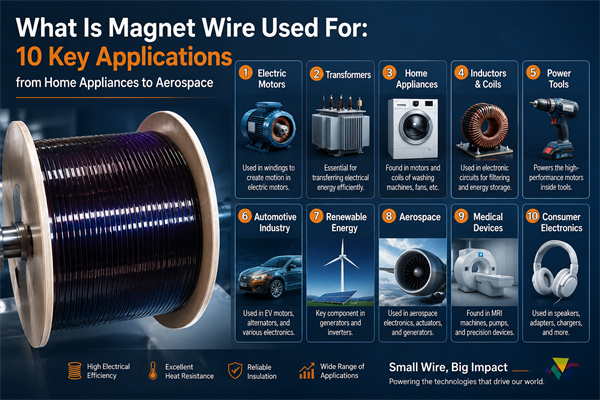
Top 10 Application Scenarios of Magnet Wire
1.Motors (The Most Widespread Application)
Motors have the greatest and most common application field for magnet wire.
Home Appliance Motors:
Air conditioning compressor motors
Refrigerator compressor motors
Motors in washing machine
Washing machine motors.
Range hood motors.
Electric fans motor
Industrial Motors:
Asynchronous three-phase motor
Permanent magnet synchronous motor
Stepper motors. Stepper motors have many advantages but the most relevant are listed here. They are not free-running and as they are not synchronic, they are much more robust to other power supplies than other types of motor. They also generate a holding torque even when de-energized.
Servo motors
New Energy Vehicle Motors:
Drive motors
Drive motors.
Motors directing
Brake motors
Electro-hydraulically powered, big brake motors strongly recommended for use in lifting, specialized, and excavating applications, voltage: 240V 50Hz. Pour electromécaniquement nourris, grands moteurs de freins certified for use in lifting, specialized, and excavating applications, voltage: 240V 50Hz.
Water pump motors
Special Requirements for Motors:
High slot fill rate2014
Very efficient
High reliability for long-life operation
Good heat dissipation performance
2.Transformers
Power Transformers:
Large power transformers
Distribution transformers
Dry type transformers
Oil-immersed transformers
Special Transformers:
The rectifier transformers: should meet the specifications of the rectifier installations as well as those for distribution transformers.
Furnace transformers
Transformer test
Traction transformers:
Small Transformers:
Electronic transformers
Switching power supply transformers
Transformers of communication
Instrumentation transformers
Special Requirements for Transformers:
High insulation strength.
Careful with the long term of operation stable;
High temperature resistance
Recommended minimum short circuit resistance
3.Inductors and Coils
Power Inductors:
Power inductors.
Filter inductors
Boost inductors
Common mode inductors
High-Frequency Inductors:
Communication inducers
Line inductors.
Tuning inductors
Oscillation inductor
Special Inductors:
Energy storage inductors
Toroidal inductor
Air core inductors
4.Generators
Wind power generators
Hydro generators
Hydro generators (or turbines) have been utilized over the centuries and are highly effective means for generating electricity thanks to their efficiency. The fundamental principle behind hydropower is to extract energy from water or another liquid flow. These can operate as stand-alone or utilising the power grid.
Generator sets using diesel power
Steam generators.
Standby generator
5.Solenoid Valves and Relays
Solenoid Valves: hydraulic, pneumatic, automotive, industrial control valves
Relays: Power, signal, automotive, industrial control relays
6.Automotive Electrical Systems
Powertrain: Starter motors, generators, ignition coils, fuel pump motors.
Body Systems: Power window motors, motor for electric mirrors, electric car seat, wiper motors.
New Energy Vehicles: Driving, Steer, brake, thermal control motors
Special Requirements for Automotive:
Vibration resistance
Variation of resistance with temperature
Reliability over time
Mandatory certifications (IATF 16949)
7.Home Appliances
Home appliances: Toasters, washing machines, vacuum cleaners, dishwashers.
Small appliances: Electric fans, microwave ovens, induction cookers, vacuum cleaners, coffee machines, blenders
Kitchen Appliances: Range hoods, dish washers, ovens, air fryers.
8.Industrial Automation Equipment
Industrial robots5 We define industrial robots as high precision, power, and force Two or three axes industrial robots used within a variety of manufacturing processes. They are dedicated to manufacturing applications since they successfully perform the jobs traditionally completed by far more workers.
CNC machine tools
Automated production lines.
Carriage packaging machinery
Printing equipment
Textile machinery.
9.Aerospace and Defense
Aircraft engines
Power systems for spacecraft
Sonar systems
Communication Systems2. Communication systems.
Navigation systems
Weapon systems
Special Requirements for Aerospace:
Tolerance to extreme environments
Highly reliable
Lightweight
Gain in the power gains in a. Radiation resistance:(between the input Impedance, Z in, the radiation resistance, R; and the load Z 0:) Z 0 Z in E Z 0. Z in Z in akk.
Lived a long life
10. Medical Equipment
Magnetic Resonance Imaging (MRI)
CT scanners.
Ultrasoundequipment
Surgical robots
Medical pumps
Precision medical instruments: Healthcare.
Special Requirements for Medical:
Precision measuring
the smallest is 250nm so it is quite accurate
B. High reliability. Despite the not so high reliability of the personality tests utilized in the study, the high reliability reported on the outcome measures limits the number of false positive and false negative due to the measurement.
Safety
Biocompatibility
Development Trends in Magnet Wire Applications
1. New Energy Vehicles Drive Growth
New energy vehicles are the largest growth point for magnet wire applications:
- Hairpin flat wire technology for drive motors
- High power density requirements
- Lightweight requirements
- High efficiency requirements
2. Inverterization Promotes Technical Upgrades
Inverter technology is rapidly expanding in various fields—inverter air conditioners, inverter motors, inverter compressors. Inverterization puts new requirements on magnet wire: high-frequency pulse resistance, corona resistance.
3. 5G and IoT
5G and IoT devices need large quantities of miniaturized inductors: 5G base station filters, IoT sensors, smart home devices.
4. Renewable Energy
Wind power, solar inverters, energy storage systems.
5. Industry 4.0 and Smart Manufacturing
Industrial robots, smart equipment, high-end CNC machine tools.
6. High-End Medical Equipment
MRI, CT scanners, surgical robots, portable medical devices.
Selection Key Points in Magnet Wire Applications
1. Clarify Application Scenario
- Ordinary home appliances: E or B Class insulation is sufficient
- Industrial motors: F Class recommended
- New energy vehicles: H Class or even Class 200
- Aerospace: Must be C Class or higher
2. Evaluate Working Conditions
- Maximum operating temperature
- Voltage rating
- Frequency characteristics
- Environmental factors
3. Select Appropriate Materials
- Copper vs aluminum vs copper clad aluminum
- Single coating vs double coating
- Enamel material type
4. Consider Economics
- Cost vs performance balance
- Total lifecycle cost
- Maintenance cost
5. Select Reliable Supplier
- Production experience and process level
- Quality management system
- Certifications
- After-sales service
FAQ
Q: What is the difference between magnet wire and ordinary wire?
A: Magnet wire has a thin insulation layer (10-50μm) suitable for dense winding; ordinary wire has a thick insulation layer (0.5-2mm) mainly used for power transmission.
Q: Which home appliances contain magnet wire?
A: Almost all home appliances with motors contain magnet wire: air conditioners, refrigerators, washing machines, range hoods, electric fans, etc.
Q: How much magnet wire does a new energy vehicle use?
A: A new energy vehicle uses approximately 5-10 kg of magnet wire, including drive motors, steering motors, brake motors, air conditioning compressors, etc.
Q: Why do medical devices use magnet wire?
A: MRI and other medical equipment need high-precision magnetic field coils, requiring extremely high insulation, reliability, and precision from magnet wire.
Q: What are the main future growth areas for magnet wire?
A: New energy vehicles, inverter home appliances, 5G communications, renewable energy, and high-end medical equipment are the main future growth areas.