

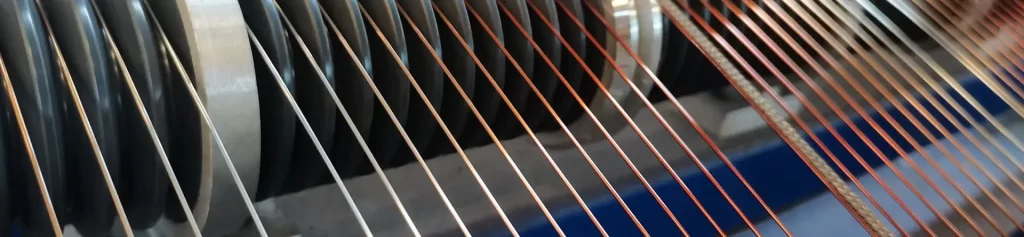
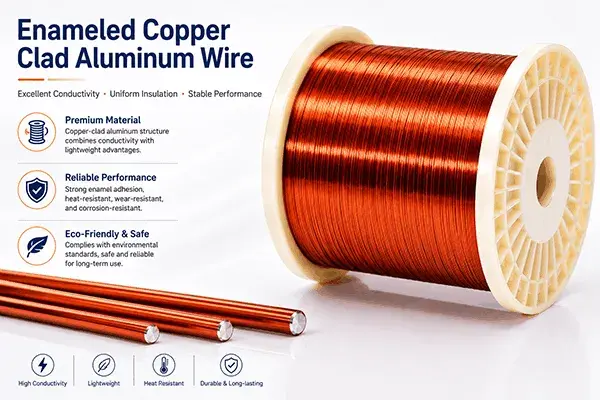
Enameled Copper Clad Aluminum Wire (ECCA or ECCAW) is a composite conductor material composed of a Copper Clad Aluminum (CCA) conductor with an outer insulating enamel layer. This material combines the excellent conductivity of copper with the lightweight and economic characteristics of aluminum, while providing reliable electrical insulation through the enamel layer, and has become an important basic material in the modern electrical engineering field. The development of enameled copper clad aluminum wire stems from comprehensive consideration of cost, performance, and sustainability. Against the backdrop of increasingly tight copper resources and rising cost pressures, ECCA provides a conductor solution that balances performance and cost for high-frequency inductors, consumer electronics, household appliances, and other fields. This article systematically describes the definition, classification, structure, manufacturing process, performance characteristics, application fields, standard system, and comparison with related products of enameled copper clad aluminum wire, providing comprehensive technical reference for engineering technicians.
Definition of Enameled Copper Clad Aluminum Wire
Basic Definition
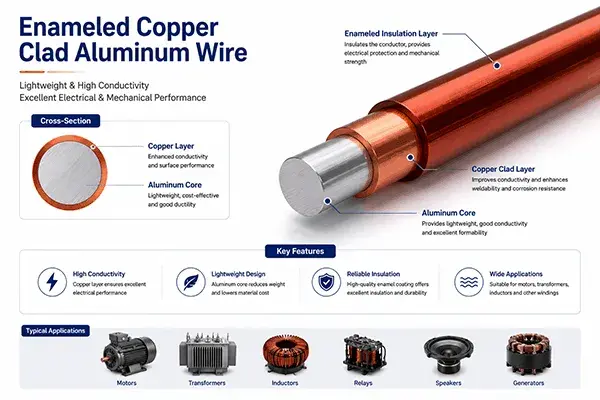
Enameled copper clad aluminum wire refers to an enameled wire product formed by using Copper Clad Aluminum Wire (CCA) as the conductor and coating one or more layers of insulating enamel on its surface. Copper clad aluminum wire is a bimetallic composite conductor, formed by the inner electrical grade aluminum core and the outer oxygen-free copper layer through metallurgical bonding processes. The insulating enamel layer plays the role of electrical insulation, enabling enameled copper clad aluminum wire to achieve electrical isolation in winding structures. The complete product definition of enameled copper clad aluminum wire contains three core elements: bimetallic conductor (aluminum core plus copper layer), insulating enamel layer, and meeting the technical requirements of relevant standards.
Product Naming
Enameled copper clad aluminum wire has different naming methods in different regions and different standard systems: International Common Name: Enameled Copper Clad Aluminum Wire (ECCA or ECCAW). North American Market: Enameled Copper Clad Aluminum Magnet Wire. European Market: Lack-isolierter Kupfermanteldraht (German). Chinese Market: Enameled Copper Clad Aluminum Wire. Different naming methods all refer to the same type of product, namely enameled wire with copper clad aluminum wire as the conductor and coated with insulating enamel.
Product Classification
Enameled copper clad aluminum wire can be classified by multiple dimensions: Classification by Copper Layer Proportion: Class 10A/10H: copper volume proportion approximately 10%; Class 15A/15H: copper volume proportion approximately 15%. Classification by Insulating Enamel Type: Polyurethane enameled copper clad aluminum wire (UEW); Polyester enameled copper clad aluminum wire (PEW); Polyester imide enameled copper clad aluminum wire (EIW); Polyamide imide enameled copper clad aluminum wire (AIW); Composite insulating enamel copper clad aluminum wire. Classification by Thermal Class: Class 130 (Class B); Class 155 (Class F); Class 180 (Class H); Class 200 (Class C); Class 220. Classification by Specification Size: Ultra-fine wire (diameter less than 0.10 mm); Fine wire (diameter 0.10 to 0.50 mm); Medium-coarse wire (diameter 0.50 to 2.00 mm); Coarse wire (diameter greater than 2.00 mm).
Structural Composition of Enameled Copper Clad Aluminum Wire
Bimetallic Conductor Structure
The conductor of enameled copper clad aluminum wire is copper clad aluminum wire, adopting a concentric bimetallic structure: Aluminum Core (Inner Layer): Uses electrical grade aluminum with purity usually above 99.5%. The aluminum core provides the main volume support and weight reduction effect. The density of aluminum is only 2.70 g/cm3, approximately one-third of copper. Copper Layer (Outer Layer): Uses oxygen-free copper with purity usually above 99.95%. The volume proportion of the copper layer is usually 10% or 15%, providing excellent conductive surface and weldability. The resistivity of copper is as low as 1.68 times 10 to the negative 8th power Omega meters. Metallurgical Bonding Interface: Permanent metallurgical bonding is formed between the copper layer and the aluminum core through the cladding welding process, and the bonding strength should meet the requirements of ASTM B-566 standard. The quality of the bonding interface directly affects the overall performance and reliability of the product.
Insulating Enamel Layer Structure
The insulating enamel layer is coated on the surface of the copper clad aluminum wire conductor, providing electrical insulation, mechanical protection, and environmental protection functions. The insulating enamel layer is usually a single-layer structure, but multi-layer composite structures can be used in high-performance applications: Base Layer: In direct contact with the copper layer, providing good adhesion and flexibility. Surface Layer: In contact with the external environment, providing heat resistance, chemical resistance, and wear resistance. The thickness of the insulating enamel layer varies according to the type of enamel and product specifications, usually between 0.02 mm and 0.10 mm. The enamel layer thickness increase should comply with the provisions of corresponding standards.
Overall Structural Characteristics
The overall structure of enameled copper clad aluminum wire has the following characteristics: Concentricity: The thickness of the copper layer and enamel layer should remain uniform in the circumferential direction, ensuring consistent electrical performance. Concentricity Deviation: The conductor eccentricity should be controlled within the range specified by the standard, usually not exceeding 15% of the conductor diameter. Roundness: The finished wire should maintain good roundness, and the roundness deviation should comply with standard requirements. Surface Quality: The insulating enamel layer should be smooth and uniform, without bubbles, impurities, pinholes, or other defects.
Manufacturing Process
Copper Clad Aluminum Wire Manufacturing
The first step in manufacturing enameled copper clad aluminum wire is to manufacture the copper clad aluminum wire conductor. Main process methods include: Cladding Welding Method (Mainstream Process): Through specialized cladding welding equipment, copper strips are continuously clad on the outer surface of the aluminum core, and metallurgical bonding is achieved through heating and pressing. This method can achieve permanent bonding between the copper layer and aluminum core, with high bonding strength and stable conductivity. Electroplating Method: A copper layer is electroplated on the surface of the aluminum core to form a copper clad aluminum structure. The cost of this method is relatively low, but the thickness uniformity of the plating layer is relatively poor, and the bonding strength is relatively weak. Co-extrusion Method: Synchronous forming of copper aluminum bimetals is achieved through special extrusion processes. This method is suitable for products with special specifications. Mainstream copper clad aluminum wire products are produced using the cladding welding method, complying with the technical requirements of ASTM B-566 standard.
Enamel Coating Process
The main process methods for coating insulating enamel on the surface of copper clad aluminum wire conductors: Vertical Coating Method: The wire passes vertically through the enamel tank and baking furnace, suitable for fine specification products. This method has good enamel layer uniformity and is suitable for high-speed production. Horizontal Coating Method: The wire passes horizontally through the enamel tank and baking furnace, suitable for coarse specification products. This method has high flexibility and wide specification range. Die Coating Method: Precision dies are used to control the enamel layer thickness, suitable for high-precision products. This method has precise enamel layer thickness control, but the production speed is relatively slow. Modern enameled copper clad aluminum wire production lines usually adopt vertical or horizontal coating processes, equipped with precise enamel layer thickness control systems and multi-channel baking furnace curing systems.
Key Process Control Points
The following key process parameters need to be strictly controlled during the manufacturing process of enameled copper clad aluminum wire: Copper Layer Quality: The copper layer thickness, uniformity, and bonding strength should comply with ASTM B-566 standard. Aluminum Core Purity: The purity of electrical grade aluminum should be above 99.5%, and impurity content should be strictly controlled. Enamel Viscosity: Enamel viscosity affects the enamel layer thickness and uniformity, requiring regular testing and adjustment. Furnace Temperature: The curing temperature affects the cross-linking degree and final performance of the enamel film, requiring precise zone-by-zone control. Line Speed: The line speed during coating and curing needs to match the enamel viscosity and furnace temperature. Enamel Layer Thickness: Ensure the enamel layer thickness meets standard requirements through online measurement and feedback control.
Performance Characteristics
Electrical Performance
DC Resistance: The DC resistance of enameled copper clad aluminum wire is higher than that of solid copper enameled wire, but lower than that of solid aluminum enameled wire. The resistivity of Class 15A copper clad aluminum wire is approximately 2.65 times 10 to the negative 8th power Omega meters, which is 1.58 times that of pure copper. High-Frequency Conductivity: Under high-frequency conditions above 5MHz, due to skin effect, current is mainly conducted in the copper layer, and the high-frequency conductivity of enameled copper clad aluminum wire is close to that of solid copper enameled wire. Dielectric Strength: The insulating enamel layer should have sufficient dielectric strength to meet the provisions of enameled wire standards. The dielectric strength of enameled copper clad aluminum wire is equivalent to that of enameled copper wire. Insulation Resistance: Under standard conditions, the insulation resistance of enameled copper clad aluminum wire should comply with the provisions of corresponding standards.
Mechanical Performance
Tensile Strength: The tensile strength of Class 15A enameled copper clad aluminum wire is approximately 100 to 180 MPa, between pure copper and pure aluminum. Flexibility: Annealed enameled copper clad aluminum wire has good flexibility and can meet the winding requirements of coils of various shapes. Elongation: The elongation of annealed enameled copper clad aluminum wire can reach more than 20%, with good winding performance. Adhesion Strength: Stable adhesion strength should be maintained between the insulating enamel layer and the copper clad aluminum wire conductor, without delamination under processing and operating conditions. Abrasion Resistance: The insulating enamel layer should have a certain surface hardness to withstand friction during the winding process.
Thermal Performance
Thermal Class: The thermal class of enameled copper clad aluminum wire is determined by the insulating enamel system, covering a wide range of applications from Class 130 to Class 220. Thermal Shock Resistance: The insulating enamel layer should be able to withstand thermal stress caused by sudden temperature changes. Thermal Aging Performance: Under long-term working temperature, the enamel film should maintain stable performance. Heat Softening Resistance: Under high temperature conditions, the enamel film should not soften, flow, or deform.
Chemical Performance
Solvent Resistance: The enamel film should be able to withstand erosion from common organic solvents. Oil Resistance: For oil-immersed applications, the enamel film should be able to withstand long-term immersion in oils. Hydrolysis Resistance: In high temperature and high humidity environments, the insulation performance of the enamel film should remain stable. Chemical Media Resistance: The enamel film should be able to withstand chemical media such as acids, alkalis, and salt spray.
Comparison with Solid Copper and Solid Aluminum Enameled Wire
Comparison with Enameled Copper Wire (UEW/PEW)
Conductivity: Enameled copper clad aluminum wire has slightly lower conductivity than enameled copper wire under DC and low-frequency conditions; under high-frequency conditions, the conductivity is close. Weight: The weight of enameled copper clad aluminum wire is approximately 40% to 45% of enameled copper wire. Cost: The material cost of enameled copper clad aluminum wire is 50% to 70% lower than enameled copper wire. Weldability: Both have good weldability and can use conventional tin soldering processes. Application: Enameled copper wire is suitable for all applications; enameled copper clad aluminum wire is more suitable for high-frequency and weight-sensitive applications.
Comparison with Enameled Aluminum Wire
Conductivity: Enameled copper clad aluminum wire has better conductivity than enameled aluminum wire at all frequencies. Weldability: Enameled copper clad aluminum wire can be directly soldered with tin, while enameled aluminum wire requires special welding processes. Cost: The cost of enameled copper clad aluminum wire is slightly higher than enameled aluminum wire. Weight: Enameled copper clad aluminum wire is slightly heavier than enameled aluminum wire, but the difference is not large. Application: Enameled copper clad aluminum wire has a wider application range, especially suitable for occasions requiring welding.
Comprehensive Performance Comparison
Comparison Item: Enameled Copper Wire vs Enameled Copper Clad Aluminum Wire vs Enameled Aluminum Wire. Material Cost: High vs Medium-Low vs Low. Weight: Heavy vs Medium-Light vs Light. DC Conductivity: Excellent vs Medium vs Medium-Low. High-Frequency Conductivity: Excellent vs Good vs Good. Weldability: Excellent vs Excellent vs Poor. Processability: Excellent vs Good vs Medium. Application Range: Wide vs Relatively Wide vs Limited.
Application Fields
High-Frequency Inductors and Coils
Enameled copper clad aluminum wire has unique advantages in high-frequency inductor and coil applications. Under high-frequency conditions above 5MHz, the AC conductivity of copper clad aluminum wire is equivalent to that of solid copper wire, and enameled copper clad aluminum wire is a high-quality alternative to solid copper enameled wire in high-frequency applications. Typical applications: switching power inductors, common mode inductors, differential mode inductors, wireless charging coils, RFID coils, electromagnetic induction heating coils, etc.
Consumer Electronics
Consumer electronics are sensitive to cost and weight, and enameled copper clad aluminum wire is widely used in this field. Components such as power inductors, charging coils, and speaker voice coils in mobile phones, tablets, and laptops can use enameled copper clad aluminum wire. The application of enameled copper clad aluminum wire in consumer electronics not only reduces material costs but also improves product portability through weight reduction.
Household Appliances
Motors, transformers, inductors, and other components in household appliances use a large amount of enameled copper clad aluminum wire. The power supply parts, motor windings, high-frequency inductors, etc. of air conditioners, refrigerators, washing machines, televisions, and other household appliances all show the application of enameled copper clad aluminum wire. Household appliances are cost-sensitive and have moderate life requirements (usually 5 to 10 years), making them an important application field for enameled copper clad aluminum wire.
Automotive Electronics
High-frequency inductors, sensor coils, ignition coils, and other components in automotive electronics can use enameled copper clad aluminum wire. New energy vehicle wireless charging, on-board chargers, DC-DC converters, and other components also have demand for enameled copper clad aluminum wire. Automotive-grade applications have high reliability requirements, and enameled copper clad aluminum wire needs to meet relevant automotive industry standards and reliability tests.
Communication Equipment
RF inductors, filters, transformers, and other components in communication equipment have high requirements for high-frequency performance, and enameled copper clad aluminum wire is a suitable choice. Enameled copper clad aluminum wire is used in communication products such as base station equipment, routers, and switches.
LED Lighting
Inductors, transformers, and other components in LED driver power supplies use a large amount of enameled copper clad aluminum wire. LED lighting is cost-sensitive with large application scale, and the cost advantage of enameled copper clad aluminum wire is fully utilized in this field.
Special Applications
Enameled copper clad aluminum wire can also be used in the following special occasions: Audio Coils: Speaker voice coils, headphone voice coils, and other audio applications. Instrument Coils: Precision coils in measuring instruments and sensors. Medical Equipment: Small coils and induction coils in medical instruments. Aerospace: Aerospace equipment sensitive to weight.
Standards and Certification
ASTM B-566 Standard
ASTM B-566 is the core standard for copper clad aluminum wire developed by the American Society for Testing and Materials. This standard specifies the technical requirements for bare round copper clad aluminum wire, with main contents including: Conductor Structure: Copper volume proportion of 10% or 15%, aluminum core purity requirements. Mechanical Performance: Tensile strength, elongation, and other technical requirements. Electrical Performance: Resistivity, density, and other technical parameters. Bonding Strength: Metallurgical bonding requirements between copper layer and aluminum core. Dimensional Tolerance: Allowable deviation of conductor diameter. Class Classification: Class 10A, 15A (annealed); Class 10H, 15H (hard-drawn).
IEC 60317 Standard
IEC 60317 is a series of product standards for enameled wire developed by the International Electrotechnical Commission. Enameled copper clad aluminum wire products should comply with the relevant provisions of IEC 60317, including: General Requirements: Basic requirements for enameled round wire specified in IEC 60317-0-1. Product Specific Standards: Specific standards for different insulating enamel systems, such as polyurethane, polyester, polyester imide, polyamide imide, etc. Test Methods: Dielectric strength, adhesion strength, flexibility, thermal aging, and other test methods.
NEMA MW 1000 Standard
The NEMA MW 1000 series standards are enameled wire specifications developed by the National Electrical Manufacturers Association, occupying an important position in the North American market. The NEMA standard has detailed provisions on the dimensions, tolerances, and performance requirements of enameled copper clad aluminum wire, with thermal class identification using the numerical system of Class 130, Class 155, Class 180, Class 200, etc.
GB and JIS Standards
GB/T 23312: Adopted in the Chinese market, equivalent to IEC 60317. JIS Standard: Adopted in the Japanese market, with some differences from IEC standards.
Industry Certification
Enameled copper clad aluminum wire products may require the following certifications according to application fields: UL Certification: Required to enter the North American market. CE Marking: Required to enter the EU market. Automotive Certification: Automotive electronics applications require IATF 16949 certification. RoHS Compliance: Compliance with EU RoHS directive requirements for the restriction of hazardous substances.
Quality Control and Procurement Recommendations
Key Quality Indicators
When procuring enameled copper clad aluminum wire, attention should be paid to the following quality indicators: Copper Layer Proportion: The volume proportion of the copper layer should comply with regulations (10% or 15%), and deviations should be controlled within the standard range. Bonding Strength: The metallurgical bonding between the copper layer and aluminum core should be firm, without delamination under bending, winding, and other working conditions. Resistivity: The conductor resistivity should comply with the provisions of ASTM B-566 standard. Dielectric Strength: The insulating enamel layer should have sufficient dielectric strength. Mechanical Performance: Tensile strength, elongation, and adhesion strength should meet standard requirements. Dimensional Accuracy: Conductor diameter, enamel layer thickness, and overall outer diameter should comply with standard tolerances. Enamel Film Continuity: The enamel film should be continuous and complete, without pinholes, bubbles, peeling, or other defects.
Supplier Evaluation
When selecting enameled copper clad aluminum wire suppliers, the following factors should be comprehensively considered: Production Capacity: Suppliers should have stable production scale and advanced bimetallic wire manufacturing and enameled processes. Quality Management System: Should pass ISO 9001 and other quality management system certifications. Technical R&D Capability: Should have technical research and development capabilities to provide customized products based on customer needs. Certification Qualifications: Products should pass ASTM B-566 and relevant enameled wire standard certifications. After-sales Service: Should provide timely technical support and after-sales service.
Incoming Inspection Points
Enameled copper clad aluminum wire should undergo necessary inspection upon arrival: Appearance Inspection: Check whether the copper layer and enamel layer surface are smooth and uniform. Dimensional Measurement: Measure key dimensions such as conductor diameter and enamel layer thickness. Copper Layer Quality Inspection: Detect copper layer thickness and bonding quality. Electrical Testing: Conduct dielectric strength test, insulation resistance test, and conductor resistance test. Mechanical Testing: Conduct flexibility test and adhesion strength test. Batch Consistency Verification: Verify batch information.
Conclusion
Enameled copper clad aluminum wire (ECCA) is a composite enameled wire product composed of a copper clad aluminum wire conductor and an insulating enamel layer, combining the excellent conductivity of copper with the lightweight and economic characteristics of aluminum, and has unique advantages in high-frequency applications, weight-sensitive applications, and cost-sensitive applications. Core characteristics of enameled copper clad aluminum wire: Bimetallic structure (aluminum core plus copper layer) combining conductivity and economy; insulating enamel layer providing reliable electrical insulation; excellent high-frequency performance (above 5MHz close to solid copper); light weight (approximately 40% to 45% of solid copper enameled wire); good weldability (copper outer layer can be directly soldered with tin); economical cost (50% to 70% lower than solid copper enameled wire). Main application fields of enameled copper clad aluminum wire: high-frequency inductors and coils, consumer electronics, household appliances, automotive electronics, communication equipment, LED lighting, etc. Selection should comprehensively consider factors such as the frequency characteristics of the application scenario, temperature requirements, specification requirements, copper layer quality, and connection process. It is recommended to select products from suppliers that meet ASTM B-566 and IEC 60317 standards with stable quality, and conduct strict incoming inspection. With the rapid development of emerging fields such as high-frequency electronics, wireless charging, and new energy vehicles, the application prospects of enameled copper clad aluminum wire will be even broader. Engineering technicians should deeply understand the technical characteristics and application scenarios of enameled copper clad aluminum wire, give full play to its unique advantages in appropriate occasions, and provide strong support for the high quality and high cost performance of products.