

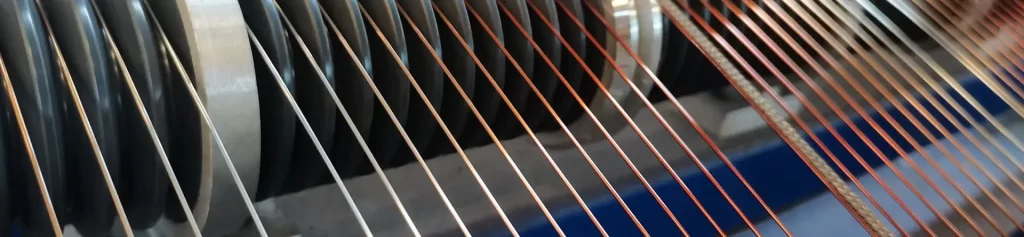
Double Fiberglass Covered Wire is a specialized high-temperature magnet wire featuring bare copper or bare aluminum as the conductor, with two layers of braided fiberglass tape applied over the conductor and subsequently impregnated with heat-resistant insulating varnish or silicone resin followed by curing. The term “Double” in its English name is the key descriptor—indicating that the insulation comprises two layers of braided fiberglass tape applied in bi-lap configuration, rather than a single layer. Unlike enameled wire, Double Fiberglass Covered Wire contains no organic enamel film as the primary insulation; instead, mechanical protection and electrical insulation are provided predominantly by inorganic fiberglass, enabling long-term operation at temperatures far exceeding the thermal limits of enameled wire.
From an electrical structural perspective, Double Fiberglass Covered Wire belongs to the “fiber-plus-varnish” composite insulation system. The overlapping (bi-lap) winding of the two fiberglass layers offsets “pinhole” defects inherent in any single layer, significantly increasing dielectric breakdown voltage; meanwhile, the heat-resistant varnish (e.g., silicone resin, polyester-modified silicone, polyimide, etc.) coated over the braided layer fills interstitial voids in the fiberglass, further reducing moisture absorption. This structure enables widespread application of Double Fiberglass Covered Wire in high-temperature insulation scenarios such as dry-type transformers, traction motors, high-voltage motors, welding equipment, and furnace transformers.
Basic Definition of Double-Layer Glass-Fiber-Insulated Wire
Conductor Material
The conductor of double-layer glass-fiber-insulated wire is typically made of:
- Pure Copper: Electrolytic-tough-pitch copper (e.g., C11000 ETP) or oxygen-free high-conductivity copper (C10100/C10200 OFHC), compliant with ASTM B49, B115, B170, etc.; round wire diameter: 0.5–6.0 mm; flat wire thickness: 1.0–8.0 mm, width: 2–25 mm—representing mainstream specifications.
- Pure Aluminum: Annealed electrical aluminum alloys such as 1350-O and 1060-O, used for large-cross-section or weight-sensitive low-voltage windings, with IACS conductivity typically not less than 61%.
Conductor surfaces require pre-treatment—including deburring, annealing softening, acid/alkali cleaning, and application of coupling agents or primer—to enhance adhesion between subsequent glass fibers and the metal surface.
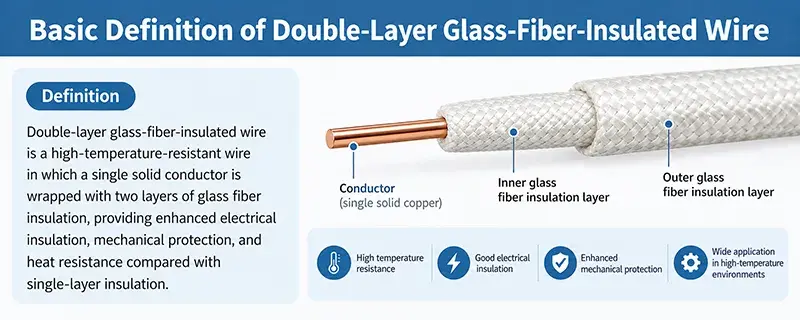
Double-Layer Glass-Fiber Braiding Layer
The term “double-layer” refers to:
- A first layer of glass fiber tape (or strand) tightly helically wound around the conductor at a defined helix angle;
- A second layer of glass fiber tape wound over the first layer in the opposite (or same) helix angle, with typical overlap ratio of 50–65%;
- Interleaved fiber orientation between layers, substantially compensating for pinholes and gaps inherent in single-layer braiding, thereby significantly improving dielectric strength and resistance to mechanical abrasion.
Common glass fiber types:
- E-glass (Electrical-grade glass fiber): Excellent electrical insulation performance and low cost; the preferred choice for double-layer glass-fiber-insulated wire; alkali metal oxide content < 1%.
- S-glass (High-strength glass fiber): Tensile strength approximately 30% higher than E-glass; used in motor windings subject to severe vibration or impact.
- A-glass (Alkali-containing glass fiber): Lowest cost but inferior electrical performance; limited to non-critical applications.
Fiber diameter is typically 5–9 μm; each strand comprises 100–400 filaments twisted into yarn, then woven on braiding machines into tapes or tubular forms of specified widths.
Impregnating Varnish
After braiding, the assembly undergoes full impregnation with heat-resistant insulating varnish followed by baking and curing at 150–200°C. Common varnish bases include:
- Silicone resin varnish: Thermal class H (180°C); the most widely used system;
- Polyester-modified silicone varnish: Balances flexibility and thermal resistance; commonly applied in classes F/H;
- Polyimide varnish: Thermal class up to 220–240°C; used in Class C insulation systems;
- Epoxy-modified varnish: Applied in classes B/F for humid and chemically aggressive environments;
- Water-based eco-friendly varnish: Low-VOC formulations developed recently to comply with REACH, RoHS, ELV, and other environmental directives.
Functions of impregnating varnish include: filling interstitial voids within the fiber matrix, securing the braided layer, enhancing structural integrity, blocking moisture and chemical ingress, and imparting a degree of surface smoothness to the finished product.
Key Differences Between Double-Layer and Single-Layer Fiberglass Covered Wire
Many customers ask: “What exactly is the difference between single-layer and double-layer?” — The core differences are threefold:
Significantly Enhanced Dielectric Strength
The breakdown voltage of single-layer fiberglass covered wire typically ranges from 1.5–3.0 kV; whereas double-layer fiberglass covered wire—due to staggered pinhole coverage—achieves a breakdown voltage of 3.0–6.0 kV or higher. This means greater safety margin at the same operating voltage; and, at the same insulation class, a larger conductor cross-sectional area can be selected to reduce resistive losses.
Higher Mechanical Strength
Double-layer braiding demonstrates markedly superior resistance to abrasion, cutting, and vibration compared to single-layer construction. In high-vibration applications—such as traction motors, hoisting and metallurgical motors, and marine propulsion motors—double-layer construction is virtually standard.
Higher Cost and More Complex Manufacturing Process
Double-layer construction entails approximately 60–80% more fiber usage, 30–50% increased braiding labor hours, and 20–40% higher varnish impregnation consumption. Consequently, double-layer fiberglass covered wire is typically deployed only where mandatory—not as a default upgrade over single-layer.
Key Performance Parameters of Double-Layer Fiberglass Covered Wire
Thermal Class
Per IEC 60085 / NEMA MW 1000 / GB/T 11021 standards:
- Class B (130°C): Single-layer epoxy or polyester varnish impregnation;
- Class F (155°C): Polyester-modified epoxy or polyester-imide varnish impregnation;
- Class H (180°C): Silicone resin or polyester-modified silicone varnish impregnation—this is the most common thermal class for double-layer fiberglass covered wire;
- Class N (200°C): Silicone rubber or modified silicone varnish impregnation;
- Class R (220°C): Polyimide varnish impregnation;
- Class 250: Polyimide-amide or specialty silicone resin varnish impregnation, enabling continuous operation at 250°C.
Dielectric Performance: Dielectric Breakdown Voltage
Per ASTM D149 / IEC 60243-1 / GB/T 1408 test methods (on bent or straight rod specimens), typical dielectric breakdown voltage ranges for double-layer fiberglass covered wire are:
| Conductor Diameter (mm) | Single-Layer Breakdown Voltage (kV) | Double-Layer Breakdown Voltage (kV) |
|---|---|---|
| 0.5–1.0 | 1.5–2.5 | 3.0–4.5 |
| 1.0–2.0 | 2.0–3.0 | 3.5–5.0 |
| 2.0–4.0 | 2.5–3.5 | 4.0–6.0 |
| 4.0–6.0 | 3.0–4.0 | 4.5–7.0 |
Insulation Resistance
Per ASTM D257 / IEC 60093 / GB/T 1410 standards, volume resistivity of double-layer fiberglass covered wire at ambient temperature is typically ≥ 10¹² Ω·cm; after 24-hour water immersion, it remains ≥ 10¹⁰ Ω·cm, indicating effective sealing of fiberglass interstices by the impregnating varnish.
Mechanical Properties
- Tensile Strength: Per ASTM B869 / B48 standards, annealed copper conductor tensile strength is 220–280 MPa;
- Elongation: 25–35% (soft tempers O60 / O61);
- Abrasion Resistance: Double-layer braiding withstands ≥ 30 cycles of standard abrasion testing (NEMA MW 1000 abrasion method);
- Bendability: No cracking and no fiber shedding after repeated 180° bending around a mandrel with diameter 10× conductor diameter.
Chemical and Environmental Resistance
Double-layer fiberglass covered wire exhibits excellent resistance to mineral oil, transformer oil, silicone oil, alcohol, and weak acids/bases; UV resistance is superior to that of enameled wire; however, resistance to strong alkalis, hydrofluoric acid, and concentrated phosphoric acid is limited—direct contact with such media must be avoided in service.
Typical Applications of Double-Layer Glass-Fiber Covered Wire
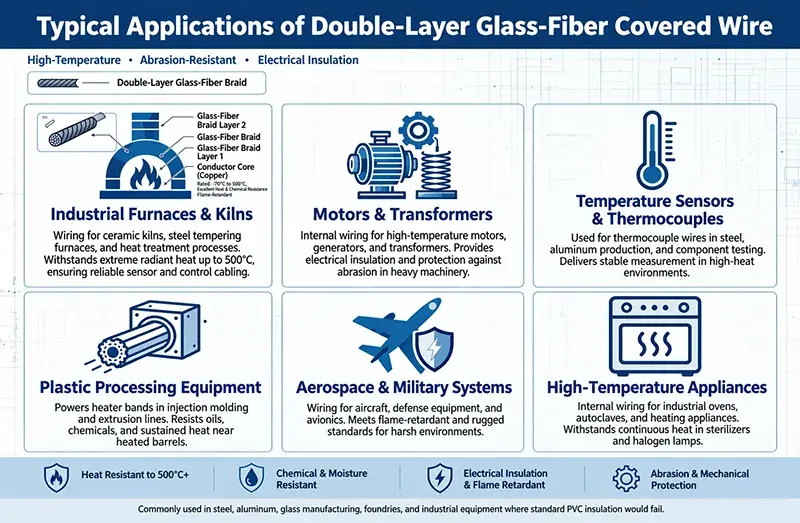
Dry-Type Transformer
Windings of dry-type transformers typically operate within the F/H-class temperature rise range of 130–180°C, demanding extremely high thermal resistance, non-combustibility, and low-smoke performance from insulation materials. Double-layer glass-fiber covered wire is commonly used in:
- Low-voltage windings of cast resin dry-type transformers;
- High-voltage windings of open ventilated dry-type transformers;
- High-current low-voltage windings of distribution transformers and rectifier transformers.
Advantages: Thermal resistance, non-support of combustion, low-smoke zero-halogen (LSZH); during fault conditions, the insulation enamel does not burn to release highly toxic smoke.
Traction Motors and Rail Transit Motors
Traction motors and auxiliary motors for metro systems, light rail vehicles, electric locomotives, and EMUs operate under severe vibration, high temperatures (180–200°C), and spatially constrained environments. Double-layer glass-fiber covered wire is commonly used in:
- Stator windings of traction motors (asynchronous TIM or permanent magnet PMSM);
- Primary windings of traction transformers;
- Motors for auxiliary converters, battery chargers, and air conditioning systems.
Applicable standards: IEC 60310, EN 45545-2 HL3 fire protection, TB/T 3230, GB/T 25123.
High-Voltage Motors and Metallurgical Motors
Stator windings of high-voltage motors (6 kV, 10 kV), main drive motors for rolling mills, and mine hoist motors require high voltage endurance and mechanical impact resistance. Double-layer glass-fiber covered wire, combined with VPI (vacuum pressure impregnation) processing, constitutes a classic solution for such motors.
Welding Machines and Furnace Transformers
Windings of welding machines (arc welders, spot welders, seam welders), medium-frequency furnace transformers, and resistance furnace windings reach operating temperatures exceeding 200°C and frequently endure short-circuit current surges. The high-temperature resistance and short-circuit withstand capability of double-layer glass-fiber covered wire make it the preferred choice.
Special-Purpose Motors and Aerospace Motors
Military or special-purpose motors—including aircraft generators, marine propulsion motors, and radar drive motors—demand extreme thermal resistance, shock resistance, and vibration resistance. The high reliability of double-layer glass-fiber covered wire renders it a standard solution.
Excitation Windings of Large Generators
Excitation windings of large hydro-generators, turbo-generators, and synchronous condensers operate at high temperatures, carry high currents, and run continuously over extended periods. Double-layer glass-fiber covered wire combined with mica tape composite insulation (Micaply / Resitherm) forms a classic insulation system.
Manufacturing Process of Double-Layer Glass-Fiber Covered Wire
Conductor Pre-Treatment
- Annealing and softening (continuous bright annealing or batch furnace annealing) to O60 / O61 condition;
- Acid–alkali cleaning to remove surface oxides and oil contaminants;
- Application of coupling agent or primer (e.g., silane coupling agents KH-550, KH-560) to enhance adhesion between glass fiber and copper/aluminum.
Braiding (Double-Layer)
- Two-stage braiding performed on dedicated braiding machines;
- First layer braided at helix angle α₁, typically 30–60°;
- Second layer braided in reverse direction with helix angle α₂, approximately opposite to or identical with α₁;
- Braid density controlled by picks per inch (PPI), typically 15–30 PPI;
- Braid pitch determined by the ratio of spool rotational speed to wire linear speed.
Impregnation and Baking
- Vacuum Pressure Impregnation (VPI): vacuum applied first to evacuate air from fiber interstices, followed by pressurization to force insulating varnish into the fiber matrix, then resin drainage and thermal curing;
- Conventional Dip & Bake: atmospheric-pressure impregnation, drip-drying, followed by thermal curing in an oven at 150–200°C; process repeated 2–4 times to achieve required film thickness;
- Baking temperature strictly controlled according to varnish base chemistry to prevent over-baking or under-baking.
Finished Product Testing
- Visual inspection and dimensional measurement: micrometer, caliper, optical projection instrument;
- Dielectric testing: spark test (Spark Test, 100% online) + power-frequency withstand voltage (Sample Type Test);
- Mechanical testing: elongation, tensile strength, bend test, abrasion test;
- Physicochemical testing: film adhesion, solvent resistance wipe test, heat shock (Heat Shock, 175°C × 6 h, no cracking);
- Long-term aging: Arrhenius thermal life curve (IEEE 101 / IEC 60172), thermal class determined by 20,000-hour extrapolation method.
Comparison Between Double-Layer Fiberglass Covered Wire and Enameled Wire
Many customers struggle with the question: “Should I use enameled wire or double-layer fiberglass covered wire?”—the core selection criteria are as follows:
| Parameter | Enameled Wire (UEW/PEW/EIW) | Double-Layer Fiberglass Covered Wire |
|---|---|---|
| Maximum Operating Temperature | 220°C (Class H/220) | 250°C+ (Classes H/N/R/250) |
| Dielectric Breakdown Voltage | Low (thin-film insulation) | High (robust braided layer + enamel fill) |
| Space Factor | High (compact winding) | Medium (fiber layer occupies space) |
| Short-Circuit Resistance | Medium | High (superior mechanical strength) |
| Radiation Resistance | Poor (organic enamel degrades easily) | Excellent (inorganic fibers resist radiation) |
| Moisture Resistance | Medium (insulation deteriorates upon moisture absorption) | Good (enamel seals the fibers) |
| Cost | Low | Higher |
| Typical Applications | Small- and medium-sized motors, transformers, household appliances | Dry-type transformers, high-voltage motors, traction systems, specialty equipment |
Rule of Thumb: ≤ 155°C, Classes B/F, compact space requirements, high-volume production → Enameled Wire; ≥ 180°C, Classes H/N/R/250, high dielectric strength, high-vibration environments, short-circuit resistance → Double-Layer Fiberglass Covered Wire.
Standard System for Double-Layer Fiberglass Covered Wire
International Standards
- IEC 60851: General test methods for winding wires;
- IEC 60317: Product specifications for magnet wires and fibreglass covered wires;
- IEC 60085: Electrical insulation – Thermal classification;
- IEC 60172: Test procedure for determining the temperature index of enameled wires and fibreglass covered wires;
- NEMA MW 1000: General specification for winding wires (including MW 41 double-layer fiberglass covered copper round wire, MW 42 double-layer fiberglass covered copper rectangular wire, MW 43 double-layer fiberglass covered aluminum round wire, MW 44 double-layer fiberglass covered aluminum rectangular wire, MW 51 single-layer fiberglass covered copper round wire, MW 52 single-layer fiberglass covered copper rectangular wire, MW 53 single-layer fiberglass covered aluminum round wire, MW 54 single-layer fiberglass covered aluminum rectangular wire, MW 61 double-layer fiberglass covered polyester-impregnated copper round wire, MW 62 double-layer fiberglass covered polyester-impregnated copper rectangular wire);
- ASTM B49, B115, B170, B48, B869: Standard specifications for copper and aluminum conductors;
- ASTM D149, D257, D2303: Test methods for dielectric strength and insulation resistance;
- IEEE 101 / 104: Methods for thermal aging evaluation.
Chinese National Standards
- GB/T 7672: Fiberglass covered winding wires (including fiberglass covered copper round wire, fiberglass covered copper rectangular wire, fiberglass covered aluminum round wire, fiberglass covered aluminum rectangular wire);
- GB/T 11021: Electrical insulation – Thermal classification;
- GB/T 1408 / GB/T 1410: Test methods for dielectric strength and volume resistivity;
- GB/T 4074: Test methods for winding wires.
EU / Environmental Standards
- RoHS 2.0 (2011/65/EU): Restriction of hazardous substances including lead, mercury, cadmium, hexavalent chromium, PBB, and PBDE;
- REACH (EC 1907/2006): Registration, Evaluation, Authorisation and Restriction of Chemicals;
- ELV 2000/53/EC: End-of-Life Vehicles Directive, imposing heavy metal restrictions on winding wires used in automotive applications;
- EN 45545-2 HL3: Highest fire protection class for railway applications.
Selection and Procurement Recommendations
Clarify Operating Conditions
- Continuous operating temperature: Class F/H/N/R?
- Voltage rating: 220 V/380 V/6 kV/10 kV?
- Vibration and shock: Standard / High / Extreme?
- Short-circuit current impulse: Magnitude?
- Environmental compliance certifications: RoHS/REACH/EN 45545-2 HL3?
- Application industry: Dry-type transformer / Traction / High-voltage motor / Welding / Special-purpose?
Focus on Key Performance Indicators
- Conductor material (copper/aluminum) and specifications (round/flat, dimensional tolerances);
- Fiberglass type (E-glass/S-glass) and braid density (PPI);
- Impregnating resin system (silicone resin/polyester-modified silicone/polyimide) and thermal class;
- Dielectric strength (breakdown voltage), insulation resistance, thermal shock resistance (Heat Shock);
- Surface smoothness, enamel adhesion, solvent wipe resistance;
- Compliance with target standards (NEMA MW 41/42/43/44, IEC 60317, GB/T 7672);
- Requirement for third-party certifications (UL, CE, CCC, SGS, REACH, RoHS).
Long-Term Partnership Considerations
- Does the manufacturer have over 30 years of magnet wire export experience?
- Are ISO 9001 / ISO 14001 / ISO 45001 integrated management system certifications in place (SGS-audited)?
- What are the minimum order quantity (MOQ), custom lead time, and batch-to-batch consistency?
- Can full traceability be provided—from conductor annealing, fiberglass braiding, to VPI impregnation?
Zhengzhou LP Industry Co., Ltd. has accumulated over 30 years of manufacturing and export expertise in double-layer fiberglass-covered magnet wire. Our facility spans 60 mu (≈40,000 m²) and features a fully integrated production line covering conductor annealing, fiberglass braiding, and VPI impregnation. Products are certified to ISO 9001 / ISO 14001 / ISO 45001, UL, REACH, and RoHS, and supplied per NEMA MW 41/42/43/44, IEC 60317, and GB/T 7672. Round wire range: 0.5–6.0 mm; flat wire thickness: 1.0–8.0 mm × width: 2–25 mm. Conductors available in copper or aluminum. Thermal classes cover B/F/H/N/R/250. Products are exported to more than 50 countries and regions, widely applied in dry-type transformers, traction motors, high-voltage motors, metallurgical motors, welding equipment, furnace transformers, and special-purpose motors. For technical datasheets, quotations, or samples, please contact us anytime:
- Email: <office@cnlpzz.com>
- WhatsApp: 0086-19337889070
Frequently Asked Questions
Does “Double-Layer” in Double-Layer Fiberglass Covered Wire Literally Require Two Physical Layers?
Yes. “Double-Layer” refers to an insulation system composed of two overlapping (bi-lap) layers of fiberglass braided tape — this is the fundamental distinction from single-layer fiberglass covered wire. Dual-layer winding significantly enhances dielectric strength and mechanical strength.
Can Double-Layer Fiberglass Covered Wire Be Manufactured in Small Dimensions Like Enamel-Coated Wire?
No. The double-braided structure is inherently thicker than enamel coating (typical outer diameter increase of 0.2–0.6 mm); therefore, double-layer fiberglass covered wire is typically used for round wire with diameter ≥ 0.5 mm or large-size rectangular wire. Fine wire (< 0.5 mm) generally employs enamel-coated wire or multi-layer enamel-coated wire.
Is Double-Layer Fiberglass Covered Wire Susceptible to Moisture?
Glass fiber itself exhibits hygroscopicity; thus, resin impregnation is essential to seal interstitial voids within the fiber matrix. After immersion in water for 24 hours, the volume resistivity of finished product shall remain ≥ 10¹⁰ Ω·cm (per ASTM D257 / GB/T 1410). For high-humidity environments, epoxy-modified or polyimide varnish may be adopted, with increased impregnation cycles as appropriate.
Is Double-Layer Fiberglass Covered Wire Environmentally Compliant?
Glass fiber, silicone resin, and polyimide varnishes themselves do not emit hazardous substances. Regulatory directives including RoHS, REACH, and ELV impose restrictions on lead, cadmium, PBB, PBDE, and other hazardous substances — compliant double-layer fiberglass covered wire products must fully conform to all such directives. Suppliers should be required to provide SGS or third-party test reports during material selection.
Can Double-Layer Fiberglass Covered Wire Directly Replace Enamel-Coated Wire?
Not as a simple substitution. Double-layer fiberglass covered wire offers superior temperature rating, mechanical strength, and dielectric strength, but exhibits lower space factor and higher cost. Application domains are clearly differentiated: enamel-coated wire is preferred for compact windings at ≤ 155°C; double-layer fiberglass covered wire is designated for high-reliability windings at ≥ 180°C.
What Is the Maximum Temperature Rating of Double-Layer Fiberglass Covered Wire?
Theoretically up to 250°C and above (H/N/R/250 class). However, actual operating temperature is constrained by multiple factors including impregnating varnish, insulation varnish lifetime, solder joint integrity, and insulation clearance. Thermal life evaluation per IEEE 101 / IEC 60172 Arrhenius curves is recommended during product selection.
Is Impregnation Mandatory for Double-Layer Fiberglass Covered Wire?
Impregnation is mandatory. Glass fiber possesses an inherently porous structure; without varnish impregnation, electrical insulation performance, moisture resistance, and mechanical strength fail to meet specifications. Impregnating varnish is an indispensable component enabling the thermal, dielectric, and mechanical performance of double-layer fiberglass covered wire.
Can Aluminum Be Used as the Conductor in Double-Layer Fiberglass Covered Wire?
Yes. NEMA MW 43 / MW 44 specify double-layer fiberglass covered aluminum round wire / aluminum rectangular wire, respectively, with conductor material typically 1350-O or 1060-O annealed electrical-grade aluminum. Aluminum conductors offer reduced weight and lower cost, though conductivity is approximately 61% that of copper — requiring corresponding cross-sectional area enlargement.
Summary
Double-Layer Fiberglass Covered Wire is a specialized high-temperature magnet wire centered on “double-layer fiberglass braiding + heat-resistant insulating varnish impregnation,” primarily targeting high-temperature, high-dielectric applications such as dry-type transformers, traction motors, high-voltage motors, metallurgical motors, welding equipment and electric furnaces, and special-purpose motors rated at Class F/H/N/R/250. Compared with enameled wire, it offers significant advantages in thermal resistance, dielectric performance, mechanical strength, and radiation resistance—though at higher cost and larger physical volume. Selection requires comprehensive evaluation across temperature, voltage, vibration, environmental compliance certifications (e.g., RoHS, REACH, ELV), and industry standards (e.g., IEC, NEMA, ASTM, GB/T, UL, IEEE, EN, JIS), supplemented by long-term reliability assessment using the Arrhenius thermal life curve.
For detailed technical specifications, customized solutions, or samples, please contact us anytime.