


Why are electric vehicles, aviation, and rail transit all switching from copper to aluminum? One sentence: aluminum’s weight is only 30 percent of copper’s. This single number is the starting point for every lightweighting story.
But the claim that aluminum is 70 percent lighter is too crude. Engineering needs more precise conversion. How much weight can aluminum save under equal conductivity? When winding a motor, laying a wiring harness, or building a transformer, how many kilograms can you save by switching from copper to aluminum? These are the questions that procurement, engineers, and designers really care about.
This article focuses on weight alone. It breaks down the copper-aluminum weight comparison thoroughly, from physical parameters to engineering calculations to industry data.
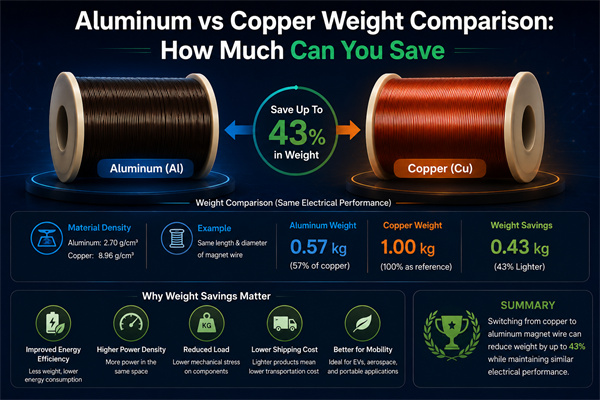
Two Physical Parameters You Cannot Skip
Before calculating any weight, confirm two physical parameters.
Copper’s density is 8.96 g/cm³. Aluminum’s density is 2.70 g/cm³. Aluminum’s density is only 30 percent of copper’s. This is a fact determined by physics and does not change with alloy grade, processing technology, or surface treatment.
Copper’s conductivity is 100% IACS (International Annealed Copper Standard). Aluminum is 61% IACS. This means that at the same cross-sectional area, copper can carry 64 percent more current. To achieve the same current carrying capacity, the cross-sectional area of aluminum wire must be enlarged by 1 divided by 0.61, which is approximately 1.64 times.
Stacking these two numbers: under equal conductivity, the weight of aluminum wire is 1.64 times 0.30 equals 0.50 of copper wire, which is a 50 percent weight reduction.
Remember these two numbers. Every “X percent weight reduction” below derives from these two numbers.
Equal Conductivity Weight Comparison
Let’s expand the formula above. Suppose a copper wire is 1 meter long, with a cross-sectional area of 1 mm² and current carrying capacity of X amperes.
Copper wire weight: 1 meter × 1 mm² × 8.96 g/cm³ = 8.96 g. To achieve the same current carrying capacity of X amperes, the aluminum wire cross-sectional area needs to be 1.64 mm². Aluminum wire weight: 1 meter × 1.64 mm² × 2.70 g/cm³ = 4.43 g. Weight reduction = (8.96 minus 4.43) divided by 8.96 = 50.5 percent.
This is the most rigorous “50 percent weight reduction” calculation under the equal conductivity standard. CCA (copper-clad aluminum) falls between the two. CCA with 10 percent copper volume reduces weight by about 45 percent under equal conductivity. CCA with 15 percent copper volume reduces weight by about 42 percent.
Quick conversion table (under equal conductivity):
Copper enameled wire 1.0 mm diameter: weight baseline (100 percent). Aluminum enameled wire 1.28 mm diameter: weight 50 percent. CCA enameled wire 1.10 mm diameter: weight 55 to 58 percent.
Key insight: replacing copper with aluminum under equal conductivity does not mean “70 percent lighter” but “50 percent lighter.” The remaining 20 percent gap is absorbed by the enlarged cross-sectional area.
Weight Reduction in Different Application Scenarios
Theoretical calculations are not enough. Let’s look at actual scenarios.
Scenario One: EV High-Voltage Wiring Harness
Tesla Model 3’s high-voltage wiring harness is the most classic case of full aluminum replacement of copper. After the vehicle’s high-voltage wiring harness was switched from copper to aluminum, the overall vehicle wiring harness weight was reduced by about 21 percent. Specifically for the high-voltage wiring harness itself, weight reduction was 30 to 40 percent (based on actual engineering data, because the high-voltage wiring harness also needs to consider insulation, connectors, bundling, and other accessories, and the weight reduction ratio under equal conductivity will slightly decrease).
Based on a pure electric vehicle’s high-voltage wiring harness weight of 30 to 50 kg, switching to aluminum can reduce weight by 10 to 20 kg. These 10 to 20 kg directly affect range. Every 100 kg of weight reduction adds 2 to 3 percent range, so 10 to 20 kg means 0.5 to 1 percent range gain.
Scenario Two: Drive Motor Windings
An 80 kW drive motor uses about 8 kg of copper enameled wire. Switching to aluminum enameled wire requires about 13 kg under equal conductivity. But aluminum’s density is only 30 percent of copper’s, so 13 kg of aluminum has 1.64 times the volume of 8 kg of copper. Actual winding weight comparison: copper winding 8 kg, aluminum winding 13 × 0.30 = 3.9 kg. Weight reduction of 51 percent.
But this only holds under equal conductivity replacement. If the customer does not require equal conductivity and just uses a “similar slot size to fit aluminum wire,” the aluminum winding weight may actually exceed copper (because more aluminum is stuffed to fill the slot). This point is easy to overlook.
Scenario Three: Transformer Windings
A 500 kVA distribution transformer uses 50 kg of copper enameled wire for the low-voltage winding. Switching to aluminum enameled wire requires about 80 kg under equal conductivity. Winding weight comparison: copper 50 kg, aluminum 80 × 0.30 = 24 kg. Weight reduction of 52 percent.
The transformer’s overall weight includes core, windings, insulating oil, and shell. The winding weight reduction of 26 kg is less than 2 percent of the transformer’s overall weight of 1 to 2 tons. So the “weight reduction” value of replacing copper with aluminum in transformers is small, mainly driven by material cost and resource security considerations.
Scenario Four: Power Cables
Power cables (not enameled wire) show the most obvious aluminum-copper weight reduction effect. A 1 km long, 240 mm² cross-section low-voltage power cable:
Copper cable: 1 km × 240 mm² × 8.96 g/cm³ = 2,150 kg. Aluminum cable (equal conductivity 393 mm²): 1 km × 393 mm² × 2.70 g/cm³ = 1,061 kg. Weight reduction of 50.7 percent.
For overhead lines, a 50 percent weight reduction from replacing copper with aluminum means the tower load design can be relaxed by 50 percent. This has a chain effect on tower spacing, tower height, and tower foundation for long-distance transmission lines. The real value of aluminum replacing copper in power cables is making “weight” itself a design variable.
Scenario Five: Home Appliance Motors
Home appliance motors (air conditioner outdoor unit motors, washing machine motors, range hood motors) typically use 0.1 to 0.5 kg of copper enameled wire. Switching to aluminum enameled wire reduces weight by 30 to 50 percent per unit. But home appliance products are not weight sensitive (consumers do not care if the air conditioner outdoor unit is 200 g lighter), so home appliance aluminum replacement is primarily cost driven, not weight driven.
Real Value of Weight Reduction: Huge Scenario Differences
The five scenarios above illustrate one thing: the weight reduction value of replacing copper with aluminum is highly dependent on the application scenario.
| Scenario | Weight Reduction | Real Value of Weight Reduction |
| EV high-voltage wiring harness | 30 to 40 percent | High (directly affects range) |
| Drive motor winding | 50 percent | Medium (affects vehicle lightweighting) |
| Transformer winding | 50 percent | Low (2 to 3 percent of transformer total weight) |
| Power cable | 50 percent | High (affects tower spacing design) |
| Home appliance motor | 30 to 50 percent | Low (consumer imperceptible) |
Weight reduction is not free. Replacing copper with aluminum requires engineering changes, connection processes, reliability verification, and other costs. Only when “weight reduction itself has commercial value” is replacing copper with aluminum worthwhile.
Chain Reactions Beyond Weight Reduction
The weight change from replacing copper with aluminum triggers a series of chain design changes.
Mechanical structure: After weight reduction, the tower load design for the transformer can be relaxed, but the mechanical strength of aluminum windings is only 50 to 70 percent of copper’s. The supporting structure actually needs to be reinforced.
Heat dissipation: Copper’s thermal conductivity of 401 W/(m·K) is 1.7 times aluminum’s 237 W/(m·K). After replacing copper with aluminum, heat dissipation capacity decreases, requiring redesign of the heat dissipation structure (adding heat sinks, changing air ducts, increasing cooling power).
Vibration: Aluminum’s elastic modulus is only 56 percent of copper’s. Aluminum windings deform more easily under vibration. Additional bundling and anti-vibration designs are required.
Connection: Copper brazing is cheap and mature. Aluminum welding costs 30 to 60 percent more. This incremental cost needs to be factored into TCO.
Transportation and installation: After replacing copper with aluminum, the product becomes lighter and transportation and lifting costs decrease. A 1-ton transformer that becomes 50 kg lighter may see transportation costs drop by 5 to 10 percent. This is a hidden benefit of aluminum replacing copper.
Three Questions for Weight Reduction Decisions
Returning to the initial question: “Aluminum vs copper, how much weight can you save?” The answer is always: it depends on your scenario. But before making a decision, ask three questions.
One: Is weight a core selling point of this product? If it is an EV, aviation, or rail transit application, aluminum replacing copper has high weight reduction value. If it is a transformer fixed in a corner, weight is not the selling point.
Two: What is the downstream benefit of weight reduction? The downstream benefit for EVs is range. Every 100 kg of weight reduction adds 2 to 3 percent range. The downstream benefit for fixed equipment is installation cost, which is more limited in scope.
Three: Can the cost of weight reduction be absorbed? Replacing copper with aluminum requires engineering changes, connection processes, reliability verification, and customer education. The smaller the batch, the higher these costs amortize per unit product.
Once these three questions are answered, the answer is clear.