

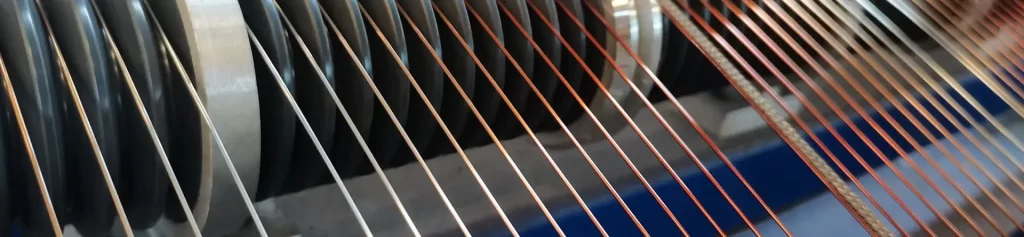
Ultra-thin aluminum foil, as one of the critical conductive materials of chip inductor winding manufacturing, is widely used for chip inductor forming. A chip inductor, a surface mount device (SMD), typically use miniature planar spiral coil structures that are formed by photolithography or precision etching onto extremely thin insulating substrates. In comparison with the conventional wound inductors, chip inductors have the merits of miniature size, lightweight, precision, high HF characteristics and fully automatic mass production.
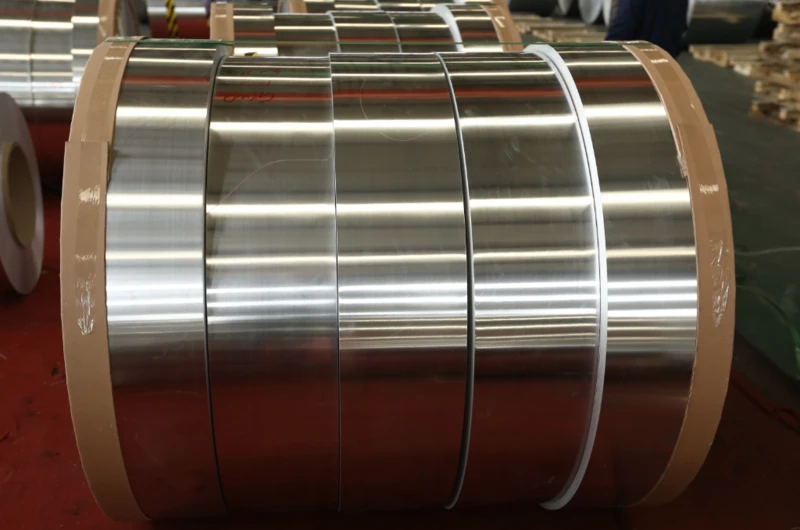
I. Operating Characteristics and Technical Requirements of Chip Inductors
1.1 Chip Inductor Structure and Principles
In general the current chip inductors have multilayer construction of insulating substrate, conducting coil pattern, internal electrodes, and external electrodes. The solid state insulating substrate should be Alumina (AlO) ceramic or ferrite material. The conducting coil pattern by photolithography and etching which width and space between lines are several microns. The external electrode is electroplates or welding in order to construct an PCB connection.
An inductor is based on electromagnetic induction. In an inductor, the inductance is accurately linked with the number of turns, the area within the turns and the reluctance of the magnetic circuit. At higher frequencies the parasitic capacitance, parasitic inductance, skin effect and proximity effect will all become noticeable.
1.2 Chip Inductor Operating Characteristics
Miniature dimensions: Common package sizes include 0201 (0.6mm×0.3mm), 0402 (1.0mm×0.5mm), 0603 (1.6mm×0.8mm), 0805 (2.0mm×1.2mm), 1206 (3.2mm×1.6mm), with some ultra-miniature products reaching 01005 (0.4mm×0.2mm).
Extremely wide operating frequency range: From low-frequency MHz to high-frequency GHz. Low-frequency chip inductors (several MHz to tens of MHz) are mainly used for power filtering and signal processing; high-frequency chip inductors (hundreds of MHz to several GHz) are mainly used for RF front-end, impedance matching, and resonant circuit applications.
Extremely high precision requirements: Inductance tolerance is typically required within ±5%, with some precision products requiring ±2% or even ±1%.
Excellent high-frequency performance: Stable electrical characteristics at GHz frequencies with high Q-factor and high self-resonant frequency (SRF).
Stringent reliability requirements: Must meet automatic pick-and-place mounting process requirements and withstand reflow soldering high-temperature shocks, with lifetime requirements typically exceeding tens of thousands of hours.
1.3 Core Application Areas
- Consumer electronics: smartphones, tablets, laptops, smartwatches, TWS earphones
- Automotive electronics: in-vehicle entertainment systems, ADAS, power battery management systems
- Medical devices: implantable medical devices, portable diagnostic equipment
- Communication equipment: 5G base stations, IoT modules, satellite communication equipment
- Industrial control: industrial automation equipment, power management systems
II. Core Requirements for Ultra-Thin Aluminum Foil
2.1 Extremely Thin Thickness Requirements
Chip inductor dimensions are miniature with extremely limited winding space. 0201 package coil thickness is typically only several tens of microns, and 0402 packages are typically 50-100 microns. Therefore, ultra-thin aluminum foil thickness must be within the 0.005-0.05mm (5-50 micron) range, with some ultra-miniature products even requiring below 0.003mm (3 microns).
2.2 Extremely High Thickness Uniformity Requirements
- For ±5% tolerance products: foil thickness tolerance within ±0.001mm
- For ±2% tolerance precision products: foil thickness tolerance within ±0.0005mm
- Thickness uniformity typically required within ±2% across full roll length
2.3 Excellent Mechanical Properties
- Tensile strength: 100-200MPa to maintain integrity during winding and processing
- Elongation: 5-20% to accommodate bending stress
- Flexibility: No cracks or breakage under micro-bending conditions
2.4 Excellent High-Frequency Electrical Performance
Skin depth calculation formula: δ=66.1/√f (mm)
At 1GHz frequency, skin depth is approximately 0.066mm (66 microns). Since chip inductor coil thickness is typically only several to several tens of microns, far less than skin depth, skin effect impact on chip inductors is relatively limited. The key parameter is low resistivity with conductivity IACS ≥59%.
2.5 Extremely High Surface Quality Requirements
Ultra-thin aluminum foil surface must be free from: scratches, indentations, foreign matter, oxide spots, and other defects.
2.6 Extremely High Edge Quality Requirements
Foil edges must be neat and burr-free. Poor edge quality may cause interlayer short circuits or degraded electrical performance.
III. Detailed Specifications
3.1 Ultra-Thin Aluminum Foil Substrate Specifications
- Material: Pure aluminum 1060, aluminum content ≥99.60%
- Conductivity: Annealed state IACS ≥59%
- Thickness range: 0.005-0.05mm (5-50 microns)
- Width range: 0.5-10mm
3.2 Thickness Grade Classification
| Thickness Grade | Thickness Range | Main Applications |
|---|---|---|
| Ultra-thin grade | 0.005-0.01mm | Ultra-miniature chip inductors (01005, 0201 packages) |
| Extra-thin grade | 0.01-0.02mm | Small chip inductors (0402 package) |
| Thin grade | 0.02-0.05mm | Standard chip inductors (0603, 0805 packages) |
3.3 Mechanical Property Parameters
| State | Tensile Strength | Elongation | Applications |
|---|---|---|---|
| O State (Annealed) | 55-95MPa | ≥25% | Bending required |
| H18 State (Hard) | ≥125MPa | ≥2% | Shape retention |
3.4 High-Frequency Performance Parameters
| Operating Frequency | Skin Depth | Recommended Foil Thickness |
|---|---|---|
| 10MHz | 0.66mm | 0.01-0.05mm |
| 100MHz | 0.21mm | 0.005-0.05mm |
| 500MHz | 0.094mm | 0.005-0.03mm |
| 1GHz | 0.066mm | 0.005-0.02mm |
| 2GHz | 0.047mm | 0.005-0.015mm |
| 5GHz | 0.030mm | 0.005-0.01mm |
IV. Selection Guide
4.1 Selection by Package Size
| Package Size | Dimensions (mm) | Coil Thickness | Recommended Foil Thickness |
|---|---|---|---|
| 01005 | 0.4×0.2 | 10-20μm | 0.005-0.01mm |
| 0201 | 0.6×0.3 | 20-40μm | 0.005-0.015mm |
| 0402 | 1.0×0.5 | 30-60μm | 0.01-0.02mm |
| 0603 | 1.6×0.8 | 40-80μm | 0.015-0.03mm |
| 0805 | 2.0×1.2 | 50-100μm | 0.02-0.05mm |
| 1206 | 3.2×1.6 | 60-120μm | 0.02-0.05mm |
4.2 Selection by Operating Frequency
Low frequency (10-100MHz): Wide thickness selection range, 0.01-0.05mm
Medium frequency (100MHz-1GHz): Recommend 0.005-0.03mm
High frequency (above 1GHz): Recommend 0.005-0.02mm ultra-thin grades
4.3 Selection by Precision Requirements
Standard precision (±10% tolerance): Standard ultra-thin aluminum foil, thickness tolerance within ±0.002mm
Medium precision (±5% tolerance): High-precision thickness control, tolerance within ±0.001mm
High precision (±2% tolerance): Customized production, uniformity within ±0.0005mm
V. Dimensional Tolerance Requirements
5.1 Thickness Tolerance
- Ultra-high precision: ±0.001mm for high-reliability products
- Ultra-ultra-high precision: ±0.0005mm for precision chip inductors
5.2 Width Tolerance
- Ultra-high precision: ±0.02mm for automatic winding
- Ultra-ultra-high precision: ±0.01mm for precision etching
5.3 Thickness Uniformity
- Full roll length direction: ≤±2%
- Roll width direction: ≤±1%
- High-precision products: ≤±0.5%
VI. Production Process Key Points
6.1 Ultra-Thin Aluminum Foil Production Process
Ingot preparation → Hot rolling → Cold rolling → Annealing → Slitting → Inspection
Key control points: Thickness uniformity within ±0.001mm, defect-free surface, neat and burr-free edges
6.2 Storage and Transportation
- Constant temperature and humidity storage to prevent oxidation
- Avoid heavy pressure and impact to prevent creasing
- Use dedicated reels and packaging materials
- Moisture-proof and shock-proof during transportation
VII. Quality Inspection Methods
7.1 Dimensional Inspection
Thickness: High-precision thickness gauge with 0.0001mm accuracy; Width: Projector or high-precision caliper
7.2 Appearance Inspection
Surface: Scratches, indentations, oxide spots, foreign matter; Edge: Burrs, rough edges, chipped edges
7.3 Performance Inspection
Mechanical: Universal testing machine for tensile strength and elongation; Electrical: Eddy current conductivity meter, standard IACS ≥59%
VIII. Supplier Selection Recommendations
8.1 Key Evaluation Points
- Ultra-thin production capability: Stable production below 0.01mm
- Thickness control precision: Tolerance within ±0.001mm
- Clean production environment: High cleanliness standards
- Testing capability: High-precision thickness inspection equipment
8.2 Sample Testing Process
Dimensional inspection → Thickness uniformity test → Performance test → Process suitability test
IX. Common Specifications Reference
9.1 By Package Size
| Package | Thickness | Width | Tolerance |
|---|---|---|---|
| 01005 | 0.005-0.01mm | 0.5-2mm | ±0.001mm |
| 0201 | 0.005-0.015mm | 1-3mm | ±0.001mm |
| 0402 | 0.01-0.02mm | 2-5mm | ±0.001mm |
| 0603 | 0.015-0.03mm | 3-8mm | ±0.001mm |
| 0805 | 0.02-0.05mm | 5-10mm | ±0.002mm |
9.2 By Frequency Range
| Frequency Range | Thickness | Main Applications |
|---|---|---|
| 10-100MHz | 0.01-0.05mm | Power inductors, filter inductors |
| 100MHz-1GHz | 0.005-0.03mm | RF inductors, matching inductors |
| Above 1GHz | 0.005-0.02mm | High-frequency RF inductors |
X. Conclusion
Our company has 30 years of experience in exporting electrical wire and metal foil, with extensive expertise in ultra-thin aluminum foil production.
Core advantages:
- Thickness range 0.005-0.05mm, meeting 01005 to 0805 package requirements
- Ultra-high thickness precision, tolerance up to ±0.001mm
- Excellent thickness uniformity, full roll uniformity ≤±2%
- Superior surface quality with high cleanliness standards
- Excellent high-frequency performance, conductivity IACS ≥59%
- Customized specifications available per inductor design requirements
- Complete test reports for each batch
- Professional technical team providing selection support
Contact our technical team for selection support.
Contact Information:
Email: office@cnlpzz.com
WhatsApp: 0086-19337889070