

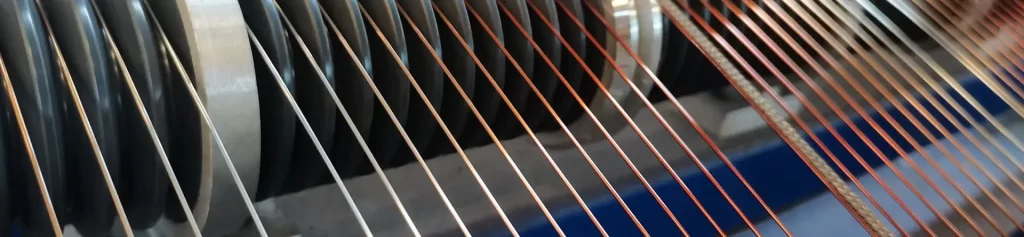
The transformer copper foil winding market surpassed USD 3.8 billion in 2024 and is highly concentrated — the top 8 global manufacturers hold 65% of the market. Buying copper foil looks simple, but transformer manufacturers face four technical thresholds: enamel adhesion, thickness tolerance, bending resistance, and insulation system matching. This article provides a five-chapter practical guide for transformer procurement officers: from the core advantages of copper foil windings, real profiles of the four manufacturer types, key comparisons between copper and aluminum foil, through to a five-step sourcing checklist.
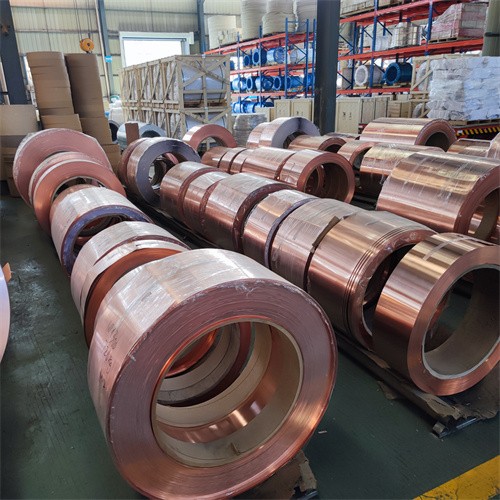
1. Four Irreplaceable Advantages of Copper Foil Windings
1. Very Low Resistance: Copper’s resistivity is only 61% of aluminum’s. Copper foil of the same size delivers 35-40% lower load loss than aluminum foil, with 0.5-1.2% efficiency improvement.
2. Long-Term Dimensional Stability: Coefficient of thermal expansion is 35% lower than aluminum; turn-to-turn distances change very little over long operation, avoiding local hot spots. Transformer design life can reach 30-40 years (vs. 25-30 years for aluminum foil).
3. Excellent Short-Circuit Impact Resistance: Copper’s yield strength is 1.5-2 times that of aluminum; deformation under short-circuit electromagnetic forces is reduced by 40-50%.
4. Easy to Solder: Copper foil ends can be joined by ordinary tin, copper, or silver brazing — this is aluminum foil’s biggest pain point and copper foil’s key selling point.
2. Real Profiles of the Four Transformer Copper Foil Manufacturer Types
- International Giants (Elektrisola / Essex / Rea): Technology leaders serving the global top 500 transformer manufacturers. Pros: mature formulations, complete long-term reliability data. Cons: prices are 4-7 times those of major Chinese factories, MOQ 1-2 tons.
- Domestic Large and Medium-Sized Enameled Wire Leaders (Jiangxi Copper Yez, Great Wall Electrical): Comprehensive strength, complete enamel formulations. Pros: mature process, can work with medium and small transformer factories. Cons: ultra-high-end 220°C enamels still depend on international suppliers.
- Professional Copper Foil Manufacturers (LP Industry, Outlast, New Material, etc.): Focused solely on copper foil, with deep accumulation. Pros: tight dimensional tolerances, complete export certifications. Cons: only copper foil, cannot provide one-stop service for round wire / aluminum wire.
- Small Processing Plants / Enameled Wire Derivatives: Typically 100-300 tons monthly, product width 100-500mm. Pros: flexible, cheap. Cons: thickness tolerance ±10-12%, serving only local low-end markets.
Practical reminder: when judging a manufacturer’s capability, look for in-house enamel formulation lab + independent breakdown voltage tester + 1,000-hour accelerated aging test equipment — these are the keys to distinguishing “processing factory” from “professional manufacturer”.
3. Copper Foil vs Aluminum Foil: 5 Key Parameters Compared
- Resistance: Copper 1.72×10⁻⁸ Ω·m vs Aluminum 2.83×10⁻⁸ Ω·m. Copper foil loss is 35-40% lower.
- Density: Copper 8.96 g/cm³ vs Aluminum 2.70 g/cm³. Aluminum is 70% lighter.
- Price (2024): Copper USD 8,500-9,500/ton, Aluminum USD 2,400-2,700/ton. Aluminum is around 30% the cost of copper.
- Short-Circuit Resistance: Copper yield 200-300 MPa, Aluminum 80-120 MPa. Copper is 1.5-2x stronger in deformation resistance.
- Soldering: Copper can be conventionally soldered; aluminum requires TIG (GTAW) or resistance welding. Aluminum process is complex and costly.
Practical choice: capacity above 2,500 kVA, EHV, offshore wind, mining flameproof transformers prioritize copper foil; 500-2,500 kVA distribution transformers, oil-immersed transformers mostly switch to aluminum foil.
4. Four Core Specifications When Procuring Copper Foil
- Thickness: Typical 0.2-2.0mm, transformer common 0.3-1.0mm. Thickness tolerance ±0.005mm is premium grade (±0.01mm is pass-grade).
- Width: 50-1,200mm. Width tolerance ±0.5mm is top-tier. Transformer plants commonly use 200-600mm.
- Enamel: Copper foil windings must be insulated on both sides — polyester-imide (PEI) + polyamide-imide (PAI) dual coating. Enamel thickness 0.06-0.12mm. PEI single layer is 180°C rated; PEI+PAI is 200°C.
- Bending Resistance: Elongation ≥ 25% (copper foil winding bend radius requires ≥ 5x thickness). Insufficient elongation cracks at the radius.
5. Copper Foil Procurement Checklist (5 Steps)
- Define Transformer Parameters and Target Market: capacity, voltage class, insulation system (oil/dry-type), target customer (European IEC / American IEEE / Chinese GB) — these determine enamel type and specification tolerance.
- Shortlist 3-5 Manufacturers: Find candidates via China International Transformer Exhibition (IEC Transformer Show), CWIEME Europe, IEEE Transformer Conference US. Distinguish “processing factory” from “professional manufacturer”.
- Request Samples + Third-Party Testing: Send 2-5kg samples from each, run UL 1446 + IEC 60851 + RoHS/REACH. Third-party reports from SGS / CTI / TÜV.
- Audit Factory + Enamel Formulation Check: Focus on whether the enamel lab is independent, whether 1,000-hour accelerated aging equipment is complete, and whether batch traceability systems are online.
- Small-Batch Pilot + Long-Term Agreement: Pilot 500-1,000kg first to verify one or two transformers’ full-life losses, then sign a 12-24 month long-term agreement to lock in price.
One last word: choosing a copper foil manufacturer is not about who is cheapest, but who can guarantee enamel stability for 10 years. Copper foil windings are designed for 30-year life — if one batch’s enamel ages prematurely, the in-service repair cost is 10x the copper foil’s own value. Choosing a manufacturer is choosing long-term protection.
One more point: the global three largest high-end transformer manufacturers ABB / Siemens / GE strictly control their copper foil material supplier list — not anyone can get in. This means copper foil manufacturers that supply these customers are top-tier global choices. Buyers can reverse-verify through the ABB / Siemens / GE qualified supplier list.
Another trend: ultra-high voltage (UHV, 800kV+) transformers still use 100% copper foil windings. The reason is straightforward — under UHV scenarios, the three requirements of short-circuit impact, hot-spot concentration, and reliability all hit aluminum foil’s ceiling; no matter how cheap, aluminum foil cannot meet them. So the talk of “aluminum foil replacing copper foil in high-voltage scenarios” is still premature. This gives another decisive clue to manufacturer selection.
One last unavoidable topic: copper foil manufacturers’ price swings have visibly widened in the past two years. LME copper went from a low of USD 7,800/ton in 2023 to a high of USD 9,600/ton in 2024, and is now around USD 9,200/ton — a 20%+ swing in two years. Buyers used to signing 6-month long contracts have been burned. In current practice, buyers meeting ABB / Siemens / GE standard requirements commonly request price linkage clauses (LME month-to-month linkage, plus 5-point buffer) to smooth out LME swings. Looking at which supplier accepts this linkage mechanism is the hallmark of “understanding the transformer industry.” Buyers save not only raw material costs but also negotiation attention and quality disputes.