

1. Temperature Grade Standard Systems and Terminology Mapping
The international enameled wire thermal class is expressed as a “class designation + rated temperature” dual parameter, derived from the Class identification system specified in NEMA MW 1000-2018, transformed by IEC 60317, and identically adopted by GB/T 6109. The Class number is not a dielectric breakdown voltage or mechanical strength index; it is the maximum allowable exposure temperature for that grade of enameled wire in a 20000-hour accelerated aging test. Thermal aging life follows the Arrhenius model, and life is halved for every 10 °C increase in temperature.
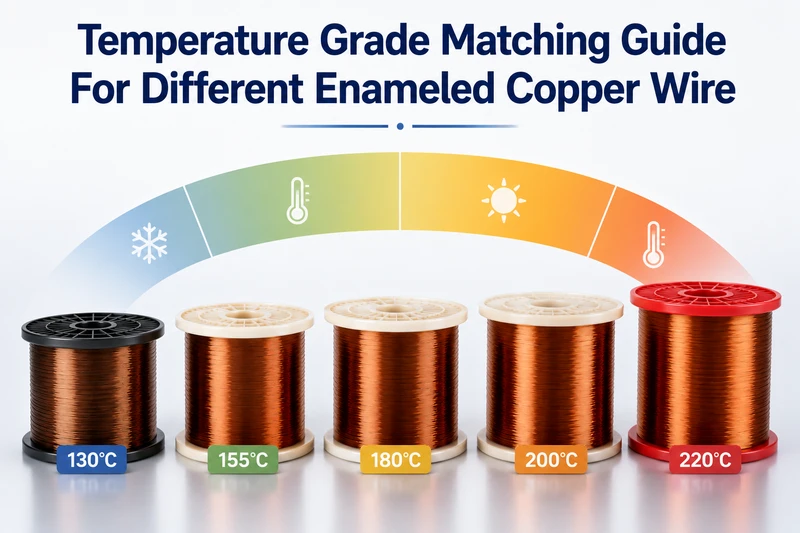
| Class 105 | 105 °C | Oleoresinous (O) | NEMA MW 1, IEC 60317-1, GB/T 6109.1 | Early home appliances, LV transformers |
|---|---|---|---|---|
| Class 130 | 130 °C | Polyurethane (UEW) + Polyester (PEW) | NEMA MW 2, IEC 60317-2/-21, GB/T 6109.2 | Class B motors, home appliances |
| Class 155 | 155 °C | Modified polyester (PEW), polyester-imide (EIW) | NEMA MW 27, IEC 60317-27, GB/T 6109.5 | Class F motors, transformers |
| Class 180 | 180 °C | Polyester-imide (EIW), polyamide-imide (AIW) composite | NEMA MW 30-C, IEC 60317-8, GB/T 6109.11 | Class H motors, UPS, drives |
| Class 200 | 200 °C | Polyamide-imide (AIW) single coat or EIW/AIW composite | NEMA MW 35-C, IEC 60317-13, GB/T 6109.17 | Class C motors, NEV drive |
| Class 220 | 220 °C | Polyamide-imide (AIW) / Polyimide (PI) | NEMA MW 37-C, IEC 60317-46, GB/T 6109.22 | Class N motors, aerospace, special |
| Class 240 | 240 °C | Polyimide (PI) | NEMA MW 38-C, IEC 60317-47, GB/T 6109.23 | Class R aerospace, deep well, nuclear |
Selection must not rely solely on winding “average temperature rise”; the required Class must be back-calculated from “hot spot temperature + 10–15 °C safety margin”. Hot spot temperature occurs at the winding end, slot opening, and the contact surface between the winding and the iron core, and is 10–25 °C higher than the average temperature rise measured by the resistance method.
2. Temperature Grade Matching For Nine Major Application Scenarios
The temperature grade of enameled wire is strongly coupled with the lifetime target of the downstream product. Home appliances promise 5–10 years, NEV drive motors promise 8–15 years or 300,000 km, and aerospace and nuclear units promise 20–40 years. The longer the lifetime, the higher the hot spot temperature, and the stricter the grade selection must be.
2.1 Home Appliance Motors and Small Transformers
The home appliance sector covers air-conditioner compressors, refrigerator compressors, washing-machine motors, fan motors, microwave-oven transformers, IH rice-cooker coils, and similar products. Operating temperatures in home appliances are constrained by the IEC 60335-1 household appliance safety standard, with internal component hot spots generally not exceeding 100–130 °C.
- Air-conditioner / refrigerator compressor motors: Class 130 or Class 155. Under R134a/R410a refrigerant back-pressure conditions, winding hot spots are 100–125 °C, and the 20000 h thermal aging life of Class 130 enameled wire covers 10 years of operation. Variable-frequency compressors see hot spot rise of 10–15 °C due to switching losses, so they tend toward Class 155.
- Washing-machine universal motors: Class 130 for dry operation; Class 155 for premium models with electronic speed regulation.
- Microwave-oven transformers: Class 130–155; hot spot at the magnetron cooling loop is 110–140 °C.
- IH rice-cooker coils: Operating at 20–50 kHz, with localized skin-effect hot spots of 120–140 °C. Class 155 modified polyester-imide enameled wire is fully adequate.
- Small switching power supply transformers: Class 130–155, upgrading to Class 180 when power density rises.
Class 130 enameled wire holds more than 60% market share in home appliances and is the single largest enameled wire application category. Aluminum enameled wire for home appliances has risen to over 70% share in recent years (air-conditioner fans, refrigerator compressor auxiliary windings); aluminum wire is used with downgraded Class per IEC 60317 equivalent standards.
2.2 Industrial Motors and Transformers
The industrial sector is the core market for medium- and high-voltage motors, distribution transformers, and variable-frequency drive motors. GB/T 1094 (oil-immersed transformers), GB/T 14711 (small and medium motors), and GB/T 2521 (motor wires) jointly constrain selection.
- Y-series and Y2-series low-voltage motors (0.55–315 kW): Class B (130 °C) insulation system with Class 130 round enameled copper wire. Y3-series high-efficiency motors are upgraded to Class F (155 °C) using Class 155 polyester-imide enameled wire.
- High-voltage motors (6 kV / 10 kV, 315–5000 kW): Class F or H insulation with Class 155/180 flat enameled copper wire, single-side enamel thickness 0.06–0.15 mm (Grade 2/3). The 10 kV motor stator winding hot spot is 130–160 °C; the F-class insulation system with Class 155 enameled wire is the industry mainstream.
- Large fan and pump motors (1000–50000 kW): Class H or C insulation, hot spots 155–200 °C, using Class 180 polyester-imide or Class 200 polyamide-imide flat enameled copper wire. Cross-section 25–120 mm², conductor diameter 2.50–6.00 mm.
- Distribution transformers (10–2500 kVA, 10/0.4 kV): Class 130 round enameled copper wire; Class F insulated transformers adopt Class 155. Dry-type transformers tend to Class 155/180 because of 10–15 °C poorer heat dissipation.
- Rectifier transformers (35 kV valve-side current 10000–50000 A): Class 180 flat enameled copper wire, insulation class H (180 °C). Petrochemical and metallurgical furnace transformers use Class 200.
2.3 New Energy Vehicle Drive Motors
NEV drive motors are the most representative high-end enameled wire application scenario. Typical operating conditions: peak power 50–400 kW, peak speed 15000–20000 rpm, torque density 30–50 Nm/kg, peak efficiency 97%. Hot spots concentrate at the winding end, slot opening, and the hairpin bend of flat wire, with temperatures of 150–200 °C for short-term peaks.
- Round-wire solution (50–200 kW, Class A or below motors): Class 180 or Class 200, round copper wire diameter 0.80–1.50 mm, PDIV ≥2.5× rated voltage. The 800 V high-voltage platform requires Class 200 enamel thickness Grade 2 or above.
- Hairpin flat-wire solution (200–400 kW): Class 200 polyamide-imide flat enameled copper wire, cross-section 4–15 mm², single-side enamel 80–150 μm. Slot fill factor 70–80% (improvement of 30–40% over round wire’s 45–55%). AIW enamel withstands 1000+ abrasion cycles, 1000 h ATF coolant-oil resistance, and PDIV ≥3× rated.
- 800 V high-voltage platform: Class 200 flat enameled copper wire + ATF-oil-resistant system, PDIV requirement ≥3× rated (≥2.4 kV), insulation coordination designed per IEC 60664.
- Drive motor insulation class: Class H (180 °C) with hot spot designed at 180 °C but Class 200 enameled wire providing 20 °C margin; Class C (200 °C) design uses Class 220 with 20 °C margin. Short-term peaks (30 s) allow hot spots of 220–250 °C, but long-term enameled wire life is designed per Class 180/200.
NEV drive motors are the largest growth market for Class 200 enameled wire. Penetration rose from under 5% in 2018 to over 35% in 2025, and hairpin solutions exceeded 60% of new-vehicle installations in 2024.
2.4 Photovoltaic and Wind Power Inverter Inductors
High-frequency inductors, boost transformers, and filter inductors inside PV and wind power inverters operate at 10–100 kHz, with significant skin and proximity effects. Hot spots concentrate in the middle of the coil interior.
- PV inverter boost transformers (500–6300 kW): Class 180 flat enameled copper wire or Litz wire, insulation class H. Central inverters require efficiency above 98.5%, with winding hot spots of 130–150 °C.
- Energy-storage PCS bidirectional converters (50–5000 kW): Class 155/180 round or flat enameled copper wire, hot spot 120–140 °C, with high-frequency (10–30 kHz) designs trending toward Class 180 Litz structures.
- Wind power converters (1–18 MW): Class 180/200 flat enameled copper wire, operating frequency 1–10 kHz. Nacelle ambient temperature -25 to +55 °C, hot spot 140–180 °C. Onshore wind power uses Class 180 mainstream; offshore wind power uses Class 200.
- Wind power generator internal windings (direct-drive PMSG / semi-direct-drive): Class 180/200 flat enameled copper wire, with winding end and slot-bottom hot spots of 140–170 °C. Offshore IGBT high-power-density solutions adopt Class 200.
- PV combiner boxes and string inverters: Class 130/155 round enameled copper wire, magnetic component hot spots of 110–130 °C.
2.5 Rail Traction and Motors
Rail traction motors face severe operating conditions: starting torque 2.5× rated, regenerative braking energy feedback, wide temperature range -40 to +55 °C, vibration 5–30 g, service life 30+ years.
- Subway / EMU traction motors (120–600 kW): Class 200 flat enameled copper wire, insulation class C (200 °C). At 3× rated inrush current, short-term winding temperatures of 250 °C are permitted, but long-term enameled wire selection uses Class 200 with a 50 °C margin.
- High-speed rail pantograph transformers and traction rectifier transformers: Class 200 flat enameled copper wire, winding hot spots 160–200 °C, insulation class H/C.
- Rail auxiliary power inverters (DC-DC, DC-AC): Class 180 round enameled copper wire, power density requirement 10–20 W/cm³.
- Maglev train long stators: Class 200 rectangular enameled copper wire, hot spots 180–220 °C during 27 km/h acceleration segments, insulation class C.
- Heavy-haul locomotive traction motors: Class 200/220 flat enameled copper wire, vibration 20–30 g, operating temperature 180–220 °C.
Class 200/220 flat enameled copper wire for rail traction motors is one of the high-end enameled wire application markets, with unit prices 8–15× that of ordinary Class 130 enameled wire.
2.6 UPS, Industrial Drives and Servo Motors
The inductors, transformers, and motor windings inside UPS, industrial inverters, and servo motors span thermal classes between home appliance and rail traction, but power density and switching frequency continue to rise.
- UPS input / output transformers (100–5000 kVA): Class 155/180 flat enameled copper wire, IGBT switching frequency 4–16 kHz, core hot spot 110–140 °C.
- Servo motors (0.1–75 kW): Class 155/180 round enameled copper wire; encoder-integrated motor designs are upgrading toward Class 180. Permanent-magnet synchronous servo efficiency 95–97%, winding hot spot 120–150 °C.
- Industrial variable-frequency motors (0.55–800 kW): Class 155/180 round enameled copper wire. At 4–8 kHz switching frequency, skin effects are significant, with slot-bottom hot spots 15–25 °C higher than the average.
- Industrial robot servo motors: Class 180 flat enameled copper wire; 5–15 kW mainstream designs adopt hairpin structures to improve slot fill factor.
2.7 Medical Equipment and MRI
Medical equipment imposes stringent requirements on enameled wire biocompatibility, noise, and long-term stability. Typical applications include MRI main-magnet gradient coils, CT tubes, X-ray high-voltage generators, medical linear accelerators, and implantable medical devices.
- MRI gradient coils (1.5T / 3.0T): Class 180 rectangular enameled copper wire (5×2 mm to 15×5 mm), single-side enamel 0.10–0.20 mm, insulation class H. Under pulsed-current operation, hot spots reach 130–170 °C. Class 180 PI coating is compatible with liquid-helium cryogenic environments.
- CT tubes and X-ray high-voltage generators: Class 180 round enameled copper wire. Under DC 200–500 kV high-voltage conditions, PDIV requirement is ≥2× rated voltage.
- Implantable medical devices (pacemakers, neural stimulators): Class 180 PI/PEEK enameled ultra-fine wire, diameter 0.020–0.050 mm, ISO 10993 biocompatibility certification, service life 10–20 years.
- Medical linear accelerator magnetic focusing coils: Class 180 rectangular enameled copper wire; AIW enamel radiation resistance 10⁶ Gy.
- In-vitro diagnostic instruments (PCR, blood analysis): Class 130/155 enameled ultra-fine wire, winding hot spots 80–110 °C.
Medical-grade enameled wire requires FDA, CE, and ISO 13485 system certifications, and enamel toxicity, allergenicity, and carcinogenicity screening is stricter than industrial grade.
2.8 Aerospace, Marine, and Weapon Equipment
Aerospace, marine, and weapon equipment are the high-end markets for Class 220/240 enameled wire, where the coating is mainly polyimide (PI), with service life of 20–40 years.
- Aero-engine starter motors and fuel-pump motors: Class 220 flat enameled copper wire, winding hot spot 180–220 °C, insulation class N. Ambient temperature cycles from -55 to +200 °C in a wide temperature range.
- Aero hydraulic-pump motors and environmental control system motors: Class 200/220 round or flat enameled copper wire, vibration 20–50 g.
- Marine propulsion motors (5–50 MW): Class 200/220 flat enameled copper wire; sea-water-cooled hot spots 150–180 °C, insulation class H/C.
- Nuclear reactor main-pump motors (5–25 MW): Class 220 flat enameled copper wire, 60-year design life, LOCA-condition hot spots 200–250 °C for short-term peaks.
- Weapon equipment servo motors, fuzes, electromagnetic launchers: Class 220/240 flat enameled copper wire, vibration 30–100 g, shock 100 g.
- Deep-well petroleum logging motors (150–300 °C): Class 240 flat enameled copper wire; PI enamel withstands 250 °C short-term and 220 °C long-term.
2.9 Special Motors and Superconducting Applications
Special motors cover frontier fields such as superconducting-magnet coils, medical proton therapy, maglev propulsion, electromagnetic launch, and space solar power.
- Superconducting magnets (NbTi / Nb₃Sn / YBCO): Class 155 rectangular enameled copper wire (no cracking at 4 K liquid-helium condition), PDIV ≥5 kV/mm.
- Maglev train superconducting coils: Class 155 rectangular enameled copper wire, no cracking over 1000+ thermal cycles between 4.2 K and 300 K.
- Space solar power station microwave transmitter coils: Class 200 PI flat enameled copper wire, vacuum + UV-irradiation environment.
- Medical proton / heavy-ion therapy accelerators: Class 180/200 rectangular enameled copper wire, hot spot 140–180 °C.
- Electromagnetic launchers (carrier-based aircraft launch): Class 220/240 rectangular enameled copper wire, peak current 10000 A, peak flux density 5 T.
- Hall-effect thruster PPU coils: Class 220 rectangular enameled copper wire, space vacuum environment.
3. Five Core Principles for Temperature Grade Selection
3.1 Hot Spot Temperature Determines the Lower Limit of Class Selection
The Class number of enameled wire must be ≥ winding hot spot temperature + 10–15 °C safety margin. The safety margin depends on the lifetime requirement: home appliances 5–10 years with 10 °C margin; industrial 10–20 years with 10–15 °C margin; NEV 8–15 years with 15–20 °C margin; rail 30 years with 20–25 °C margin; aerospace 20–40 years with 20–30 °C margin.
3.2 Thermal Aging Life Follows the Arrhenius Model
Enameled wire thermal aging life decays exponentially with rising temperature; the rule of thumb is that life is halved for every 10 °C rise. Class 130 enameled wire yields 20000 h (about 2.3 years) at 130 °C, 10000 h at 140 °C, 5000 h at 150 °C, and 2500 h at 160 °C. Class 200 enameled wire yields 20000 h at 200 °C, 5000 h at 220 °C, and 2500 h at 240 °C.
3.3 Chemical Media Reduce Effective Class Temperature
Oil-immersed transformer insulating oils (No. 10, No. 25, No. 45 mineral oils), ester oils (natural esters, synthetic esters), silicone oils, ATF coolant oils, coolants (ethylene glycol, propylene glycol), salt spray, mildew, and acidic/alkaline atmospheres all accelerate enamel aging. In oil-immersed environments, Class 130 enameled wire is equivalent to Class 105; in ATF oil environments, Class 180 is equivalent to Class 155.
3.4 Mechanical Vibration Accelerates Thermal Aging
Vibration-induced enamel microcracks are the “catalyst” for thermal aging. Under rail 5–30 g vibration, Class 180 enameled wire life drops to 70–80%; under aerospace 20–50 g vibration it drops to 60–70%; under weapon equipment 30–100 g shock it drops to 50%.
3.5 PDIV Is an Auxiliary Criterion for High-Frequency Operation
Under variable-frequency drives and 800 V high-voltage platforms, PDIV breakdown becomes the lifetime-limiting factor. PDIV breakdown voltage must be ≥2× rated for Class 130 enameled wire, ≥2.5× for Class 155, and ≥3× rated for Class 180/200. 800 V NEV drive PDIV requires ≥2.4 kV (Grade 2 enamel); ≥3 kV (Grade 3 enamel).
4. Common Mistakes in Temperature Grade Selection
4.1 Substituting Average Temperature Rise for Hot Spot Temperature
Winding average temperature rise is measured by the resistance method and is 10–25 °C lower than the actual hot spot. If Class 130 is selected based on average temperature rise while the actual hot spot is 150 °C, enameled wire life drops sharply from 20000 h to 5000 h, causing failure 3–5 years earlier. Always use thermocouples to measure the actual slot-bottom and winding-end temperatures for back-calculation.
4.2 Ignoring Cooling Media and Chemical Environment
Oil immersion, ATF oil, ester oil, and coolant all reduce the effective grade of enamel. NEV drive motor hairpin flat wire operating under ATF oil will swell and fail within 3–6 months if Class 200 AIW enamel (oil-resistant 1000 h) is not specified, because Class 180 PEW enamel cannot withstand the oil.
4.3 Underestimating Frequency and Skin Effect
At 4–8 kHz for variable-frequency motors, skin depth is 1–2 mm, giving flat enameled wire a clear advantage over round wire; above 100 kHz, Litz structure is mandatory. Mismatched winding types cause localized hot spots 50–100 °C above the Class margin.
4.4 Overlooking Vibration and Shock
Rail 5–30 g vibration, aerospace 20–50 g vibration, and weapon 30–100 g shock cause enamel microcracks and increase thermal aging speed by 1.5–3×. Class 200 flat enameled wire under 30 g vibration is equivalent to Class 155.
4.5 Loose Standard References
Some manufacturers claim “temperature resistance 200 °C” without specifying the Class and 20000 h lifetime conditions. The four elements “Class 200, 200 °C, 20000 h, IEC 60317-13, NEMA MW 35-C” must be complete; missing any one invalidates the claim.
5. Temperature Grade Evolution Trends Over the Next Five Years
Class 240 commercialization: Polyimide enameled wire is mature in nuclear, deep-well, and aerospace applications, but civilian markets are constrained by cost (30–50× that of Class 130). Over the next five years, Class 240 PI enameled wire commercialization will accelerate in offshore wind power, nuclear reactor main pumps, weapon equipment, and maglev trains, with market size growing 25% annually.
800 V / 1000 V high-voltage platforms: As NEV voltage platforms upgrade from 400 V to 800 V and then to 1000 V, Class 200 AIW flat enameled copper wire penetration will rise from 35% to over 60%. PDIV ≥3× rated voltage becomes standard.
Environmentally friendly water-based enamels: EU RoHS 2.0, REACH, and China GB 30981 are driving water-based, UV-cured, and EB-cured enameled wire coatings to replace traditional solvent-based enamels. Class 200 water-based polyester-imide enamel and Class 220 water-based polyamide-imide enamel will commercialize progressively from 2025 to 2028.
Smart-sensing enameled wire: Fiber Bragg gratings (FBG) embedded in enameled wire for real-time temperature and strain monitoring are being piloted in NEV drive, wind power, rail traction, and nuclear applications, scaling up after 2027.
Composite insulation systems: Multi-layer composite structures of enameled wire + mica tape, enameled wire + fiberglass, and enameled wire + film target Class 240–260 equivalent grades as a frontier research direction from 2026 to 2030.
6. Conclusion and Selection Recommendations
The core of enameled wire temperature grade matching is the four-dimensional coupling of hot spot temperature + lifetime target + environmental media + vibration and shock, and should not be judged solely by “how many degrees of temperature resistance”. Each of the eight application scenarios—home appliances, industrial base, NEV, wind power, rail traction, medical, aerospace, and special—has its own matching Class combination: home appliances Class 130/155, industrial motors Class 130–180, NEV Class 180/200, wind power Class 180/200, rail Class 200, medical Class 130–180, aerospace Class 220, and special Class 220/240.
Selection recommendations: First determine the measured hot spot temperature value, then add 10–25 °C margin, then convert to the Class number per the lifetime target, and finally check the grade correction for chemical media and vibration/shock. Standard references must be triple-confirmed per IEC 60317 + NEMA MW 1000 + GB/T 6109. Be cautious of marketing claims of “temperature resistance X degrees” and require suppliers to provide complete Class grade, 20000 h aging data, PDIV test reports, ATF oil resistance reports, vibration aging reports, and accelerated lifetime validation data.
The essence of temperature grade matching is a three-way dialogue among materials, design, and operations. Engineers must translate the vague claim of “temperature resistance 200 °C” into a verifiable parameter set such as “Class 200, 200 °C, 20000 h, PDIV ≥3×, ATF 1000 h, vibration 30 g for 1000 h, lifetime conversion ≥30 years”. Only this way can under-designed failure and over-designed waste be avoided, and enameled wire truly fulfill its core responsibility for the safe operation of electrical equipment.