

1 Introduction
The enameled copper wire is the core of winding insulation, and its thickness directly affects key properties such as dielectric strength, mechanical strength, and heat resistance. According to the IEC 60317 standard, enameled copper wire thickness is divided into three levels: Level 1, Level 2, and Level 3, corresponding to different minimum enameled copper wire thicknesses and minimum breakdown voltage requirements. Level 1 enameled copper wire, i.e., a thin enameled copper wire, is a typical example of a single-layer coating process. Level 2 and Level 3 enameled copper wires are usually achieved through double-layer or multi-layer coating processes.
The performance difference between single-layer and double-layer enameled copper wire is a core consideration for winding engineers. This article, based on international standards such as NEMA MW 1000-2018, IEC 60317 series, and IEC 60851 test methods, systematically elaborates on the performance differences between single-layer and double-layer enameled copper wire from eight dimensions: structure, manufacturing process, electrical performance, mechanical performance, thermal performance, chemical performance, application scenarios, and selection evaluation. This provides a systematic technical reference for winding engineers and purchasers.
2 Comparison of enamel coating structures
2.1 Single-layer enamel coating structure
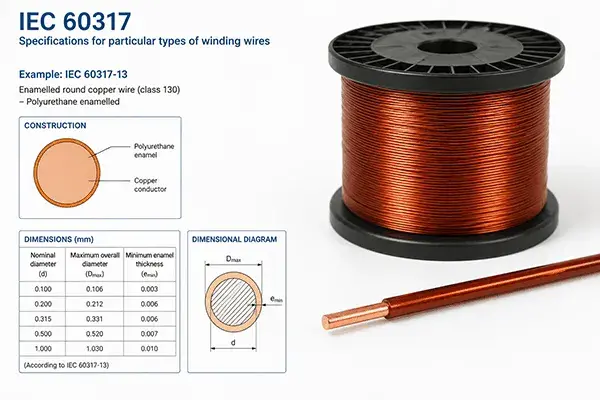
Single-layer enamel coating refers to a process where only one layer of insulating enamel coating is applied to the surface of enameled copper wire. According to the IEC 60317 standard, single-layer enamel coating corresponds to Class 1 enamel coating thickness, with a minimum thickness of approximately 0.02 to 0.06 mm, depending on the conductor diameter. Class 1 enamel coating has a relatively simple structure, and defects are mainly isolated defects generated during the coating process. The uniformity of the enamel coating thickness is affected by the precision of the coating process.
The thickness uniformity deviation of a single-layer enamel coating is typically controlled within the range of ±15% to ±25%. The coating process involves applying a single layer of enamel through a mold and then curing it. Single-layer enamel-coated copper wire manufacturing technology is mature, has high production efficiency, and low cost, making it the mainstream enamel coating structure for applications such as small and medium-sized motors, home appliances, and consumer electronics.
2.2 Double-layer enamel coating structure
Double-layer enamel coating refers to a process where two layers of insulating enamel coating are applied to the surface of enameled copper wire. According to IEC 60317, double-layer enamel coating corresponds to either Class 2 or Class 3 enamel coating thickness. The minimum thickness for Class 2 enamel coating is approximately 0.04 to 0.10 mm, and for Class 3, it is approximately 0.06 to 0.13 mm, depending on the conductor diameter. Double-layer enamel coating can be achieved by applying the same enamel twice or different enamel twice.
The structure of a double-layer enamel coating is relatively complex, consisting of a base layer and a top layer. The base layer is in direct contact with the copper conductor and performs core functions such as dielectric insulation, mechanical adhesion, and thermal conduction. The top layer covers the base layer and provides additional functions such as chemical resistance, abrasion resistance, weather resistance, and other special properties. The chemical compositions of the base and top layers can be the same or different. Using the same paint for a double-layer coating process is simple, while using different paints allows for complementary performance.
The thickness uniformity deviation of double-layer enameled copper wire is typically controlled within ±10% to ±15%. The double-layer coating process achieves thickness superposition through two coating and two curing processes, resulting in a significantly lower defect rate compared to single-layer enameled copper wire. However, the manufacturing process for double-layer enameled copper wire is more complex, has slightly lower production efficiency, and costs 20% to 50% higher.
2.3 Structural Differences of enamel coating
The main structural differences between single-layer and double-layer enamel coatings include: the number of coating layers, coating thickness, coating uniformity, defect rate, and process complexity. A single-layer enamel coating is a single-layer structure with a relatively thin thickness, larger uniformity deviation, higher defect rate, and a simpler process. A double-layer enamel coating is a two-layer structure with a relatively thick thickness, smaller uniformity deviation, lower defect rate, and a more complex process.
Differences in the enamel coating structure directly determine the differences in the electrical, mechanical, thermal, and chemical properties of enameled copper wires, and are the root cause of performance gaps.
3 Comparison of Manufacturing Processes
3.1 Single-layer enamel coating manufacturing process
The manufacturing process of single-layer enameled copper wire includes: conductor pretreatment, enameling coating, curing, inspection, and packaging. Conductor pretreatment includes annealing, cleaning, and drying to ensure a clean conductor surface. Enameling is done using a single enameled solution applied through a mold; coating speed, enameled solution viscosity, and mold precision are key process parameters. Curing uses a hot air circulation or electrically heated curing oven; curing temperature and curing time are key process parameters.
The core challenge of single-layer enamel coating is controlling the uniformity of the coating. Factors such as fluctuations in paint viscosity, variations in coating speed, and uneven curing temperature all affect the uniformity of the enamel coating. Single-layer enamel coating technology is mature and highly efficient, with single-line production speeds reaching hundreds of meters per minute.
3.2 Double-layer enamel coating manufacturing process
The manufacturing process of double-layer enameled copper wire includes: conductor pretreatment, bottom layer enamel coating, bottom layer curing, top layer enamel coating, top layer curing, inspection, and wire packaging. The double-layer coating process adds an extra coating and curing step to the single-layer coating process, resulting in a longer process flow and slightly lower production capacity.
The key to double-layer enameled copper wire coating is the matching of the processes for the base layer and the top layer. The curing degree of the base layer enameled copper wire, its surface condition, the viscosity of the top layer enameled copper wire, and the coating parameters all affect the overall performance of the double-layer enameled copper wire. In double-layer enameled copper wire coating, using the same enameled copper wire is simple but offers limited performance improvement; using different enameled copper wires is more complex but allows for complementary performance and is a common process for high-end enameled copper wires.
In a two-layer enamel coating process, the thickness uniformity of the enamel coating is superior to that of a single-layer enamel coating process. The thickness superposition effect of the two enamel coatings compensates for local thickness deviations, thereby improving the overall thickness uniformity.
3.3 Analysis of Process Differences
The main differences between single-layer and double-layer enamel coating processes are: number of processes, production efficiency, enamel coating uniformity, enamel coating defect rate, and cost. Number of processes: Single-layer requires 1 coat, double-layer requires 2 coats; Production efficiency: Double-layer is 30% to 50% lower than single-layer; enamel coating uniformity: Double-layer is superior to single-layer; Defect rate: Double-layer is 30% to 50% lower than single-layer; Cost: Double-layer is 20% to 50% higher than single-layer.
The differences in manufacturing processes ultimately determine the market positioning of single-layer and double-layer enameled copper wires. Single-layer enameled wires dominate the low-to-mid-end market, while double-layer enameled wires dominate the mid-to-high-end market.
4 Electrical Performance Differences
4.1 Breakdown Voltage Difference
Breakdown voltage is a core indicator of dielectric strength and directly determines the insulation reliability of enameled copper wire. According to IEC 60317, the breakdown voltage requirements for enameled round copper wire are as follows: Class 1: approximately 1500 to 7500 volts; Class 2: approximately 2350 to 12000 volts; Class 3: approximately 3000 to 14000 volts.
The breakdown voltage of a single-layer enamel coating is approximately 1500 to 7500 volts for Class 1 enamel coating. The breakdown voltage of a double-layer enamel coating is approximately 2350 to 12000 volts for Class 2 enamel coating and approximately 3000 to 14000 volts for Class 3 enamel coating. The breakdown voltage of a double-layer enamel coating is 50% to 80% higher than that of a single-layer enamel coating, depending on the conductor diameter and the enamel coating class.
The physical mechanism of the breakdown voltage increase is as follows: the thickness superposition effect of the double-layer enamel coating makes the electric field distribution of the enamel coating more uniform; the dielectric complementary effect between the bottom layer enamel coating and the top layer enamel coating improves the overall dielectric strength; the double-layer coating process significantly reduces the defect rate of the enamel coating and significantly reduces the weak points of the enamel coating.
4.2 Dielectric Loss Difference
The dielectric loss tangent, tan δ, reflects the energy loss of the enamel coating in an alternating electric field. According to IEC 60317, the dielectric loss tangent of the enamel coating is typically no higher than 0.01. The dielectric loss of a double-layer enamel coating is less different from that of a single-layer enamel coating because the dielectric loss is mainly determined by the chemical composition of the enamel coating material and is not significantly related to the thickness of the enamel coating.
In different two-layer coating processes using different paints, the dielectric loss of the underlayer and toplayer may differ. For example, the dielectric loss of a polyimide toplayer is lower, while that of a polyester underlayer is moderate. The overall dielectric loss of the two-layer coating depends on the material composition and thickness ratio of the coating layers.
4.3 Volume Resistivity Difference
Volume resistivity reflects the ability of an enamel coating to impede electric current. According to IEC 60317, the volume resistivity of an enamel coating is typically not less than 1 × 10¹³ ohm-cm. The volume resistivity of a double-layer enamel coating differs little from that of a single-layer coating because volume resistivity is primarily determined by the chemical composition of the coating material. In different double-layer coating processes using different paints, the volume resistivity of the underlayer and toplayer enamel coatings may differ, but the overall volume resistivity still meets the standard requirements.
4.4 enamel coating continuity gap
The enamel coating continuity test is an electrical-based method for testing the integrity of the enamel coating. According to IEC 60851-5, the number of defects in the enamel coating continuity test should be below a specified threshold. The number of defects in the continuity test for double-layer enamel coatings is significantly lower than that for single-layer enamel coatings, decreasing by 30% to 50%. This reduced defect rate in double-layer enamel coatings is a key reason for the improved dielectric strength.
4.5 Partial Discharge Initiation Voltage Difference
Partial discharge initiation voltage (PDIV) is a key indicator in high-voltage winding applications. Double-layer enamel coating improves PDIV by 40% to 70% compared to single-layer enamel coating. Double-layer enamel coating offers significant advantages in high-voltage applications such as high-voltage motors, transformers, and traction motors, and can significantly extend winding insulation life.
5 Differences in Mechanical Performance
5.1 The Gap in {Flexibility}
{Flexibility} refers to the ability of enamel coating to maintain its integrity under mechanical stresses such as bending and stretching. According to IEC 60851-3 standard, enameled round copper wire should not crack when wound with a mandrel diameter of 1d to 5d.
The difference in flexibility between a double-layer and a single-layer enamel coating primarily depends on the material composition. In a double-layer coating process using the same paint, the flexibility of a double-layer enamel coating is slightly lower than that of a single-layer coating because the increased coating thickness leads to a decrease in flexibility. In different double-layer coating processes, selecting a paint with superior flexibility for the top layer can significantly improve the overall flexibility of the double-layer enamel coating.
In practical engineering, the flexibility of a double-layer enamel coating can be comparable to or better than that of a single-layer enamel coating by optimizing the enamel coating material combination and thickness ratio.
5.2 Adhesion Difference
Adhesion is an indicator of the bond strength between the enamel coating and the copper conductor. According to IEC 60851-3, the enamel coating should not crack or peel after rapid stretching to the specified elongation. The adhesion of a double-layer enamel coating is less different from that of a single-layer enamel coating because the bottom layer is in direct contact with the copper conductor; therefore, adhesion is primarily determined by the bottom layer enamel coating.
5.3 Difference in Scratch Resistance
Scratch resistance is an important indicator of the mechanical strength of enamel coatings, reflecting their ability to resist mechanical scratches. According to NEMA MW 1000-2018 Table 51 standard, Grade 1 enamel coatings should withstand at least 5 to 40 scratches, Grade 2 coatings at least 15 to 75 scratches, and Grade 3 coatings at least 25 to 100 scratches.
Double-layer enamel coatings offer significantly improved scratch resistance compared to single-layer coatings. Level 2 enamel coatings show a 50% to 100% increase in scratch resistance compared to Level 1, while Level 3 coatings offer a 100% to 200% increase. This increased scratch resistance is attributed to the increased thickness of the enamel coating, which enhances its scratch resistance.
5.4 Difference in Anti-winding Properties
Anti-winding property is the ability of an enamel coating to maintain its integrity under repeated bending. According to IEC 60851-3, enameled wire should pass the specified repeated winding test. The anti-winding property of a double-layer enamel coating is less different from that of a single-layer enamel coating because anti-winding property is mainly determined by the flexibility and adhesion of the enamel coating.
5.5 Overall Difference in Mechanical Strength
Double-layer enamel coating generally outperforms single-layer enamel coating in terms of mechanical strength. Scratch resistance is significantly improved, while flexibility, adhesion, and anti-winding properties show little difference. This overall improvement in mechanical strength makes double-layer enamel-coated copper wire more resistant to mechanical damage during winding manufacturing, thus improving winding yield and reliability.
6 Differences in Thermal Performance
6.1 Difference in Heat Resistance
Heat resistance refers to the stability of an enamel coating under long-term thermal stress. Heat resistance is primarily determined by the chemical composition of the enamel coating material and is not significantly related to the coating thickness. The heat resistance of a double-layer enamel coating is comparable to that of a single-layer enamel coating because the thermal rating of an enamel coating depends on the material composition rather than its thickness.
In different double-layer coating processes, the top layer enamel coating can be made of paints with excellent heat resistance, such as polyimide or polyamide-imide, to improve the overall heat resistance of the double-layer enamel coating.
6.2 Difference in Thermal Shock
Thermal shock resistance refers to the ability of an enamel coating to resist cracking at high temperatures. According to IEC 60851-6, enameled wire should not crack after being wound at a specified temperature. The thermal shock temperature for enamel coatings is as follows: Class 155, not less than 175 degrees Celsius; Class 180, not less than 200 degrees Celsius; Class 200, not less than 220 degrees Celsius; and Class 220, not less than 240 degrees Celsius.
The thermal shock properties of double-layer enamel coatings are not significantly different from those of single-layer enamel coatings. Thermal shock properties are primarily determined by the chemical composition and flexibility of the enamel coating material; increasing the thickness of the enamel coating has a relatively small impact on thermal shock properties.
6.3 Difference in Thermal Conductivity
Thermal conductivity is the ability of the enamel coating to conduct heat from the windings to the cooling medium. The enamel coating has a relatively low thermal conductivity, approximately 0.2 to 0.4 W/m/Kelvin, making it one of the bottlenecks for heat dissipation from the windings. The thermal conductivity of a double-layer enamel coating is slightly lower than that of a single-layer enamel coating because the increased coating thickness increases thermal resistance and lengthens the heat conduction path.
In practical engineering, the decrease in thermal conductivity of the double-layer enamel coating has a relatively small impact on the winding temperature rise, because the thermal resistance of the enamel coating is only a part of the total thermal resistance of the winding.
6.4 Difference in Thermal Aging Life
Thermal aging life is the cumulative service time of an enamel coating under thermal stress. According to the Arrhenius model, the service life of an enamel coating is reduced by approximately half for every 10 K increase in operating temperature above the thermal stage temperature. The thermal aging life of a double-layer enamel coating is comparable to that of a single-layer enamel coating because the thermal aging life is primarily determined by the chemical composition of the enamel coating material.
In different double-coating processes using different paints, selecting a paint with excellent heat resistance for the top coat can improve the overall thermal aging life of the double-coating. For example, a polyimide top coat can significantly improve the heat resistance of the double-coating.
7 Differences in Chemical Properties
7.1 Difference in Solvent Resistance
Solvent resistance reflects the stability of the enamel coating in organic solvents. According to IEC 60851-4, the enamel coating should not soften, blister, or peel after immersion in a standard solvent.
The solvent resistance of a double-layer enamel coating is significantly better than that of a single-layer enamel coating. The top layer of the enamel coating can be made of a solvent-resistant paint, such as polyamide-imide, to protect the bottom layer, thus significantly improving the overall solvent resistance of the double-layer enamel coating.
7.2 Difference in resistance to chemical media
Chemical resistance reflects the stability of enamel coatings in chemical media such as acids, alkalis, and salts. Double-layer enamel coatings exhibit significantly better chemical resistance than single-layer enamel coatings. Selecting a topcoat enamel coating with excellent chemical resistance can significantly improve the overall chemical resistance of the double-layer enamel coating.
7.3 Difference in Hydrolysis Resistance
Hydrolysis resistance reflects the stability of the enamel coating in water vapor and humid heat environments. Double-layer enamel coatings exhibit better hydrolysis resistance than single-layer coatings. The hydrolytic stability of the top layer of enamel coating protects the bottom layer, enhancing the overall hydrolysis resistance of the double-layer coating.
7.4 Difference in Refrigerant Resistance
Refrigerant resistance reflects the stability of the enamel coating in refrigerants, which is crucial for applications such as air conditioners and refrigerators. Polyurethane-nylon composite enamel coatings are representative of refrigerant-resistant enamel coatings. The double-layer enamel coating process uses a composite structure with a polyurethane bottom layer and a nylon top layer, resulting in significantly better refrigerant resistance than a single polyurethane enamel coating.
7.5 Difference in Oil Resistance
Oil resistance reflects the stability of enamel coatings in oily media and is crucial for applications such as automobiles and home appliances. Double-layer enamel coatings exhibit better oil resistance than single-layer coatings. Choosing a topcoat with excellent oil resistance, such as polyamide-imide, can significantly improve the overall oil resistance of double-layer enamel coatings.
8 Comparison of Application Scenarios
8.1 Typical Applications of Single-Layer enamel coating
Single-layer enameled copper wire is the mainstream choice for applications such as small and medium-sized motors, home appliances, and consumer electronics.
Small and medium-sized motors: 1.1 to 75 kW three-phase asynchronous motors, single-phase motors, stator windings and rotor windings of servo motors. Enamelled coating grade F at 155 degrees Celsius or H at 180 degrees Celsius, conductor thickness 0.30 to 2.50 mm.
Household appliances: Motor windings, transformer windings, and inductor windings for appliances such as air conditioners, refrigerators, washing machines, and fans. Enamelled coating grade F or B, conductor thickness 0.20 to 1.50 mm.
Consumer electronics: Miniature transformers, inductors, and speaker coils for mobile phones, laptops, and tablets. Enamelled coating grade F or H; conductor specifications 0.05 to 0.50 mm.
8.2 Typical Applications of Double-Layer {enamel Coating}
Double-layer enameled copper wire is the mainstream choice for applications such as large motors, traction motors, high-voltage transformers, and new energy vehicle drive motors.
Large motors: Windings of large three-phase asynchronous motors, synchronous motors, and DC motors with a capacity of 75 kW or above. enamel coating Class H or N, conductor specifications 1.00 to 6.00 mm.
traction motor: Rail transit traction motor, new energy vehicle drive motor. enamel coating rating H or N, Hairpin flat wire scheme, conductor specifications 4.00 to 8.00 mm wide, 1.50 to 3.00 mm thick.
High voltage transformer: 35 kV and above power transformer, electric furnace transformer, rectifier transformer. Enamelled coating: H or N class; conductor specifications: 2.00 to 6.00 mm round wire or 4.00 to 12.00 mm wide flat wire.
High-voltage motors: high-voltage wound rotor motors, high-voltage blowers, water pump motors. enamel coating Class H or N, conductor specifications 1.00 to 4.00 mm.
8.3 Scenario Matching Principles
The matching of application scenarios for single-layer and double-layer enamel coatings should be based on the following principles:
Voltage rating: Single-layer enamel coating is used for low-voltage applications, while double-layer enamel coating is used for medium- and high-voltage applications. For operating voltages below 380 volts, a single-layer enamel coating is sufficient; for voltages above 660 volts, a double-layer enamel coating is required; and for high-voltage applications above 3000 volts, a double-layer enamel coating is mandatory.
Reliability requirements: Single-layer enamel coating is used for general household appliances and consumer electronics; single-layer or double-layer enamel coating is used for small and medium-sized motors and industrial control; double-layer enamel coating is used for large motors, traction motors, medical and military applications.
Mechanical stress: A single layer of enamel coating should be used in low mechanical stress scenarios; a double layer of enamel coating should be used in high mechanical stress scenarios such as winding, shaping, and binding.
Chemical environment: Single-layer enamel coating is used in ordinary atmospheric environments; double-layer enamel coating should be used in chemical media environments such as refrigerants, oils, acids, alkalis and salts.
Cost budget: Single-layer enamel coating should be used in cost-sensitive scenarios; double-layer enamel coating should be used in cost-insensitive scenarios such as high-end motors and high-reliability transformers.
9 Key Points for Selection and Evaluation
9.1 Selection Decision Factors
The selection between single-layer and double-layer enamel coatings should be based on a comprehensive evaluation of the following decision factors:
Electrical performance requirements: dielectric strength, breakdown voltage, PDIV, dielectric loss.
Mechanical performance requirements: scratch resistance, flexibility, adhesion, and anti-winding.
Thermal performance requirements: heat resistance, thermal shock resistance, and thermal aging life.
Chemical performance requirements: resistance to solvents, chemical media, hydrolysis, refrigerants, and oils.
Application scenarios: motors, transformers, inductors, home appliances, emerging applications.
Economic costs: enamel coating grade, procurement cost, winding cost, total cost.
9.2 Selection Decision Matrix
Based on the above decision factors, a selection decision matrix is established:
Scenario 1: Low-voltage small and medium-sized motors, single-phase motors, and household appliance motors. Low electrical requirements, low mechanical requirements, moderate thermal requirements, low chemical requirements, and cost-sensitive. Decision: Select a single-layer enamel coating, level 1 enamel coating thickness.
Scenario 2: Medium-voltage small and medium-sized motors, servo motors, and industrial control motors. Electrical, mechanical, thermal, and chemical requirements are moderate; cost is also moderate. Decision: Select a single or double layer enamel coating, with a Class 1 or Class 2 enamel coating thickness.
Scenario 3: High-voltage large motors, traction motors, and new energy vehicle drive motors. High electrical, mechanical, thermal, and chemical requirements; cost is not a primary concern. Decision: Use a double-layer enamel coating, with a grade 2 or 3 enamel coating thickness.
Scenario 4: High-voltage transformer, electric furnace transformer, rectifier transformer. High electrical requirements, medium mechanical requirements, high thermal requirements, medium chemical requirements, and medium cost. Decision: Select double-layer enamel coating, level 2 enamel coating thickness.
Scenario 5: Extreme chemical environments such as chemical engineering and offshore wind power. Moderate electrical and mechanical requirements, high thermal and chemical requirements, cost-insensitive. Decision: Use a double-layer enamel coating, level 2 enamel coating thickness, with a polyimide or polyamide-imide top layer.
9.3 Cost-Benefit Analysis
Double-layer enamel coatings cost 20% to 50% more than single-layer enamel coatings, but offer significantly improved performance. Breakdown voltage is increased by 50% to 80%, scratch resistance is increased by 50% to 200%, and chemical stability is significantly enhanced. In high-voltage, high-reliability, and high-mechanical-stress scenarios, the performance advantages of double-layer enamel coatings far outweigh the increased cost, making them a cost-effective choice. In low-voltage, low-cost scenarios, single-layer enamel coatings are the economical option.
The economic principles for selecting enamel coating levels are as follows: Level 1 enamel coating is suitable for cost-sensitive low-voltage scenarios; Level 2 enamel coating is the standard choice for medium- and high-voltage scenarios, offering the best cost-performance ratio; Level 3 enamel coating is suitable for extreme high-voltage and high-reliability scenarios, with higher costs but optimal performance.
10 Engineering Evolution Trends
10.1 Evolution Trend of Single-Layer enamel coating
Single-layer enameled copper wire will evolve towards higher efficiency, higher uniformity, and lower cost. The rapid growth in fields such as new energy vehicles and consumer electronics continues to expand the demand for single-layer enameled copper wire.
In terms of new materials, novel single-layer coating materials such as nano-modified polyurethane and ceramic-modified polyester are gradually maturing, and can significantly improve performance while maintaining the simplicity of the single-layer coating structure.
In terms of new processes, single-layer enamel coating technology is evolving towards high speed, precision, and low defects, and the production speed of a single line continues to increase.
10.2 Evolution Trend of Double-Layer enamel coating
Double-enamel-coated copper wires will evolve towards higher performance, more complex structures, and wider applications. Emerging applications such as new energy vehicles, rail transit, and wind power are continuously increasing the performance requirements for double-enamel-coated wires.
In terms of new materials, the application of high-performance coatings such as polyimide coatings, polyamide-imide coatings, and nano-modified coatings in double-layer coatings is gradually expanding.
In terms of new structures, novel multilayer insulation structures such as three-layer enamel coating, enamel coating plus fiber composite insulation, and enamel coating plus mica tape composite insulation are gradually maturing. Double-layer enamel coating technology is evolving towards more complex multilayer structures.
In terms of new processes, new technologies such as automated double-layer coating, online monitoring of coating thickness, and online detection of coating defects continue to evolve.
10.3 Coexistence and Development Pattern
Single-layer and double-layer enamel coatings will coexist in the winding wire field for a long time. Single-layer enamel coatings will maintain a dominant position in small and medium-sized motors, home appliances, and consumer electronics. Double-layer enamel coatings will continue to expand their application in large motors, traction motors, high-voltage transformers, and emerging applications.
With the continuous development of new materials, new processes, and new applications, single-layer and double-layer enamel coatings are constantly being optimized in terms of performance, cost, and reliability, jointly supporting the continuous development of fields such as power electronics, energy conversion, transportation, and consumer electronics.
11 Conclusion
Single-layer and double-layer enameled copper wires each have their own technological advantages and application scenarios. Single-layer enameled wires have mature manufacturing processes, high production efficiency, and lower costs, making them the mainstream choice for low- to mid-range applications such as small and medium-sized motors, home appliances, and consumer electronics. Double-layer enameled wires offer a 50% to 80% increase in breakdown voltage, a 50% to 200% increase in scratch resistance, and significantly improved chemical stability, making them the preferred solution for high-end applications such as large motors, traction motors, high-voltage transformers, and new energy vehicle drive motors.
Selection decisions should be based on a comprehensive evaluation of multiple dimensions, including electrical performance, mechanical performance, thermal performance, chemical performance, application scenarios, and economic costs. For low-voltage, low-cost applications, single-layer enamel coating is preferred; for medium-voltage, medium-cost applications, either single-layer or double-layer enamel coating is acceptable; for high-voltage, high-reliability applications, double-layer enamel coating is mandatory.
With the development of strategic emerging industries such as new energy vehicles, rail transit, wind power, high-voltage direct current transmission, and intelligent manufacturing, the application of double-layer enameled copper wire will continue to expand. Meanwhile, the traditional advantages of single-layer enameled copper wire in fields such as home appliances and consumer electronics will be maintained. The two will form a positive pattern of long-term coexistence, complementary development, and common progress.
Contact information: E-mail office@cnlpzz.com, WhatsApp 0086-19337889070, Zhengzhou LP Industry Co., Ltd.
Contact Information:
- E-mail: office@cnlpzz.com
- WhatsApp: 0086-19337889070
- Zhengzhou LP Industry Co., Ltd.