


Overview
Uninterruptible power supplies (UPS) systems, as core protection equipment for critical infrastructure, directly affect the continuous operation of highly sensitive scenarios such as data centers, medical equipment, and industrial control systems. Among the core components of a UPS system—inverter, rectifier, transformer, and filter inductor—the design and material selection of the windings are crucial to determining system efficiency and lifespan.
Enameled copper wire, as the core winding material for electromagnetic coils, has become the preferred solution for high-power UPS system manufacturers due to its excellent conductivity, superior heat dissipation characteristics, and reliable insulation properties. This article will systematically explain the key points of technical selection for enameled copper wire in high-power UPS systems from the perspectives of technical principles, material characteristics, selection parameters, operating condition matching, and industry practices.
The Technical Role of Enameled Copper Wire in UPS Systems
UPS System Structure and Electromagnetic Components
UPS systems can be divided into two main categories according to their topology: power frequency series type and high frequency type. Regardless of type, electromagnetic components all bear the core function of energy conversion and transmission:
Inverter Stage: IGBT or MOSFET power devices achieve DC-to-AC energy conversion through PWM control; the output filter inductor has a decisive impact on harmonic content.
Rectifier Stage: Converts AC mains power to DC; the power factor correction inductor (PFC inductor) directly affects power factor and harmonic performance.
Transformer Stage: Industrial frequency UPS uses a 50Hz iron-core transformer for voltage matching and electrical isolation; high-frequency UPS uses a high-frequency transformer to increase power density.
Filter Inductor: Forms an LC filter network with capacitors to suppress switching frequency harmonics and reduce output voltage THD (Total Harmonic Distortion).
A common characteristic of these electromagnetic components is that they all require coils wound with enameled wire; the electrical performance of the coils directly determines the overall efficiency, temperature rise, and reliability of the system.
Technical Advantages of Enameled Copper Wire
Compared to bare copper wire and aluminum conductor winding, enameled copper wire has the following irreplaceable technical advantages:
Insulation Reliability: As the main insulation layer, the thickness of the enameled coating is controllable (0.02-0.15mm), and the withstand voltage rating can meet Class F (155°C) to Class H (180°C) and even higher requirements.
High Fill Factor: The enameled wire has a standard circular cross-section, allowing for tight winding. Compared to rectangular copper busbars, the slot fill factor can be increased by 15%-25%, effectively reducing the volume of magnetic components.
Strong Processing Adaptability: Automated winding is possible, adapting to various wire diameters (0.016mm-7.0mm round wire, thickness 0.8-10mm, width 2-25mm flat wire), meeting the design requirements of different power levels.
Excellent Thermal Conductivity: Copper’s thermal conductivity is approximately 1.7 times that of aluminum. Combined with the thermal class of the enamel coating, this ensures long-term stable operation of the coil in high-temperature environments.
Core Technical Requirements of Enameled Copper Wire for High-Power UPS Systems
High-power UPS systems typically refer to models with a power range of 10kVA or higher. These systems have significantly higher technical requirements for the enameled copper wire than ordinary consumer or industrial equipment.
Thermal Class Selection
The thermal class is the most crucial parameter for enameled copper wire. It determines the upper limit of the coil’s allowable operating temperature, directly affecting the power density design margin and lifespan of the UPS system. The industry generally adopts the IEC 60335 or UL 1446 standard system for classifying thermal classes:
| Thermal Class | Upper Temperature Limit | Typical Insulation System | Applicable Scenarios |
|---|---|---|---|
| Class B (130) | 130°C | Polyester (PE)/Polyester Imide (PEI) | Low-power UPS, low-load applications |
| Class F (155) | 155°C | Polyester Imide (PEI)/Polyamide Imide (PAI) | Medium-power UPS, conventional industrial environments |
| Class H (180) | 180°C | Polyamide Imide (PAI) | High-power UPS, high ambient temperature |
| Class N (200) | 200°C | Polyimide (PI) | Ultra-high-power UPS, high power density design |
| Class R (220) | 220°C | Modified Polyimide | Extreme operating conditions, special military/industrial applications |
Selection Recommendations: For high-power UPS systems above 10kVA, it is recommended to start with Class 155 (F); for models operating in ambient temperatures exceeding 40°C or requiring higher power density, Class 180 (H) or higher should be selected. For systems operating continuously for 7×24 hours, a temperature margin of at least 20°C should be allowed in the thermal class selection.
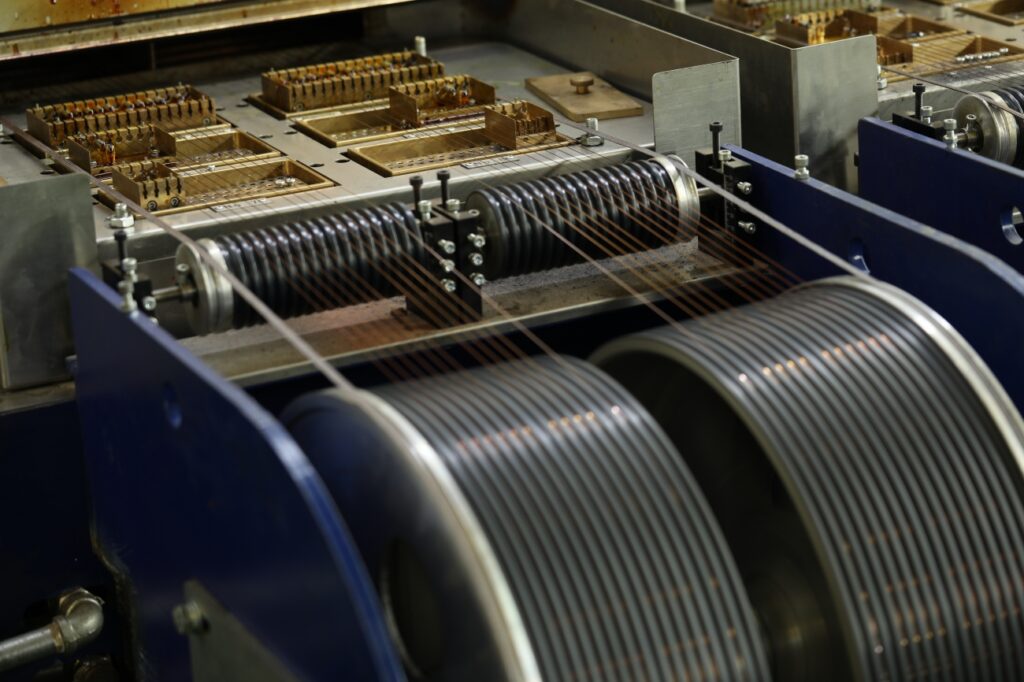
Conductor Specifications and Current Density
The coils of high-power UPS systems carry currents ranging from tens to hundreds of amperes, making the selection of conductor cross-sectional area and current density crucial.
Round Wire Specifications Selection: The standard round wire diameter ranges from 0.016mm to 7.0mm. In high-power UPS applications:
- Low-power inductors (current <10A): typically use 0.5mm-1.0mm diameter round wire
- Medium-power transformers (current 10A-50A): typically use 1.0mm-2.0mm diameter round wire
- High-power main transformers (current >50A): typically use round wire of 2.0mm or more, or use multi-strand thin wire wound in parallel
Flat Wire Specifications Selection:
Flat wire is widely used in main transformers of line-frequency UPS due to its rectangular cross-section, which enables higher slot fill rates:
- Thickness range: 0.8mm-10mm
- Width range: 2mm-25mm
- Common specifications for high-power transformers: thickness 3mm-6mm, width 10mm-20mm
Current Density Control:
Current density (J = I/A) is the core parameter determining coil temperature rise. In high-power UPS design, the selection of current density should be comprehensively considered:
- Operating mode: The current density values for continuous duty (100% load rate) and intermittent duty (load rate <50%) are different
- Heat dissipation conditions: Natural cooling, forced air cooling, forced oil cooling, or water cooling; different heat dissipation methods correspond to different upper limits of current density
- Temperature rise budget: The coil temperature rise is usually controlled within 60K-80K to ensure the service life of the insulation system
Empirical Value Range:
- Natural air cooling: Current density is usually controlled at 3A/mm²-5A/mm²
- Forced air cooling: Current density can be increased to 5A/mm²-8A/mm²
- Oil immersion: Current density can be further increased to 8A/mm²-12A/mm²
Enamel Coating Performance Requirements
The enamel coating is the insulation layer and protective layer of the enameled wire, and its performance is directly related to the reliability and service life of the coil.
Key Technical Indicators:
Breakdown Voltage: The ability of the enamel coating to withstand voltage without breaking down is the most basic insulation performance indicator. For standard products, the breakdown voltage at room temperature should be no less than 5kV (for 0.5mm wire). Breakdown voltage decreases with increasing temperature; high-power UPS designs should assess the high-temperature (rated operating temperature) breakdown voltage.
Elongation and Resilience: The enameled wire must withstand tension and bending during winding. Elongation characterizes the material’s plasticity, while resilience affects the coil’s tightness after winding. High-quality enameled wire should have an elongation of no less than 28% (for the copper conductor), and resilience should be controlled at a low level to ensure coil compactness.
Adhesion (Peel Strength): The bonding strength between the enamel coating and the copper conductor. Insufficient adhesion can cause the enamel coating to peel off during winding, leading to partial discharge or even short-circuit failure. Test methods include the pull-out test and the peel test; the peel strength of high-quality products should be no less than the specified value.
Scratch Resistance: After winding, the coil typically requires post-processing such as impregnation and baking. The enamel coating must withstand a certain amount of mechanical scratching without damage. A springyness test is a mandatory inspection item for incoming wires.
Softening Breakdown Temperature: The critical temperature characterizing the mechanical properties of the enamel coating under hot conditions. When the temperature exceeds the softening breakdown temperature, the enamel coating softens and is easily damaged under pressure. This indicator should be higher than the rated thermal class temperature of the enameled wire.
Skin Effect and Proximity Effect Considerations
In high-power UPS high-frequency switching circuits (operating frequencies typically 20kHz-100kHz), the skin effect and proximity effect have a significant impact on coil design.
Skin Effect: Alternating current tends to distribute near the conductor surface in a conductor, leading to a decrease in the effective conductive cross-sectional area and an increase in AC resistance. The skin depth is calculated using the formula:
δ = √(2/ωμγ)
where γ is the electrical conductivity of copper, μ is the magnetic permeability, and ω is the angular frequency. At 20kHz, the skin depth of copper is approximately 0.47mm; at 100kHz, it decreases to approximately 0.21mm.
Design Countermeasures: For coils operating at frequencies exceeding 20kHz, when the round wire diameter is greater than twice the skin depth, multi-strand fine wires (Litz wire structure) or flat copper foil winding should be used to reduce AC losses.
Proximity Effect: Additional losses caused by alternating magnetic fields in adjacent conductors. In high-density winding transformer and inductor design, proximity effect losses may exceed skin effect losses and become the primary factor. Layered winding design, control of the number of turns per layer, and magnetic shielding between windings can effectively suppress the proximity effect.
Differences in Wire Selection for Line-Frequency UPS and High-Frequency UPS
Technical Characteristics and Wire Requirements of Line-Frequency UPS
Line-frequency UPS uses a traditional 50Hz/60Hz line-frequency transformer as the core power conversion unit. Its technical characteristics are:
- Operating frequency: 50Hz or 60Hz
- Power devices: Thyristors (SCR) or IGBTs
- Transformer: Large size and heavy weight, but simple structure and high reliability
- Efficiency: Typical value 90%-94% (depending on load rate)
Key Points for Wire Selection:
The transformer design of line-frequency UPS follows the traditional electromagnetic induction principle, with many coil turns, high magnetic flux density, and large core cross-sectional area.
The winding arrangement usually adopts an overlapping or disc structure to reduce leakage flux. Flat wire, due to its rectangular cross-section, is superior to round wire in terms of space utilization and short-circuit mechanical strength, and is therefore widely used in the main transformer of line-frequency UPS.
Regarding thermal class, the insulation system of industrial frequency transformers is typically designed to Class B (130°C) or Class F (155°C). However, considering that transformers are usually installed at the bottom of the cabinet, have poor heat dissipation, and may experience long-term full-load operation, it is recommended to choose Class F (155°C) or higher products.
Technical Characteristics and Wire Requirements of High-Frequency UPS
High-frequency UPS uses high-frequency switching conversion technology, and its power density is significantly higher than that of industrial frequency models. Its technical characteristics are:
- Operating frequency: PWM carrier frequency 20kHz-100kHz
- Power devices: IGBT or MOSFET, soft-switching or hard-switching topology
- Transformer: High-frequency magnetic core, small size and light weight
- Efficiency: Typical value 94%-98% (depending on topology and load rate)
Key Points for Enameled Wire Selection:
The operating frequency of high-frequency transformers is much higher than that of power frequency transformers. According to Faraday’s law of electromagnetic induction:
V = N × dΦ/dt = N × Bmax × A × 2πf
At the same power level, if the frequency f is increased by n times, the required core cross-sectional area A and number of turns N can be reduced by n times accordingly, achieving a significant increase in power density. However, higher frequencies also bring skin effect and proximity effect problems.
For power transformers operating in the 20kHz-50kHz frequency range, when using round wire, it is recommended that the wire diameter not exceed 1.0mm (corresponding to a skin depth of approximately 0.47mm) to avoid additional losses due to the skin effect. For higher frequency applications (>50kHz), multi-strand fine wire (Litz wire) or flat copper foil should be used.
High-frequency inductors typically use iron-silicon-aluminum or iron-silicon magnetic rings, and the coil current density is usually designed to be 4A/mm²-6A/mm² (natural cooling) or 6A/mm²-10A/mm² (forced air cooling).
Selection Decision Matrix
| Parameters | Line-Frequency UPS | High-Frequency UPS |
|---|---|---|
| Operating Frequency | 50Hz/60Hz | 20kHz-100kHz |
| Common Wire Types | Primarily flat wire, supplemented by round wire | Round wire (multi-strand) as supplement, flat copper foil |
| Common Wire Diameter | 1.0mm-3.0mm (round wire) | 0.3mm-1.0mm (round wire) |
| Flat Wire Specifications | Thickness 3-6mm, Width 10-20mm | Thickness 0.5-1.5mm, Width 3-10mm |
| Thermal Class Recommendations | Class F (155°C) as starting point | Class F (155°C) or Class H (180°C) |
| Insulation System | Oil-immersed or resin-cast | Vacuum impregnation or epoxy resin encapsulation |
| Skin Effect Influence | Can be ignored | Requires careful consideration; Litz wire may be necessary |
Certification Standards and Environmental Compliance
The end-market for high-power UPS systems typically has stringent requirements for reliability and safety. As a core material, enameled wire must meet multiple certification and environmental standards.
Main Certification Standards
UL Certification (US Market Access):
UL 1446, “Insulation System Overall Rating Test,” is the core standard for enameled wire insulation systems. Products that have passed UL certification can have their corresponding insulation system rating checked in the UL Yellow Card system. For UPS manufacturers exporting to the US market, wire suppliers should provide complete UL certification documentation, including the UL file number and insulation system rating.
IEC Standards (Internationally Applicable):
The IEC 60317 series of standards specifies the requirements, performance, and testing methods for various types of enameled wire. Among them, IEC 60317-3 (polyester-coated copper round wire), IEC 60317-8 (polyester-imide-coated copper round wire), and IEC 60317-20 (polyamide-imide-coated copper round wire) are the most commonly used product standards in the industry.
REACH and RoHS (Environmental Compliance):
The EU’s Registration, Evaluation, Authorization and Restriction of Chemicals (REACH) regulation and the Restriction of the Use of Certain Hazardous Substances in Electrical and Electronic Equipment Directive (RoHS) are the environmental thresholds for electrical and electronic products entering the EU market. Enameled wire manufacturers should provide a REACH compliance declaration and a RoHS test report, confirming that the product does not contain restricted substances such as lead, cadmium, mercury, hexavalent chromium, polybrominated biphenyls (PBBs), and polybrominated diphenyl ethers (PBDEs).
Typical Application Market Certification Requirements
North American Market: UL certification is mandatory. Some customers require material suppliers to have UL certification, as well as individual certifications based on the Customer’s Insulation System (CIIS).
European Market: CE marking requires compliance with the Low Voltage Directive (LVD) and Electromagnetic Compatibility Directive (EMC). At the material level, REACH and RoHS compliance are the main concerns. Some industrial customers (such as Siemens, ABB, Schneider Electric, and other OEMs) have their own material supplier admission systems.
Southeast Asian Market: Standards vary by country, but IEC standards are generally accepted. The Indian market requires BIS certification, and Saudi Arabia requires SASO certification. Some customers specify NEMA standards.
Domestic Export: Products with ISO 9001 quality management system certification are a basic requirement. For large UPS projects, some owners or general contractors require material suppliers to have ISO 14001 (Environmental Management) and ISO 45001 (Occupational Health and Safety) certifications.
Selection Process and Quality Control Recommendations
Systematic Selection Process
The selection of enameled copper wire for high-power UPS systems should follow a systematic process, avoiding simple substitutions based solely on specification tables.
Operating Condition Definition. Clearly define the UPS system’s power rating, topology type (line-frequency/high-frequency), operating frequency, load rate, operating ambient temperature, heat dissipation method, and other basic parameters.
Design Parameter Calculation. Based on electromagnetic design calculations, determine the number of turns, wire diameter, number of strands, and arrangement of the coils; calculate current density and temperature rise to derive preliminary wire specifications and thermal class requirements.
Sample Verification. Conduct sample testing on the initially selected specifications. Verification items include: breakdown voltage, elongation, scratch resistance, softening breakdown temperature, and necessary overall efficiency and temperature rise tests.
Small-Batch Trial Production. After successful sample verification, conduct small-batch trial production to assess the supplier’s mass production consistency level, including performance stability and delivery reliability between batches.
Batch Import. After completing the above verifications, follow the APQP (Advanced Product Quality Planning) process to complete supplier import and material approval, officially entering the batch supply stage.
Incoming Material Inspection and Quality Control
It is recommended that UPS manufacturers establish a comprehensive incoming material inspection system, including at least the following inspection items:
Routine Inspection (per batch):
- Visual Inspection: Smooth surface, free of bubbles, impurities, and peeling
- Dimensional Inspection: Outer diameter/thickness/width within the tolerance range of the specifications
- Breakdown Voltage Test: Not less than 80% of the specified value at room temperature
- Elongation Test: Not less than the standard value
Type Testing (per quarter or with each new specification):
- Thermal Class Test (Thermal Shock Test)
- Softening Breakdown Temperature Test
- Scratch Resistance Test
- Chemical Resistance Test (if applicable)
Annual Supplier Audit:
Conduct annual on-site audits of key material suppliers to assess their quality management system, process control capabilities, testing equipment capabilities, and continuous improvement mechanisms.
Common Failure Modes and Prevention
Enamel Coating Breakdown Failure:
Causes include: overvoltage surges, temperatures exceeding design limits, mechanical damage, chemical corrosion, etc.
Prevention measures: Include sufficient voltage and temperature margins in the design; avoid mechanical damage during winding and impregnation processes; avoid strong acids, alkalis, or organic solvents in the operating environment.
Fatigue Fracture Failure:
Causes include: thermal expansion and contraction due to temperature cycling, vibration environments, impact loads, etc.
Prevention measures: High-power UPS systems typically operate in industrial environments; coils must possess sufficient resistance to bending fatigue. For vibration environments, vacuum impregnation or epoxy resin potting processes should be used to enhance the mechanical strength of the coils.
Partial Discharge Failure:
Causes include: weak points in insulation, air bubbles, moisture intrusion, etc. Partial discharge is one of the main causes of insulation system aging.
Prevention measures: Perform thorough vacuum impregnation and baking drying after winding; conduct partial discharge tests on finished coils; take precautions against moisture during storage and transportation.
Conclusion and Recommendations
The technical requirements for enameled copper wire in high-power UPS systems are a systematic engineering project, involving multiple dimensions such as electrical performance, thermal performance, mechanical performance, chemical performance, and reliability.
During the selection process, it is crucial to avoid simply comparing prices or specifications. Instead, a system-wide approach should be taken, comprehensively considering operating condition matching, reliability requirements, certification compliance, and supply chain assurance capabilities.
As enameled wire manufacturers, we recommend that UPS manufacturers establish technical communication with material suppliers early in the product development stage. Early involvement in material selection and design verification for new models can effectively shorten the development cycle, reduce development risks, and improve product reliability.
Simultaneously, establishing a sound supplier management system and incoming material inspection system is a key measure to ensure material consistency and product reliability during mass production.
If you have any technical questions during the selection process for high-power UPS systems using enameled copper wire, please feel free to contact our technical team. We will provide professional selection advice and technical support based on your specific operating conditions.