

Introduction
Selecting Fiberglass Covered Wire for Motors is a core topic in motor engineering and magnet wire manufacturing concerning the selection of high-temperature winding insulation materials. Fiberglass covered wire (also referred to as glass fiber covered wire or glass fiber insulated wire), as a representative high-temperature-resistant insulated magnet wire, serves as a critical insulation material for motors operating under demanding conditions—including high-temperature motors, traction motors, explosion-proof motors, and new-energy vehicle drive motors. Understanding the fundamental selection logic, performance matching principles, motor-type-specific selection strategies, common selection pitfalls, and typical application cases of fiberglass covered wire holds significant practical guidance value for motor engineers, motor design engineers, procurement engineers for specialty motors, and magnet wire selection engineers.
From the perspective of motor engineering practice, glass-fiber-covered magnet wire represents a critical technical option beyond the application boundaries of enameled wire (magnet wire) for motor winding insulation. Enameled wire (magnet wire) is the standard insulation form for medium- and low-temperature motors, general-purpose motors, and motors used in household appliances; however, its temperature rating is limited (up to Class 220), and its mechanical strength is insufficient for high-temperature, high-vibration, high-overload, or severe operating conditions. Glass-fiber-covered magnet wire employs braided or wound glass fiber as the primary insulation, combined with organic coatings—such as silicone resin, polyester resin, or epoxy resin—for bonding and protection. It achieves temperature ratings from Class 155 up to and exceeding Class 220, and exhibits significantly higher mechanical strength than enameled wire, making it the preferred insulation form for motors operating under severe conditions.
The engineering implications of selecting fiberglass-covered wire for motor windings can be systematically elaborated from eight dimensions: the foundational logic of selection, core advantages of fiberglass-covered wire, application boundaries relative to enameled wire, key selection parameters, selection strategies for different motor types, common selection misconceptions, typical application cases, and quality control and supplier evaluation. This article provides a systematic engineering reference for motor engineers, motor design engineers, procurement engineers for specialty motors, and winding wire selection engineers.
Basis of Selection Logic
Selection of glass-covered magnet wire for motor windings must be based on engineering practice logic; understanding this selection logic is the foundation for correct selection.
Fundamental Basis for Selection
The fundamental principle for selecting glass-fiber-covered magnet wire is to match the engineering requirements of motor winding insulation with the performance characteristics of the glass-fiber-covered magnet wire. Engineering requirements for motor winding insulation include thermal class, dielectric strength, mechanical strength, environmental resistance, long-term reliability, and cost constraints. Performance characteristics of glass-fiber-covered magnet wire include thermal endurance, mechanical properties, dielectric properties, processability, and cost profile. Selection essentially involves establishing an optimal match between engineering requirements and performance characteristics.
Multi-dimensional Selection Considerations
Glass-fiber magnet wire selection is not a unidimensional performance-based choice but rather a comprehensive evaluation involving multiple dimensions—performance, cost, and supply chain considerations. Optimizing a single performance parameter (e.g., temperature index) does not necessarily yield the overall optimal solution. Selection must integrate multidimensional factors including technical performance, economic viability, reliability, manufacturability, and serviceability, thereby establishing a multidimensional comprehensive evaluation system.
Engineering Mindset for Product Selection
Selecting glass-covered magnet wire requires an engineering mindset—avoiding purely academic or idealized approaches. The core of engineering thinking is achieving a balanced optimization of performance, cost, and reliability while meeting engineering requirements. Selection must account for constraints imposed by the actual operating environment (e.g., temperature, humidity, vibration, shock), feasibility of manufacturing processes (e.g., winding, coil insertion, shaping, impregnation), and ease of operation and maintenance (e.g., online monitoring, fault diagnosis, maintenance cost).
Core Advantages of Glass-Fiber-Insulated Magnet Wire
Glass-filament-wound wire offers several core advantages over enameled wire and other insulation types; understanding these advantages forms the basis for proper selection.
Excellent Thermal Resistance
The thermal endurance of glass-filament-covered magnet wire is its most prominent advantage. The inherent thermal endurance of glass fiber—specifically E-glass (alkali-free glass fiber)—exceeds 300°C, significantly higher than the thermal endurance of enamel coatings on enameled wire. Combined with various types of organic coatings, glass-filament-covered magnet wire achieves multiple thermal classes: Class 155 (F), Class 180 (H), Class 200 (N), and Class 220 (R). This exceptional thermal endurance makes glass-filament-covered magnet wire the preferred insulation system for high-temperature motors, high-overload motors, and motors operating under severe service conditions.
High Mechanical Strength
Glass-fiber-covered magnet wire exhibits significantly superior mechanical strength compared to enameled wire. The glass fiber itself possesses extremely high tensile strength, flexural strength, and abrasion resistance; combined with the bonding and protective function of the organic coating, the glass-fiber-covered magnet wire forms a robust mechanical structure. This high mechanical strength enables the glass-fiber-covered magnet wire to withstand mechanical stresses encountered during winding, coil insertion, shaping, and tying processes, as well as mechanical loads—including vibration, impact, and centrifugal force—experienced during motor operation.
Excellent Flame-Retardant Performance
Glass-fiber-covered magnet wire exhibits excellent flame-retardant properties. Glass fiber itself is an inert inorganic material that is non-combustible and non-supporting of combustion. When combined with flame-retardant organic coatings—particularly silicone resin coatings—glass-fiber-covered magnet wire resists ignition under abnormal operating conditions such as high temperature, open flame, and electrical faults, significantly reducing the risk of motor fire. Its superior flame-retardant performance makes glass-fiber-covered magnet wire the preferred insulation system for high-safety applications, including explosion-proof motors, mining motors, chemical-industry motors, and motors installed in underground spaces.
Excellent chemical resistance
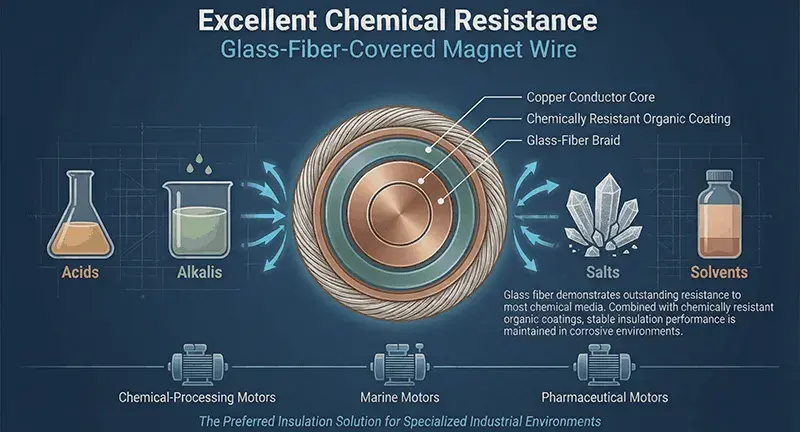
Glass-fiber-covered magnet wire exhibits excellent resistance to chemical media. Glass fiber demonstrates outstanding resistance to most chemical media, including acids, alkalis, salts, and solvents. When combined with chemically resistant organic coatings, glass-fiber-covered magnet wire maintains stable insulation performance in chemically corrosive environments. Its superior chemical resistance makes glass-fiber-covered magnet wire the preferred insulation solution for motors operating in specialized environments, such as chemical-processing motors, marine motors, and pharmaceutical motors.
Excellent radiation resistance
Glass-fiber-covered magnet wire exhibits excellent radiation resistance. Glass fiber demonstrates high tolerance to ultraviolet (UV) radiation, gamma (γ) rays, and other forms of radiation. When combined with radiation-resistant organic coatings, glass-fiber-covered magnet wire maintains stable performance under intense radiation environments. Its superior radiation resistance makes glass-fiber-covered magnet wire the preferred insulation system for nuclear power motors, motors operating in irradiated environments, and motors deployed outdoors for extended periods.
Application Boundaries of Magnet Wire
The application boundary between glass-filament-wrapped wire and enameled wire in motor windings is the core basis for selection decisions.
General Principles for Application Boundaries
The application boundary between glass-filament-wrapped wire and enameled wire is primarily determined by temperature class, mechanical stress, environmental requirements, safety requirements, and cost constraints. Temperature class is the primary boundary: enameled wire is suitable for applications up to Class 130, whereas glass-filament-wrapped wire is suitable for applications at Class 155 and above. Mechanical stress is a secondary boundary: high-vibration, high-impact, and high-centrifugal-force applications favor glass-filament-wrapped wire. Safety requirements constitute a critical boundary: applications with high safety requirements—such as explosion-proof, chemical, and nuclear power environments—favor glass-filament-wrapped wire. Cost constraints represent the practical boundary: enameled wire incurs lower costs, while glass-filament-wrapped wire entails higher costs, necessitating comprehensive trade-off analysis.
Dominant Applications of Magnet Wire
The primary application scenarios for magnet wire include general-purpose industrial motors (medium- and small-capacity, Class 130 and below), household appliance motors (e.g., air conditioners, washing machines, refrigerators), general low-voltage motors, small motors, and electronic motors. Magnet wire offers advantages in these applications, including low cost, mature winding processes, and high automation production efficiency. Its limitations include restricted thermal class ratings, limited mechanical strength, and unsuitability for high-vibration or high-impact environments.
Glass-Fiber-Insulated Magnet Wire Primary Application Scenarios
Glass-fiber-covered magnet wire is primarily used in high-temperature motors (operating temperature exceeding Class 130), traction motors (driving motors for rail transit vehicles), new-energy vehicle drive motors, wind-power generators, industrial high-voltage motors (large industrial motors), explosion-proof motors, mining motors, chemical-industry motors, nuclear-power motors, marine motors, aerospace motors, and special-purpose motors. In these applications, glass-fiber-covered magnet wire offers irreplaceable advantages, including superior thermal resistance, high mechanical strength, excellent flame retardancy, and outstanding environmental resistance.
Comprehensive Evaluation of Boundary Conditions
Selection for borderline applications—where both magnet wire and glass-filament-wrapped wire are viable—requires comprehensive evaluation of thermal margin, mechanical stress margin, reliability requirements, cost budget, and application-specific requirements. A typical borderline application is industrial motors rated Class 130 to Class 155, necessitating integrated assessment of thermal margin, mechanical stress, safety requirements, long-term reliability, and maintenance cost. Selection decisions for borderline applications typically rely on extensive engineering experience and detailed engineering data.
Key Selection Parameters
Selection of glass-covered magnet wire involves multiple critical parameters; understanding these parameters is essential for accurate selection.
Temperature Rating Parameters
Temperature class is the primary parameter for selecting glass-covered magnet wire. Selection of temperature class must be based on the motor’s long-term operating temperature, peak operating temperature, design life, and reliability requirements. Class 155 (Class F) is suitable for conventional high-temperature motors; Class 180 (Class H) for high-temperature motors and traction motors; Class 200 (Class N) for severe high-temperature motors and special-purpose motors; and Class 220 (Class R) for extreme high-temperature applications and special military motors.
Organic Coating Types
The type of organic coating is a critical parameter in selecting glass-filament magnet wire. Silicone resin coatings offer excellent thermal endurance (Class 180 to Class 220) and are comparatively costly, making them commonly used for premium-grade glass-filament magnet wire. Polyester resin coatings provide moderate cost and good thermal endurance (Class 155 to Class 180), making them widely used for general-purpose glass-filament magnet wire. Epoxy resin coatings exhibit superior adhesion and good chemical resistance, suitable for motors operating in special environments. Polyurethane resin coatings deliver excellent oil resistance, suitable for motors operating in oil-immersed or oil-containing environments.
Number of Glass Fiber Layers
The number of glass fiber layers is a critical parameter in selecting glass-fiber-covered magnet wire. A greater number of glass fiber layers results in increased insulation thickness, higher dielectric strength, and improved mechanical strength; however, it also leads to a lower fill factor and higher cost. Selection of the number of glass fiber layers must be based on voltage class, insulation requirements, mechanical requirements, and cost budget. Single-layer glass fiber is suitable for low-voltage, small motors; double-layer or multi-layer glass fiber is suitable for medium- and high-voltage, medium- and large-size motors.
Conductor Specifications
Conductor specifications are a critical parameter in the selection of glass-film-covered magnet wire. Conductor materials include electrolytic-tough-pitch copper (ETP) and oxygen-free copper (OFC), among others. Conductor cross-sectional shapes include round wire, rectangular (flat) wire, and square wire. Conductor cross-sectional dimensions must be determined based on motor capacity, current density, fill factor, and other factors. High-end motors preferentially utilize oxygen-free copper to achieve superior electrical conductivity and corrosion resistance.
Dielectric Strength Requirements
Dielectric strength is a critical parameter for selecting glass-fiber-covered magnet wire. The dielectric strength requirement depends on the motor’s operating voltage, overvoltage withstand capability, and insulation coordination design. The dielectric strength of glass-fiber-covered magnet wire is influenced by factors such as the number of glass fiber layers, the type of organic coating, and the thickness of the organic coating. Selection of dielectric strength must be based on the motor’s insulation coordination requirements and verified through insulation testing (dielectric withstand testing, partial discharge testing).
Mechanical Strength Requirements
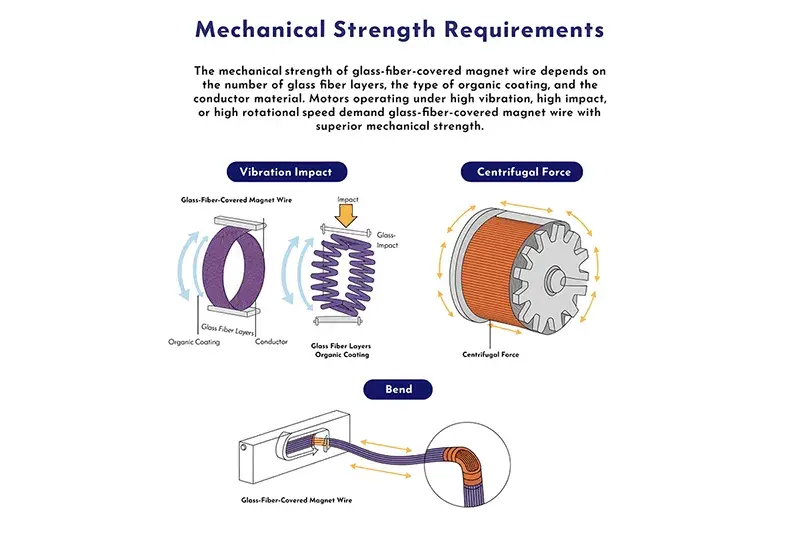
Mechanical strength is a critical parameter for selecting glass-fiber-covered magnet wire. Mechanical strength requirements depend on motor vibration levels, impact loads, centrifugal forces, etc. The mechanical strength of glass-fiber-covered magnet wire is influenced by factors such as the number of glass fiber layers, the type of organic coating, and the conductor material. Motors operating under high vibration, high impact, or high rotational speed demand glass-fiber-covered magnet wire with superior mechanical strength; therefore, magnet wire combinations exhibiting excellent mechanical strength must be selected.
Selection Strategies for Different Motor Types
Selection strategies for glass-filament-wound magnet wire vary significantly across different motor types, and understanding these differences is critical to accurate selection.
Traction Motor Selection Strategy
Traction motor (driving motor for rail transit vehicles) selection requirements for glass-fiber-covered magnet wire include high temperature class (Class 180 to Class 200), high mechanical strength (to withstand mechanical shock from frequent start-stop cycles), excellent vibration resistance, and outstanding long-term reliability (to meet a design life exceeding 30 years). Traction motors commonly employ Class 180 or Class 200 glass-fiber-covered magnet wire, with a typical double-layer glass fiber construction; organic coatings are preferably silicone resin or high-temperature-resistant polyester resin.
Selection Strategy for Traction Motors in New Energy Vehicles
Selection requirements for glass-fiber-covered magnet wire used in new-energy vehicle (NEV) traction motors include high temperature ratings (Class 180 to Class 200), high power density (high fill factor), high efficiency (low dielectric loss), and excellent long-term reliability. NEV traction motors commonly employ Class 180 or Class 200 glass-fiber-covered magnet wire in conjunction with hairpin winding processes. The application of glass-fiber-covered magnet wire in the NEV sector represents an emerging trend and an expansion of the application boundary for enameled wire.
Wind Turbine Selection Strategy
Wind turbine generators require glass-fiber-covered magnet wire with high weather resistance (resistance to high humidity, salt fog, and UV radiation), high temperature rating (Class 180), excellent long-term reliability (meeting a design life of over 20 years), and low maintenance requirements. Class 180 glass-fiber-covered magnet wire is widely adopted for wind turbine generators, with silicone resin or specially formulated polyester resin preferred for the organic coating due to their superior weather resistance.
Explosion-Proof Motor Selection Strategy
Explosion-proof motors require glass-fiber-covered magnet wire with high flame retardancy (non-ignitable, non-combustible support, low smoke emission, low toxicity), high temperature class, high mechanical strength, and high long-term reliability. Class 180 or higher glass-fiber-covered magnet wire is commonly selected for explosion-proof motors; for the organic coating, flame-retardant silicone resin or flame-retardant epoxy resin is preferred. The flame retardancy of glass-fiber-covered magnet wire is a critical safety performance parameter for explosion-proof motors.
Selection Strategy for Industrial High-Voltage Motors
Industrial high-voltage motors (large industrial motors, high-voltage motors) require glass-fiber-covered magnet wire with high dielectric strength (to meet high-voltage insulation requirements), high mechanical strength (to withstand mechanical stresses in large motors), high temperature rating, and high long-term reliability. Class 180 to Class 200 glass-fiber-covered magnet wire is commonly selected for industrial high-voltage motors, typically featuring double-layer or multi-layer glass fiber wrapping, integrated with insulating sleeves, insulating cardboard, and other components to form a complete insulation system.
Motor Selection Strategy for Household Appliances
Household appliance motors (e.g., air conditioner compressor motors, washing machine motors, refrigerator motors) typically do not use glass-fiber-covered magnet wire; enameled wire is the predominant choice. Household appliance motors have relatively low thermal class requirements (Class 130 to Class 155), low mechanical stress requirements, and stringent cost constraints—making enameled wire a cost-effective and suitable solution. A limited number of high-end household appliance motors (e.g., certain premium air conditioner compressors) may consider glass-fiber-covered magnet wire, but its application share remains low.
Common Selection Misconceptions
Common misconceptions in the selection of glass-covered magnet wire are critical pitfalls to avoid in engineering practice; understanding these misconceptions ensures accurate product selection.
Over-specification Misconception
Over-specification is one of the common pitfalls in magnet wire selection. It refers to selecting high-specification glass-fiber-covered magnet wire whose performance far exceeds actual application requirements, resulting in unnecessary cost increases. Typical cases of over-specification include selecting an excessively high temperature index (e.g., Class 220 instead of the required Class 200), specifying excessive numbers of glass fiber layers, or selecting overly advanced organic coatings. To avoid over-specification, precise matching based on actual engineering requirements is essential—avoiding the “higher is better” selection mindset.
Misconception of Inadequate Selection
Insufficient selection is another common mistake in magnet wire specification. Insufficient selection refers to choosing low-specification glass-fiber-covered magnet wire whose performance falls below actual application requirements, thereby introducing reliability risks. Common cases of insufficient selection include selecting an inadequate temperature class (insufficient safety margin), specifying too few layers of glass fiber (insufficient dielectric strength), and selecting an incompatible organic coating (insufficient environmental resistance). To avoid insufficient selection, a thorough engineering evaluation based on application requirements must be conducted, with appropriate safety margins retained.
Misconception of Selection Based Solely on Price
Relying solely on price for product selection is one of the common misconceptions in specification. “Price-only selection” refers to evaluating only the procurement cost of glass-filament-wrapped magnet wire, without considering total cost of ownership (TCO), reliability costs, or maintenance costs. Such price-only selection often reduces initial procurement costs but results in higher total lifecycle costs. Scientific selection should be based on total cost of ownership (TCO) evaluation—not merely on initial procurement cost.
Overlooking Process Compatibility Misconceptions
Ignoring process compatibility is one of the common misconceptions in magnet wire selection. Selecting glass-fiber-covered magnet wire without considering its compatibility with motor winding manufacturing processes may lead to reduced production efficiency, lower yield rates, and increased costs. The number of glass fiber layers, type of organic coating, and conductor specifications of glass-fiber-covered magnet wire must be compatible with winding manufacturing processes—including winding, coil insertion, shaping, tying, and impregnation.
Overlook Supply Chain Misconceptions
Neglecting the supply chain is one of the common misconceptions in magnet wire selection. Failing to consider supply chain stability, supplier qualifications, lead times, and technical support for glass-fiber-covered magnet wire during selection may result in procurement difficulties, inconsistent delivery, and quality risks. Selection of glass-fiber-covered magnet wire must involve a comprehensive evaluation of the supplier’s overall capabilities, including production capacity, quality control, technical support, and after-sales service.
Typical Application Cases
Typical application cases help illustrate the practical use of glass-filament-covered magnet wire in motors.
Traction Motor Application Case
The traction motor of a metro vehicle in a certain urban rail transit system operates at high temperatures (up to 180°C) and endures severe operating conditions, including frequent start-stop cycles, overload, and vibration. The winding insulation employs Class 180 glass-fiber-covered magnet wire (double-layer glass fiber + silicone resin coating), with flat copper conductor. Field operation experience of the traction motor has validated the reliability of glass-fiber-covered magnet wire under high-temperature, high-vibration, and high-overload conditions.
Application Case: Traction Motors for New Energy Vehicles
A new-energy vehicle traction motor operates at elevated temperatures (up to 180°C–200°C), with high power density and stringent efficiency requirements. The winding insulation employs Class 200 glass-fiber-covered magnet wire (double-layer glass fiber + polyamide-imide coating), integrated with hairpin winding technology. The application of glass-fiber-covered magnet wire in the new-energy vehicle sector represents an emerging trend, with increasing real-world implementation cases.
Wind Turbine Application Case
A large-scale wind turbine installed in a coastal, high-humidity, salt-fog environment operates at elevated temperatures (maximum temperature up to 150°C). The winding insulation employs Class 180 glass-fiber-covered magnet wire (double-layer glass fiber + weather-resistant silicone resin coating), with flat copper conductor. Long-term operational experience of the wind turbine has validated the weather resistance and reliability of glass-fiber-covered magnet wire under severe environmental conditions.
Explosion-Proof Motor Application Case
An explosion-proof motor for use in coal mines, operating in environments with methane explosion hazards, imposes extremely high flame-retardant requirements on its insulation. The winding insulation employs Class 180 glass-fiber-covered magnet wire (dual-layer glass fiber + flame-retardant silicone resin coating), with round copper conductor. Operational experience of explosion-proof motors has validated the flame retardancy and reliability of glass-fiber-covered magnet wire in applications demanding high safety performance.
Industrial High-Voltage Motor Application Case
A large industrial high-voltage motor (10 kV) operates at elevated temperatures and under significant mechanical stress, with stringent long-term reliability requirements. The winding insulation employs Class 180 glass-fiber-covered magnet wire (double-layer glass fiber + silicone resin coating), integrated with insulating sleeves, insulating cardboard, and other components to form a complete insulation system. Field operation experience of industrial high-voltage motors has validated the insulation reliability of glass-fiber-covered magnet wire in high-voltage, high-capacity applications.
Quality Control and Supplier Evaluation
Quality control and supplier evaluation are critical safeguards for selecting glass-filament-wound magnet wire.
Quality Control Key Points
Key quality control points for glass-covered magnet wire include conductor material quality, glass fiber quality, organic coating quality, braiding/winding quality, and overall insulation quality. Conductor material quality control covers conductor composition, purity, mechanical properties, and electrical conductivity. Glass fiber quality control covers fiber diameter, fiber tensile strength, and fiber temperature resistance. Organic coating quality control covers coating thickness, coating uniformity, coating cure quality, and coating adhesion. Braiding/winding quality control covers glass fiber alignment, braid density, and winding tension. Overall insulation quality control covers insulation thickness, outer diameter tolerance, surface appearance, mechanical strength, and dielectric strength.
Key Points for Supplier Evaluation
Key evaluation criteria for glass-covered magnet wire suppliers include production capacity, quality control capability, R&D capability, supply capability, and after-sales service capability. Production capacity evaluation covers production equipment, manufacturing processes, production scale, and production flexibility. Quality control capability evaluation covers the quality management system, testing equipment, testing methods, and testing frequency. R&D capability evaluation covers the R&D team, R&D investment, and new product development capability. Supply capability evaluation covers lead time, supply stability, and emergency supply capability. After-sales service capability evaluation covers technical support, issue response, and post-sale assurance.
Certifications and Standards
Certifications and standards for glass-covered magnet wire include IEC standards (IEC 60851, IEC 60317, etc.), NEMA standards (NEMA MW 1000, etc.), UL standards (UL 1446, etc.), and ISO standards (ISO 9001, etc.). Compliance with these certifications and standards ensures reliable quality of glass-covered magnet wire; therefore, products certified to and compliant with the relevant standards shall be prioritized during procurement.
Continuous Improvement Mechanism
The application of glass-covered magnet wire requires the establishment of a continuous improvement mechanism. The supplier’s continuous improvement mechanism includes optimization of production processes, development of new materials, development of new products, and upgrading of quality control. The purchaser’s continuous improvement mechanism includes supplier evaluation and updating, product quality tracking, application feedback collection, and integration of new requirements. The continuous improvement mechanism ensures long-term enhancement of application quality for glass-covered magnet wire.
Conclusion
The engineering implications of selecting fiberglass-covered wire for motor windings encompass eight core engineering dimensions: the foundational logic for selection (fundamental principles, multi-dimensional considerations, and engineering mindset); core advantages of fiberglass-covered wire (exceptional thermal resistance, high mechanical strength, excellent flame retardancy, superior resistance to chemical media, and good radiation resistance); application boundaries versus enameled wire (general principles governing application boundaries, scenarios dominated by enameled wire, scenarios dominated by fiberglass-covered wire, and comprehensive evaluation of boundary cases); key selection parameters (temperature rating, organic coating type, number of fiberglass layers, conductor specifications, dielectric strength requirements, and mechanical strength requirements); selection strategies for different motor types (traction motors, new-energy vehicle drive motors, wind turbine generators, explosion-proof motors, industrial high-voltage motors, and household appliance motors); common selection pitfalls (over-specification, under-specification, price-only selection, neglect of process compatibility, and neglect of supply chain considerations); typical application case studies (traction motors, new-energy vehicle drive motors, wind turbine generators, explosion-proof motors, and industrial high-voltage motors); and quality control and supplier evaluation (key quality control points, key supplier evaluation criteria, certifications and standards—including IEC 60317, NEMA MW 1000, ASTM B566, UL 1446, and IATF 16949—and continuous improvement mechanisms).
Glass-fiber-covered magnet wire, as a representative high-temperature-resistant insulated winding wire, is the preferred insulation solution for motors operating under severe conditions—including high-temperature motors, traction motors, new-energy vehicle drive motors, wind turbine generators, explosion-proof motors, and industrial high-voltage motors. The superior temperature resistance, mechanical strength, flame retardancy, and environmental resistance of glass-fiber-covered magnet wire are features that enameled wire cannot readily match.
Selection of glass-film-covered magnet wire for motors requires a comprehensive evaluation of multiple factors—including motor type, operating conditions, performance requirements, cost budget, and supplier capabilities—to establish a scientific selection assessment system. Accurate selection of glass-film-covered magnet wire significantly enhances motor reliability, safety, and long-term service life while reducing total lifecycle cost, making it a critical engineering decision in motor design and manufacturing.
With the continuous advancement of motor technology, rapid development of new-energy vehicles, large-scale expansion of wind power generation, and continuous improvement of rail transit networks, the application of glass-fiber-covered magnet wire will continue to grow. Glass-fiber-covered magnet wire manufacturers should continuously optimize product performance, deepen application research, and expand product specification portfolios to provide the motor industry with higher-performance, more reliable, and more cost-competitive glass-fiber-covered magnet wire products.