

RoHS is the European Union’s strictest restriction on hazardous substances in electrical products.
RoHS Compliant Magnet Wire is the “green passport” required for exporting to the EU market.
Today, let’s take a deep dive into all aspects of RoHS compliant magnet wire.
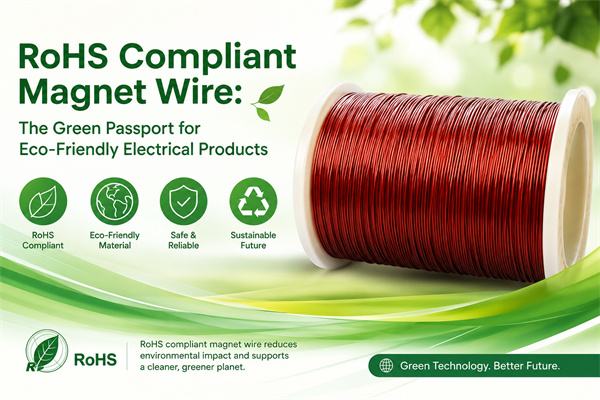
I. Understanding the Concept: What Is RoHS Compliant Magnet Wire?
RoHS stands for “Restriction of Hazardous Substances.”
It is an environmental directive (EU Directive 2011/65/EU) issued by the European Union in 2003 and revised in 2011, designed to limit the use of hazardous substances in electrical and electronic products.
RoHS Compliant Magnet Wire refers to:
- The content of hazardous substances in the magnet wire is below the limits set by the RoHS directive
- Meets EU environmental requirements
- Can be freely sold in the EU market
Core Mission:
- Protect the environment and human health
- Promote greening of the electrical and electronic industry
- Establish globally unified environmental standards
II. History of the RoHS Directive
1. RoHS 1.0 (Issued 2003)
- Official name: Directive 2002/95/EC
- Effective date: July 1, 2006
- Restricted 6 categories of hazardous substances
2. RoHS 2.0 (Issued 2011)
- Official name: Directive 2011/65/EU
- Effective date: January 2, 2013
- Incorporated into CE certification requirements
- Expanded product scope
3. RoHS 3.0 (Revised 2015)
- Official name: Directive 2015/863
- Added 4 phthalate restrictions
- Updated limit values
4. China RoHS
- National standard: SJ/T 11364
- Mark: “China RoHS” or “e”
- Basically consistent with EU RoHS
III. Hazardous Substances Restricted by RoHS
1. Original 6 Hazardous Substances (RoHS 1.0/2.0)
| Substance | Limit | Common Sources |
|---|---|---|
| Lead (Pb) | < 1000 ppm | Solder, PVC stabilizers |
| Mercury (Hg) | < 100 ppm | Thermometers, switches |
| Cadmium (Cd) | < 100 ppm | Batteries, pigments |
| Hexavalent Chromium (Cr6+) | < 1000 ppm | Anti-rust coatings |
| Polybrominated Biphenyls (PBB) | < 1000 ppm | Flame retardants |
| Polybrominated Diphenyl Ethers (PBDE) | < 1000 ppm | Flame retardants |
2. Newly Added 4 Phthalates (RoHS 3.0)
| Substance | Limit | Common Use |
|---|---|---|
| DEHP | < 1000 ppm | Plasticizer |
| BBP | < 1000 ppm | Plasticizer |
| DBP | < 1000 ppm | Plasticizer |
| DIBP | < 1000 ppm | Plasticizer |
3. Overview of Restricted Substances
10 Total Restricted Substances:
- 4 heavy metals (Lead, Mercury, Cadmium, Hexavalent Chromium)
- 2 brominated flame retardants (PBB, PBDE)
- 4 phthalates (DEHP, BBP, DBP, DIBP)
IV. Impact of RoHS Compliance on Magnet Wire
1. Conductor Materials
Copper Conductor:
- Pure copper itself does not contain RoHS-restricted substances
- But need to avoid using lead-containing solder
- Annealing process may introduce impurities
Aluminum Conductor:
- Pure aluminum itself does not contain RoHS-restricted substances
- Surface treatment may introduce hexavalent chromium
- Need to use environmentally friendly surface treatment agents
2. Insulation Enamel
Traditional Enamel:
- Early formulations may use lead-containing stabilizers
- Some flame retardants may contain PBB/PBDE
- Some plasticizers may contain phthalates
RoHS Compliant Enamel:
- Lead-free formula
- Eco-friendly flame retardants
- Eco-friendly plasticizers
- RoHS testing passed
3. Manufacturing Process
- Avoid using lead-containing equipment
- Avoid using mercury-containing thermometers
- Avoid using cadmium-containing pigments
- Packaging materials free of phthalates
V. RoHS Testing Methods
1. Common Testing Standards
| Standard | Description |
|---|---|
| IEC 62321 | International Electrotechnical Commission RoHS testing method |
| EN 62321 | EU RoHS testing method |
| GB/T 26125 | China RoHS testing method |
2. Testing Techniques
X-Ray Fluorescence Spectroscopy (XRF):
- Rapid screening
- Suitable for production line quick testing
- Precision up to ppm level
Inductively Coupled Plasma Mass Spectrometry (ICP-MS):
- Laboratory precision testing
- Suitable for RoHS certification
- Precision up to ppb level
Gas Chromatography-Mass Spectrometry (GC-MS):
- Phthalate testing
- Suitable for RoHS 3.0 testing
3. Testing Process
Step 1: Sampling
- Extract representative samples
- Record sample information
- Sample pretreatment
Step 2: Digestion
- Acid digestion
- Microwave digestion
- Sample solution preparation
Step 3: Instrument Analysis
- XRF initial screening
- ICP-MS precision testing
- GC-MS phthalate testing
Step 4: Result Determination
- Compare with limits
- Issue test report
- Determine pass/fail
VI. Key Requirements for RoHS Compliant Magnet Wire
1. Substance Restrictions
All 10 restricted substances must meet limit requirements.
2. Test Reports
- Issued by third-party testing institutions
- Report validity usually 1-2 years
- Include test results for all 10 substances
3. Documentation Preparation
RoHS compliant magnet wire requires the following documents:
- Test Report
- Declaration of Conformity (DoC)
- Material Declaration
- Safety Data Sheet (SDS)
4. Marking Requirements
- Products should be marked with RoHS compliance mark
- Packaging should have compliance statement
- Instructions should include environmental information
VII. Application Fields of RoHS Compliant Magnet Wire
1. Consumer Electronics
RoHS compliant magnet wire is the foundational material for consumer electronics:
- Mobile Phones: Micro speakers, vibration motors
- Computers: Cooling fans, power inductors
- Home Appliances: Refrigerator, air conditioner, washing machine motors
- Audio Equipment: Headphones, speakers
2. Automotive Electronics
- New Energy Vehicles: Drive motors
- Automotive Electronic Control: ECU, sensors
- Vehicle Entertainment: Audio, navigation
- Automotive Lighting: LED headlights
3. Industrial Equipment
- Industrial motors
- Industrial control equipment
- Industrial automation
- Industrial lighting
4. Medical Equipment
- MRI, CT
- Medical instruments
- Medical robots
5. Communication Equipment
- 5G base stations
- Network equipment
- Servers
6. Aerospace
- Aerospace motors
- Spacecraft
- Satellites
VIII. RoHS and Other Environmental Regulations
1. REACH Regulation
REACH (EC No 1907/2006) is the EU chemicals regulation:
- Requires chemical registration, evaluation, authorization
- Restricts “Substances of Very High Concern” (SVHC)
- Implemented in coordination with RoHS
RoHS vs REACH:
| Comparison | RoHS | REACH |
|---|---|---|
| Scope | Electrical and electronic products | All chemicals |
| Restrictions | 10 substances | SVHC list |
| Limits | Clear | Case-by-case |
2. WEEE Directive
WEEE (2012/19/EU) is the Waste Electrical and Electronic Equipment directive:
- Regulates e-waste recycling
- Requires extended producer responsibility
- Promotes circular economy
3. China RoHS
- National standard: SJ/T 11364
- Mark: Orange “e”
- Basically consistent with EU RoHS
4. US Environmental Regulations
Although there is no federal RoHS, various states have similar regulations:
- California Proposition 65
- New York State electronic equipment regulations
- Various state environmental regulations
5. Other Regions
- Korea RoHS
- Japan RoHS (J-MOSS)
- India E-Waste Rules
- Taiwan NCC
IX. Supply Chain Management for RoHS Compliant Magnet Wire
1. Supplier Management
- Select suppliers with RoHS compliance systems
- Sign RoHS compliance agreements
- Regular supplier audits
- Require RoHS reports
2. Incoming Inspection
- RoHS testing for each batch of incoming materials
- Maintain testing records
- Traceability system
- Non-conforming product handling
3. Process Control
- Avoid contamination during production
- Clean equipment and tools
- Prevent cross-contamination
- Employee training
4. Outgoing Inspection
- RoHS testing before shipment
- Batch traceability
- Test report archiving
- Customer report issuance
X. Cost Analysis of RoHS Compliant Magnet Wire
1. Cost Composition
Testing Cost:
- XRF testing: approximately 200-500 yuan/sample
- ICP-MS testing: approximately 1000-3000 yuan/sample
- Complete RoHS testing: approximately 3000-10000 yuan/batch
Material Cost:
- Eco-friendly enamel approximately 5-15% more expensive than traditional enamel
- Lead-free process may increase cost
Management Cost:
- System certification
- Personnel training
- Documentation management
- Audit cost
2. Comprehensive Value
- “Passport” to enter the EU market
- Enhance corporate environmental image
- Conform to global trends
- Reduce return risk
- Strengthen customer trust
3. Return on Investment
- Initial investment: testing equipment, system construction
- Long-term returns: market access, brand premium
- ROI period: usually 1-2 years
XI. How to Select RoHS Compliant Magnet Wire Suppliers
1. Qualification Review
- ISO 9001 quality management system
- ISO 14001 environmental management system
- IATF 16949 automotive industry quality system
- RoHS compliance system
2. Report Review
- Third-party testing report
- Report authenticity
- Testing institution qualification
- Report validity period
3. Production Capability
- Eco-friendly enamel production capability
- Process control capability
- Testing equipment configuration
- Traceability system
4. Service Capability
- Technical support
- Problem response
- Continuous improvement
- Long-term cooperation
XII. Common Misconceptions About RoHS Compliant Magnet Wire
1. Misconception One: Having a Test Report Means RoHS Compliance
Correct Understanding:
- Test reports have a time limit
- Test reports need to correspond to specific products
- Reports need to be issued by authoritative institutions
- Report content should be complete
2. Misconception Two: All Magnet Wires Meet RoHS
Correct Understanding:
- Some traditional magnet wires may not comply
- Need to explicitly confirm RoHS compliance
- Request latest test reports
3. Misconception Three: RoHS Certification Once Is Enough
Correct Understanding:
- Formula changes require re-testing
- Process changes require re-evaluation
- Regulation updates require re-review
- Regular test report updates
4. Misconception Four: RoHS = Non-Toxic
Correct Understanding:
- RoHS only restricts 10 substances
- May still contain other hazardous substances
- Still need to pay attention to use safety
- Complete environmental protection requires combining other regulations
XIII. Development Trends of RoHS Compliant Magnet Wire
1. Stricter Regulations
- Restricted substances may increase
- Limit values may decrease
- Scope may expand
- Penalties may increase
2. Globalization
- RoHS has been adopted by multiple countries
- China RoHS, national RoHS
- Korea, Japan, India RoHS
- Global unification trend
3. Technological Progress
- Eco-friendly enamel R&D
- Testing technology upgrade
- Production process improvement
- Alternative material development
4. Corporate Responsibility
- ESG (Environmental, Social, Governance) requirements
- Sustainable development
- Green supply chain
- Circular economy
XIV. FAQ
Q: What is the difference between RoHS compliant magnet wire and ordinary magnet wire?
A: RoHS compliant magnet wire has hazardous substance content below RoHS directive limits, using eco-friendly enamel and processes. Ordinary magnet wire may contain substances exceeding the limits.
Q: How much more expensive is RoHS compliant magnet wire?
A: Usually approximately 5-15% more expensive than ordinary magnet wire. But it can enter the EU market and has higher added value.
Q: How to obtain RoHS test reports?
A: Select a qualified third-party testing institution (such as SGS, Intertek, TUV, etc.), submit samples for testing, and receive reports within 5-7 working days.
Q: How long is the RoHS test report valid?
A: Usually 1-2 years. But if formula or process changes, re-testing is required.
Q: Do all magnet wires exported to the EU need to be RoHS compliant?
A: Yes. Almost all electrical and electronic products exported to the EU require RoHS compliance.
Q: What is the difference between RoHS and REACH?
A: RoHS is a 10-substance restriction for electrical and electronic products, while REACH is a registration and evaluation system for all chemicals. The two are implemented in coordination.
Q: Where does the lead in magnet wire mainly come from?
A: Mainly from: lead-containing stabilizers (PVC), lead-containing solder, lead-containing pigments, lead-containing additives, etc.
Q: How to determine the authenticity of a supplier’s RoHS report?
A: Verify the testing institution’s qualification, report number, testing items, report date, etc. If necessary, inquire directly with the testing institution.
XV. Summary
RoHS compliant magnet wire is the basic requirement for entering the EU market.
Core Points:
- RoHS 2.0: EU Directive 2011/65/EU
- RoHS 3.0: 4 phthalates
- 10 Total Restricted Substances
- Testing Method: IEC 62321
Key Limits:
- Lead, Mercury, Cadmium, Hexavalent Chromium: < 100-1000 ppm
- PBB, PBDE: < 1000 ppm
- Phthalates: < 1000 ppm
Compliance Points:
- Select compliant eco-friendly enamel
- Strictly control production process
- Third-party testing report
- Complete documentation system