

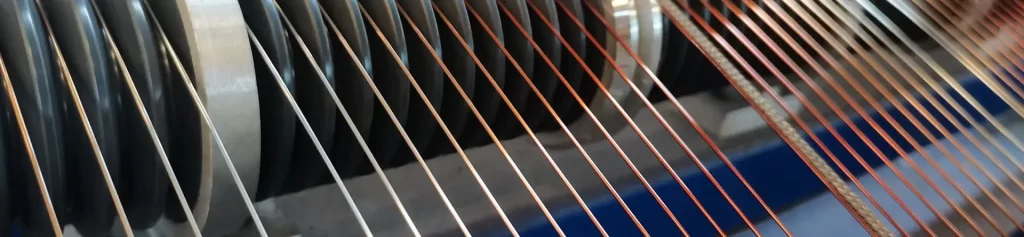
Relays and solenoids are the most widely used electromagnetic actuators in industrial automation, automotive electrical systems, home appliances, and pneumatic and hydraulic systems. Enameled copper wire, as the conductive core of the relay and solenoid coil, directly determines the product’s suction characteristics, temperature rise curve, insulation reliability, electrical life, and mechanical life through its selection and manufacturing process. This article systematically explains the working principles of relays and solenoids, the technical requirements of enameled copper wire, the enamel coating system, manufacturing processes, performance parameters, and selection decisions.
Basic Operating Principles of Relays and Solenoids
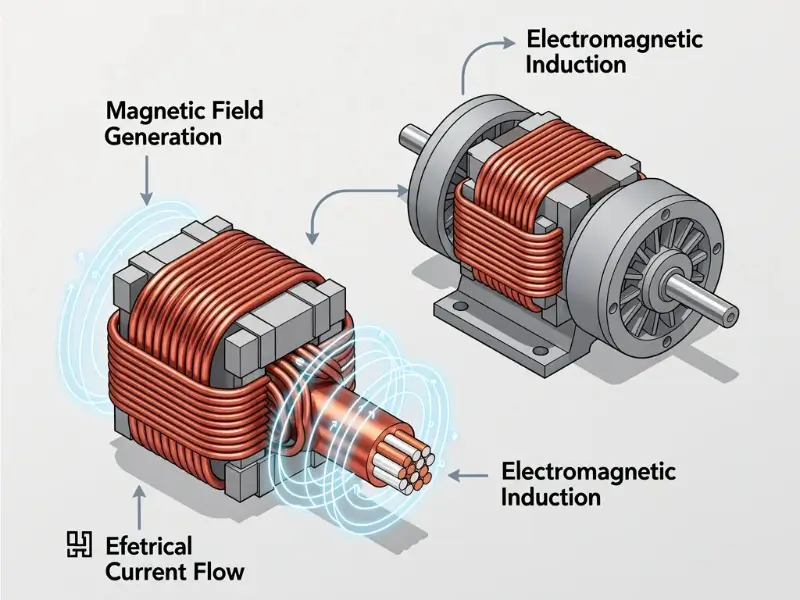
A relay is an electrically controlled switching element based on the principle of electromagnetic induction, controlling the opening and closing of a high-current circuit with a small current. A solenoid is an electromechanical actuator based on the principle of electromagnetic induction, using electromagnetic force to drive the valve core to move, thereby controlling the flow of fluid. Both consist of a coil, core, yoke, armature, and spring. The key difference lies in that in a relay, the armature drives the contact, while in a solenoid, the armature drives the valve core.
Based on operating voltage, relays and solenoid valves are mainly classified into: DC type (5V/12V/24V/48V/110V) and AC type (110V/220V/380V). DC type coils typically use enameled copper round wire, while AC type coils may use either enameled copper round wire or enameled aluminum round wire (in cost-sensitive applications). This article focuses on the selection of enameled copper wire for DC type relays and solenoid valves.
Based on their structural form, relays are classified into: PCB Mount Relay, Plug-in Relay, Socket Mount Relay, Automotive Relay, Power Relay, Signal Relay, Solid State Relay (SSR), Latching Relay, and Reed Relay. Solenoid valves are classified into: Direct Acting Solenoid Valves, Pilot Operated Solenoid Valves, 2-position 2-way/2-position 3-way/2-position 4-way/3-position 4-way Solenoid Valves, Hydraulic Solenoid Valves, Pneumatic Solenoid Valves, Water Valves, Gas Valves, and Refrigerant Valves.
The coil is one of the core components of relays and solenoid valves. A coil is typically made of hundreds to thousands of turns of enameled copper wire wound on a bobbin, and through insulation treatments (potting, impregnation, coating), it forms an integral structure that provides electrical insulation, mechanical support, and moisture and dust protection. When the coil is energized, the current generates a magnetic field. This magnetic field passes through the iron core and yoke to form a closed magnetic circuit, and the armature, under the action of the magnetic field, overcomes the spring force and actuates. In a relay, the armature drives the contacts to close or open, thus switching the circuit on or off; in a solenoid valve, the armature drives the valve core to move, thus controlling the fluid.
Key Functions of Enameled Copper Wire in Coils
Enameled copper wire plays three key roles in relays and solenoid valve coils: electromagnetic energy conversion, mechanical structural support, and electrical insulation.
In terms of electromagnetic energy conversion, the enameled copper wire carries the coil current and determines the strength and distribution of the magnetic field. The purity (≥99.90% ETP or ≥99.97% OFC), resistivity (≤0.01707 Ω·mm²/m), cross-sectional area accuracy, and uniformity of the enameled copper wire directly affect the coil’s resistance, inductive reactance, magnetic field strength, power consumption, temperature rise, and response time. The design deviation of the coil resistance is usually controlled within ±5%, and the consistency of the enameled copper wire’s resistance per meter (Ω/m) is crucial.
In terms of mechanical structural support, the enameled copper wire forms the skeleton of the coil. The enameled copper wire must maintain its integrity during winding, embedding, shaping, potting, and drying processes. The scratch resistance, flexibility, and adhesion of the enameled copper wire are core guarantees of the coil’s mechanical reliability. Relay and solenoid valve coils typically use 0.04-0.50mm fine enameled wire (AWG 24-44), and the enameled copper wire withstands tensile stress, bending stress, and scratching stress during high-speed winding.
In terms of electrical insulation, the enamel coating isolates voltage between adjacent turns, between the coil and the core, and between the coil and the casing. While the operating voltage of the coil is typically low (5-380V), the insulation reliability of the enamel coating is a core testing item in product safety standards (such as IEC 61810-1 Relay Safety, IEC 60730-1 Controller Safety, and UL 60947 Control Appliances).
Enameled Copper Wire Specifications and Electrical Parameter Matching
The selection of enameled copper wire for relay and solenoid valve coils must match the electrical parameters of the coil: rated voltage, coil resistance, number of turns, inductive reactance, suction force, release voltage, and temperature rise.
Regarding wire diameter selection, the diameter of the enameled copper wire is determined based on a combination of rated voltage and coil resistance. Low-voltage DC coils (5V/12V/24V) typically use thicker enameled wire (0.10-0.40mm, AWG 22-38) to reduce resistance; high-voltage AC coils (110V/220V/380V) typically use thinner enameled wire (0.04-0.10mm, AWG 38-44) to increase the number of turns and improve impedance. Coil resistance design range: 5V coil 30-300Ω, 12V coil 100-1500Ω, 24V coil 500-5000Ω, 220V AC coil 5-30kΩ.
In terms of turns design, the number of turns N of the coil is determined by the magnetomotive force (F = N × I) and the magnetic flux density (Φ = F × μ × A / l). Too few turns result in insufficient magnetomotive force and insufficient attraction force; too many turns result in excessively high coil resistance, prolonged response time, and increased temperature rise. Typical relay turns: 500-5000 turns; typical solenoid valve turns: 1000-10000 turns.
Regarding resistance tolerance, the tolerance of coil resistance is typically ±5% or ±10%. The resistance per meter tolerance of the enameled copper wire is the decisive factor in the coil resistance tolerance. The IEC 60317 standard specifies that the conductor diameter tolerance of enameled wire is ±0.001-0.013mm (depending on the nominal diameter), corresponding to a resistance per meter tolerance of ±2-3%. The resistance consistency of the enameled copper wire directly affects the batch interchangeability of relays and solenoid valves.
Regarding inductive reactance, the inductive reactance of AC coils (AC 220V/380V) is the main factor limiting current. Enameled copper wire is typically thinner (0.04-0.10mm) to increase the number of turns and improve inductive reactance. The inductive reactance of DC coils has a significant impact on pull-in speed and release time; the higher the inductive reactance, the longer the release time.
Enamel Material System in Detail
The choice of enameled copper wire coating material for relays and solenoid valves directly affects the product’s temperature resistance, insulation, weldability, and mechanical properties. The selection of the enameled copper wire coating should comprehensively consider operating temperature, assembly process, insulation class, and cost.
Polyurethane (UEW, 130°C) enamel coating is the most commonly used enamel coating material for relays and solenoid valve coils. Polyurethane enamel coating exhibits excellent solderability; it automatically decomposes and peels off at a soldering temperature of 380°C, eliminating the need for mechanical stripping and significantly simplifying the automated assembly process for relays and solenoid valves. Pure polyurethane enamel coating has a long-term operating temperature of 130°C (Class B) and is suitable for applications with operating temperatures not exceeding 120°C.
155 grade UEW (modified F-grade heat-resistant polyurethane) increases the long-term heat resistance temperature from 130°C to 155°C (F grade) through resin modification, while maintaining the solderability of polyurethane. 155 grade UEW enamel coating is widely used in mobile phone charger transformers, ignition coils, and various industrial relays, and is the mainstream choice for modern relays and solenoid valve coils. 155 grade UEW enamel coating exhibits significantly better thermal shock resistance than pure polyurethane enamel coating, high breakdown voltage (≥3000V for stranded wire pair method), and good oil and chemical resistance.
Polyester (PEW, 130-155°C) enamel coating offers high mechanical strength, good scratch resistance, and a moderate price. While it lacks the direct solderability of polyurethane, requiring mechanical or chemical stripping, it is widely used in applications demanding high mechanical strength (such as automotive relays and vibration environments). Polyester enamel coating has limited thermal shock resistance, typically ranging from 155-175°C.
Polyester imide (PEI, 180°C) enamel coating exhibits superior heat resistance compared to polyester, making it the preferred enamel coating for H-class motor windings and high-temperature relays. Polyester imide enamel coating possesses excellent chemical stability, exhibiting strong resistance to various solvents in insulating impregnating varnishes (such as xylene and styrene), while also demonstrating excellent resistance to transformer oils and chemical corrosion. Polyester imide enamel coating can withstand long-term operating temperatures of 180°C in automotive and industrial relays.
Polyamide-imide (PAI/AIW, 200-220°C) enamel coating is the enamel coating material with the best heat resistance. The softening breakdown temperature of polyamide-imide enamel coating can reach 330-350°C. Even when subjected to instantaneous thermal shock exceeding 200°C, the internal stress of the enamel coating is extremely low, and it will not crack. Polyamide-imide enamel coating is used in high-temperature relays (such as automotive engine compartment relays), military relays, and aerospace relays.
Composite coating combines the advantages of different enamel coating materials. The 200/220 grade EIW/PAIW composite line uses a golden combination of a base layer of EIW (approximately 70-80% of the enamel coating thickness) and a top layer of PAIW (approximately 20-30%). The base layer of EIW provides mechanical strength and cost advantages, while the top layer of PAIW provides heat resistance and corona resistant properties. Composite enamel coatings are used in relays and solenoid valves in harsh environments.
Breakdown Voltage and Insulation Reliability
The insulation reliability of relay and solenoid valve coils is a core element of product safety. Dielectric breakdown voltage is a key indicator for evaluating the insulation performance of enameled copper wire.
NEMA MW 1000-2018 Part 1 specifies several breakdown voltage test methods. The Foil Method uses a metal foil wound around the surface of the enameled wire as an electrode to test the breakdown voltage of the enamel coating under a uniform electric field. Table 29 specifies the minimum breakdown voltage for the Foil Method. The Twisted Pair Method involves twisting two enameled wires together at a specified tension to test the breakdown voltage of the enamel coating under a non-uniform electric field. Table 30 specifies the tension and number of rotations for the Twisted Pair Method, and Table 31 specifies the minimum breakdown voltage for the Twisted Pair Method. The Twisted Pair Method is the standard method for evaluating the insulation performance of the enamel coating under actual winding operating conditions. The Cylinder Method is suitable for breakdown voltage testing of large-diameter enameled wires (≥1.6mm). Table 33 specifies the voltage growth rate, Table 34 specifies the test load, and Table 35 specifies the minimum breakdown voltage for the Cylinder Method.
Typical breakdown voltage reference values: Grade 1 foil electrode breakdown voltage is typically ≥2000V, Grade 2 ≥3000V, and Grade 3 ≥4000V. Grade 1 stranded pair breakdown voltage is typically ≥2500V, Grade 2 ≥4000V, and Grade 3 ≥6000V. Relay and solenoid valve coils typically operate at lower voltages (5-380V), and Grade 1 provides sufficient insulation margin.
Polyester fiberglass winding rectangular copper wire (suitable for high-current coils in power relays) breakdown voltage: Grade 1 single layer (PG1) ≥1350V, Grade 1 double layer (PG2) ≥1560V, Grade 2 single layer (PG1) ≥2350V, Grade 2 double layer (PG2) ≥2560V. When using rectangular enameled wire in high-current applications, attention must be paid to the design of corner radii and insulation distances.
Pinhole density is a key indicator for evaluating the integrity of enamel coatings. Pinholes are tiny defects in the enamel coating that can trigger partial discharge under high voltage, leading to coating breakdown. IEC 60851 specifies the pinhole test method for enamel coatings, using mercury or saline electrodes containing a conductive solution to test the continuity of the coating. Table 38 specifies the test voltage (DC volts ± 5%) and the maximum number of failures per 100 feet, while Table 39 specifies the maximum number of failures for low-voltage continuity testing. The pinhole density of relays and solenoid valve enamel coatings should be ≤1 pinhole/30m.
Coil Manufacturing Process Requirements for Enameled Copper Wire
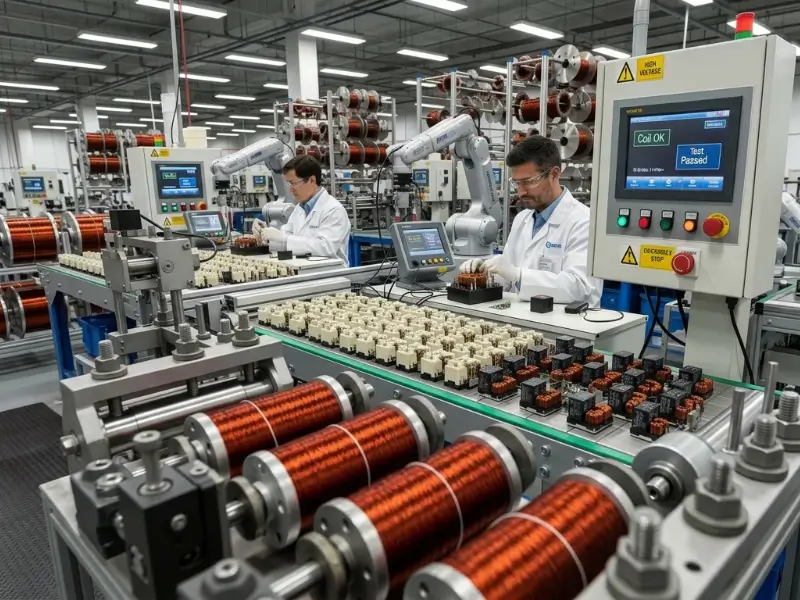
The manufacturing process of relays and solenoid valve coils places many demands on enameled copper wires: winding process, welding process, potting process, assembly process, and testing process.
In terms of the winding process, enameled copper wire is pulled from the spool on a high-speed winding machine (5000-12000 rpm) and wound onto the bobbin via a tensioner, guide nozzle, and wire laying mechanism. The enameled copper wire must withstand winding tension (typically 5-50g, depending on the wire diameter), bending stress, and scratching stress. The elongation of the enameled copper wire is a key indicator of its resistance to winding stress. Table 27 specifies the minimum elongation for round wire (enameled wire with a nominal diameter of 0.025-0.250mm, elongation ≥10-25%, depending on specific specifications). Insufficient elongation can lead to wire breakage during winding, reducing yield.
Regarding wiring precision, the precision of coil winding directly affects the coil’s electrical parameters and heat dissipation performance. The roundness, outer diameter uniformity, and enamel coating thickness uniformity of the enameled copper wire are key factors in wiring precision. The outer diameter tolerance of the enameled copper wire is ±0.005-0.013mm (depending on the nominal diameter), and the roundness tolerance is 50-70% of the outer diameter tolerance.
In terms of soldering technology, the connection between the coil lead wire and the enameled copper wire is a critical manufacturing step. Grade 155 UEW and pure polyurethane enameled coatings are directly solderable; at a soldering temperature of 380°C, the enameled coating automatically decomposes and falls off, allowing the enameled copper wire to be directly soldered to the lead wire, simplifying the process. Polyester (PEW), polyester imide (PEI), and polyamide imide (PAI) enameled coatings are not directly solderable and require methods such as mechanical stripping (scraping, grinding), chemical stripping (using enameled coating solvents), or thermal stripping (localized high-temperature decomposition) to remove the enameled coating before soldering.
Regarding lead wires, relays and solenoid valves typically use UL-certified PVC-insulated copper wire or silicone-insulated copper wire, and the thermal class of the lead wire should be compatible with the enameled copper wire. The connection between the lead wire and the enameled copper wire is usually achieved using an automatic soldering machine (automatic tinning and spot welding).
Regarding potting processes, insulation treatment is required after the coil winding is completed. Common processes include potting, impregnation, and trickle impregnation. Potting materials typically include epoxy resin, polyurethane resin, and silicone rubber. The potting material should be compatible with the enameled copper wire coating (no swelling, cracking, or peeling), and the curing temperature should be lower than the maximum withstand temperature of the enameled copper wire coating.
Key Performance Parameters and Testing Methods
Key performance parameters for relays and solenoid valves include: pull force, release voltage, pick-up voltage, operate time, release time, coil resistance, insulation resistance, withstand voltage, temperature rise, electrical endurance, and mechanical endurance.
Regarding the pull-in and release voltage, the pull-in voltage is the electromagnetic force on the armature in the activated position, and should be greater than the spring reaction force with sufficient margin (usually 1.5-2 times). The pull-in voltage is the minimum voltage at which the coil just activates the armature, typically 70-80% of the rated voltage. The release voltage is the maximum voltage at which the coil just releases the armature, typically 10-30% of the rated voltage. The consistency of the resistance and the accuracy of the number of turns of the enameled copper wire directly affect the batch consistency of the pull-in and release voltages.
Regarding pull-in and release times, pull-in time refers to the time from when the coil is energized to when the contacts close (typically 5-50ms), and release time refers to the time from when the coil is de-energized to when the contacts open (typically 5-30ms). The pull-in time of a DC coil is affected by the coil inductance and resistance, while the release time is affected by the freewheeling diode and the coil resistance. The pull-in time of an AC coil is affected by the rate of change of magnetic flux and eddy currents.
Regarding temperature rise, the coil generates heat due to copper losses (I²R) after energization, and the temperature rise should be within the limits specified for the insulation class. Temperature rise = (coil power × thermal resistance) + ambient temperature. The temperature rise limit is 65K for Class A insulation, 80K for Class E, 90K for Class B, 115K for Class F, and 140K for Class H. The enamel coating grade of the copper wire should be higher than the insulation class requirement to ensure long-term thermal stability.
Regarding insulation resistance and withstand voltage, the insulation resistance between the coil and the iron core, and between the coil and the casing, should be above 100MΩ (using a 500V DC megohmmeter). The withstand voltage test is typically 1.5-2 times the rated voltage, with no breakdown required for 1 minute. The integrity of the enamel coating on the copper wire is crucial for passing both the insulation resistance and withstand voltage tests.
Regarding electrical and mechanical lifespan, electrical life is the number of times a relay contact operates under rated load (typically 10⁵-10⁶ times), while mechanical life is the number of times it operates without load (typically 10⁷-10⁸ times). The lifespan of a solenoid valve is usually measured by the number of operations (typically 10⁶-10⁸ times) or the cumulative energizing time (typically 1000-10000 hours). The integrity of the enameled copper wire is a core guarantee of its lifespan reliability.
Typical Application Scenarios
The selection of enameled copper wire for relays and solenoid valves varies significantly depending on the application scenario.
In the automotive relay category, relays include starter relays, hazard light relays, wiper relays, horn relays, fuel pump relays, air conditioning relays, headlight relays, and ECU control relays. Automotive relays operate at 12V/24V, with an operating temperature range of -40°C to +125°C and a vibration frequency of 5Hz-2000Hz. Recommended enameled copper wire selection: 155 grade UEW (enamel coating), wire diameter 0.10-0.30mm (AWG 28-38), Grade 1 or Grade 2.
Regarding relays for household appliances, these include relays for air conditioners, refrigerators, washing machines, water heaters, and microwave ovens. The operating voltage of these relays is 5V/12V/24V/220V, and the operating temperature is -10°C to +85°C. Recommended enameled copper wire selection: pure polyurethane (UEW) or 155 grade UEW (enamel coating), wire diameter 0.05-0.25mm (AWG 30-44), Grade 1 or Grade 2.
In industrial control relays, there are intermediate relays, time relays, counting relays, solid-state relays, power relays, and magnetic latching relays. Industrial relays operate at voltages of 12V/24V/110V/220V/380V and at temperatures ranging from -25°C to +70°C. Recommended enameled copper wire selection: pure polyurethane (UEW) or 155 grade UEW (enamel coating) (for low-voltage control circuits), or polyester imide (PEI, 180°C, industrial-grade high-temperature), with a wire diameter of 0.05-0.50mm (AWG 24-44) and a grade of 1-3.
In the automotive solenoid valve sector, solenoid valves include EGR valves, turbocharger solenoid valves, transmission shift solenoid valves, ABS solenoid valves, suspension solenoid valves, fuel tank vent valves, and activated carbon canister solenoid valves. Automotive solenoid valves operate at 12V/24V, with an operating temperature range of -40°C to +150°C and a vibration frequency of 5Hz-2000Hz. Recommended enameled copper wire selection: 155 grade UEW (general purpose) or 200 grade polyamide-imide (PAI) (high-temperature applications), wire diameter 0.10-0.40mm (AWG 22-38), Grade 1 or Grade 2.
Regarding hydraulic and pneumatic solenoid valves, these include directional control valves, pressure control valves, flow control valves, 2-position 2-way, 2-position 3-way, 2-position 4-way, and 3-position 4-way valves. The operating voltage of these valves is 12V/24V/110V/220V, and the operating temperature is -20°C to +80°C (general grade) and -40°C to +200°C (high temperature grade). Recommended enameled copper wire selection: pure polyurethane (UEW) or 155 grade UEW (enamel coating) (general grade), polyamide-imide (PAI) (enamel coating) (high temperature grade), wire diameter 0.10-0.50mm (AWG 24-38), Grade 1 or Grade 2.
Regarding solenoid valves for household appliances, these include inlet valves for washing machines, gas valves for gas water heaters, gas valves for gas stoves, four-way valves for air conditioners, solenoid valves for refrigerators, solenoid valves for water purifiers, and solenoid valves for coffee machines. The operating voltage of these solenoid valves is 12V/24V/220V, and the operating temperature is -10°C to +85°C. Recommended enameled copper wire selection: pure polyurethane (UEW) with enameled coating, wire diameter 0.10-0.30mm (AWG 28-38), Grade 1.
For military/aerospace relays, these include sealed relays, magnetically latched relays, high-voltage relays, high-frequency relays, and time-delay relays. Military relays operate at temperatures ranging from -55°C to +125°C (standard) and -55°C to +200°C (high temperature), with vibration resistance of 10-50g and shock resistance of 100g. Recommended enameled copper wire selection: polyamide-imide (PAI, 200°C) or polyimide (PI, 240°C) enamel coating, wire diameter 0.05-0.30mm (AWG 28-44), Grade 2 or Grade 3.
Selection Decision Recommendations
The selection of enameled copper wire for relays and solenoid valves should be based on a comprehensive judgment of product type, operating voltage, operating temperature, mechanical environment, reliability requirements, and cost.
Recommended initial solution: For general-purpose relays and solenoid valves (home appliances, consumer electronics, commercial equipment), choose pure polyurethane (UEW, Grade B heat resistant) enameled copper wire, with a wire diameter of 0.10-0.30mm (AWG 28-38), Grade 1. Advantages: Excellent solderability, low price, and easy to automate production.
Intermediate Recommendation: For industrial-grade relays and solenoid valves (industrial control, automotive electrical systems, general military applications), choose 155-grade UEW (F-grade heat-resistant) enameled copper wire, with a wire diameter of 0.10-0.40mm (AWG 22-38), Grade 1 or Grade 2. Advantages: Improved heat resistance, thermal shock resistance, and maintained solderability.
Recommended Advanced Solution: For high-temperature relays and solenoid valves (automotive engine compartments, hydraulic and pneumatic high-temperature applications, and near industrial furnaces), choose polyester imide (PEI, H grade 180°C) or polyamide imide (PAI, N/R grade 200-220°C) enameled copper wire, 0.10-0.50mm diameter (AWG 24-38), Grade 2. Advantages: high temperature resistance, chemical resistance, and long lifespan.
Recommended solutions for extreme environments: For harsh environments such as aerospace, military, deep sea, and outdoor use, choose polyamide-imide (PAI, 220°C) or polyimide (PI, 240°C) enamel coating, or composite enamel coating (EIW + PAIW, 200-220°C), with a wire diameter of 0.05-0.30mm (AWG 28-44), Grade 2 or Grade 3. Advantages: highest temperature resistance, longest lifespan, and best reliability.
Not recommended options: Polyvinyl acetal (120 grade) is not recommended for modern relays and solenoid valves due to its low thermal class and generally poor mechanical properties. Pure polyurethane (130°C) is not recommended for relays and solenoid valves in high-temperature environments due to its low thermal class.
Development Trends
The manufacturing of relays and solenoid valves is developing towards miniaturization, low power consumption, high power density, and high reliability, which puts forward new technical requirements for enameled copper wire.
In terms of miniaturization, the sizes of MEMS relays, SMD relays, and miniature solenoid valves are continuously shrinking, and the radial ultra-fineness of enameled copper wires is developing (<0.04mm). The integrity, breakdown voltage, and consistency of the enameled wire coating are technical challenges.
In terms of low power consumption, new types of keep relays, dual-coil magnetic latching relays, and energy-saving solenoid valves achieve low power consumption by reducing the holding current (<0.1W). Low-power enameled copper wires require high resistance consistency, low temperature rise, and high insulation reliability.
In terms of high power density, the power density of power relays, contactors, and electromagnetic switches is constantly increasing, requiring enameled copper wires with high slot fill factor, high thermal conductivity, and high temperature resistance. 200/220 grade enamel coating (PAI, composite EIW + PAIW) is a core technology.
In terms of high reliability, automotive-grade (AEC-Q200), industrial-grade (IEC 61810), and military-grade (MIL-PRF-83536) relays and solenoid valves place increasingly higher demands on the reliability of enameled copper wires. Accelerated aging tests (IEC 60172), temperature cycling tests, and vibration fatigue tests have become mandatory verification reports provided by enameled copper wire suppliers.
In the field of intelligent manufacturing, the winding, welding, potting, assembly, and testing of relays and solenoid valves are gradually being automated. The direct solderability of enameled copper wire (155 grade UEW, pure polyurethane), high elongation (≥20%), and low defect rate (pinhole ≤1/30m) are key to automated production.
Conclusion
Relays and solenoid valves are the most widely used electromagnetic actuators using enameled copper wire. The selection of enameled copper wire directly affects the product’s suction characteristics, temperature rise curve, insulation reliability, electrical life, and mechanical life. Pure polyurethane (UEW, 130°C), 155 grade UEW (155°C), polyester imide (PEI, 180°C), polyamide imide (PAI, 200-220°C), and composite enameled copper wire (EIW + PAIW) are the five mainstream enameled copper wire materials for relays and solenoid valves.
The selection of enameled copper wire should comprehensively consider product type, operating voltage, operating temperature, mechanical environment, reliability requirements, and cost. NEMA MW 1000-2018, IEC 60317, IEC 60851, and IEC 60172 are the core technical guidelines for the selection and testing of enameled copper wire. Breakdown voltage, pinhole density, elongation, scratch resistance, and thermal shock are the core indicators for evaluating the quality of enameled wire.
As relays and solenoid valves evolve towards miniaturization, low power consumption, high power density, and high reliability, 155-grade UEW, PAI, composite enamel coatings, and ultra-fine enameled wires (<0.04mm) will become the core directions for future technological development. Engineers should fully leverage the advantages of various enamel coating materials while rigorously evaluating their long-term reliability under mechanical vibration, temperature cycling, and chemical environments.