

Introduction
Rectangular enameled copper wire, as a high-performance electrical material, plays an important role in the winding design of modern electrical equipment. Compared with traditional round wire, rectangular cross-section conductors have significant advantages in space utilization and slot fill factor, and are especially suitable for transformer, motor, and reactor windings with strict requirements for coil fill factor.
This article systematically elaborates on the technical characteristics of rectangular enameled copper wire from the aspects of product structure features, slot fill factor advantages, technical specifications, application fields, and selection principles, providing selection and design references for engineering technicians.

1. Product Definition and Structural Characteristics
1.1 Basic Definition
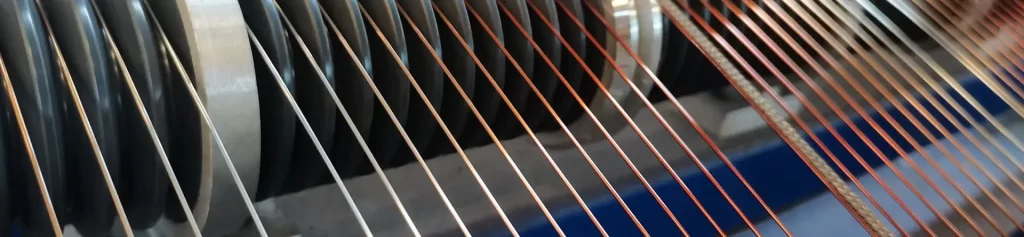
Rectangular enameled copper wire is a flat wire made from oxygen-free copper rod as raw material, drawn to a rectangular cross-section, coated with organic insulating varnish, and cured at high temperature. The product has a rectangular or square cross-section. The conductor size is usually expressed as thickness × width. The insulation layer is uniformly coated on the conductor surface, forming a complete electrical insulation structure.
1.2 Structural Characteristics
The structural design of rectangular enameled copper wire is based on the following technical elements:
Conductor Cross-Section: A rectangular or square cross-section is used, and the aspect ratio can be flexibly designed according to the coil slot type. Under the same conditions, the conductor cross-sectional area is the same as that of a circular conductor, but the rectangular cross-section can utilize winding space more effectively.
Insulation Layer Structure: The insulating varnish layer is uniformly coated on the four sides and rounded corners of the conductor, with a thickness generally between 0.02~0.12 mm. Depending on the insulation level and withstand voltage requirements, a single-layer or double-layer coating process can be selected.
Rounded Corner Design: The four corners of the conductor are usually designed with rounded transitions, with a rounded corner radius of approximately 15%~25% of the conductor thickness. The rounded corner design reduces stress concentration at the corners, improving the uniformity and dielectric strength of the insulation layer.
2. Advantages of High Fill Factor
2.1 Definition of Fill Factor
The fill factor, also known as slot fill factor, is the ratio of the total cross-sectional area of the conductors in the coil winding to the total usable space area of the winding. A higher fill factor indicates a higher utilization rate of the winding space, which is of great significance for improving equipment performance and reducing manufacturing costs.
2.2 Comparison of Fill Factors between Round and Rectangular Conductors
Round Conductors: When round conductors are arranged in the coil winding, even with the most optimized hexagonal close-packing method, the theoretical maximum fill factor is approximately 0.907 (90.7%). In actual production, due to factors such as conductor tolerance, inhomogeneity of the insulation layer, and winding process, the actual fill factor of round conductors is usually between 75%~85%.
Rectangular Conductors: When rectangular conductors are arranged in the coil winding, the conductor cross-section matches the winding slot shape better, and the gaps between conductors are significantly reduced. Theoretically, the maximum fill factor of rectangular conductors can reach 0.95 (95%), and in actual production, it is usually 88%~93%.
| Conductor Type | Theoretical Max Fill Factor | Actual Fill Factor |
|---|---|---|
| Round Conductors | 90.7% | 75%~85% |
| Rectangular Conductors | 95% | 88%~93% |
2.3 Technical Advantages of High Fill Factors
Reduced Winding Resistance: Under the same winding space conditions, a high fill factor means that more conductor cross-sections can be accommodated, thereby reducing the DC resistance of the winding, reducing copper losses, and improving equipment efficiency.
Improved Heat Dissipation: Rectangular conductors are arranged more densely, and the contact area between conductors is larger, which is conducive to the conduction of heat inside the winding to the external cooling system, reducing the winding temperature rise.
Reduced Equipment Size: Under the same electrical performance requirements, using rectangular conductors can reduce the winding size, thereby reducing the overall volume and weight of the equipment, which is especially important for space-constrained applications.
Increased Power Density: A higher fill factor means that higher power output can be achieved in the same volume, which is of great significance for high power density equipment such as new energy vehicles drive motor and high-frequency transformer.
3. Technical Specifications System
3.1 Geometric Specifications Parameters
Rectangular Conductor Specifications Range:
| Parameter | Specifications Range |
|---|---|
| Conductor Thickness | 0.8mm ~ 10.0mm |
| Conductor Width | 2.0mm ~ 25.0mm |
| Thickness/Width Ratio | 0.08 ~ 0.80 |
| Corner Radius | 0.1mm ~ 0.5mm |
| Single-Sided Insulation Thickness | 0.02mm ~ 0.12mm (Single Layer) / 0.04mm ~ 0.15mm (Double Layer) |
The selection of conductor specifications should be determined comprehensively based on the winding slot design, current carrying capacity, and manufacturing process.
3.2 Insulation Classification
Based on the heat resistance of the insulation material, rectangular enameled copper wire can be classified into the following classes:
| Thermal Class | Maximum Operating Temperature | Typical Insulation Type |
|---|---|---|
| Class B | 130℃ | Modified polyester |
| Class F | 155℃ | Polyester imide |
| Class H | 180℃ | Polyester imide |
| Class N | 200℃ | Polyester imide / Polyamide imide |
| Class R | 220℃ | Polyamide imide |
| Class C | 240℃ | Polyamide imide |
3.3 International Standard System
IEC 60317 Series: Electrical standards developed by the International Electrotechnical Commission (IEC). IEC 60317-4 specifies the technical requirements for rectangular enameled copper wire, including conductor dimensional tolerances, insulation thickness, electrical performance, and mechanical performance indicators.
NEMA MW 1000 Series: Standards from the National Electrical Manufacturers Association (NEMA), specifically MW 51-C to MW 65-C series, specifying different insulation types for rectangular enameled copper wire.
GB/T 6109 Series: Chinese national standards, specifying technical requirements for various types of enameled wire; the specifications and performance of rectangular enameled copper wire are extended from these.
4. Key Manufacturing Processes
The manufacturing process of rectangular enameled copper wire includes the following core steps:
Conductor Drawing: The copper rod is gradually reduced in diameter to the target rectangular cross-section using multiple drawing dies. The drawing process for rectangular conductors is more complex than that for round conductors, requiring precise control of the deformation amount in each pass to ensure dimensional accuracy and fillet quality. Special dies are required during the drawing process; the die cavity design must consider metal flow characteristics and deformation resistance to ensure conductor surface quality and dimensional consistency. Typically, 10~20 drawing passes are required, with the deformation amount in each pass controlled between 8%~15% to avoid over-work hardening.
Annealing Treatment: The drawn conductor requires continuous bright annealing to eliminate work hardening and restore its flexibility. Annealing is typically performed in a continuous annealing furnace under a protective atmosphere (such as nitrogen or argon), with the annealing temperature controlled between 350℃~500℃, the specific temperature determined based on the conductor specifications and material. Controlling the annealing temperature and speed is crucial for ensuring the conductor’s conductivity and mechanical properties. The annealed conductor should have a conductivity of at least 58 S·m/mm² and an elongation of at least 30%.
Insulation Coating: After passing through a dedicated varnish tank, an insulating varnish layer is applied to the conductor’s surface before it enters a vertical or horizontal oven for high-temperature curing. The coating process requires strict control of the varnish viscosity, coating speed, and oven temperature gradient to ensure uniform insulation layer thickness and curing quality. The solids content, volatile matter ratio, and viscosity of the insulating varnish directly affect the coating quality; the viscosity is typically controlled within the range of 15~25 seconds (Ford Cup 4). Oven temperatures are generally divided into preheating, curing, and cooling zones, with each zone’s temperature set according to the type of insulating varnish, typically between 200℃~400℃. For high-thermal-class insulating varnishes, multiple coats and baking cycles may be required to achieve the specified insulation thickness.
Quality Inspection: Includes dimensional inspection, insulation resistance testing, breakdown voltage testing, flexibility testing, and visual inspection to ensure product compliance with technical specifications. Dimensional inspection utilizes high-precision projectors or optical measuring instruments to ensure conductor thickness, width, and insulation layer thickness tolerances are within ±0.01mm. Electrical performance testing includes room-temperature insulation resistance testing, high-temperature insulation resistance testing, power frequency breakdown voltage testing, and high-frequency dielectric loss testing. Mechanical performance testing includes winding tests, tensile tests, scratch tests, and thermal shock tests to evaluate conductor flexibility, adhesion, and thermal shock resistance.
5. Application Area Analysis
5.1 Transformer Field
Power Transformers: Large power transformer windings typically use rectangular enameled copper wire. A high fill factor effectively reduces winding resistance and copper losses, improving transformer efficiency. In oil-immersed transformers, the planar arrangement of rectangular conductors facilitates oil flow and heat dissipation. For power transformers with capacities above 1000kVA, winding temperature rise is a key factor determining transformer lifespan. Using rectangular enameled copper wire can reduce winding temperature rise by 5℃~10℃, significantly extending transformer lifespan. Furthermore, the larger planar contact area of rectangular conductors is beneficial for the mechanical stability of the winding under short-circuit electrodynamic forces.
Dry-type Transformers: Dry-type transformer windings have more stringent requirements for insulation performance and heat dissipation. Rectangular enameled copper wire, with its high fill factor and excellent insulation performance, has become the preferred material for dry-type transformer windings. Dry-type transformers typically employ epoxy resin casting or impregnation processes. The regular arrangement of rectangular conductors facilitates resin penetration and curing, reducing the risk of air gaps and partial discharge. For Class F and Class H dry-type transformers, the thermal class of the rectangular enameled copper wire must match the insulation system, typically using polyester imide or polyamide-imide insulating varnish.
Special Transformers: Rectifier transformers, electric furnace transformers, mining transformers, and other special transformers operate under complex conditions, requiring high mechanical strength and thermal stability of the windings. Rectifier transformers typically operate in high-harmonic environments, where windings must withstand significant additional losses; the high fill factor of rectangular conductors effectively reduces winding temperature rise. Electric furnace transformers operate at extremely high temperatures, requiring Class C (240℃) rectangular enameled copper wire to ensure long-term stable operation. Mining transformers must have excellent moisture and corrosion resistance, requiring special treatment of the insulation layer to adapt to harsh environments.
5.2 Motor Industry
Large Industrial Motors: In medium and large motors in metallurgy, mining, electric power and other fields, the stator winding slot type is usually rectangular or trapezoidal. Using rectangular enameled copper wire can significantly improve the slot fill factor and reduce the winding temperature rise. For large motors with power above 500kW, the proportion of winding copper loss to total loss can reach 60%~70%. Using rectangular enameled copper wire can increase the slot fill factor from 75% to over 90%, reduce the winding DC resistance by 15%~20%, thereby significantly reducing copper loss and temperature rise. In addition, the planar arrangement of rectangular conductors is conducive to the fixation of the winding end, improving the mechanical stability of the motor under vibration and short-circuit electrodynamic forces.
New Energy Vehicle Drive Motors: New energy vehicle drive motors have extremely high requirements for power density and efficiency, and the winding space is extremely limited. The high fill factor characteristic of rectangular enameled copper wire can maximize the use of winding space, improving the power density and efficiency of the motor. In permanent magnet synchronous motors, using rectangular enameled copper wire flat wire winding can increase motor efficiency by 2%~3%, increase power density by 15%~20%, while reducing motor volume and weight. Currently, mainstream new energy vehicle drive motor manufacturers have widely adopted rectangular enameled copper wire flat wire winding technology, which has become an industry development trend.
Special Motors: Servo motors, elevator traction motors, wind generators and other special motors have strict requirements for reliability and durability. Rectangular enameled copper wire is a key material to ensure the long-term stable operation of such motors. Servo motors must have high precision and high response speed; the electrical performance and mechanical stability of the winding directly affect motor performance. Elevator traction motors must have high reliability and long life; rectangular conductors can reduce the risk of local overheating of the winding and extend motor service life. Wind generators operate in harsh environments and must have good moisture and salt spray resistance; the insulation layer of rectangular enameled copper wire must be specially treated to adapt to harsh environments such as offshore wind power.
5.3 Reactors and Other Fields
Industrial Reactors: In various filter reactors, current-limiting reactors, and power factor correction reactors, the high fill factor of rectangular enameled copper wire can effectively reduce winding losses and improve equipment efficiency. Filter reactors typically operate in high-harmonic environments, where windings must withstand large AC losses; the high fill factor of rectangular conductors can reduce winding DC resistance and reduce copper losses. Current-limiting reactors must have high short-circuit withstand capacity; rectangular conductors have higher mechanical strength and can maintain winding structural stability under short-circuit electrodynamic forces. Power factor correction reactors have strict temperature rise requirements; the superior heat dissipation performance of rectangular enameled copper wire can reduce winding temperature rise by 5℃~8℃.
High-Frequency Transformers: In switching power supplies and inverter high-frequency transformers, the larger surface area of rectangular conductors is conducive to heat dissipation under high-frequency conditions. Under high-frequency conditions, skin effect and proximity effect significantly increase the AC resistance of windings; rectangular conductors can reduce the skin effect influence by optimizing cross-sectional dimensions, improving high-frequency efficiency. In addition, the regular arrangement of rectangular conductors facilitates full utilization of the core window, increasing the transformer’s power density.
Induction Heating Coils: The working coils of induction heating equipment typically use rectangular enameled copper wire. A high fill factor improves the coil’s current carrying capacity and enhances heating efficiency. Induction heating coils need to withstand high-frequency currents and high-temperature environments; the heat resistance and heat dissipation performance of rectangular enameled copper wire meet these requirements.
Welding Equipment Transformers: Transformers in welding equipment such as electric welding machines and spot welding machines need high current output and fast response characteristics. The high fill factor of rectangular enameled copper wire reduces winding resistance, improves the stability of the welding current, and enhances welding quality.
6. Selection Recommendations
6.1 Basic Selection Principles
Slot Matching Principle: The cross-sectional dimensions of the rectangular conductor should match the slot type of the coil winding to ensure maximum fill factor. The conductor thickness/width ratio should be designed in coordination with the slot depth/width ratio.
Insulation Class Selection: Select a matching thermal class based on the actual operating temperature of the equipment and the insulation system requirements. It is recommended that the design operating temperature be 15~20℃ lower than the rated heat resistance temperature to allow for a safety margin.
Electrical Performance Evaluation: When determining the conductor cross-sectional area, current carrying capacity, DC resistance, AC resistance (including skin effect and proximity effect), and temperature rise requirements should be comprehensively considered.
6.2 Supplier Evaluation Factors
The following aspects should be emphasized when selecting suppliers:
Certifications: ISO9001 quality management system certification is a basic requirement. Products exported to the US must have UL certification, and those exported to the EU must comply with REACH/RoHS directives.
Manufacturing Capabilities: The drawing and coating processes for rectangular conductors are more complex than those for round conductors. Suppliers must possess professional rectangular wire production equipment and process control capabilities.
Technical Strength: The ability to provide complete technical parameter documents, product testing reports, and winding design technical support is an important criterion for evaluating a supplier’s professional capabilities.
Export Experience: Companies with export experience to multiple countries and regions worldwide typically have more standardized product quality and business processes.
7. Conclusion
Rectangular enameled copper wire, due to its cross-sectional shape advantage, is significantly superior to round conductors in terms of coil winding fill factor. A high fill factor not only reduces winding resistance and losses, improving equipment efficiency, but also reduces equipment size and increases power density, playing a crucial role in promoting the miniaturization and high efficiency of modern electrical equipment.
With the rapid development of industries such as new energy vehicles, renewable energy, and intelligent manufacturing, the market demand for rectangular enameled copper wire will continue to grow. A thorough understanding of the product’s technical characteristics, specifications, and selection principles is crucial for engineers to optimize winding design and improve equipment performance. In future technological developments, rectangular enameled copper wire will evolve towards higher fill factor, higher thermal class, and thinner insulation layer to meet the demands of electrical equipment requiring higher power density and higher efficiency.