


REACH is one of the European Union’s most stringent chemicals regulations, and enameled aluminum wire exported to the EU must comply with REACH.
This is the chemical compliance credential for products entering the EU market, relating to multiple aspects such as legal sales, customs clearance, and brand reputation. Today we will systematically explain the core points of REACH certified enameled aluminum wire, from the regulation itself to practical processes, from testing methods to supplier selection.
I. What Is REACH
REACH stands for “Registration, Evaluation, Authorisation and Restriction of Chemicals,” a chemicals regulation adopted by the EU on December 18, 2006, and officially implemented on June 1, 2007, with regulation number EC No 1907/2006.
Its core mission is to protect human health and the environment from chemical hazards, maintain and enhance the competitiveness of the EU chemical industry, promote alternative substance evaluation, and safeguard the EU single market. REACH manages chemicals through four mechanisms: registration, evaluation, authorization, and restriction.
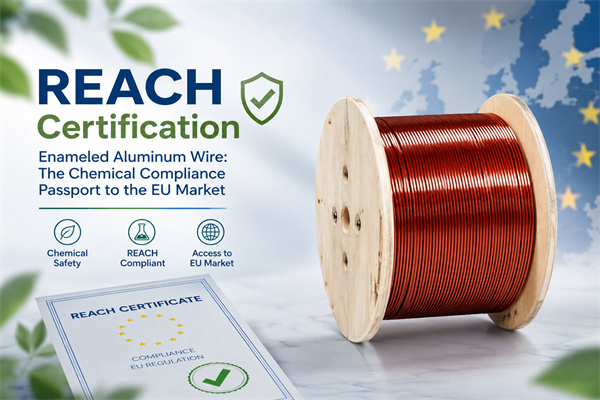
Chemicals with annual production or import volumes exceeding 1 ton must be registered with the European Chemicals Agency (ECHA), and Substances of Very High Concern (SVHC) must be authorized by ECHA before use. The REACH Restriction List (Annex XVII) lists hundreds of restricted substances.
As industrial products, the chemical composition of enameled aluminum wire (aluminum conductor, enamel materials, additives, etc.) must comply with REACH requirements, otherwise it may face product rejection, fines, or even recalls.
II. Differences Between REACH and RoHS
Many customers confuse REACH and RoHS. Although both are EU environmental regulations, they have completely different positioning. RoHS (2011/65/EU) is a restriction on hazardous substances for electrical and electronic products, limiting only 10 fixed substances (Lead, Mercury, Cadmium, Hexavalent Chromium, PBB, PBDE, DEHP, DBP, BBP, DIBP).
RoHS has clear limits (100-1000ppm) and focuses mainly on electrical and electronic safety. REACH (EC 1907/2006), on the other hand, is comprehensive management for all chemicals, with restricted substances including hundreds in Annex XVII plus the dynamically updated SVHC Candidate List (over 240 as of 2024).
REACH limits vary by situation (graded by tonnage) and focuses mainly on chemical safety. RoHS is a “blacklist”—explicitly prohibited substances and limits; REACH is a “whitelist plus dynamic regulation”—in addition to the restriction list, SVHC must also be monitored.
Enameled aluminum wire usually needs to comply with both RoHS and REACH regulations simultaneously, which are implemented in coordination.
III. Key Substances Restricted by REACH
REACH Annex XVII lists hundreds of restricted substances, mainly including benzene and some benzene series, cadmium and its compounds, lead and some lead compounds, phthalates (DEHP, DBP, BBP, DIBP), polycyclic aromatic hydrocarbons (PAHs), chlorinated solvents, and heavy metals (mercury, arsenic, chromium, etc.).
The SVHC Candidate List is the focus of REACH management, including carcinogenic, mutagenic, and toxic to reproduction (CMR) substances, persistent bioaccumulative toxic (PBT) substances, very persistent and very bioaccumulative (vPvB) substances, and endocrine disruptors, updated twice a year (usually in January and July).
Enameled aluminum wire needs to focus on phthalates, lead and lead compounds, cadmium and cadmium compounds, PAHs, formaldehyde, specific amines (azo dye decomposition products), chlorinated solvent residues, etc.
If the SVHC content in enameled aluminum wire exceeds 0.1% (w/w), notification to ECHA, provision of SDS to downstream users, and labeling of SVHC information on products are required.
IV. Specific REACH Requirements for Enameled Aluminum Wire
Regarding conductor materials, high-purity aluminum (≥99.99%) itself does not contain REACH-restricted substances, but surface treatment agents need to be REACH compliant, and the annealing process should also avoid the use of additives containing REACH-restricted substances.
For enamel raw materials, base polymers such as polyester, polyurethane, polyesterimide, polyamide-imide, and polyimide need REACH registration. Additives (plasticizers, stabilizers, catalysts, etc.) need to be REACH compliant, and solvents also need REACH compliance.
Manufacturing processes require avoiding the use of substances restricted by REACH Annex XVII, strictly controlling the use of chemicals in production, and properly handling wastewater, exhaust gas, and waste residue.
In terms of documentation, REACH compliant enameled aluminum wire requires a complete file system including SDS (Safety Data Sheet), DoC (Declaration of Conformity), material declarations, test reports, and upstream REACH registration numbers.
V. REACH Certification Process
The complete REACH certification process includes six steps. The first step is to identify the raw material list and establish a complete BOM (Bill of Materials), including aluminum conductor (grade, purity), enamel materials (composition, supplier), additives (type, dosage), packaging materials, etc.
The second step is to obtain upstream REACH information, request SDS, REACH registration numbers, and REACH compliance statements from suppliers for all raw materials, and confirm whether they contain SVHC. The third step is product testing, commissioning third-party testing institutions to conduct REACH related substance testing.
The fourth step is to compile REACH technical documentation, including product information, raw material list, SDS compilation, test reports, risk assessment reports, and safety usage instructions. The fifth step is to issue a REACH Declaration of Conformity.
The sixth step is continuous compliance monitoring, paying attention to SVHC list updates (1-2 times per year), Annex XVII updates, upstream supplier REACH changes, and periodic REACH compliance reviews. REACH compliance is not a one-time job and requires long-term continuation.
VI. REACH Testing Methods and Institutions
REACH testing methods vary by substance. SVHC testing uses Gas Chromatography-Mass Spectrometry (GC-MS) to detect organic SVHC, and Liquid Chromatography-Mass Spectrometry (LC-MS) to detect polar organic SVHC.
Inductively Coupled Plasma Mass Spectrometry (ICP-MS) detects metal SVHC, and X-Ray Fluorescence Spectroscopy (XRF) is used for rapid screening. For Annex XVII restricted substance testing, heavy metals use ICP-MS, phthalates use GC-MS, polycyclic aromatic hydrocarbons use GC-MS and HPLC, and formaldehyde uses spectrophotometry and HPLC.
Testing institutions should select authoritative third parties such as SGS, Intertek, TUV, BV, CTI, or domestic ones like CTI Huacei, Pony Testing, etc. A qualified REACH test report should include report number, testing institution qualifications, testing basis, testing items, testing results, testing date, and validity period.
VII. Advantages of REACH Compliance and Global Coordination
REACH compliant enameled aluminum wire offers multiple advantages. The biggest advantage is the “passport” to enter the EU market—legal sales, smooth customs clearance, and avoidance of fines and recalls. It also enhances corporate image, fulfills social responsibility, conforms to sustainable development, and strengthens brand value.
Reducing long-term risk is another important advantage, avoiding supply chain disruptions, recall losses, and legal disputes. Broadening markets covers the EU market as well as other markets converging with REACH, such as Korea K-REACH, Turkey KKDIK, and UK REACH.
In terms of supply chain management, REACH compliant upstream suppliers should be selected, REACH compliance agreements signed with suppliers, supplier REACH status regularly audited, and REACH material traceability systems established.
Cost impact will increase expenses for testing, documentation, raw materials, etc., but can avoid recall losses, reduce compliance risks, and enhance scale effects.
VIII. Selecting REACH Compliant Suppliers
Selecting REACH compliant enameled aluminum wire suppliers requires review from four dimensions. In terms of qualification review, EU REACH registration/compliance experience, third-party test reports, complete SDS and DoC, and supply chain REACH management capabilities are required.
For test report review, testing institution qualifications (ISO 17025 certification), report authenticity, testing item completeness, report validity period, and SVHC list version validity are required. In terms of production capacity, REACH compliant raw material procurement, production process REACH control, complete documentation systems, and continuous compliance capabilities are required.
In terms of service capability, technical support, problem response, regulatory update tracking, and long-term cooperation capabilities are required.
Complete REACH certified enameled aluminum wire management includes ten aspects: establishing BOM, obtaining SDS, monitoring SVHC, testing and verification, establishing systems, supply chain management, continuous monitoring, personnel training, emergency response, and professional consultation.
IX. Common Misconceptions and Future Trends
Common REACH compliance misconceptions include: believing that having an SDS means REACH compliance (in fact, SDS is only part of compliance), RoHS compliance means REACH compliance (they are different regulations), one-time testing means permanent compliance (continuous monitoring is required), and all substances have clear limits (some are restricted by use).
Enameled aluminum wire exported to the EU requires REACH compliance. Metallic aluminum itself falls within the exemption scope, but its compounds may require registration. The SVHC Candidate List is updated twice a year, and enterprises can query the latest version through the ECHA official website (echa.europa.eu).
In terms of global trends, the REACH system is being emulated by Korea K-REACH, Turkey KKDIK, UK REACH, etc., and China’s 14th Five-Year Plan is also establishing a similar chemicals management system.
While complying with EU REACH, enterprises should prospectively establish a global chemicals compliance system.