

I. Introduction: Polyester paint film – the “basic backbone” of the electromagnetic wire industry
In electrical equipment such as motors, transformers, inductors, etc., electromagnetic wires (winding wires) are the core conductive materials. The global demand for electromagnetic wires exceeds 2 million tons per year, of which Polyester Enameled Copper Wire accounts for about 40-50% of the market share, making it one of the most widely used and produced electromagnetic wire varieties. From small motors for household appliances, to medium-sized motors for industrial water pumps, to transformers and inductors, polyester enameled copper wire can be seen in almost every scenario of daily life and industry.
Polyester paint film stable insulated enameled copper wire is an electromagnetic wire product using high purity electrolytic copper rods as conductors and polyester resin or polyester imide (PEI) resin as insulated paint film. The insulating layer is formed by coating and baking on the surface of the copper conductor for many times to form a continuous, uniform and strong adhesion polymer film. This coating not only has excellent electrical insulation, but also withstands stretching, bending and friction during winding, while maintaining stable physical and chemical properties at operating temperatures from 130°C to 155°C.
According to the International Electrotechnical Commission IEC 60317 standard and the Chinese national standard GB/T 6109 series, the heat rating of polyester enameled copper wire coversClass B (130°C) and Class F (155°C) . Class B uses pure polyester (PE) paint film and Class F uses polyesterimide (PEI) paint film or polyester modified paint film. This thermal classification is critical for electrical equipment design engineers because it directly determines the upper limit of the allowable operating temperature of the coil, which in turn affects the power density design of the motor or transformer, the insulation system configuration, and the service life expectancy.
As one of the world’s leading enameled wire manufacturers, LP Winding Wire specializes in the production of a full range of enameled copper wire from Class B (130°C) to Class H (180°C), including polyester enameled copper wire, polyesterimide enameled copper wire, polyamideimide enameled copper wire, double-coated enameled copper wire, self-adhesive enameled copper wire, etc. This paper will systematically explain the technical characteristics and practical application of polyester paint film to stabilize insulated enameled copper wire from multiple dimensions such as chemical structure, key performance parameters, production process, application field, selection guide, quality control, and comparison with other insulation grades.
1.1 Market position of polyester enameled copper wire in the electromagnetic wire industry
Polyester enameled copper wire is the basic variety in the global electromagnetic wire market. According to industry statistics, the global electromagnetic wire market in 2025 is about 28 billion US dollars, of which polyester series enameled copper wire accounts for about 40-50%. The annual output of polyester enameled copper wire in the Chinese market exceeds 600,000 tons, which is the largest production and consumption market of polyester enameled copper wire in the world.
The reason why polyester enameled copper wire has become a mainstream variety in the electromagnetic wire market is mainly due to its golden balance of performance and cost : compared with higher temperature grades of polyamide imide (Pai), polyimide (PI) and other products, the cost of polyester enameled copper wire is only 1/5 to 1/3 of the former; compared with lower temperature grades of polyurethane (PU) enameled wire, polyester enameled copper wire is significantly better than PU products in heat resistance, mechanical strength and chemical resistance. In most general-purpose motors, transformers, home appliances and other application scenarios in the operating temperature range of 130°C to 155°C, polyester enameled copper wire is the best cost-effective choice.
1.2 5 Core Benefits of Polyester Enameled Copper Wire
Polyester enameled copper wire can dominate the electromagnetic wire market for a long time, due to the synergy of its five core advantages.
Advantage 1: Excellent electrical insulation performance . The volume resistivity of polyester paint film can reach the order of 10 ^ 14 to 10 ^ 15 Ω · cm at room temperature, and the dielectric breakdown voltage can reach 6-10 kV (Φ 1.0 mm specification). Key electrical parameters such as insulation resistance and dielectric loss tangent meet or even exceed the requirements of IEC 60317 and GB/T 6109 standards.
Advantage 2: Good mechanical strength and processing performance. Polyester paint film has excellent flexibility, adhesion and wear resistance, and can withstand stretching, bending, friction during high-speed winding without cracking or peeling of the paint film. The elongation of the copper conductor can reach 30-40%, and the round rod winding test, tensile test, and scraping test of the paint film all perform well.
Benefit 3: Stable chemistry . Polyester paint film has good resistance to common chemical media such as acids, alkalis, oils, and refrigerants, and is suitable for various working environments.
Benefit 4: Wide temperature range adaptability . Class B polyester enameled copper wire is suitable for operating temperatures ranging from -40°C to 130°C and Class F polyesterimide enameled copper wire is suitable for operating temperatures ranging from -40°C to 155°C.
Advantage 5: Excellent value for money . Polyester enameled copper wire is one of the most cost-effective varieties in the electromagnetic wire industry. Its comprehensive cost is far lower than high-end enameled wires such as Pai and PI, and its performance can cover most general application scenarios.
1.3 6 main application areas of polyester enameled copper wire
Household appliances and motors . Small motors in household appliances such as washing machines, air conditioners, refrigerators, microwave ovens, and electric fans are the most common application scenarios for polyester enameled copper wires.
General industrial motors . Pump motors, fan motors, compressor motors, machine tool motors, and other general industrial motors make extensive use of polyester enameled copper wires.
Transformers and inductors . The windings of electromagnetic components such as small and medium-sized transformers, inductors, choke coils, power adapters, etc. make extensive use of polyester enameled copper wires.
Automotive electrical systems . Automotive starter motors, generators, ignition coils, sensor coils, air conditioning compressor motors, etc. use Class F polyester imine enameled copper wires.
Electric tool motors . The motors of electric tools such as electric drills, electric saws, electric grinders, electric batches, etc. use Class F polyester imine enameled copper wires.
Office equipment . Stepper motors and DC motors for office equipment such as printers, copiers, and scanners use polyester enameled copper wires.
II. Chemical structure and insulation mechanism of polyester paint film
2.1 Chemical structure of polyester resin
Polyester resins are a general term for a large group of polymer whose backbone contains an ester group (-COO-) structure. In the application of electromagnetic wire insulating paint, polyester resins prepared by polycondensation reaction with aromatic dibasic acids (such as Terephthalic Acid or Phthalic Acid) and polyols (such as Ethylene Glycol, Glycerin) are mainly used.
The molecular structure of the polyester resin exhibits the following characteristics:
- The main chain contains a large number of ester groups (-COO-), giving the paint film good flexibility and adhesion
- The molecular chain segment contains a rigid benzene ring structure (derived from aromatic dicarboxylic acid), providing mechanical strength and wear resistance
- The molecular chain segment contains a flexible methylene segment (derived from aliphatic diol), providing flexibility
- By controlling the type, ratio and reaction conditions of dicarboxylic acid and polyol, the molecular weight, glass transition temperature (Tg), crystallinity and other parameters of polyester resin can be adjusted
2.2 Chemical structure of polyesterimide (PEI)
Pure polyester resin has a tendency to thermo-oxygen aging at long-term operating temperatures above 130°C. In order to improve the heat resistance level, material scientists have developed Polyester Imide (PEI) modification technology.
Polyester Imide is a polymer formed by introducing an Imide Ring structure into the polyester molecular chain. The imide ring is a highly stable group containing a -CO-N-CO- five-membered ring structure with excellent heat resistance, chemical resistance and mechanical strength. By introducing an imide ring in the polyester molecular chain, the heat resistance level of the paint film can be significantly improved, making the Class F (155°C) class possible.
Typical chemical structures of polyesterimine include:
- Aromatic polyester imide: prepared by reacting terephthalic acid, trimellitic anhydride (TMA) with polyols and diamines
- Modified polyester imide: further introduce other modification groups on the basis of polyester imide to further improve performance
2.3 Insulation mechanism of polyester paint film
From the perspective of insulation mechanism, the electrical insulation performance of polyester paint film mainly depends on * * polar ester groups * * in its molecular structure.
The ester group (-COO-) has moderate polarity and is able to form tightly stacked amorphous or quasi-crystalline structures at the molecular level, thus giving the paint film a higher volumetric resistivity and dielectric breakdown electric field strength .
The insulation mechanism of polyester paint film can be summarized in the following three levels:
- Molecular Level: Polar ester groups form tight molecular stacking, hindering carrier migration
- Aggregation State Level: Amorphous or quasi-crystalline structure reduces free volume and ionic conductivity
- Macroscopic Level: Uniform and continuous paint film avoids local electric field concentration and delays breakdown process
Polyester Imide paint film due to the introduction of high stability of the imide ring structure, its heat resistance is significantly better than pure polyester paint film, can maintain stable physical and chemical properties at 155° C long-term operating temperature.
III. Production process of polyester enameled copper wire
3.1 Pretreatment of copper rods
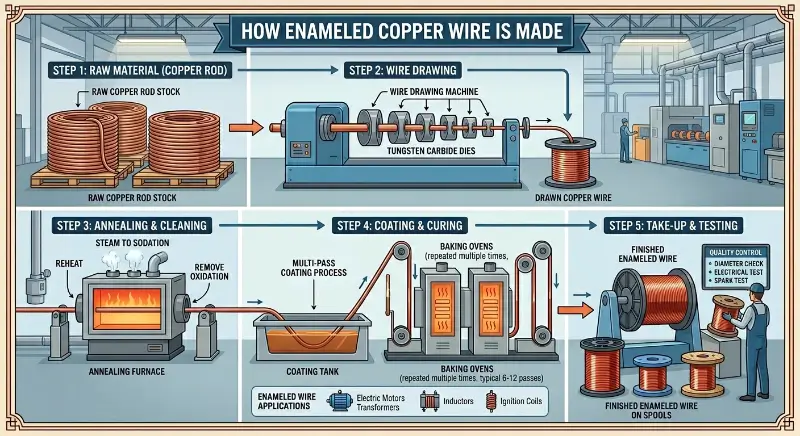
The production of polyester enameled copper wire starts with copper rod pretreatment .
Step 1: pull the copper rod . Gradually reduce the diameter to the target specifications (such as Φ 1.0 mm, Φ 0.8 mm, Φ 0.5 mm, etc.) by passing the low-oxygen copper rod of Φ 8 mm to Φ 10 mm size through the multi-pass continuous drawing die.
Step 2: Continuous annealing . During the drawing process, the grains inside the copper rod are elongated and work hardening occurs, resulting in a decrease in elongation. The copper grains are recrystallized by continuous annealing (300-500°C for seconds to tens of seconds) to restore softness and conductivity.
Step 3: Chemical cleaning . Use alkaline cleaning agents (such as sodium hydroxide, sodium carbonate) with surfactants to spray or soak the copper wire at 60-80°C to remove oil stains, oxide layers and impurities. The surface of the copper wire after cleaning should have a uniform rose red color.
3.2 Preparation of lacquer
Lacquer formulation is one of the key processes in the production of polyester enameled copper wires.
Typical polyester lacquer formulations include:
- Polyester resin or polyester imide resin: solid content 25-35%
- Solvent: cresol, xylene, solvent oil and other mixed solvents
- Leveling agent: improve paint film surface smoothness
- Curing agent: promote paint film cross-linking curing
- Thickener: adjust paint viscosity
- Colorant: give paint film specific color
After the preparation of the paint is completed, strict quality inspection is required, including solid content, viscosity (25°C effluent time), gel time, storage stability and other indicators.
3.3 Coating and baking process
Coating and baking is the core process of enameled wire production. At present, the industry generally adopts blanket painting or mold painting with continuous production lines of vertical or horizontal baking ovens.
Coating process. When painting, the polyester insulating paint is filled in the paint groove, and a uniform and appropriate amount of paint is covered on the surface of the copper wire passing at high speed through the capillary action of the felt, lip mold or round hole mold. The coating amount is precisely controlled by parameters such as mold aperture, paint viscosity, and linear velocity.
Baking and curing . The coated film needs to be cured in a high-temperature oven. The baking temperature is usually divided into multi-segment settings:
- Pre-baking section: 150-200°C, allowing the solvent to evaporate smoothly
- Main baking section: 300-450°C, promote the cross-linking curing reaction of resin
- Cooling section: gradually cool down to room temperature to set the paint film
The choice of baking temperature and time depends on the thickness of the film, the formulation of the lacquer and the structural design of the furnace. Insufficiently baked paint film will show a “sandwich” state, the paint film will be soft and sticky; excessive baking will cause the paint film to change color and become brittle.
Coat multiple times. For products requiring a thicker film, multiple coatings and baking (typically 4-8) are required, each adding a new film thickness to the previous layer.
3.4 Online Inspection and Quality Control
On-line inspection in the production process of polyester enameled copper wires is of paramount importance.
Online testing items include:
- Diameter Measurement: Use laser diameter gauge, accuracy up to ±0.001 mm
- Paint Film Thickness Measurement: Use eddy current thickness gauge
- Breakdown Voltage Test: Sampling high voltage test for each roll of enameled wire
- Pinhole Detection: Use pinhole tester or high pressure foam bath method
- Appearance Inspection: Inspect surface defects through industrial camera or manual visual inspection
If any of the test indicators is unqualified, the corresponding enameled wire roll should be automatically removed or marked for degradation.
3.5 Special Challenges for Polyester Enameled Copper Wire Production
Particular challenges in the production of polyester enameled copper wire include:
Challenge 1: Paint film thickness control accuracy . The thickness of the paint film needs to be controlled within ± 2 μm accuracy. Too thick will increase the cost, and too thin will reduce the insulation performance.
Challenge 2: Baking temperature uniformity . The temperature distribution in the oven needs to be uniform, otherwise the degree of curing of the paint film will be inconsistent.
Challenge three: paint stability . Viscosity changes, gels, etc. may occur during prolonged use of polyester paint, requiring regular replenishment of new paint and monitoring of viscosity.
Challenge 4: Environmental requirements . Organic solvents (e.g. cresol, xylene) in polyester lacquers need to be recycled during production to meet VOC emission standards.
IV. Key Performance Parameters and Test Methods of Polyester Enameled Copper Wire
4.1 Electrical performance parameters
Dielectric Breakdown Voltage . Breakdown voltage is the most intuitive parameter characterizing insulation strength. Test standard: IEC 60851-5. Test method: Immerse the enameled wire sample in the metal beads, apply 50 Hz AC voltage, and gradually step up to the paint film breakdown. Class B polyester enameled copper wire requirements: breakdown voltage ≥ 6 kV (Φ 1.0 mm, film thickness 30-40 μm). Class F polyesterimide enameled copper wire requirements: breakdown voltage ≥ 7 kV.
Film Continuity . Test method: The enameled wire is passed through a test tank containing mercury or electrolyte, and a short circuit is formed at the pinhole of the paint film, and the pinhole is detected and counted. Class B/F polyester enameled copper wire requirements: the number of pinholes per 30 meters of paint film is ≤ 3 (IEC level 1), in fact, it is usually 0-0.5 per 100 meters.
Insulation Resistance . Test method: Measure the insulation resistance of the enameled wire at 500V DC voltage. Class B/F polyester enamelled copper wire requirements: insulation resistance ≥ 2,000 MΩ · m (20°C), ≥ 20 MΩ · m (130°C/155°C).
Dissipation Factor . Test method: Measure the dielectric loss of the paint film at power frequency or high frequency voltage. Class B/F polyester enameled copper wire requirements: tan δ ≤ 0.01 (1 kHz, 20°C), ≤ 0.05 (1 kHz, operating temperature).
4.2 Mechanical performance parameters
Elongation . Test method: Stretch the enameled wire to break and measure the elongation at break. Class B/F polyester enameled copper wire requirements: elongation ≥ 30% (Φ 1.0 mm), high quality products up to 35-40%.
Tensile Strength . Test method: Stretch the enameled wire to break and measure the maximum tensile stress. Class B/F polyester enameled copper wire requirements: 200-250 MPa (soft), 350-450 MPa (hard).
Flexibility and Adhesion . Test method: Round rod winding test, tensile test, scraping test. Class B/F polyester enameled copper wire requirements: 1 × d round rod is not cracked, and the adhesion of the paint film is strong.
Abrasion Resistance . Test standard: NEMA MW 1000. Test method: Reciprocating scraping test to measure the number of scratches required for the paint film to be damaged. Class B/F polyester enameled copper wire requirements: single scratch force ≥ 8 N.
4.3 Thermal performance parameters
Heat Shock . Test method: After the enameled wire is subjected to thermal shock at 155-180°C × 30 min, it is immediately wound with a 1 × d round rod. Class B/F polyester enameled copper wire requirements: no cracking, no peeling.
Thermal Aging . Test standard: IEC 60172. Test method: Accelerate aging at three temperature points of 130°C, 155°C, and 180°C, and measure the time when the breakdown voltage drops to the specified value. Class B polyester enameled copper wire requirements: temperature index (TI) ≥ 130, 20,000 hours life. Class F polyesterimide enameled copper wire requirements: temperature index (TI) ≥ 155, 20,000 hours life.
Cut-Through Temperature . Test method: Apply a specified load on the enameled wire sample, and gradually heat up to the softening breakdown of the paint film. Class B/F polyester enameled copper wire requirements: softening breakdown temperature ≥ 200°C (Class B), ≥ 250°C (Class F).
Thermal Weight Loss . Test standard: ASTM E1131. Test method: TGA thermogravimetric analysis. Class B/F polyester enameled copper wire requirements: 5% thermal weight loss temperature ≥ 300°C.
4.4 Chemical performance parameters
Solvent Resistance . Test method: Soak the enameled wire in a standard solvent (such as xylene, acetone) and measure the hardness and adhesion of the paint film. Class B/F polyester enameled copper wire requirements: There is no obvious softening, blistering, or peeling of the paint film after soaking.
Oil Resistance . Test method: Test the dielectric strength after the enameled wire is immersed in 100°C transformer oil for 24 hours. Class B/F polyester enameled copper wire requirements: dielectric strength retention rate ≥ 80%.
Refrigerant Resistance . Test method: Test the dielectric strength after soaking the enameled wire in R22, R134a, R410A and other refrigerants. Polyester enameled copper wire for refrigeration compressors Requirements: Dielectric strength retention rate ≥ 70%.
Hydrolysis Resistance . Test method: Test the dielectric strength of the enameled wire after 1000 hours of exposure at 95°C and 95% humidity. Class B/F polyester enameled copper wire requirements: dielectric strength retention rate ≥ 60%.
V. Comparison of polyester enameled copper wire with other insulation grades
5.1 Comparison of temperature levels
Polyester enameled copper wire (Class B 130°C/Class F 155°C) is located at the middle and low end of the enameled wire temperature classification system and is suitable for most general application scenarios.
Temperature Class Comparison Table:
- Class A(105°C):Oil-based paint film
- Class B(130°C):Polyester (PE) paint film
- Class F(155°C):Polyester Imide (PEI) paint film
- Class H(180°C):Polyamide-imide (PAI) paint film
- Class N(200°C):Polyimide (PI) paint film
- Class R(220°C)and Class 240 (240°C): special PI+PAI composite paint film
Polyester enameled copper wire offers the best price/performance in the operating temperature range of 130-155°C.
5.2 Comparison of paint film materials
Performance comparison of different paint film materials:
Polyurethane (PU) paint film . The mechanical strength is average, the adhesion is strong, and the weldability is good. Long-term use temperature 120°C. Low price.
Polyester (PE) paint film . Good mechanical strength, good flexibility, and average heat resistance. Long-term use temperature 130°C. Low price.
Polyester Imide (PEI) paint film . The mechanical strength is good, the heat resistance is good, and the weldability is average. Temperature for long-term use 155°C. Medium price.
Polyamide imide (Pai) paint film . Excellent mechanical strength, excellent heat resistance and excellent chemical resistance. Long-term use temperature 180°C. The price is higher.
Polyimide (PI) paint film . Excellent mechanical strength, excellent heat resistance, excellent chemical resistance, excellent radiation resistance. Long-term use temperature above 200°C. High price.
Polyester enameled copper wire (PE/PEI) has significant advantages in terms of comprehensive performance and cost balance.
5.3 Comparison of performance parameters
Comparison of key performance parameters of enameled wires with different insulation grades:
- Dielectric Breakdown Voltage: Polyester (PE) 6-8 kV, Polyester Imide (PEI) 7-9 kV, Polyamide-imide (PAI) 8-10 kV
- Thermal Aging Life (155°C test temperature): Polyester (PE) >20,000 hours, Polyester Imide (PEI) >20,000 hours, Polyamide-imide (PAI) >20,000 hours
- Chemical Resistance: Polyester (PE) withstands general chemical media, Polyester Imide (PEI) withstands medium chemical media, Polyamide-imide (PAI) withstands strong chemical media
- Temperature Range: Polyester (PE) -40°C to +130°C, Polyester Imide (PEI) -40°C to +155°C, Polyamide-imide (PAI) -60°C to +180°C
- Relative Cost: Polyester (PE) = 1, Polyester Imide (PEI) = 1.5, Polyamide-imide (PAI) = 3-5
Polyester enameled copper wire has an overwhelming cost advantage.
5.4 Comparison of applicable working conditions
Comparison of applicable working conditions of different enameled wires:
Polyurethane (PU) enameled wire is suitable for : cost-sensitive application scenarios without high temperature requirements.
Polyester (PE) enameled wire for : household appliances, low power motors, universal transformers (operating temperature < 130°C).
Polyester Imide (PEI) enameled wire for : General industrial motors, medium power transformers, air conditioning compressors, power tools (operating temperature < 155°C).
* * Polyamideimide (Pai) enameled wire for * *: traction motors, generators, high power transformers, industrial pumps (operating temperature < 180°C).
Polyester enameled copper wire has the best price/performance ratio in most general-purpose applications.
VI. Selection Guide for Polyester Enameled Copper Wire
6.1 5 Key Factors in Model Selection
The following 5 factors should be considered in the selection of polyester enameled copper wire.
The operating temperature is the basis for selection. Class B polyester enameled copper wire is suitable for operating temperature ≤ 130°C; Class F polyester imine enameled copper wire is suitable for operating temperature 130-155°C. A safety margin of 10-15°C should be reserved for selection.
Select the film thickness according to the working voltage of the winding. Grade 1 film (25-32 μm) for low-voltage windings (< 1 kV); Grade 2 film (30-38 μm) for medium-voltage windings (1-10 kV); Grade 3 film (35-42 μm) for high-voltage windings (> 10 kV).
Determine the conductor diameter according to the winding design. LP Winding Wire Polyester enameled copper wire is available in full specifications from Φ 0.10-3.00 mm. The ultra-thin wire (Φ 0.10-0.30 mm) is suitable for high frequency small windings; the thin wire (Φ 0.30-1.00 mm) is suitable for general motor and transformer windings; the thick wire (Φ 1.00-3.00 mm) is suitable for high power windings.
Consider the special requirements of the working environment such as chemical medium, radiation, humidity, etc. In the chemical corrosion environment, a polyesterimide paint film with better chemical resistance should be selected; in the high humidity environment, a paint film with good hydrolysis resistance should be selected; in the refrigeration compressor environment, a paint film with good refrigerant resistance should be selected.
Select according to the certification requirements of the application industry. Appliance applications should comply with IEC 60317, GB/T 6109 certification; automotive applications should comply with ISO/TS 16949, IATF 16949 certification; transformer applications should comply with IEC 61558 certification.
6.2 Recommended specifications for different applications
Class B polyester enameled copper wire is recommended, with a conductor diameter of Φ 0.30-0.80 mm, a film thickness of 25-32 μm, and a temperature class of 130°C.
Class F polyesterimide enameled copper wire is recommended, with a conductor diameter of Φ 0.50-2.00 mm, a film thickness of 30-38 μm, and a temperature grade of 155°C.
Class B/F polyester enameled copper wire is recommended, with a conductor diameter of Φ 0.20-1.00 mm and a film thickness of 25-35 μm.
Class F polyesterimide enameled copper wire is recommended, in compliance with IATF 16949 certification, with a conductor diameter of Φ 0.30-1.50 mm and a film thickness of 28-35 μm.
Class F polyesterimide enameled copper wire is recommended, the diameter of the conductor is Φ 0.50-1.20 mm, and the thickness of the paint film is 30-38 μm, which requires wear resistance and impact resistance.
Class F polyesterimide enameled copper wire + refrigerant resistant coating is recommended, the diameter of the conductor is Φ 0.50-1.00 mm, and the thickness of the paint film is 30-38 μm, which meets the IEC 60317 standard.
6.3 Common Misunderstandings in Selection
For applications with operating temperatures ≤ 130°C, Class B polyester enameled copper wire fully meets the requirements, and selecting Class F or Class H will result in unnecessary cost waste.
Increasing the thickness of the paint film will reduce the fill rate of the conductor, reduce the cross-sectional area of the winding, and affect the electrical performance. The appropriate film thickness should be selected according to the operating voltage.
The conductor material (copper/aluminum) has a significant effect on the performance of the enameled wire. The aluminum core enameled wire is light in weight and low in cost, but the conductivity and weldability are poor; the copper core enameled wire has good conductivity and weldability, but the weight is large and the cost is high.
The flexibility of the polyester film is better than that of the PU film, but the flexibility of the thick film decreases. For applications that require tightly bent or profiled windings, the model with a thinner paint film should be selected.
Different industries have different certification requirements, and suppliers and products with corresponding certification should be selected.
VII. Production quality control of polyester enameled copper wire
7.1 Raw material quality control
Copper pole quality control:
- Copper purity ≥99.97%, oxygen content ≤10 ppm
- Resistivity ≤0.01724 Ω·mm²/m (20°C)
- Appearance without oxidation, without defects
- Batch traceability, each batch attached with inspection report
Polyester quality control :
- Solid content 30-35%
- Viscosity (25°C) 300-500 cP
- Gel time meets process specifications
- Residual solvent ≤1%
- Batch stable, no gel, no precipitation
7.2 Process Quality Control
Conductor pretreatment process :
- Annealing temperature 300-500°C ±5°C
- Elongation after annealing 30-40%
- Copper wire surface contact angle after cleaning ≤30°
Coating process :
- Paint temperature 20-30°C ±1°C
- Paint viscosity 300-500 cP ±5%
- Coating speed 5-30 m/min ±0.5%
- Paint film thickness online measurement accuracy ±1 μm
Baking process :
- Baking temperature gradient setting meets process specifications
- Each stage temperature control accuracy ±5°C
- Tension control 50-200 g ±5 g
- Baking atmosphere flow rate stable
Collection process :
- Take-up tension 30-150 g ±5 g
- Spool appearance, weight, marking meet standards
- Moisture-proof, pollution-proof packaging
7.3 Quality control of finished products
Electrical performance testing :
- Dielectric breakdown voltage: sampling inspection per batch
- Paint film continuity: 100% online detection
- Insulation resistance: sampling inspection per batch
Mechanical performance testing:
- Elongation: sampling inspection per batch
- Tensile strength: sampling inspection per batch
- Wear resistance: sampling inspection per batch
- Mandrel winding: sampling inspection per batch
Thermal performance testing :
- Heat shock: sampling inspection per batch
- Softening breakdown: sampling inspection per batch
- Thermal aging: periodic type test
Chemical performance test
- Solvent resistance: periodic type test
- Oil resistance: periodic type test
- Refrigerant resistance: periodic type test (for refrigeration compressor applications)
Appearance inspection
- Paint film color uniform and consistent
- No bubbles, impurities, particles
- No scratches, indentations
- Spool packaging intact
VIII. Development trend of polyester enameled copper wire
8.1 New Material Trends
Trend one: nano-modified polyester paint film . Adding nanomaterials such as nano-SiO2 and nano-Al2O3 to the polyester paint film can significantly improve the wear resistance, heat resistance, and thermal conductivity of the paint film, while reducing the thickness of the paint film.
Trend 2: Waterborne polyester paint film . Traditional polyester paint films use organic solvents (cresol, xylene) and have large VOC emissions. Research and development of waterborne polyester paint film to reduce VOC emissions, in line with environmental requirements, is the sustainable development direction of the enameled wire industry.
Trend 3: Eco-friendly polyester paint film . The use of bio-based raw materials instead of petroleum-based raw materials reduces the carbon footprint and meets the requirements of sustainable development.
Trend 4: High Heat Resistant Polyester Film . Developed modified polyester paint film with heat resistance above 155°C to further enhance the application range of polyester enameled copper wire.
8.2 New Process Trends
Trend 1: Online Quality Monitorin. Machine vision, X-ray thickness measurement, infrared thermal imaging and other technologies are used to achieve 100% online monitoring of film thickness, pinholes and thermal distribution to improve quality stability.
Trend two: intelligent production. Introduce industrial Internet, big data and artificial intelligence technology to realize intelligent optimization, predictive maintenance and flexible production of enameled wire production process.
Trend three: energy saving . Optimize baking oven structure, heat recovery system, baking temperature curve, reduce energy consumption by 20-30%.
Trend four: high-speed production . Increase the production speed of enameled wire from the current 30-50 m/min to 80-100 m/min to improve production efficiency.
8.3 New Application Trends
Trend 1: New Energy Vehicles . With the popularity of the 800V high-voltage platform for electric vehicles, the working voltage of the motor has been increased to 800V, and polyester enameled copper wire has broad application prospects in new energy vehicle drive motors.
Trend 2: Smart Home . Polyester enameled copper wire is widely used in small motors, sensor coils, transformers, etc. in smart home devices.
Trend three: 5G communication . The demand for polyester enameled copper wires for 5G base station power supplies, filters, transformers and other equipment has increased.
Trend four: energy storage systems . With the rapid development of large-scale energy storage systems, household energy storage, mobile energy storage, etc., the demand for inductors and transformers with high power density and high reliability has increased, and the application space of polyester enameled copper wires has expanded.
8.4 Market prospects for polyester enameled copper wire
With the rapid development of emerging industries such as new energy vehicles, smart homes, 5G communications, and energy storage systems, the market demand for polyester enameled copper wires will continue to grow.
It is expected that in 2025-2030, the average annual growth rate of the global polyester enameled copper wire market will reach 4-6%, and the average annual growth rate of the Chinese polyester enameled copper wire market will reach 5-7%, which is higher than the global average.
The main suppliers in China’s polyester enameled copper wire market are LP Winding Wire, Essex Furukawa, Sumitomo Electric, Suzhou Jufeng, Fujian New Start, etc.
As one of the world’s leading enameled wire manufacturers, LP Winding Wire can provide a full range of enameled copper wires from Class B (130°C) to Class H (180°C), Φ 0.10-3.00 mm full specifications, UL, TÜV, CCC, CSA, IATF 16949 and other international certifications, with significant market competitive advantages.
IX. Common Problems and Solutions of Polyester Enameled Copper Wire
9.1 Design Phase FAQs
This leads to low or high enameled wire temperature level selection. Solution: Establish an accurate working temperature assessment model, taking into account factors such as ambient temperature, load temperature rise, hot spot temperature, transient overload, etc.
Causes insufficient insulation strength or low conductor fill rate. Solution: Select the thickness of the paint film according to the working voltage, surge voltage, safety margin and other factors.
Causes difficulty in winding or degradation in electrical performance. Solution: Consider the overall coordination of the outer diameter of the copper wire, the thickness of the paint film, and the size of the winding.
9.2 Frequently Asked Questions at the Production Stage
Reason: residual solvent in the paint, too high baking temperature, insufficient baking time. Solution: Optimize the lacquer preparation process and adjust the baking temperature curve.
Causes: mold wear, fluctuating paint viscosity, unstable coating speed. Solution: Regularly check the mold, control the viscosity of the paint, and stabilize the coating speed.
Reason: uneven baking temperature, different lacquer lotions. Solution: Regularly calibrate the baking temperature and strengthen the batch management of lacquer.
9.3 Use Phase FAQs
Cause: The paint film is too thick, the winding tension is too large, and the winding tool is worn. Solution: Select the appropriate film thickness, control the winding tension at 50-150 g, and replace the wear tool.
Reason: improper groove insulation, unreasonable wire embedding process. Solution: Optimize the wire embedding process with suitable groove insulation.
Causes: thermal aging of the paint film, moisture absorption, chemical erosion. Solution: Regularly detect the insulation resistance and replace the aged enameled wire in time.
Reason: Chemical erosion of the paint film by the refrigerant. Solution: Choose refrigerant-resistant modified polyester enameled copper wire or polyamide-imide enameled copper wire.
X. LP Winding Wire’s Polyester Enameled Copper Wire Solution
10.1 LP Winding Wire Company Profile
LP Winding Wire is a leading global enameled wire manufacturer specializing in a full range of enameled copper wire from Class B (130°C) to Class H (180°C), including polyester enameled copper wire, polyesterimide enameled copper wire, polyamideimide enameled copper wire, double-coated enameled copper wire, self-adhesive enameled copper wire, paper wrapped wire, glass wire wrapped wire, Nomex paper wrapped wire, PI film wrapped wire and other series products.
The company has an annual production capacity of 30,000 tons, UL, TÜV, CCC, CSA, IATF 16949, AS 43701 and other international certifications, and its products are exported to more than 50 countries and regions around the world such as North America, Europe, Asia, and the Middle East.
10.2 LP Winding Wire Polyester Enameled Copper Wire Product Specifications
LP Winding Wire offers polyester enameled copper wire in the following specifications:
Ultra-fine line series (Φ 0.10-0.30 mm) . Conductor material: High purity oxygen-free copper. Paint film construction: polyester (PE) or polyesterimide (PEI). Film thickness: 25-32 μm. Elongation: ≥ 30%. Applicable temperature: Class B (130°C)/Class F (155°C).
Fine line series (Φ 0.30-1.00 mm) . Conductor material: High purity oxygen-free copper. Paint film construction: polyester (PE) or polyesterimide (PEI). Film thickness: 28-35 μm. Elongation: ≥ 30%. Applicable temperature: Class B (130°C)/Class F (155°C).
Medium bold series (Φ 1.00-2.00 mm) . Conductor material: High purity oxygen-free copper. Paint film construction: polyester (PE) or polyesterimide (PEI). Film thickness: 30-40 μm. Elongation: ≥ 30%. Applicable temperature: Class B (130°C)/Class F (155°C).
Thick line series (Φ 2.00-3.00 mm. Conductor material: High purity oxygen-free copper. Paint film construction: polyester (PE) or polyesterimide (PEI). Film thickness: 35-45 μm. Elongation: ≥ 30%. Applicable temperature: Class B (130°C)/Class F (155°C)
XI. Summary
Polyester paint film stabilized insulated enameled copper wire is one of the most widely used and produced varieties in the electromagnetic wire industry. With its excellent electrical insulation performance, good mechanical strength, stable chemical properties, wide temperature range adaptability and excellent cost performance, it plays an irreplaceable role in many fields such as household appliances, general industrial motors, transformers and inductors, automotive electrical systems, electric tools, and office equipment.
Class B (130°C) polyester enameled copper wire and Class F (155°C) polyesterimide enameled copper wire, based on polyester (PE) paint film and polyesterimide (PEI) paint film, respectively, cover the temperature requirements of most general application scenarios. Compared with higher temperature grade polyamide imide (Pai), polyimide (PI) and other products, polyester enameled copper wire has significant advantages in balancing performance and cost, and is the preferred electromagnetic wire variety in the operating temperature range of 130-155°C.
Correct selection is the key to the success of polyester enameled copper wire applications. Consider factors such as operating temperature, operating voltage, conductor diameter, working environment, and industry certification, and select the appropriate temperature class (Class B/F), film thickness, conductor specifications, and certification class.
As the world’s leading enameled wire manufacturer, LP Winding Wire can provide a full range of enameled copper wire products from Class B (130°C) to Class H (180°C), including polyester enameled copper wire, polyesterimide enameled copper wire, polyamideimide enameled copper wire, etc., Φ 0.10-3.00 mm full specifications, UL, TÜV, CCC, CSA, IATF 16949 and other international certifications, is your trusted partner.
With the rapid development of emerging industries such as new energy vehicles, smart homes, 5G communications, and energy storage systems, polyester enameled copper wires will continue to develop in the direction of nano-modification, water-based, intelligent, and green environmental protection, and the market prospects are broad.
XII. Appendix A: Technical Data Sheet for Polyester Enameled Copper Wire
12.1 Class B (130°C) Polyester Enameled Copper Wire Technical Parameters
Typical technical parameters of Class B (130°C) polyester enameled copper wire:
- Conductor Material: High-purity oxygen-free copper (Cu content ≥99.97%)
- Conductor Diameter: Φ 0.10-3.00 mm
- Paint Film Material: Polyester Resin
- Paint Film Thickness: Grade 1: 25-32 μm, Grade 2: 30-38 μm, Grade 3: 35-42 μm
- Elongation: ≥30% (Φ 1.0 mm)
- Tensile Strength: 200-250 MPa (soft state), 350-450 MPa (hard state)
- Dielectric Breakdown Voltage: ≥6 kV (Φ 1.0 mm, room temperature)
- Paint Film Continuity: ≤3 pinholes per 30 m (IEC Class 1)
- Insulation Resistance: ≥2,000 MΩ·m (20°C), ≥20 MΩ·m (130°C)
- Temperature Index (TI): ≥130
- Heat Shock: 155°C × 30 min without cracking
- Softening Breakdown Temperature: ≥200°C
- Refrigerant Resistance: Not applicable (Class B is generally not used for refrigeration compressors)
12.2 Class F (155°C) Polyester Imide Enameled Copper Wire Technical Parameters
Typical technical parameters of Class F (155°C) polyesterimide enameled copper wire:
- Conductor Material: High-purity oxygen-free copper (Cu content ≥99.97%)
- Conductor Diameter: Φ 0.10-3.00 mm
- Paint Film Material: Polyester Imide Resin
- Paint Film Thickness: Grade 1: 25-32 μm, Grade 2: 30-38 μm, Grade 3: 35-42 μm
- Elongation: ≥30% (Φ 1.0 mm)
- Tensile Strength: 200-250 MPa (soft state), 350-450 MPa (hard state)
- Dielectric Breakdown Voltage: ≥7 kV (Φ 1.0 mm, room temperature)
- Paint Film Continuity: ≤3 pinholes per 30 m (IEC Class 1)
- Insulation Resistance: ≥2,000 MΩ·m (20°C), ≥20 MΩ·m (155°C)
- Temperature Index (TI): ≥155
- Heat Shock: 180°C × 30 min without cracking
- Softening Breakdown Temperature: ≥250°C
- Refrigerant Resistance: Resistant to R134a, R410A and other common refrigerants (special formula required)
12.3 Comparison with other temperature grade enameled wires
Key Performance Comparison of Polyester Enameled Copper Wire with Other Temperature Grade Enameled Wire:
- Class B (130°C) Polyester (PE): Applicable temperature 130°C, breakdown voltage ≥6 kV, relative cost = 1
- Class F (155°C) Polyester Imide (PEI): Applicable temperature 155°C, breakdown voltage ≥7 kV, relative cost = 1.5
- Class H (180°C) Polyamide-imide (PAI): Applicable temperature 180°C, breakdown voltage ≥8 kV, relative cost = 3-5
- Class N (200°C) Polyimide (PI): Applicable temperature 200°C, breakdown voltage ≥8 kV, relative cost = 5-8
Polyester enameled copper wire offers the best value for money in the operating temperature range of 130-155°C.
XIII. Appendix B: Application Cases of Polyester Enameled Copper Wire
13.1 Case 1: Home Air Conditioning Compressor Motor
A household air conditioning compressor motor adopts LP Winding Wire Φ 0.65 mm Class F polyesterimide enameled copper wire + refrigerant-resistant coating, operating temperature is 130°C, refrigerant R410A, operating life is more than 10 years, and meets the requirements of IEC 60317-13 certification.
13.2 Case 2: Washer Drive Motor
A washing machine drive motor adopts LP Winding Wire Φ 0.50 mm Class B polyester enameled copper wire, the operating temperature is 110°C, the power density is 0.5 kW/kg, the operation is stable and reliable, and it meets the requirements of GB/T 6109.7 certification.
13.3 Case 3: Industrial Pump Motor
An industrial water pump motor adopts LP Winding Wire Φ 0.80 mm Class F polyesterimide enameled copper wire with an operating temperature of 140°C and a power density of 1.5 kW/kg, which ensures stable and reliable operation.
13.4 Case 4: Small Transformers
A small power transformer adopts LP Winding Wire Φ 0.30 mm Class B polyester enameled copper wire with an operating temperature of 120°C and an insulation strength of 6 kV, which meets the requirements of IEC 61558 certification.
13.5 Case 5: Automotive Air Conditioning Blower Motor
An automotive air conditioning blower motor adopts LP Winding Wire Φ 0.40 mm Class F polyester imine enameled copper wire, which is certified by IATF 16949, has an operating temperature of 140°C, and has an operating life of more than 15 years.
13.6 Case 6: Electric tool motors
An electric tool motor adopts LP Winding Wire Φ 0.60 mm Class F polyesterimide enameled copper wire + wear-resistant coating. The operating temperature is 145°C, which meets the requirements of IEC 60317-13 certification.