


Paper-insulated wire vs. rectangular enameled copper wire: An engineering selection comparison guide. Transformer engineers and high-power motor winding designers face the same question every day—which winding conductor is more suitable? 、Paper-insulated wire and rectangular enameled copper wire are two parallel technological paths that have existed for decades, representing two completely different engineering philosophies: the former started with oil-immersed transformers in the 1920s and still dominates high-power electric motors today; the latter started with dry-type transformers and variable frequency motor drives in the 1980s and is now the preferred choice for new energy vehicle drive motors and high-power density transformers.
Many engineers’ understanding of these two types of conductors is limited to “paper-insulated wire is the old stuff used in transformers, and rectangular enameled wire is the new stuff used in new motors.” This understanding is too superficial. In fact, from insulation system, conductor shape, fill factor, heat dissipation method to manufacturing cost, there are engineering trade-offs in every dimension. This article provides a systematic comparison of these two winding conductors from an engineer’s practical perspective—after reading it, you should be clear about when to use which one.
Basic Understanding of Paper-Covered Wire and Rectangular Enameled Copper Wire
What is Paper-Covered Wire?
Paper-covered wire is a type of wound conductor with insulating paper (cable paper, telephone paper, or Nomex aromatic polyamide paper) as the outer insulation layer. A typical structure consists of 2-4 layers of insulating paper tightly wrapped around round or flat copper wire. Depending on the insulation class, ordinary cable paper (temperature resistance 105°C) or Nomex aromatic polyamide paper (temperature resistance 220°C) can be used. The most typical application of paper-covered wire is oil immersion in transformers. Transformer oil itself is an excellent insulating and cooling medium. When paper-covered wire operates in oil, the insulating paper, transformer oil, and copper conductor work together to provide insulation. Therefore, the insulation design logic of paper-covered wire is “paper is the skeleton, oil is the main force.” From a manufacturing perspective, paper-covered wire is relatively simple. After the conductor is drawn, it is spirally wrapped with insulating paper tape. The overlap rate is generally controlled at 30-50%, and the wrapping pitch is determined by the reloading equipment. After wrapping, it is then impregnated with enamel or oil (for dry transformer scenarios).
What is Rectangular Enameled Copper Wire?
Rectangular enameled copper wire (also called flat copper wire) is an enameled copper wire with a rectangular cross-section. The insulation layer is a single or multiple layers of enamel coating (polyester, polyimide, polyamide-imide, or polyimide). Commonly used enamel coating systems include PEW (polyester, 130-155°C), EIW (polyester-imide, 155-180°C), AIW (polyamide-imide, 180-220°C), and PIW (polyimide, 220-240°C). Typical applications of rectangular enameled copper wire include high-power dry-type transformers, variable frequency motors (drive motors in new energy vehicles), high-frequency reactors, welding machines, and wind turbine windings. The biggest advantage of rectangular cross-sections is their high fill factor—rectangular windings can achieve a space utilization rate of over 90%, while round wire windings typically only reach 60-70%. This is the core reason why rectangular enameled wire is preferred in high-power-density applications. From a manufacturing perspective, rectangular enameled wire is more complex than round enameled wire. The copper rod is first extruded or stretched into a rectangular cross-section, then multiple layers of enamel coating and curing are applied using molds and enamel tanks (NEMA standards specify enamel coating thickness based on Grade 1/2/3). The most critical technological challenge is controlling the radius (R) of the rectangular cross-section—too small an R angle can easily lead to stress concentration in the enamel coating, while too large an R angle results in a loss of fill factor.
The essential difference between the two types of conductors:
Paper-insulated wire and rectangular enameled copper wire represent two different insulation design philosophies. Paper-insulated wire insulation is a composite system of “skeleton + environment,” relying on the operating environment (oil) to jointly perform the insulation task. Rectangular enameled copper wire insulation, on the other hand, is a “self-enclosed” system, where the enameled coating independently completes the insulation task, independent of the external environment. This difference determines the distinct application scenarios: paper-insulated wire is suitable for enclosed oil-immersed environments (oil-immersed transformers), while rectangular enameled copper wire is suitable for open or semi-enclosed environments (dry-type transformers, motor windings). Using paper-insulated wire in air will significantly reduce its insulation strength; immersing rectangular enameled copper wire in oil is completely unnecessary—the enameled coating itself is sufficiently oil-resistant.
Performance Parameter System Comparison
| Item | Paper-insulated Wire | Rectangular Enamelled Copper Wire |
|---|---|---|
| Insulation System | 2-4 layers of insulating paper tape (cable paper/Nomex) | 1-3 layers of enamel coating (PEW/EIW/AIW/PIW) |
| Thermal Class | 105°C (cable paper) / 220°C (Nomex) | 130-240°C (according to enamel coating grade) |
| Breakdown Voltage | Several kilovolts (multi-layer paper stacking) | IEC 60317 specifies 1-5 kV |
| Fill Factor | 60-70% (round wire winding) | 85-95% (rectangular close stacking) |
| Heat Dissipation Method | Oil cooling (enclosed environment) | Air/resin/water cooling (open environment) |
| Conductor Shape | Round wire + Flat wire | Flat wire/rectangular wire |
| Applicable Current Density | 1.5-3 A/mm² | 3-8 A/mm² |
| Typical Applications | Oil-immersed transformer | Dry transformer, NEV drive motor |
| Standard System | NEMA MW 31/33/60/61, IEC 60317-29 | NEMA MW 18/36/38/84, IEC 60317 |
| Manufacturing Cost | Medium (mature technology) | Medium-high (complex technology) |
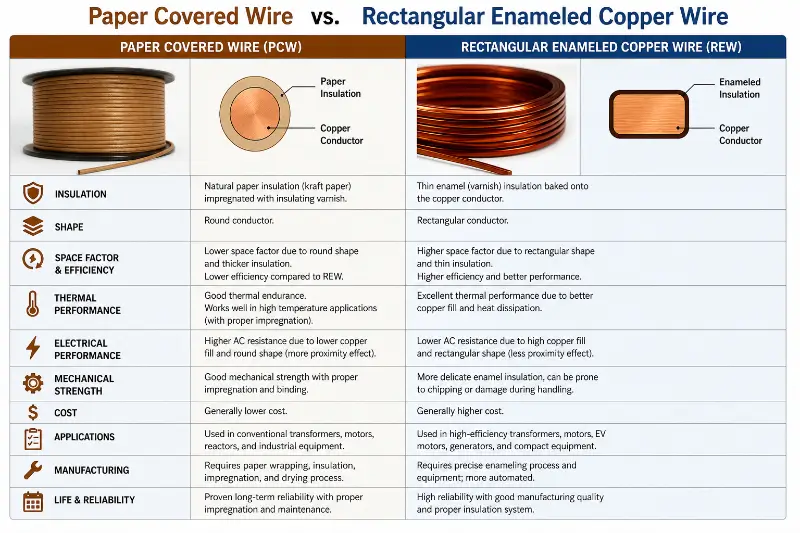
Comparison of standard systems
The international standard NEMA MW 1000 is
the core standard system for winding conductors in North America. In the field of paper-insulated wire, NEMA MW 1000 specifies the MW 31 (round wire, 90/105°C), MW 33 (rectangular wire, 155°C), MW 60/61 (aromatic polyamide wire, 220/240°C), and MW 64/65 (polyimide tape-covered, 240°C) series. These models cover all paper-insulated wire applications, from ordinary oil-impregnated transformers to high-temperature specialty transformers. In the field of rectangular enameled copper wire, NEMA MW 1000 specifies the MW 18 (polyvinyl acetal, 105°C), MW 36/38 (polyimide-coated polyamide-imide, 200/220°C), MW 84 (polyamide-imide, 240°C), and MW 20 (polyimide, 220°C) series. These models correspond to different enameled wire classes. IEC 60317 is the International Electrotechnical Commission (IEC) standard for winding conductors. IEC 60317-29 specifically specifies round wire and rectangular wire, while IEC 60317-0-2/0-3/0-4 and other general sections specify dimensional tolerances and breakdown voltage test methods for rectangular enameled wire. Chinese standard GB/T 7672 is the Chinese national standard for enameled wire, equivalent to IEC 60317-29. GB/T 6109 is a series of Chinese national standards for enameled wire, corresponding to the NEMA MW 1000 model system. A common practice for export-oriented companies is to organize domestic production according to GB/T standards and supply overseas according to NEMA or IEC standards.
Standard Selection Recommendations For paper-insulated wire projects, the standard selection priority is
IEC 60317 > NEMA MW 1000 > GB/T 7672. For rectangular enameled copper wire projects, the standard selection priority is NEMA MW 1000 > IEC 60317 > GB/T 6109. European and American customers are accustomed to NEMA models, while Middle Eastern and Southeast Asian customers accept IEC or GB standards. Special high-temperature projects (such as aerospace motors and new energy vehicles) require NEMA MW 84 or MW 20.
Comparison of Industrial Paper-Sheathed Wire and Rectangular Enameled Copper Wire Standards
| Standard Number | Applicable Objects | Main Models | Thermal Class | Main Markets |
|---|---|---|---|---|
| NEMA MW 1000 | Full Range Winding Conductor | MW 31/33/60/61 (Paper-Sheathed) | 90-240°C | North America |
| NEMA MW 1000 | Rectangular Enamelled Wire | MW 18/36/38/84 (Enameled) | 105-240°C | North America |
| IEC 60317-29 | Round + Rectangular Paper-Covered | IEC 60317-29 | 105-240°C | Global |
| IEC 60317-0-2/0-3 | Rectangular Enameled Wire | General sections | 130-240°C | Global |
| GB/T 7672 | Paper-Covered Wire | Equivalent to IEC 60317-29 | 105-240°C | China |
| GB/T 6109 | Enameled Wire | Corresponding NEMA MW | 130-240°C | China |
Application scenario comparison
Oil-immersed transformers are
the main battleground for paper-insulated wires. Almost all power transformers of 110 kV and above use paper-insulated copper or aluminum wire. The insulating paper can operate stably in transformer oil for 20-30 years, and Nomex paper-insulated wire has an even longer lifespan. The heat dissipation of oil-immersed transformers relies entirely on the circulation and convection of the transformer oil. The heat generated by the windings is conducted to the oil through the paper insulation and then carried away by the oil circulation. While paper-insulated wire has a lower thermal conductivity than copper conductor, the thermal resistance of the insulating paper has minimal impact in oil-cooled environments—because oil’s heat capacity and thermal conductivity are much greater than air’s. Rectangular enameled copper wire is also used in dry-type transformers, but it’s unsuitable for direct oil immersion. This is because long-term immersion in oil can cause swelling or chemical reactions in the enamel coating, damaging the insulation strength. Therefore, rectangular enameled copper wire is used in dry-type transformer projects, while paper-insulated wire must be used in oil-immersion transformer projects.
New Energy Vehicle Drive Motors New energy vehicle drive motors are the primary application area for rectangular enameled copper wire. Mainstream models such as the Tesla Model 3, BYD Han EV, and NIO ET7 all use rectangular enameled copper wire (hairpin winding) in their drive motors. This is because new energy vehicles require extremely high power density—a 200 kW motor is only 1/3 the size of a traditional gasoline vehicle motor. The advantages of rectangular enameled copper wire in new energy vehicle motors are threefold:
First, high slot fill factor (90%+), allowing for more copper to be packed, resulting in greater torque for the same volume; second, high heat dissipation efficiency, as the ends of the hairpin windings are directly exposed to air or cooling oil; and third, ease of automated production, with hairpin forming, insertion, and welding all being automated processes, and the rectangular cross-section being more suitable for robotic operation than round wire. Paper-insulated wire is almost never used in new energy vehicle motors. This is because paper-insulated wire cannot withstand the high-frequency PWM drive voltage of new energy vehicle motors (IGBT switching frequency 5-20 kHz), and the high-frequency insulation strength of enamel coating far exceeds that of paper insulation layer.
High-Frequency Reactors and Inductors High-frequency reactors and inductors (such as switching power supply PFC, UPS filters, and wind power converter inductors) are
also important applications of rectangular enameled copper wire. The heat dissipation efficiency of rectangular cross-sections in high-current (hundreds of amperes) applications is significantly higher than that of round wire—because the rectangular cross-section has a longer perimeter, resulting in a larger contact area with air or the heat dissipation medium. Paper-insulated wire is rarely used in high-frequency reactors. This is because the skin effect of high-frequency current concentrates the current on the conductor surface, and the paper insulation layer increases dielectric loss, reducing the Q value of the inductance.
Special Transformers and Reactors Special transformers (such as medical transformers, rail traction transformers, and wind power transformers) select between paper-insulated wire and rectangular enameled copper wire depending on the operating environment. Medical transformers (MRI, CT, etc.) generally use rectangular enameled copper wire because the medical environment is
sensitive to noise and vibration, and the rectangular cross-section offers better mechanical stability. Rail traction transformers use Nomex paper-insulated wire (220°C) with mineral oil because the temperature variation in the rail environment is large (-40°C to +70°C), and Nomex paper can withstand temperature shocks.
Wind Power and Solar Inverters Wind power and solar inverters represent
emerging markets for rectangular enameled copper wire. The LCL filter inductors, boost inductors, and DC-Link inductors in wind power converters all use rectangular enameled copper wire or rectangular enameled aluminum wire (which is lighter and cheaper). Rectangular enameled copper wire is also beginning to be used in the output filter inductors and boost inductors of photovoltaic converters.
Comparison of Industrial Paper-Sheathed Wire and Rectangular Enameled Copper Wire Application Scenarios
| Application Areas | Recommended Selection | Key Selection Parameters | Remarks |
|---|---|---|---|
| Oil-immersed transformer (≥110 kV) | Paper-Sheathed Copper Wire | Insulation paper thickness, oil compatibility | Main battlefield |
| Dry-type transformer (H-class and above) | Rectangular Enameled Copper Wire | Enamel coating temperature (≥180°C), fill factor | Fire protection |
| New energy vehicle drive motor | Rectangular Enameled Copper Wire (hairpin) | High slot fill factor, high-freq insulation | Mainstream |
| Wind power converter inductor | Rectangular Enameled Copper/Aluminum Wire | High current cooling, low loss | High power density |
| Photovoltaic inverter inductor | Rectangular Enameled Copper Wire | High-freq insulation, lifespan | Growing market |
| Special transformer (medical/rail) | Paper-Sheathed (Nomex) or Rectangular Enameled | Temperature shock, mechanical stability | Requires evaluation |
| Application Areas |
| Recommended Selection |
| Key Selection Parameters |
| Remarks |
Process and Manufacturing Cost Comparison
Manufacturing Process Comparison The manufacturing process of paper-insulated wire is relatively simple:
conductor (round or flat copper) drawing → annealing → insulating paper tape wrapping → impregnation treatment. Wrapping pitch and overlap rate are key process parameters. Ordinary cable paper-insulated wire is suitable for 105°C oil immersion environment, while Nomex paper-insulated wire requires higher wrapping tension and precision. The manufacturing process of rectangular enameled copper wire is complex: copper rod extrusion/stretching into a rectangle → annealing → multiple coatings → multiple curing (coating temperature 150-400°C) → enameled coating thickness inspection. Controlling the radius (R) of the rectangular cross-section and ensuring enameled coating uniformity are process challenges. Too small a radius leads to stress concentration in the enameled coating, while too large a radius results in a loss of fill factor.
Manufacturing Cost Comparison
The cost of paper-insulated wire mainly consists of conductor copper and insulating paper. Cable paper costs approximately 5-10% of the total cost, while Nomex paper accounts for approximately 15-25%. The cost of rectangular enameled copper wire mainly consists of conductor copper and enamel coating. The enamel coating cost accounts for approximately 3-8% of the total cost (PEW lowest, PIW highest). In terms of unit price, the price difference between paper-insulated wire and rectangular enameled copper wire with the same conductor cross-sectional area is not significant (difference ±5%). However, considering the total cost per unit length of winding, rectangular enameled copper wire, due to its higher fill factor (90%+), requires less wire – resulting in a lower total cost per unit power density.
Selection Decision Process
The first step in assessing the application environment is to clarify the application environment: oil-immersed or dry-type?
Enclosed or open? High-frequency or low-frequency? This is the most critical decision in choosing between paper-insulated wire and rectangular enameled copper wire. Oil-immersed environment + enclosed + low frequency → Paper-insulated wire (optimal choice). Dry-type environment + open + high frequency → Rectangular enameled copper wire (optimal choice). Other situations require item-by-item evaluation.
Power Density Assessment The second step is
to assess power density requirements. Power density = Total power / Winding volume. Power density < 50 kW/L → Paper-insulated wire (round wire) + oil cooling. Power density 50-200 kW/L → Rectangular enameled copper wire + forced air cooling. Power density > 200 kW/L → Rectangular enameled copper wire (hairpin type) + oil or water cooling.
Thermal Class Assessment The third step is
to assess operating temperature. Oil-immersed transformers typically operate at 105°C (cable paper) or 130°C (oil hotspot). Dry transformers operate at 155-180°C (H-class enamel coating). Special high-temperature applications (aviation, nuclear power) 220-240°C (Nomex paper or PIW enamel coating).
Cost Assessment and Procurement:
Step 4: Assess cost and procurement convenience. Paper-insulated wire has a mature supply chain in the transformer industry, with long-term suppliers to major domestic transformer manufacturers (TBEA, Mingyang Electric, ABB). Rectangular enameled copper wire has a mature supply chain in the new energy vehicle industry, with an increasing number of domestic suppliers of rectangular enameled copper wire for hairpin windings (LP Industry, Jinbei Electric, Great Wall Electric). For short-term project procurement cycles, the delivery time for paper-insulated wire is 2-4 weeks (standard products), and 6-8 weeks for customized products. The delivery time for rectangular enameled copper wire is 3-6 weeks (standard products), and 8-12 weeks for customized products.
Verification and Testing:
Step 5: Sample Verification. For paper-insulated wire, verify insulation strength (according to IEC 60317-29) and oil resistance (1000 hours in oil at 90°C). For rectangular enameled copper wire, verify enamel coating integrity (pinhole test IEC 60851), breakdown voltage, and insulation integrity after bending.
Selection Quick Reference Table
| Key Parameters | Selection 1: Paper-insulated Wire | Selection 2: Rectangular Enamelled Copper Wire |
|---|---|---|
| Application Environment | Oil-immersed enclosed | Dry-type/open |
| Operating Frequency | Power frequency (50/60 Hz) | Power + Medium-high freq (≤20 kHz) |
| Power Density | < 50 kW/L | 50-500 kW/L |
| Thermal Class | 105-220°C | 130-240°C |
| Fill Factor | 60-70% (Round wire) | 85-95% (Rectangular) |
| Standards | NEMA MW 31/33/60/61, IEC 60317-29 | NEMA MW 18/36/38/84, IEC 60317 |
| Typical Applications | Oil-immersed power transformer | NEV drive motor, dry-type transformer |
| Procurement Convenience | High (mature supply chain) | Medium-high (long customization cycle) |
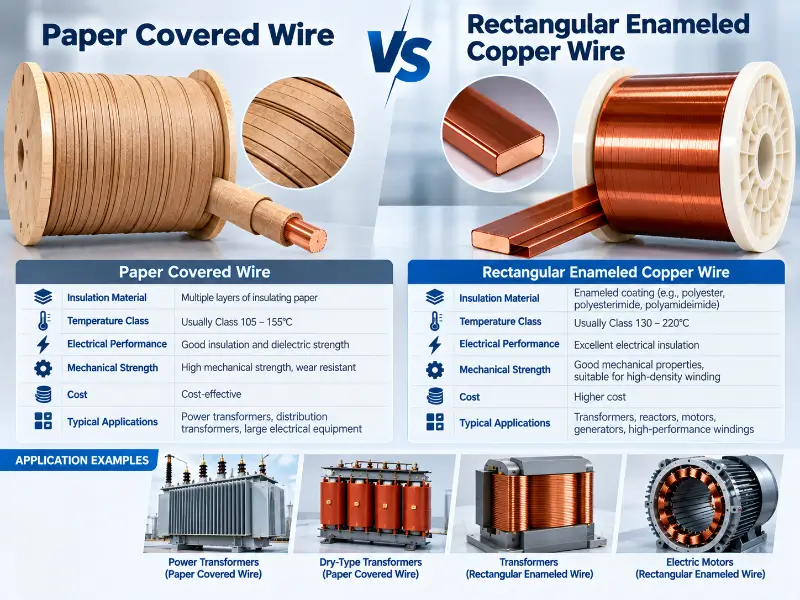
Summary
Paper-insulated wire and rectangular enameled copper wire represent two parallel technological paths. There is no absolute superiority or inferiority, only differences in applicable scenarios. Paper-insulated wire is the core material of oil-immersed transformers, with nearly a century of application history from the 1920s to the present. It boasts mature technology, high reliability, and controllable costs. Rectangular enameled copper wire emerged as a material after the 1980s and has become the preferred choice in the fields of new energy vehicle drive motors and dry-type transformers. Its advantages include high fill factor, high power density, and ease of automated production. From a selection perspective, engineers need to clarify four core parameters: application environment (oil-immersed or dry-type), power density (< 50 kW/L or > 50 kW/L), operating temperature (< 130°C or > 180°C), and standard system (IEC, NEMA, or GB/T). Once these four parameters are clarified, the choice between paper-insulated wire and rectangular enameled copper wire is essentially determined. Looking at industry development trends, new energy vehicles (drive motors) and wind power converters are the two fastest-growing markets for rectangular enameled copper wire. While the oil-immersed transformer market is stable, its growth is limited, mainly driven by replacement and upgrade demands. From a materials technology perspective, the evolution of paper-insulated wire is towards high-temperature materials such as Nomex paper and polyimide paper; the evolution of rectangular enameled copper wire is towards PIW (polyimide) coating and hairpin-type ultra-thin coating. From a procurement and supply chain perspective, paper-insulated wire suppliers are mainly concentrated in the transformer industry, while rectangular enameled copper wire suppliers are mainly concentrated in the new energy vehicle industry chain. LP Industry, a 30-year veteran in the field of electrical wire manufacturing, supplies both paper-insulated wire and rectangular enameled copper wire, covering four major standard systems: NEMA, IEC, GB/T, and JIS. Conductor widths range from 2-25mm, providing complete solutions for various applications. Finally, a practical point to emphasize: paper-insulated wire and rectangular enameled copper wire may be used interchangeably in certain projects—for example, rectangular enameled copper wire for the low-voltage winding of a dry-type transformer, while paper-insulated wire wound on an insulating cylinder is used for the high-voltage winding. Such mixed-use solutions require electrical insulation matching verification (breakdown voltage, creepage distance) and thermal matching verification (thermal resistance balance). This mixed use is common in rail traction transformers and wind power transformers, and is an effective engineering solution for achieving both power density and high-voltage insulation.