

Introduction
Paper Covered Wire vs. Fiber Glass Covered Wire is a core topic of comparative analysis between two mainstream insulated winding wires in the transformer manufacturing industry, specialty motor industry, and winding wire manufacturing industry. Paper Covered Wire and Fiber Glass Covered Wire (also referred to as Glass Fiber Covered Wire or Fiberglass Insulated Wire), as two important types of insulated winding wires, exhibit significant differences in insulation structure, material composition, performance characteristics, and application fields. A comprehensive understanding of the full-spectrum comparison—including differences in insulation mechanisms, performance, processing methods, and applications—holds substantial practical guidance value for procurement engineers at transformer manufacturers, motor engineers, electrical engineers, and winding wire selection engineers.
From the perspective of winding wire engineering practice, paper-covered wire and glass-fiber-covered wire represent two distinct technical approaches to insulation structures: “paper-oil composite insulation” and “glass-fiber-organic coating insulation,” respectively. Paper-covered wire employs multiple layers of insulating paper to form the insulation layer, relying on synergistic interaction with transformer oil to establish a paper-oil composite insulation system—characterized by high dielectric strength, moderate cost, and excellent long-term reliability—making it the classic insulation solution for oil-immersed power transformers. Glass-fiber-covered wire utilizes woven or helically wound glass fiber to form the insulation layer, supplemented by organic coatings (e.g., silicone resin, polyester resin, epoxy resin) for bonding and protection; it offers exceptional thermal endurance (Class 155 to Class 220) and high mechanical strength, rendering it the preferred insulation solution for dry-type transformers, high-temperature motors, and specialty electrical equipment.
The engineering implications of Paper-Covered Wire versus Fiber Glass-Covered Wire can be systematically elaborated across eight dimensions: fundamental concepts of the two winding wire types, comparison of insulation structures and materials, performance comparison, process comparison, cost comparison, application domain comparison, selection criteria, and typical application cases. This article provides a systematic engineering reference for procurement engineers, motor engineers, electrical engineers, and winding wire selection engineers at transformer manufacturers.
Fundamental Concepts
Understanding the fundamental concepts of paper-covered wire and glass-fiber-covered wire forms the basis for comparative analysis.
Basic Concepts of Paper-Insulated Magnet Wire
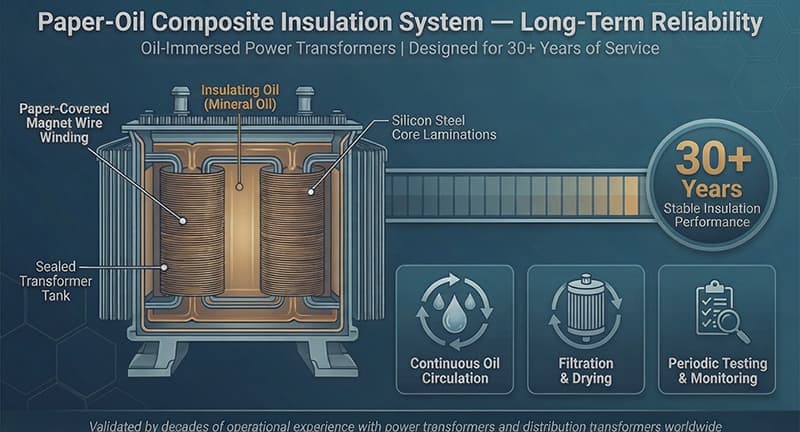
Paper-covered wire (paper-insulated wire) is a specialized winding wire consisting of a round or rectangular copper conductor wrapped helically with insulating paper (e.g., cable paper, telephone paper, or polyester film-paper composite materials). The insulation layer of paper-covered wire comprises multiple layers of paper, with the number of layers determined by the required insulation class. After transformer winding assembly, paper-covered wire is impregnated together with the transformer core and coil assembly in transformer oil; the porous structure of the paper absorbs the oil, forming a paper–oil composite insulation system.
Paper-covered magnet wire has a long history and is a classic insulating material widely used for power transformers, distribution transformers, and special-purpose transformers. The insulation structure of paper-covered magnet wire consists of a composite configuration formed by multiple layers of paper insulation, achieving high dielectric strength through the paper-oil composite dielectric medium. The core manufacturing process for paper-covered magnet wire is the helical wrapping of insulating paper; process control parameters—including paper layer tension, paper layer overlap ratio, winding speed, and paper layer arrangement—directly affect the finished product’s insulation performance and surface quality.
Basic Concepts of Glass-Fiber-Insulated Magnet Wire
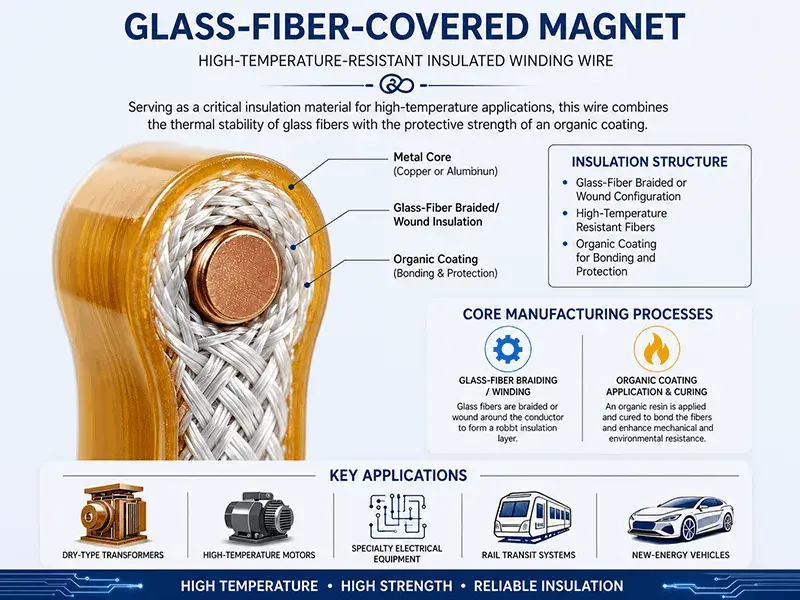
Glass fiber covered wire (also known as fiber glass covered wire, glass fiber insulated wire) is a specialized winding wire comprising a round or rectangular copper conductor, over which an insulating layer is applied by braiding or winding primarily E-glass fiber. The insulation system consists predominantly of glass fiber, supplemented by an organic coating—such as silicone resin, polyester resin, or epoxy resin—to bind the glass fibers and provide electrical insulation and mechanical protection.
Glass-fiber-covered magnet wire represents high-temperature-resistant insulated winding wire and serves as a critical insulation material for high-temperature applications, including dry-type transformers, high-temperature motors, specialty electrical equipment, rail transit systems, and new-energy vehicles. Its insulation structure consists of a glass-fiber braided or wound configuration, achieving high-temperature insulation performance through the inherent high-temperature resistance of glass fibers combined with the bonding and protective function of an organic coating. The core manufacturing processes for glass-fiber-covered magnet wire are the glass-fiber braiding/winding process and the organic coating application and curing process.
Summary of Conceptual Comparisons
Paper-covered wire and glass-fiber-covered wire represent two distinct insulation technology pathways at the fundamental conceptual level. Paper-covered wire embodies the “paper–oil composite insulation” approach, relying on synergistic operation with transformer oil to achieve high dielectric strength. Glass-fiber-covered wire embodies the “glass-fiber–organic coating” approach, leveraging the high-temperature resistance of glass fiber combined with protection from the organic coating to achieve high-temperature insulation performance. These two technology pathways are respectively tailored to different application scenarios and performance requirements.
Insulation Structure and Material Comparison
The insulating structure and materials constitute the core distinguishing dimension between paper-covered wire and glass-fiber-covered wire.
Insulation Structure Comparison
The insulation structure of paper-covered wire is a multi-layer composite structure consisting of “conductor + multiple layers of insulating paper.” The insulating paper is helically wound around the conductor surface, with multiple layers overlaid to form a continuous insulation layer. The number of paper layers is determined by the voltage class, ranging from 1–2 layers for low-voltage applications to more than 10 layers for extra-high-voltage applications. The insulation layer thickness of paper-covered wire typically ranges from 0.1 mm to several millimeters.
The insulation structure of glass-fiber-covered magnet wire consists of a composite construction comprising “conductor + braided glass fiber layer + organic coating.” The glass fibers are applied to the conductor surface via braiding or winding to form a continuous glass fiber insulation layer. An organic coating—such as silicone resin, polyester resin, or epoxy resin—is applied over the glass fiber layer to bond the fibers and provide electrical insulation and mechanical protection. The insulation thickness of glass-fiber-covered magnet wire typically ranges from 0.1 mm to 0.5 mm.
Conductor Material Comparison
The conductor materials for paper-covered and glass-filament-covered magnet wire are essentially identical, primarily comprising copper (e.g., electrolytic-tough-pitch copper ETP, oxygen-free copper OFC) or aluminum (e.g., electrical-grade pure aluminum 1350 alloy). Conductor cross-sectional shapes for both types of winding wire include round, rectangular (flat), and square configurations. Conductor material selection for either type is determined by transformer capacity, voltage class, and application requirements.
Insulation Material Comparison
The insulating material for paper-covered magnet wire is cellulose-based paper, primarily comprising cable paper (Kraft Paper), crepe paper, and polyester film–paper composite materials (e.g., DMD, NMN, NHN). Cable paper is manufactured from unbleached kraft pulp and exhibits excellent oil absorption, mechanical strength, and dielectric properties. Crepe paper is produced from bleached kraft pulp and features reduced thickness, making it suitable for interlayer insulation. Polyester film–paper composite materials combine the high dielectric strength of polyester film with the oil absorption capability of paper, rendering them the preferred insulation material for premium transformers.
The insulating material of glass-covered magnet wire is based on glass fiber, primarily using E-glass fiber. E-glass fiber exhibits excellent high-temperature resistance (long-term operating temperature exceeding 300 °C), mechanical strength, chemical stability, and electrical insulation properties. The diameter of the glass fibers typically ranges from several micrometers to tens of micrometers; the smaller the filament diameter, the denser the insulation layer.
Organic Coating Comparison
Glass-covered magnet wire requires an organic coating to bond the glass fibers and provide additional insulation protection. Common organic coatings include silicone resin, polyester resin, epoxy resin, and polyurethane resin. Different organic coatings impart distinct thermal endurance, mechanical, and chemical properties to glass-covered magnet wire.
Silicone resin coatings exhibit excellent thermal resistance (Class 180 to Class 220) and are the preferred coating for high-temperature-resistant glass-fiber-covered magnet wire. Polyester resin coatings offer moderate cost and good thermal resistance (Class 155 to Class 180), making them the commonly used coating for general-purpose glass-fiber-covered magnet wire. Epoxy resin coatings provide superior adhesion and good chemical resistance, rendering them suitable for glass-fiber-covered magnet wire intended for special-environment applications.
Performance Comparison
Performance is the core consideration dimension for selecting paper-covered and glass-fiber-covered magnet wire.
Temperature Resistance Comparison
The temperature resistance of paper-covered wire is limited by the synergistic operating temperature of the insulating paper material and transformer oil. The standard operating temperature for oil-immersed transformers is approximately 105°C (per IEC 60076 temperature rise limits for oil-immersed transformers). The paper–oil composite insulation system of paper-covered wire exhibits long-term stable dielectric strength and mechanical strength at the standard oil-immersion temperature. The temperature resistance of paper-covered wire has limited potential for improvement, making it difficult to meet the operating temperature requirements of dry-type transformers or high-temperature motors.
Glass-fiber-covered magnet wire exhibits significantly superior thermal endurance compared to paper-covered magnet wire. Glass fiber itself withstands temperatures exceeding 300°C, far surpassing the thermal capability of paper-based insulation materials. When combined with various organic coatings, glass-fiber-covered magnet wire achieves thermal classes of Class 155 (F), Class 180 (H), Class 200 (N), and Class 220 (R), satisfying the operating temperature requirements of dry-type transformers, high-temperature motors, and specialty electrical equipment. In high-temperature environments (150°C to 200°C), glass-fiber-covered magnet wire is the only viable insulated winding wire option.
Dielectric Strength Comparison
Paper-insulated wire (paper-oil composite insulation) exhibits significantly higher dielectric strength than glass-fiber-insulated wire. The dielectric strength of paper-oil composite insulation can reach several tens of kilovolts per millimeter—several times that of glass-fiber-insulated wire. Paper-insulated wire is suitable for winding insulation in high-voltage (HV), extra-high-voltage (EHV), and ultra-high-voltage (UHV) transformers. Oil-immersed power transformers rated at 110 kV, 220 kV, 500 kV, and 1000 kV widely employ paper-insulated wire for winding insulation.
The dielectric strength of glass-fiber-covered magnet wire is limited by the number of glass fiber layers, the thickness of the organic coating, and the dielectric properties of the organic coating, and is typically suitable for voltage classes below 35 kV. Glass-fiber-covered magnet wire is the preferred insulation form for dry-type transformers, low-voltage transformers, and high-temperature motors, but is not suitable for high-voltage or extra-high-voltage transformers.
Mechanical Property Comparison
Glass-fiber-covered magnet wire exhibits significantly superior mechanical strength compared to paper-covered magnet wire. Glass fiber itself possesses extremely high tensile strength, flexural strength, and abrasion resistance; combined with the bonding and protective function of the organic coating, glass-fiber-covered magnet wire achieves excellent overall mechanical integrity. It can withstand mechanical stresses induced during winding, coil insertion, and shaping processes, and can endure the substantial electromagnetic forces generated during transformer short-circuit conditions.
The mechanical strength of paper-covered wire is limited by the insulating paper. The tensile strength, flexural strength, and abrasion resistance of the insulating paper are relatively low; therefore, paper-covered wire must be handled with care during winding processing to avoid damage to the paper layer. In oil-immersed transformers, the windings are immersed in transformer oil, and the buoyant force exerted by the transformer oil reduces mechanical stress during short-circuit conditions; thus, the mechanical strength of paper-covered wire typically meets requirements for oil-immersed applications.
Long-term Reliability Comparison
Paper-covered magnet wire (paper–oil composite insulation system) exhibits excellent long-term reliability. Oil-immersed power transformers are typically designed for a service life exceeding 30 years, and the paper–oil composite insulation system maintains stable performance over extended operation. Continuous oil circulation, filtration, drying, and periodic testing ensure the long-term reliability of the insulation system. Extensive long-term operational experience with power transformers and distribution transformers fully validates the long-term reliability of the paper–oil composite insulation system.
The long-term reliability of glass-covered magnet wire is jointly influenced by the aging resistance of both the glass fiber and the organic coating. While the glass fiber exhibits excellent aging resistance, the organic coating has relatively limited aging resistance. Silicone resin coatings demonstrate superior thermal aging resistance (i.e., longer service life at elevated operating temperatures), whereas polyester resin coatings exhibit comparatively poorer thermal aging resistance. During prolonged high-temperature operation, aging and failure of the organic coating in glass-covered magnet wire must be closely monitored.
Environmental Performance Comparison
The environmental performance of paper-covered magnet wire (paper–oil composite insulation system) must consider the environmental performance of transformer oil. Conventional mineral-based transformer oils exhibit poor biodegradability and may cause environmental pollution in case of leakage. The application of environmentally friendly transformer oils—such as vegetable oils and synthetic ester oils—significantly enhances the environmental performance of the paper–oil composite insulation system. Insulating paper, derived from natural fibers, exhibits excellent environmental performance.
The environmental performance of glass-fiber-covered magnet wire must consider the environmental performance of the organic coating. Conventional organic coatings (e.g., silicone resins, polyester resins) may generate hazardous gases during high-temperature decomposition. The application of environmentally friendly organic coatings—such as water-based coatings and solvent-free coatings—significantly enhances the environmental performance of glass-fiber-covered magnet wire. Glass fiber itself is an inert inorganic material with excellent environmental performance.
Process Comparison
Process is a critical dimension in the manufacturing of paper-covered and glass-filament-covered magnet wire.
Manufacturing Process Comparison
The manufacturing process of paper-covered magnet wire centers on helical wrapping of insulating paper. The process sequence includes conductor drawing, conductor annealing, conductor surface cleaning, selection and pre-treatment of insulating paper, paper wrapping, in-process quality control, final inspection, and packaging. Key characteristics of the paper-covered magnet wire manufacturing process are its continuous nature, relatively low line speed, and numerous process control points.
The manufacturing process of glass-fiber-covered magnet wire centers on glass fiber braiding/winding and organic coating application and curing. The process flow includes conductor drawing, conductor annealing, glass fiber braiding/winding, organic coating application, organic coating curing, in-process quality control, final inspection, and packaging. Key characteristics of the glass-fiber-covered magnet wire manufacturing process include high process complexity, long organic coating curing time, and high equipment investment.
Process Flexibility Comparison
The manufacturing process for paper-covered magnet wire offers high flexibility. By adjusting parameters such as the number of paper insulation layers, paper layer width, and overlap ratio, production can be flexibly adapted to different product specifications. Specification changeovers are relatively flexible, and process adjustment time is short.
The manufacturing process for glass-fiber-covered magnet wire exhibits relatively low flexibility. Adjusting specifications on glass-fiber braiding/winding equipment and organic coating application equipment is complex; specification changes require replacing braiding dies and adjusting coating process parameters, resulting in extended process changeover times.
Process Quality Control Comparison
Quality control points in paper-covered wire manufacturing include conductor quality, insulating paper quality, paper layer winding quality, tension control, overlap ratio control, and moisture content control. Quality control is primarily achieved through in-process inspection and final inspection.
Quality control points in the manufacturing process of glass-covered magnet wire include conductor quality, glass fiber quality, braiding/winding quality, organic coating quality, coating curing quality, and coating thickness control. Quality control primarily relies on in-process inspection and final inspection; due to the unique nature of the organic coating curing process, the technical difficulty of quality control is relatively high.
Cost Comparison
Cost is a critical factor in the selection between paper-covered and glass-fiber-covered magnet wire.
Direct Cost Comparison
The raw material cost of paper-covered wire comprises the copper conductor cost and the insulating paper cost. The insulating paper cost is relatively low, as it is a bulk industrial material. The processing cost of paper-covered wire primarily involves the cost of paper-layer winding, a relatively simple process with low per-unit-length processing cost. Consequently, the overall direct cost of paper-covered wire is moderate.
The raw material cost of glass-covered magnet wire comprises the copper conductor cost, glass fiber cost, and organic coating cost. The glass fiber cost is higher than that of insulating paper. The organic coating—particularly high-temperature-resistant organic coatings—is costly. The processing cost of glass-covered magnet wire primarily involves glass fiber braiding/wrapping and organic coating curing processes, which are complex and result in a relatively high per-unit-length processing cost. Consequently, the overall direct cost of glass-covered magnet wire is typically higher than that of paper-covered magnet wire.
Comprehensive Cost Comparison
A comprehensive cost comparison between paper-covered wire and glass-fiber-covered wire must consider the overall cost structure of the transformer. In oil-immersed transformers (using paper-covered wire), transformer oil, transformer tank, and insulating oil circulation systems account for a relatively large proportion of the total cost. In dry-type transformers (using glass-fiber-covered wire), winding cost accounts for a relatively large proportion of the total cost. Cost comparison between these two types of transformers must be conducted based on specific transformer specifications, application requirements, and prevailing market pricing conditions.
The total cost of paper-insulated winding oil-immersed transformers is typically lower than that of glass-fiber-insulated dry-type transformers, especially at high voltage levels and large capacities. The total cost advantage of glass-fiber-insulated dry-type transformers primarily lies in added value such as maintenance-free operation, flame retardancy, environmental friendliness, and ease of installation.
Application Field Comparison
The application field is the ultimate manifestation of the differences between paper-covered and glass-fiber-covered magnet wire.
Primary Application Areas of Paper-Insulated Magnet Wire
Paper-covered magnet wire is primarily used in oil-immersed power transformers, distribution transformers, furnace transformers, rectifier transformers, traction transformers, new-energy step-up transformers, and test transformers. Oil-immersed transformers feature long design service life (over 30 years) and demand high insulation reliability; the paper–oil composite insulation system represents a classic solution. Paper-covered magnet wire is widely adopted as winding insulation in high-voltage, extra-high-voltage, and ultra-high-voltage oil-immersed power transformers rated at 110 kV, 220 kV, 500 kV, and 1000 kV.
Primary Application Areas of Glass-Filament-Enamel Wire
Glass-fiber-covered magnet wire is primarily used in dry-type transformers, high-temperature motors, special-purpose electrical equipment, rail transit systems, traction motors for new-energy vehicles, wind turbine generators, and traction motors. Dry-type transformers feature a long design service life (over 20 years) and demand high insulation reliability; the glass-fiber–organic coating insulation system represents a classic solution. Dry-type transformers offer irreplaceable advantages in applications such as high-rise buildings, underground spaces, and flammable/explosive environments.
Application Boundary Analysis
The application boundaries between paper-covered wire and glass-fiber-covered wire are primarily determined by voltage class, operating temperature, environmental requirements, reliability requirements, and cost constraints. Voltage class is the primary boundary: paper-covered wire (for oil-immersed transformers) dominates high-voltage applications above 35 kV, while both types of winding wire are used in low-voltage applications below 35 kV. Operating temperature is a critical boundary: glass-fiber-covered wire (for dry-type transformers and high-temperature motors) dominates high-temperature applications exceeding 130 °C. Environmental requirements constitute a significant boundary: hazardous (flammable/explosive) locations, densely populated areas, and noise-sensitive environments prefer dry-type transformers (glass-fiber-covered wire).
Selection Criteria
Selection of paper-covered wire versus glass-fiber-covered wire requires comprehensive consideration of multidimensional factors.
Core Dimensions for Selection Decision
Core selection criteria include voltage rating, capacity, operating temperature, environmental requirements, reliability requirements, service life requirements, cost constraints, installation space, and maintenance accessibility. The weighting of each criterion varies across different application scenarios, requiring comprehensive evaluation based on the specific application.
Voltage class dimension: Paper-covered wire is preferred for applications above 35 kV (e.g., oil-immersed transformers); for applications below 35 kV, selection is determined through comprehensive evaluation based on other dimensions.
Operating temperature considerations: For applications with long-term operating temperatures exceeding 130°C, glass-fiber-covered magnet wire must be selected. For applications with long-term operating temperatures around 105°C, paper-covered magnet wire (for oil-immersed transformers) is preferred. For applications with long-term operating temperatures around 130°C, either glass-fiber-covered magnet wire with a matching thermal class or oil-immersed transformers may be selected.
Environmental requirements dimension: Dry-type transformers (glass-fiber-covered magnet wire) are preferred for flammable and explosive locations, densely populated areas, noise-sensitive locations, and underground spaces. Oil-immersed transformers (paper-covered magnet wire) are preferred for outdoor large-scale power stations and conventional industrial parks.
Reliability Requirements Dimension: For ultra-high-reliability applications—such as nuclear power, rail transit, and critical infrastructure—paper-insulated magnet wire may be selected for oil-immersed transformers, while glass-fiber-insulated magnet wire may be selected for dry-type transformers, depending on the specific application. For standard-reliability applications, selection shall be based on a comprehensive evaluation of cost, maintenance convenience, and other factors.
Common Misconceptions in Selection Decision-Making
Common misconceptions in selection decisions include choosing solely based on initial cost, overlooking long-term reliability differences, ignoring installation space constraints, and neglecting variations in maintenance costs. The initial cost of paper-wrapped magnet wire oil-immersed transformers is typically lower than that of glass-fiber-wrapped magnet wire dry-type transformers; however, a comprehensive evaluation must account for total cost factors including long-term maintenance cost, footprint, and fire protection cost. Although the initial cost of glass-fiber-wrapped magnet wire dry-type transformers is higher, they offer advantages such as maintenance-free operation, flame retardancy, and ease of installation, resulting in a lower total cost of ownership in specific applications.
Typical Application Cases
Typical application cases help clarify the practical application differences between paper-covered and glass-fiber-covered magnet wire.
Oil-Immersed Power Transformer Case
A 220 kV oil-immersed power transformer with a capacity of 240 MVA employs paper-wrapped conductors (multi-layer cable paper wrapping) for winding insulation. The paper–oil composite insulation system of the paper-wrapped conductors meets the dielectric strength requirements for the 220 kV voltage class. The transformer utilizes mineral oil circulation cooling, with a long-term operating temperature of approximately 105 °C. The transformer’s design service life exceeds 30 years; thus, the long-term reliability of the paper–oil composite insulation system is critical to ensuring stable, long-term operation of the transformer.
Dry-Type Transformer Case Study
A 10 kV dry-type transformer with a capacity of 2500 kVA employs glass-fiber-covered magnet wire (glass fiber + silicone resin coating) for winding insulation. The glass-fiber-covered magnet wire has a temperature rating of Class 180 (Class H), satisfying the operating temperature requirements of dry-type transformers. Dry-type transformers are suitable for indoor installation (e.g., high-rise buildings, underground spaces, metro stations) and offer advantages such as flame retardancy, maintenance-free operation, and low noise.
High-Temperature Motor Case Study
A new-energy vehicle traction motor, whose winding insulation employs high-temperature-resistant glass-fiber-covered magnet wire (glass fiber + polyamide-imide coating). The motor operates at elevated temperatures (150°C to 180°C), exceeding the temperature rating of conventional enameled wire; thus, glass-fiber-covered magnet wire is the preferred insulation solution for high-temperature motors.
Traction Transformer Case Study
A certain rail transit traction transformer employs either paper-covered magnet wire (oil-immersed type) or glass-fiber-covered magnet wire (dry-type) for winding insulation. Oil-immersed traction transformers offer high insulation reliability and strong short-circuit resistance, representing the mainstream solution for early traction transformers. Dry-type traction transformers feature maintenance-free operation, flame retardancy, and ease of installation, constituting the development trend for next-generation traction transformers.
Conclusion
Engineering implications of Paper-Covered Wire vs. Fiber Glass-Covered Wire encompass eight core engineering dimensions: fundamental concepts (paper-covered wire / fiber glass-covered wire / conceptual comparison), insulation structure and materials comparison (insulation structure / conductor material / insulation material / organic coating), performance comparison (temperature resistance / dielectric strength / mechanical properties / long-term reliability / environmental performance), process comparison (manufacturing process / process flexibility / process quality control), cost comparison (direct cost / total cost), application domain comparison (applications of paper-covered wire / applications of fiber glass-covered wire / application boundaries), selection decision criteria (core dimensions / common misconceptions), and typical application cases (oil-immersed power transformers / dry-type transformers / high-temperature motors / traction transformers).
Paper-covered wire and glass-fiber-covered wire represent two distinct insulation technology pathways—“paper-oil composite insulation” and “glass fiber-organic coating insulation,” respectively—exhibiting significant differences in insulation structure, performance characteristics, and application fields. Paper-covered wire offers advantages in dielectric strength, long-term reliability, and overall cost, making it the preferred insulation system for high-voltage and extra-high-voltage oil-immersed power transformers. Glass-fiber-covered wire provides superior thermal resistance, mechanical strength, and flame retardancy, rendering it the preferred insulation system for dry-type transformers, high-temperature motors, and specialty electrical equipment.
Selection between paper-covered wire and glass-fiber-covered wire requires comprehensive consideration of multiple factors, including voltage class, operating temperature, environmental requirements, reliability requirements, service life requirements, and cost constraints. Both types of winding wire offer irreplaceable value in different application scenarios, and technical selection must be based on a holistic evaluation of the specific requirements of the intended application.