

Introduction
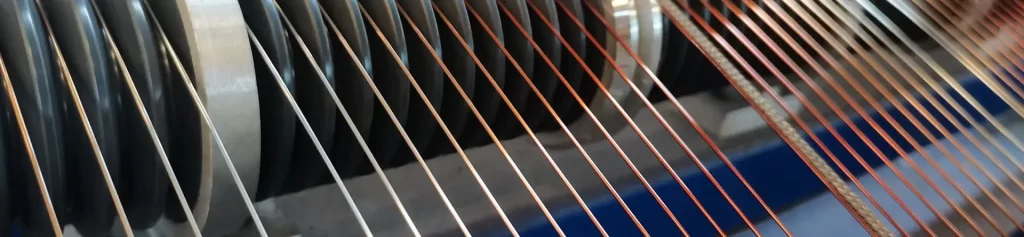
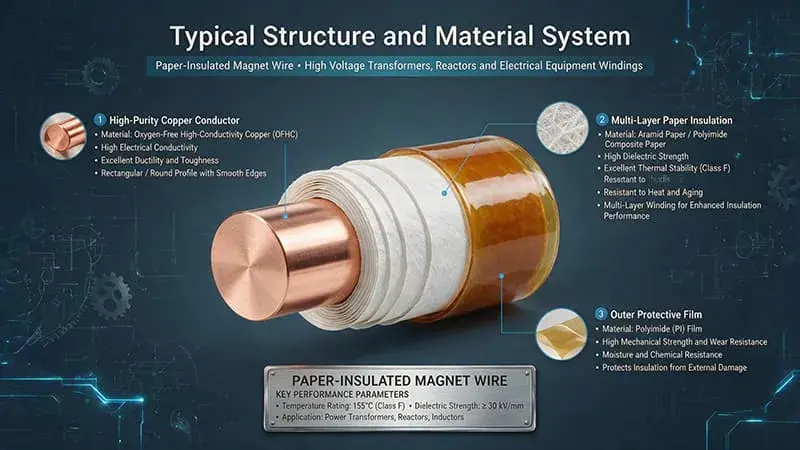
Paper covered wire holds a rather special place in the family of electromagnetic wire insulation structures. Unlike enameled wire that relies on a thin film of insulation, paper covered wire uses insulating paper spirally wound around the conductor and then undergoes an impregnation treatment. In oil-immersed transformers, it is undoubtedly the mainstay-almost indispensable for 110 kV to 500 kV high-voltage windings.
But this is also where the problem lies. The insulation strength of paper covered wire is affected by too many factors: the dielectric properties of the insulating paper itself, the number of winding layers, the compatibility of impregnating resin, the moisture content of the oil-paper system, temperature, electric field distribution, partial discharge… If any link has issues, a transformer may fail after a few years of operation.
This article intends to make this matter clear-from basic theory to breakdown mechanisms, from material systems to testing methods, from engineering applications to selection decisions. We will use standards such as IEC 60851-5, IEC 60243, ASTM D149, and GB/T 4074, while also incorporating nearly 30 years of practical experience in electromagnetic wire manufacturing and application.
Insulation Strength Basic Theory
The core indicators of insulation strength are breakdown voltage and dielectric strength. The former is the critical voltage at which insulation fails, and the latter is the quotient of breakdown voltage divided by insulation thickness, expressed in kV/mm or V/mil.
Electric field strength and insulation thickness jointly determine breakdown risk. Under AC electric fields, insulating materials bear alternating stress, and polarization losses within the material convert into heat, which may trigger thermal breakdown. Under DC electric fields, the main factors are conduction losses and space charge effects.
Another key parameter is dielectric constant (ε_r) and dielectric loss tangent (tan δ). The former reflects the polarization capacity of the material, and the latter reflects energy loss. Oil-immersed transformers are extremely sensitive to tan δ-0.005 is a threshold value, exceeding which means accelerated insulation aging.
Key Definitions and Units
Breakdown voltage is usually expressed in kV rms (AC effective value), with test conditions including 50/60 Hz power frequency voltage and voltage increase rates of 20-500 V/s. Dielectric strength (kV/mm) = breakdown voltage / insulation thickness.
Insulation Behavior Differences Under AC and DC Electric Fields
Under AC electric fields, insulation bears polarization reversal stress, and tan δ determines heating power; under DC electric fields, the main factors are conduction and space charge accumulation, and insulation resistance (IR) becomes the primary parameter.
Correspondence Between Insulation Strength and Temperature Class
IEC 60085 specifies Class A (105°C), Class B (130°C), Class F (155°C), Class H (180°C), and other thermal endurance classes. Insulation strength is closely related to temperature-for every 10°C increase in temperature, the breakdown voltage of most organic insulation materials decreases by approximately 5-8%.
Breakdown Mechanisms
Insulation failure is not caused by a single reason, and the time scales of different failure modes differ dramatically. From nanosecond-level electrical breakdown, to minute-level thermal breakdown, to year-level electrochemical breakdown and mechanical breakdown, each mechanism requires different test methods to capture.
Electrical Breakdown
When electric field strength exceeds the intrinsic breakdown field strength of the material, conduction band electron avalanche breakdown occurs-the time scale is nanoseconds to microseconds. The intrinsic breakdown field strength of Kraft Paper is approximately 8-10 kV/mm, Nomex® 410 is approximately 18-30 kV/mm, and mica paper can reach 20-25 kV/mm.
Thermal Breakdown
When the heat generated by dielectric loss (tan δ) and conduction loss exceeds the heat dissipation capacity, insulation temperature continues to rise until failure-the time scale is minutes to hours. Oil-immersed transformers need to be especially vigilant against thermal breakdown in high electric field density areas.
Electrochemical Breakdown
Partial Discharge (PD) continuously erodes insulation materials, producing ozone, nitrogen oxides, and other corrosive products-the time scale is months to years. This is the most common cause of long-term failure of oil-paper insulation.
Mechanical Breakdown
Insulation paper winding unevenness, conductor burrs, vibration fatigue, thermal stress deformation, and other factors lead to local insulation thinning or damage, ultimately being broken down by the electric field. This is particularly common in high-vibration scenarios such as traction motors and mining transformers.
Material Dielectric Properties
Material is the foundation of insulation strength. Insulating papers commonly used in paper covered wire include Kraft Paper, Nomex® 410/414, mica paper, and Crepe Paper, each of which exhibits different performance under different voltage levels and temperature environments.
4 Types of Insulating Paper Dielectric Properties Comparison
| Insulating Paper Type | Chemical Composition | Thickness Range (mm) | Dielectric Constant ε_r | Dielectric Loss tan δ | Dielectric Strength (kV/mm) | Maximum Temperature (°C) | Typical Applications |
|---|---|---|---|---|---|---|---|
| Kraft Paper | Cellulose | 0.05-0.25 | 2.0-2.5 | 0.005-0.015 | 8-10 | 105 | Oil-immersed transformer main insulation |
| Crepe Paper | Cellulose (stretched and wrinkled) | 0.10-0.50 | 1.8-2.2 | 0.008-0.020 | 6-8 | 105 | Transformer lead insulation |
| Nomex® 410 (meta-aramid) | Meta-aramid | 0.05-0.76 | 2.5-3.0 | 0.006 | 18-30 | 220 | Dry-type transformer, Class H motor |
| Mica Paper | Mica + binder | 0.10-0.50 | 5-7 | 0.001-0.005 | 20-25 | 240+ | High-voltage motor, fire-resistant cable |
Influence of Impregnating Resin on Dielectric Properties
The role of impregnating resin is to fill the interlayer gaps of insulating paper and improve overall dielectric strength. Commonly used resins include transformer oil (mineral oil), epoxy resin, polyester resin, and silicone resin. The breakdown voltage of the paper-resin composite system after impregnation is typically 30-50% higher than that of dry paper.
Influence of Conductor Surface State on Insulation
Conductor surface roughness (Ra) affects the adhesion of enamel coating and insulating paper. C11000 copper conductor Ra typically requires ≤1.6 μm, and aluminum conductor Ra ≤3.2 μm. Surface oxide layers (Cu₂O/Al₂O₃) reduce insulation adhesion and must be removed by micro-etching or cleaning.
Breakdown Voltage Testing Methods
IEC 60851-5:2008 Test 13 specifies three breakdown voltage testing methods, selected based on conductor diameter: metal cylinder method for ≤0.1 mm, twisted pair method for 0.1-2.5 mm, and U-bend metal shot bath method for >2.5 mm.
Method 1: Metal Cylinder Method
Applicable to fine wires with conductor diameter ≤0.1 mm. The specimen is wound once around a polished metal cylinder of 25 mm diameter, with load applied according to IEC 60851-1 Table 2.1 (0.013-0.4 N depending on diameter), and voltage increased to breakdown. Voltage increase rate is 20 V/s, and results are the average of 5 measurements.
Method 2: Twisted Pair Method
Applicable to conductor diameters 0.1-2.5 mm. The specimen is bent into a U-shape, with both ends twisted in opposite directions over approximately 125 mm length, with a specified number of twists (IEC 60851-1 Table 3). Voltage is applied between the two conductors. Because of dual insulation, the test voltage is typically twice that of other methods.
Method 3: U-Bend Metal Shot Bath Method
Applicable to thick wires with conductor diameter >2.5 mm. The specimen is bent into a U-shape and placed in a plastic bucket filled with metal shot (steel, nickel, or nickel-plated iron), with shot covering to 90 mm above the bottom of the U-bend. Voltage is applied between the conductor and the metal shot.
Comparison of Three Methods for Application Scenarios
| Testing Method | Applicable Diameter | Specimen Preparation Complexity | Test Voltage Range | Main Applications |
|---|---|---|---|---|
| Metal Cylinder Method | ≤0.1 mm | Low | 100 V – 5 kV | Instrument coils, electronic transformers |
| Twisted Pair Method | 0.1-2.5 mm | Medium | 500 V – 30 kV | Small and medium motors, standard transformers |
| U-Bend Method | >2.5 mm | High | 1 kV – 100 kV | Large transformers, high-voltage motors |
tan δ and Dielectric Loss
Dielectric loss tangent (tan δ) is a key parameter for measuring the energy loss of insulating materials under AC electric fields. Oil-immersed transformers are extremely sensitive to tan δ-typically requiring tan δ ≤0.005 at 20°C and ≤0.025 at 90°C.
tan δ Testing Method (IEC 60851-5 Test 19)
IEC 60851-5 Test 19 specifies the testing method for dielectric dissipation factor. Specimens may use metal bath electrodes or conductive suspension electrodes. Test frequency is 50/60 Hz, and voltage does not exceed 1/3 of breakdown voltage. tan δ is measured by a Schering bridge or automatic dielectric loss tester.
Relationship Between tan δ and Insulation State
The tan δ of dry insulating paper is mainly determined by polarization loss and is less affected by temperature. When moisture content increases, tan δ rises significantly-this is a key indicator for oil-immersed transformers to judge moisture intrusion. When insulation ages, polar degradation products (such as furfural) also cause tan δ to rise.
Influence of Temperature on tan δ
| Temperature (°C) | Kraft Paper Dry State tan δ | Kraft Paper with 2% Moisture tan δ | Oil-Impregnated Kraft Paper tan δ |
|---|---|---|---|
| 20 | 0.008 | 0.015 | 0.003 |
| 60 | 0.010 | 0.025 | 0.005 |
| 90 | 0.013 | 0.040 | 0.008 |
| 120 | 0.018 | 0.060 | 0.015 |
Partial Discharge (PD)
Partial Discharge (PD) is a microscopic discharge phenomenon resulting from local electric field concentration within the insulation. Although the energy of a single PD is very small, long-term accumulation gradually erodes insulation and is the main cause of long-term failure of oil-paper insulation.
PDIV and PDEV
PDIV is the voltage at which detectable PD (≥5 pC) begins to appear, and PDEV is the voltage at which PD extinguishes. For oil-immersed transformers, PDIV typically requires ≥1.5 times the working voltage. IEC 60851-5 and IEC 60270 specify PD testing methods.
Correspondence Between PD Types and Insulation Defects
| PD Type | Typical Location | Discharge Characteristics | Insulation Defects |
|---|---|---|---|
| Internal Discharge | Air gaps between insulating paper layers | Bipolar pulses, symmetrical | Poor impregnation, containing air gaps |
| Surface Discharge | Insulation surface | Unipolar pulses, asymmetrical | Surface contamination, moisture intrusion |
| Corona Discharge | Conductor tip | Continuous pulses | Burrs, insufficient conductor corner radius |
| Creep Discharge | Electric field concentration area on insulation surface | Intermittent large pulses | Insufficient creepage distance |
High-Voltage Motor PDIV Testing Standards
IEC 60034-18-41 specifies PD testing methods for variable frequency drive motors. It requires that PDIV not be lower than 1.5 times the peak phase voltage during 1,000 hours of PD testing. The Pw IPM™ testing system is the industry standard method.
Influencing Factors
Insulation strength is affected by multiple factors-temperature, humidity, frequency, thickness, pressure, aging, etc. In engineering design, it is necessary to comprehensively consider the superimposed effects of these factors.
Influence of Temperature
When temperature increases, the breakdown voltage of insulation materials decreases. The Arrhenius model describes the relationship between lifetime and temperature: log₁₀ L = A + B/T. For Kraft Paper, for every 10°C increase, the breakdown voltage decreases by approximately 5-8%.
Influence of Humidity
Moisture content has a great influence on oil-immersed insulation. The moisture content of dry insulating paper is <0.5%, which can rise to 2-5% when damp. For every 1% increase in moisture content, the breakdown voltage decreases by 10-15%. The moisture content of transformer oil must be controlled below 30 ppm.
Influence of Frequency
Insulating materials bear higher dielectric stress at high frequencies. The breakdown voltage at 100 Hz is approximately 5-10% lower than that at 50 Hz. The square wave voltage of variable frequency drive (VFD) motors contains a large amount of high-frequency harmonics, and dv/dt can reach 1-5 kV/μs, which has a greater impact on insulation.
Influence of Thickness
The relationship between insulation thickness and breakdown voltage is not linear. In the thin insulation range (<0.1 mm), increasing thickness improves significantly; over 0.5 mm, the marginal benefit decreases. Multi-layer insulation (each layer 0.05-0.1 mm) has a 20-30% higher breakdown voltage than single-layer (0.5 mm) because the interlayer air gaps are dispersed.
Influence of Pressure
Insulation paper winding tension affects interlayer pressure. Insufficient tension → interlayer air gaps → increased PD; excessive tension → paper fiber damage → decreased breakdown voltage. Optimal tension is typically 5-15 N/cm (depending on paper thickness).
Aging and Lifetime Prediction
The Arrhenius model is the standard method for thermal lifetime prediction: log₁₀ L = A + B/T. IEC 60172 and IEEE Std 1 specify the test methods, extrapolating 20,000 h lifetime through accelerated aging data from 9 temperature points. The typical lifetime of Class A (105°C) paper covered wire is 20-30 years.
Engineering Applications
The insulation strength requirements for paper covered wire vary dramatically across different application scenarios. Oil-immersed transformers require the highest (breakdown voltage can reach tens of kV), dry-type transformers are moderate, and household appliance motors are relatively lower.
Oil-Immersed Transformer (110 kV – 500 kV)
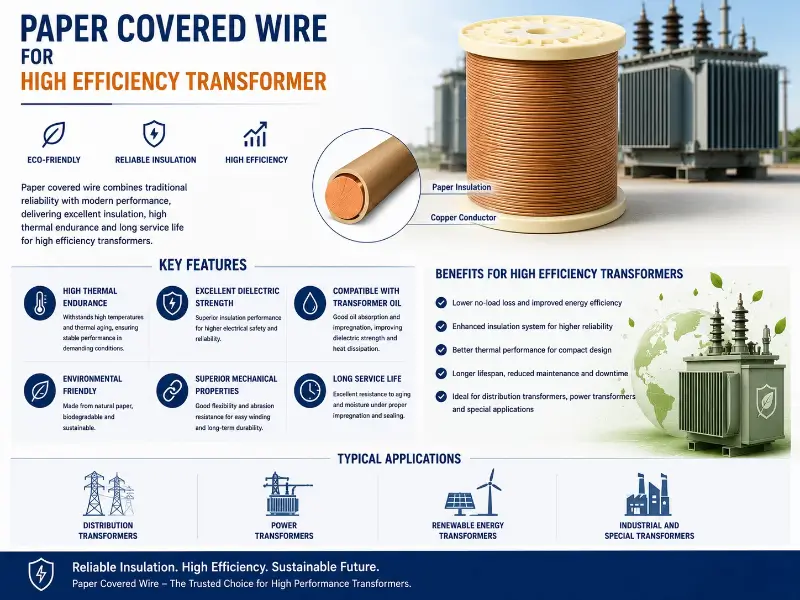
The oil-paper insulation system is the core of high-voltage transformers. The main insulation thickness of 110 kV transformers is approximately 6-8 mm (multi-layer Kraft Paper), and 500 kV transformers can reach 20-30 mm. Breakdown voltage requirement ≥40 kV. tan δ ≤0.005 at 20°C / ≤0.025 at 90°C.
Dry-Type Transformer and Class H Motor
Dry-type transformers use Nomex® 410 or Nomex® 414 insulating paper, without oil immersion. Class H (180°C) temperature resistance, with breakdown voltage requirement ≥15 kV. Class H motors are equally applicable, and the insulation strength is significantly improved after VPI (Vacuum Pressure Impregnation) treatment.
High-Voltage Motor (6 kV – 13.8 kV)
High-voltage motor stator windings use mica paper + glass fiber reinforced composite insulation. PDIV ≥3.0 times rated voltage. The VPI or VPR (Vacuum Pressure Resin) process specified by IEC 60034-18-41 is the standard method.
Traction Motor and Rail Transit
Traction motors bear high vibration, high temperature, and frequent start-stop. Insulation uses mica paper + glass fiber + epoxy resin composite. Pass IEC 60068-2-52 salt spray test for 96 h, and EN 45545-2 HL3 fire protection level requirement.
Wind Power and Offshore Applications
Wind farms (especially offshore wind power) transformers and generators face salt spray, humidity, and temperature cycling. Insulation systems need to pass IEC 60068-2-60 mixed gas flow test, with Kraft Paper + mineral oil system + desiccant being the classic solution.
Household and Consumer Electronics
Household appliance motors (air conditioners, refrigerators, washing machines) use low-cost solutions-Kraft Paper + polyester resin or epoxy resin. Breakdown voltage requirement ≥3 kV, insulation thickness 0.1-0.3 mm.
Standards System
The standards system for insulation strength testing covers international standards (IEC), American standards (ASTM, NEMA), Chinese standards (GB), Japanese standards (JIS), and special industry standards (IEEE, UL).
Core Standards Comparison
| Standard Number | Standard Name | Test Content | Applicable Scope |
|---|---|---|---|
| IEC 60851-1~6 | Winding wire test methods | Electrical/mechanical/chemical/thermal properties | All electromagnetic wires |
| IEC 60243 | Insulating material electrical strength | Breakdown voltage testing method | General insulation materials |
| IEC 60270 | Partial discharge measurement | PD testing method | High-voltage insulation |
| IEC 60034-18-41 | Rotating machine insulation | VFD motor PD testing | Variable frequency drive motors |
| IEC 60172 | Electrical insulation thermal endurance | Arrhenius extrapolation | Thermal endurance evaluation |
| ASTM D149 | Dielectric breakdown voltage | Dielectric strength testing | General insulation materials |
| ASTM D2307 | Enameled wire thermal endurance | Thermal aging testing | Enameled wire |
| GB/T 4074 | Winding wire test methods | Chinese equivalent to IEC 60851 | Chinese market |
| NEMA MW 1000 | Magnet wire standard | American standard winding wire | North American market |
| IEEE Std 1 | Motor insulation thermal endurance | General thermal evaluation standard | North American motors |
| UL 1446 | Insulation system certification | EIS system certification | North American insulation systems |
Differences Between Different Standards Systems
The IEC system focuses on electrical performance (PDIV, tan δ, breakdown voltage), the ASTM system focuses on material performance (tensile, tearing, thermal aging), and the NEMA system focuses on product specifications (diameter, enamel thickness). China’s GB/T 4074 equivalently adopts IEC 60851, but adds tan δ limits that suit China’s power grid characteristics.
Third-Party Certification Bodies
International authoritative certification bodies include UL (USA), CSA (Canada), VDE (Germany), TÜV (Germany/Europe), SGS (Switzerland), Intertek (USA/UK), and CTI (China). Chinese domestic certifications include the China Electric Power Research Institute and Shanghai Cable Research Institute. UL 1446 EIS certification is mandatory for the North American market.
Testing Verification Process
A complete insulation strength verification process should cover five stages: raw materials inspection, semi-finished product inspection, finished product inspection, factory sampling inspection, and third-party testing. Each stage has different testing priorities and accepted judge standards.
Raw Materials Inspection
Insulating paper incoming inspection items: thickness (GB/T 451.3), tensile strength (GB/T 12914), tearing resistance (GB/T 455), dielectric strength (GB/T 1408.1), moisture content (GB/T 462), ash content (GB/T 742). Kraft Paper dielectric strength requirement ≥8 kV/mm, moisture content ≤8%.
Semi-Finished Product Inspection
After winding completion and before impregnation, inspection items: layer count confirmation (visual + counter), overlap width (≥2 mm), tension uniformity, paper surface integrity (no damage, no contamination). Conductor corner radius ≤0.5 mm to avoid tip discharge.
Finished Product Inspection
After impregnation and curing, inspection items: breakdown voltage (IEC 60851-5 Test 13), insulation resistance (IEC 60851-5 Test 5), tan δ (IEC 60851-5 Test 19), PDIV (IEC 60270), withstand voltage test (1.5 times working voltage for 1 min). Sampling per ISO 2859-1 AQL 1.0 Level II.
Factory Sampling Inspection
Each batch of products is sampled per AQL 1.0 Level II (sample size determined by batch size), inspection items: appearance (visual), dimensions (micrometer), breakdown voltage (per specification), DC resistance (20°C). Acceptance criteria: critical defect AQL=0, major defect AQL=1.0, minor defect AQL=2.5.
Third-Party Testing
New products, special applications, and export certifications need to be sent to third-party testing. UL 1446 EIS certification process takes 3-6 months, including material testing, system testing, thermal aging, and final review. CE certification per EN 60317 series. CCC certification per GB/T 4074.
Selection Decision Framework
The insulation strength selection of paper covered wire needs to comprehensively consider five dimensions: voltage level, temperature class, application scenario, compliance requirements, and cost constraints. Below is a systematic 5-step decision framework.
5-Step Selection Decision Framework
| Step | Evaluation Dimension | Key Parameters | Decision Output |
|---|---|---|---|
| Step 1 | Voltage Level | ≤1 kV / 1-10 kV / 10-40 kV / ≥40 kV | Insulation thickness, layer count, material |
| Step 2 | Temperature Class | Class A (105°C) / B (130°C) / F (155°C) / H (180°C) / N (200°C) / R (220°C) / 240°C | Insulating paper type, impregnating resin |
| Step 3 | Application Scenario | Oil-immersed / Dry-type / High-voltage motor / Traction / Wind power / Household appliance | Insulation structure, composite solution |
| Step 4 | Compliance Requirements | IEC / ASTM / GB / NEMA / UL 1446 / Specific industry | Certification, testing standards |
| Step 5 | Cost Constraint | Economy type / Balanced type / High-performance type | Material grade, process simplification |
Insulation Strength Recommendations for Different Application Scenarios
| Application Scenario | Recommended Insulation Structure | Breakdown Voltage Requirement | Key Testing |
|---|---|---|---|
| Oil-immersed transformer 110 kV | Kraft Paper multi-layer + mineral oil | ≥40 kV | Breakdown voltage, tan δ, PDIV |
| Oil-immersed transformer 500 kV | Kraft Paper + Crepe Paper + mineral oil | ≥80 kV | Breakdown voltage, tan δ, PDIV, lightning impulse |
| Dry-type transformer 10 kV | Nomex® 410 single or multi-layer | ≥15 kV | Breakdown voltage, thermal shock |
| Dry-type transformer 35 kV | Nomex® 410 multi-layer | ≥30 kV | Breakdown voltage, thermal shock, PD |
| High-voltage motor 6 kV | Mica paper + glass fiber + VPI | ≥15 kV | Breakdown voltage, PDIV, thermal endurance |
| High-voltage motor 13.8 kV | Mica paper + glass fiber + VPI | ≥30 kV | Breakdown voltage, PDIV, VFD testing |
| Traction motor | Mica paper + glass fiber + epoxy | ≥10 kV | Breakdown, vibration, EN 45545-2 HL3 |
| Household appliance motor | Kraft Paper + polyester resin | ≥3 kV | Breakdown voltage, adhesion |
Common Selection Mistakes and Avoidance Methods
Mistake 1: Only looking at breakdown voltage without considering thickness – the same 10 kV breakdown voltage, 0.5 mm single-layer and 5×0.1 mm multi-layer structures are completely different. Avoidance method: Specify dielectric strength (kV/mm) rather than only looking at absolute breakdown voltage.
Mistake 2: Ignoring the change of tan δ under temperature – insulation with 20°C tan δ ≤0.005 may rise to above 0.025 at 90°C. Avoidance method: Require suppliers to provide tan δ data at 20°C/90°C points.
Mistake 3: For oil-paper insulation only looking at paper but not oil – oil quality (moisture content, tan δ, breakdown voltage) is equally critical. Avoidance method: Separately test transformer oil, breakdown voltage ≥30 kV/2.5 mm, moisture content ≤30 ppm.
Mistake 4: PDIV testing only looking at average value but not minimum value – PDIV should be based on the minimum of 5 measurements, and a single low PDIV indicates early failure. Avoidance method: Require all 5 PDIV data to be ≥1.5× working voltage.
Conclusion
Paper covered wire insulation strength is a systematic project – from material selection, breakdown mechanism understanding, testing method matching, to comprehensive consideration of temperature, humidity, frequency, and mechanical stress in engineering applications, no link can be ignored.
To put it bluntly, paper covered wire remains irreplaceable in oil-immersed transformers – the combination of Kraft Paper + mineral oil has advantages that other materials cannot match at the 110-500 kV voltage level. But in scenarios such as dry-type, high-voltage motors, and traction, it is necessary to select Nomex®, mica paper, or composite solutions based on specific temperature class, mechanical stress, and environmental protection requirements.
There are three core principles for design selection: first, insulation strength safety margin should be at least 1.5 times, and 2-3 times for important applications; second, tan δ must be measured at multiple temperature points, not only at room temperature; third, PDIV testing must be based on the minimum value, not only on the average value.
For future trends, composite of insulating paper with nanomaterials (nano-SiO₂, nano-Al₂O₃), substitution of mineral oil with vegetable oil (FR3 oil), and smart insulation (built-in fiber optic sensors) are all directions worth attention. But regardless of how technology develops, systematic analysis and rigorous testing of insulation strength are the foundation for ensuring reliable operation of power equipment.
—
We Zhengzhou LP Industry Co.,Ltd. are a source manufacturer with 30 years of experience in the electromagnetic wire export industry, with our factory located in Zhengzhou, Henan, featuring a 60-acre modern production base equipped with ISO 9001/14001/45001 certification and SGS-audited production lines. Our paper covered wire product specifications cover round wire 0.016-7.0 mm and flat wire (thickness 0.8-10 mm, width 2-25 mm), with thermal endurance grades 155/180/200/220/240°C, compliant with IEC/GB/JIS/NEMA international standards, and exported to more than 50 countries. For technical support or sample requests, please contact: Email office@cnlpzz.com / WhatsApp 0086-19337889070.