

Paper Covered Wire Lifetime Is Not Determined by the Conductor
The conductive parts of the transformer winding are typically made of copper or aluminum, and the conductor generally doesn’t become a bottleneck in the transformer’s lifespan. What truly determines the lifespan is the insulation system surrounding the conductor; the paper in the paper-covered wire is the main material of this system.
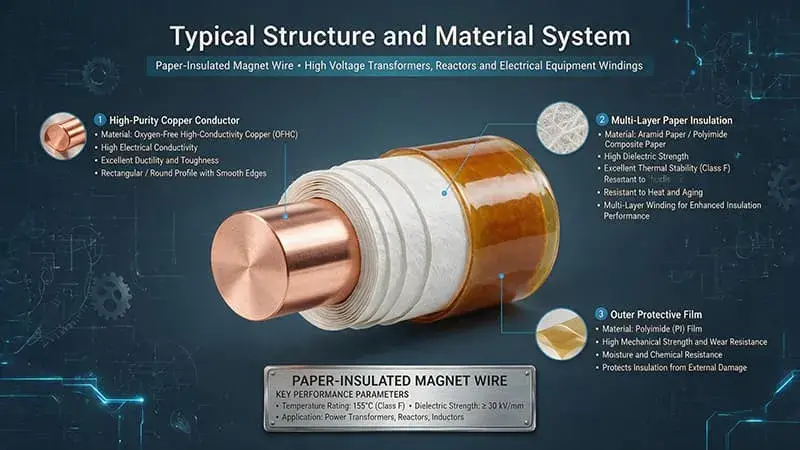
This is clearly reflected in the standard classification. ANSI/NEMA MW 1000-2018 manages magnetic enameled wires separately according to insulation type and thermal class; differences in conductor do not participate in the definition of thermal class. Paper-covered round wires correspond to MW 31-A and MW 31-C, with a thermal class of 155; paper-covered rectangular and square wires correspond to MW 33-A and MW 33-C, also with a thermal class of 155; while paper-covered rectangular and square wires, corresponding to MW 60-A and MW 60-C, jump to a thermal class of 220; and when replaced with aromatic polyamide coverings, the thermal class for the MW 64 and MW 65 series is 240.
The same copper conductor and the same winding structure can result in a nearly 90 K difference in usable temperature window simply because of different covering materials. This directly determines the starting point for lifetime assessment—before discussing “how much lifetime the paper-covered wire has left,” it is essential to clarify which type of paper-covered wire is meant here.
According to the requirements of MW 60-A in MW 1000-2018, the aromatic polyamide paper-covered coating should contain at least two layers of paper, with an overlap ratio of not less than 40%, and the covering tape should be tightly, evenly, and continuously wound; the elongation requirement is not less than 15%; the dielectric breakdown voltage requirement is not less than 300 volts per mil, or 11,800 volts per millimeter, calculated based on the minimum thickness of the paper-covered coating on one side; and the adhesion and flexibility requirements stipulate that after bending around a mandrel with a diameter six times the thickness of the bare wire, the covering tape should not be noticeably loose or cracked, exposing the copper.
These metrics read like product inspection items, but from another perspective, they are actually a factory baseline for “how much margin remains in the paper-covered wire”. Aging is a process of pushing material properties from their initial value towards their threshold value. The difference between the as-manufactured value and the threshold value is how much degradation this material can withstand.
The Three Aging Paths of Cellulose Insulation
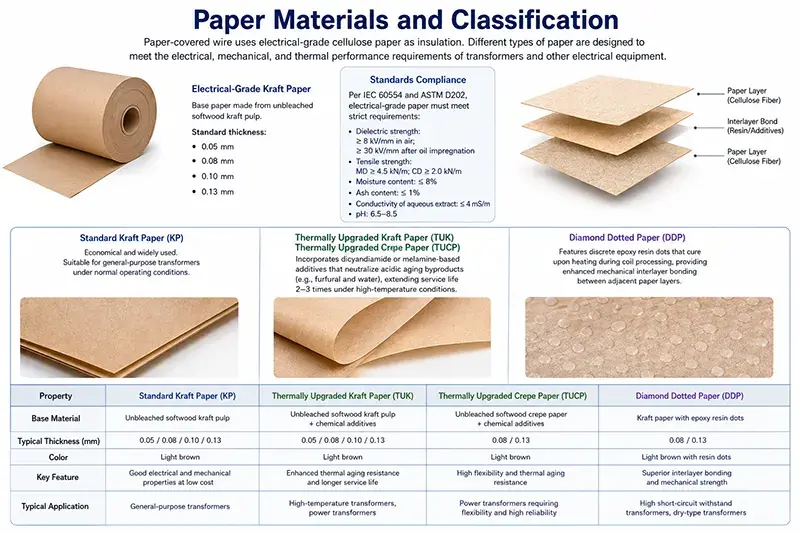
The paper insulation in a transformer is not a single material. Taking the most common kraft paper as an example, its composition is approximately 90% cellulose, 6% to 7% hemicellulose, and 3% to 4% lignin. The low lignin content gives this type of paper significant hygroscopicity, high mechanical strength, and a long molecular chain, which is why it is suitable for making insulating paper.
It is precisely this hygroscopicity that allows it to withstand three degradation paths simultaneously during service.
The thermal degradation path is the easiest to quantify. Cellulose undergoes chain breakage and dehydration at high temperatures, resulting in shortened molecular chains and a decreased degree of polymerization. The Arrhenius relation describes the exponential sensitivity of this process to temperature; a small rise in hot-spot temperature sharply compresses remaining life. This is why winding hot spot temperature, rather than the average temperature rise, is the core input for lifetime calculations.
The moisture path affects both the electrical and the mechanical domain. Increased moisture content in paper reduces dielectric strength, and more importantly, weakens the hydrogen bonds between fibers, thus decreasing the paper’s mechanical strength. Once insulating paper has lost its mechanical strength, electrical breakdown need not even occur before the winding can no longer withstand the electromagnetic forces during operation.
The oxidation path is often underestimated. Transformer oils produce acidic oxidation products over long periods of operation. These acids catalyze the hydrolysis of cellulose, creating a self-reinforcing cycle. The paper has already absorbed the oil, and the oxidation products, in turn, accelerate the paper’s degradation.
In practice the three paths do not simply add up; they are coupled. Moisture increases the rate of chemical reactions, heat accelerates the migration of moisture, and moisture, in turn, raises the local hot spot.
The Real Trigger for Condemnation: Winding Displacement
Regarding insulation life, there is a misconception that needs correction: the primary failure mode of transformer-winding insulation is not electrical breakdown.
The most consistent conclusion in cellulose insulation research is that cellulose degradation affects the mechanical rigidity of the winding. When the insulation degrades to a certain extent, the winding will shift under the electromagnetic force during operation, causing the inter-turn insulation to be compressed, sheared, and deformed, ultimately forming an inter-turn short circuit. This chain starts with the mechanical properties of the paper and ends with the winding inter-turn failure, rather than a simple insulation breakdown.
This understanding is particularly important for paper-covered wire. Structurally, paper-covered wire provides external overall coverage and mechanical restraint. The paper’s overlap ratio, coverage tightness, and elongation allowance directly determine how much deformation the wire can withstand under stress without losing structural integrity. The requirement in MW 1000-2018 regarding adhesion and flexibility—”after bending around a wire six times its bare wire thickness, it must not loosen or expose copper”—essentially defines the minimum acceptable level of this mechanical restraint capability at the factory.
Therefore, the criteria for maintaining life cannot be based solely on electrical quantities. Winding resistance, turns ratio, dielectric loss, and partial discharge are electrical-side measurements; winding displacement, inter-turn stress margin, and paper mechanical margin are mechanical-side measurements. Condemnation decisions must consider both sides.
Three Tiers of Evidence from Diagnostic Data to Remaining Life
The data available on-site is distributed across different levels, with varying degrees of accuracy and cost. Distinguishing between these levels is a prerequisite for making the assessment conclusions sound.
The first level consists of routine electrical tests, including winding DC resistance, insulation resistance, dissipation factor, and turns ratio. These data are low-cost and can be performed periodically, but they describe the current state and cannot distinguish whether aging is the result of ten years of cumulative aging or a rapid degradation over three months. To give these data a lifespan meaning, trends and a common temperature benchmark are necessary—a historical data series for the same transformer under similar oil temperatures and loads is far more valuable than a single isolated absolute value.
The second level consists of dissolved gas analysis, furfural content, and oil dielectric loss. Furfural in oil represents the furan products generated from cellulose degradation in the oil, indirectly reflecting the degree of paper degradation inside the winding and providing information on the aging rate without damaging the equipment. Dissolved gas analysis provides clues about the type and severity of the fault. Combining the two indicates whether aging is accelerating or progressing steadily.
The third level is sample analysis, with the degree of polymerization being the most stringent indicator. The degree of polymerization directly reflects the average length of the cellulose molecular chain and is highly correlated with the paper’s tensile strength and mechanical integrity. Studies have provided clear benchmarks: the degree of polymerization for newly manufactured kraft paper is around 1200, while when it drops to around 200, the insulating paper essentially loses its mechanical strength, which is generally considered the end of the transformer’s lifespan.
The paradox of degree of polymerization is that while it represents the highest level of evidence, it is also the most expensive to obtain. Measurements typically require sampling from the edge of the winding, which is destructive and results in limited sample representativeness. Using it as a routine method is impractical.
Therefore, a reasonable approach is to establish a division of labor: the degree of polymerization is responsible for anchoring “the current true state of this insulation,” while the furfural and conventional electrical testing are responsible for continuously tracking the rate of change of this state without damaging the equipment. Only by combining the two can a well-founded range of “remaining life” can be given.
Translating Diagnostic Results into a Remaining Life Range
Diagnostic data itself does not yield lifespan conclusions; a mapping process must be completed first.
The first step is to determine the baseline. Using furfural trend or historical dielectric loss and winding resistance data, a back-derived range for the current degree of polymerization is calculated. The output of this step is not a single number, but a range, because indirect inference inevitably carries error.
The second step is to match the material model. The thermal class of the paper-covered wire determines the upper limit of the life model input; the difference between the 155 and 220 classes in MW 1000-2018 will be amplified in the calculation results. At the same time, the actual operating hot spot temperature profile, not the design temperature under the rated capacity, must be substituted into the Arrhenius relation.
The third step is to introduce an acceleration factor. For every approximately 10 K increase in temperature (hot spot), the aging rate roughly increases exponentially; this is a general inference of the Arrhenius relation, with the specific multiple depending on the material itself and the activation energy. Simultaneously, factors such as moisture ingress, oxidation, and overload should be represented in the model as additional acceleration terms or correction coefficients.
The fourth step is to provide a “confidence interval” rather than a “single point value.” The practical use of a “remaining life” assessment is to support decision-making, which inevitably involves risk trade-offs. Providing a “three to five years” timeframe has entirely different values in actual management compared to providing a “five years and two months” timeframe.
One point that is often overlooked is that evaluation conclusions must be linked to the measurement conditions. For example, for winding DC resistance, the temperature and phase must be specified; for insulation resistance, the test voltage and dwell time must be specified; for furfural, the sampling point and oil quantity must be specified; and for partial discharge, the test voltage and calibration method must be specified. Values outside of these conditions are not comparable and cannot serve as a baseline for the next round of trend analysis.
Condemnation Criteria: From Single Thresholds to Combined Conditions
Using a single threshold to determine whether a transformer should be replaced is technically untenable. Insulation states are multidimensional; the correct criteria should be a combination of conditions.
The electrical criteria focus on three aspects: deviations between the winding DC resistance and the as-manufactured or historical value, which usually indicate an inter-turn short circuit or loose connection; a sustained increase in dissipation factor, reflecting an overall trend of insulation degradation; and partial discharge exceeding the level of concern and accompanied by repetitive discharge patterns, indicating the presence of internal voids or the formation of partial discharge channels.
On the oil side, two criteria are important: the trend of furfural content in the oil; a stable low level indicates that the aging rate is controllable, while a rapid increase indicates that the remaining life has entered a period requiring decision-making; the presence of characteristic gas components in the dissolved gas analysis requires differentiation between aging byproducts and active failures.
The mechanical criteria are the most critical and also the most difficult to obtain. The assessment of winding displacement and inter-turn stress relies on design information such as winding geometry, pre-tension, and the mechanical margin of the paper-covered wire, as well as indirect signals available on-site. At this level, the parameters of the paper-covered wire itself are valuable inputs: the overlap ratio determines the overall constraint stiffness of the covering, the covering tightness affects the possibility of local slippage, and the elongation margin determines how much deformation the covering layer can absorb after winding and under long-term stress.
It needs to be clarified that the operability of the mechanical-side criteria is currently weaker than that of the electrical-side and oil-side criteria. This is also the fundamental reason why remaining life assessments are currently presented as ranges rather than conclusions.
External Drivers of Accelerated Aging: Three Field Stresses
The aging of paper-covered wire is not solely driven by temperature. Transformers encounter various actual stresses during operation that are outside of their design operating conditions. These stresses must be identified separately during life assessment; otherwise, the model’s calculations will be systematically overly optimistic.
Voltage stress is one type. System overvoltage, operational overvoltage, and lightning impulse can create potential differences far exceeding rated values at the winding, inter-turn, and interlayer. The margin between the design value of the paper-covered wire’s dielectric strength and its actual impulse withstand directly determines whether such events will cause irreversible damage. The assessment needs to verify whether the design value of the winding’s impulse withstand level matches the actual operating voltage and grounding method, and also confirm whether any overvoltage events exceeding design expectations have occurred historically.
Short-circuit electromagnetic force is the second type. Outlet or close-in short circuits can generate peak electromagnetic force on the winding that far exceeds that during normal operation. The role of the paper-covered wire in this operating condition is to provide sufficient mechanical restraint to prevent the inter-turn insulation from being sheared under impact loads. These events are sudden and are often only discovered afterwards during winding deformation inspections; therefore, their historical record is itself an important input for life assessment.
Prolonged overload and low voltage operation fall into the third category, and are even more insidious. A sustained deviation from the rated load factor raises the hot-spot temperature, directly compressing the lifespan. While undervoltage operation reduces winding current, it may lead to increased core losses and local overheating, creating an operating state where “current is not high, but temperature is not low.” This type of stress will not trigger any alarms and is often only discovered during oil temperature trend analysis.
The method for incorporating these three types of external stresses into the assessment involves creating an event log in the equipment history, recording historical data for each instance of overvoltage, short circuit impulse, and load curve deviation, and then inserting these events into the degradation timeline based on their occurrence time. Without this step, the remaining life is simply a function of the temperature profile.
Replacement Decision: Economics Beyond the Technical Criteria
Even if technical evidence points to “approaching the end of life,” the timing of the replacement is not necessarily determined by technical criteria.
The economic viability of extending transformer life depends on several variables. The degree to which the transformer’s residual capacity value matches the current load level determines whether continued operation still yields any real benefit; the higher the system’s reliability requirements for this equipment, the more conservative the condemnation threshold should be; replacement options involve constraints such as power outage windows, transportation conditions, infrastructure, and spare parts; whether site conditions allow partial winding replacement rather than complete replacement also alters the economic balance.
Interestingly, these variables sometimes point in opposite directions. The technical criteria might suggest “it can still be used for two years,” but if a major maintenance window happens to arrive after two years, proactively replacing it earlier might be more economical. Conversely, the technical criteria might suggest “it can still be used for five years,” but if the load continues to rise during those five years, the decline in the residual capacity value will change the decision earlier.
In practice, the usual approach is to compile technical evidence into a condition assessment report, including four items: current status, degradation rate, remaining lifespan, and condemnation triggering conditions. The timing is then jointly determined by operations and maintenance, finance, and system dispatch. The paper-covered wire parameter in this report serves to provide a basis for the mechanical side’s judgment, rather than directly indicating the replacement year.
Start Preparing for Condemnation at the Selection Stage
The capability to assess remaining life is partly built in during the selection stage.
Choosing a higher thermal class of paper-covered wire is, in effect, purchasing life margin. The difference between the 155 and 220/240 classes in MW 1000-2018 is significantly amplified in the remaining life model, and the cost of upgrading the paper-covered wire class over the entire service life of the equipment is far lower than the cost of replacing the whole equipment later.
The selection phase also requires recording the following information: paper type and corresponding standard specifications, key parameters such as thermal class and overlap ratio, which form the comparison benchmark for subsequent evaluation. Manufacturing inspection data, including factory measured values such as elongation, breakdown voltage, adhesion, and flexibility, are the only reference for determining whether subsequent measured values have been degraded.
The choice of impregnation system also affects the interpretability of lifetime assessments. Different impregnation agents and binder systems alter the migration pathways of water within the system and the distribution of aging products, and also affect the release of furfural into the oil. Condemnation thresholds that ignore the impregnation system easily introduce systematic bias when comparing across equipment.
Turning the Assessment into a Reusable Closed Loop
A sustainable, long-term assessment process typically consists of six stages.
Establish a baseline by completing a full set of winding electrical tests, furfural measurement and oil sample testing after the equipment is put into operation or overhauled. Record the oil temperature, load, and environment conditions at that time as the starting point for all subsequent trend analyses.
Set a monitoring cycle and determine the regular testing frequency based on load level and equipment importance. High-voltage, high-capacity units and units carrying critical supply duties require more intensive tracking.
Standardize measurement conditions: all data acquisitions must record conditions such as temperature, phase, test voltage, dwell time, and sampling point. Records without these conditions lack longitudinal comparability.
Under fixed conditions, a longitudinal comparison is performed to align the current value with the baseline and the historical sequence, identifying deviations in direction.
When the trend enters the attention band, initiate intensified monitoring or arrange for retesting of oil samples and dissolved gas analysis, and arrange for winding deformation checks if necessary.
When the preset condemnation condition is met or the remaining life interval is insufficient to support the next maintenance interval, a replacement decision is triggered, and the baseline data are updated synchronously.
The point of this process is quite plain: determining how long a transformer can be used is not based on a single precise calculation, but on a judgment accumulated from a continuous, traceable and condition-documented body of evidence. The role of the paper-covered wire is to faithfully record changes in insulation condition and provide a sufficiently good mechanical margin so that the winding can still withstand degradation.
Frequently Asked Questions
Are the thermal class of paper-covered wire and the design life of a transformer the same concept?
No. The thermal class refers to the material’s temperature index under a specified test regime, describing the material’s long-term heat resistance. The transformer design life is the target operating life of the complete unit under a given load and environment. They are related but not equivalent; the actual life of the same transformer can vary considerably depending on its load curve.
Is the degree of polymerization test mandatory?
The degree of polymerization is the most direct indicator of the true condition of the paper insulation, but it is a destructive sampling test and cannot serve as a routine method. A more reasonable approach is to use it as a confirmation method towards the end of the insulation life, or whenever the condition is seriously in doubt. Routine tests such as furfural in oil and conventional electrical tests should be used to track trends, and sampling should only be performed when final confirmation is required.
Does an increase in dielectric loss mean the paper-covered wire needs to be replaced?
Not necessarily. A rise in dielectric loss may originate in the oil, in moisture ingress, or be an overall effect of moisture ingress into the winding; it reflects the state of the insulation system, not the state of the paper itself. A comprehensive assessment requires considering oil samples, trend data, and mechanical information.
Does the overlap ratio of paper-covered wire affect its lifespan?
Yes. The overlap ratio determines the overall constraint capability of the covering layer, directly affecting the displacement tolerance of the winding under the action of electromagnetic force. The standard requires that the aromatic polyamide paper covering contain at least two thicknesses of paper with an overlap ratio of not less than 40%. This parameter is not only a test item but also an important input for mechanical life assessment.
Is it more economical to replace the winding or to replace the whole transformer?
It depends on unit capacity, residual capacity value, outage window and on-site construction conditions. On a large power transformer, the difficulty and risk of an on-site winding replacement can approach those of a complete replacement, whereas winding replacement on medium and low voltage distribution transformers is usually markedly more economical. This requires an economic comparison on a project-by-project basis.
How long can diagnostic data be retained for subsequent evaluation?
It is recommended that baseline data and all trend data be retained for the full service life of the unit. While the service life of equipment may exceed the standard record-keeping period, without a continuous historical sequence, remaining life assessment falls back to a single-point judgment, and the confidence level drops sharply.