

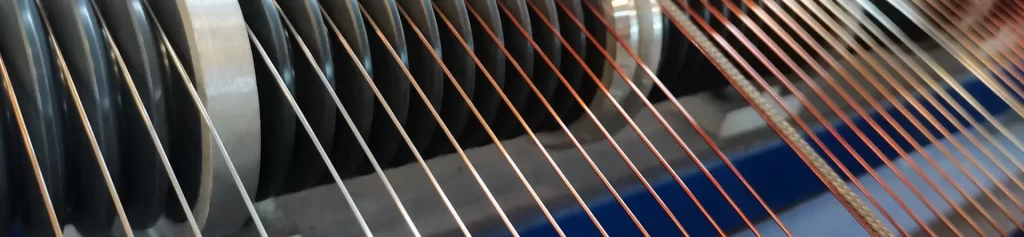
Paper Covered Wire Occupies Two Extreme Positions in the Insulation Spectrum
The Part 2 title page of NEMA MW 1000-2018 carries a complete classification index for fiber covering and enamel film insulation. Reading that table on its own makes the position of paper covered wire immediately clear.
| Thermal Class | Covering or Coating Form | Aluminum Conductor | Copper Conductor |
|---|---|---|---|
| 90 or 105 | Paper covered round wire | MW 31-A | MW 31-C |
| 90 or 105 | Paper covered rectangular and square wire | MW 33-A | MW 33-C |
| 155 | Glass fiber covered | — | MW 41-C |
| 180 | Glass fiber covered (high-temperature organic varnish treated) | — | MW 50-C |
| 200 | Glass fiber covered (silicone treated) | — | MW 44-C |
| 200 | Polyester glass fiber covered (silicone treated) | — | MW 47-C |
| 220 | Aromatic polyamide paper covered round wire | MW 61-A | MW 61-C |
| 220 | Aromatic polyamide paper covered rectangular and square wire | MW 60-A | MW 61-C |
| 240 | Aromatic polyimide tape covered round wire | MW 65-A | MW 65-C |
This table reveals three facts that are often overlooked in everyday discussions.
First, cellulose paper-based paper covered wire is limited to two thermal classes: 90 and 105, and these are exactly the grades used by most paper covered wire products on the market. Second, the three thermal classes of 155, 180, and 200 are entirely occupied by glass fiber covering systems and enamel coating/insulation systems; paper covered wire itself does not enter these bands at all. Third, the highest thermal class paper covered wire can reach is 220, and reaching it requires an entirely different material category: aromatic polyamide paper.
In other words, moving from ordinary paper covered wire to high-performance paper covered wire means crossing material classes, not adjusting a formulation. Thermally upgraded paper can improve thermal endurance within the cellulose system, but it cannot lift paper covered wire from the 105 band into the 155 or 180 bands—those three ranges are defined by the glass fiber material in the standards system. Expecting to cross thermal classes continuously by changing paper type is a common and expensive misconception in material selection.
Comparing the Material Systems Side by Side
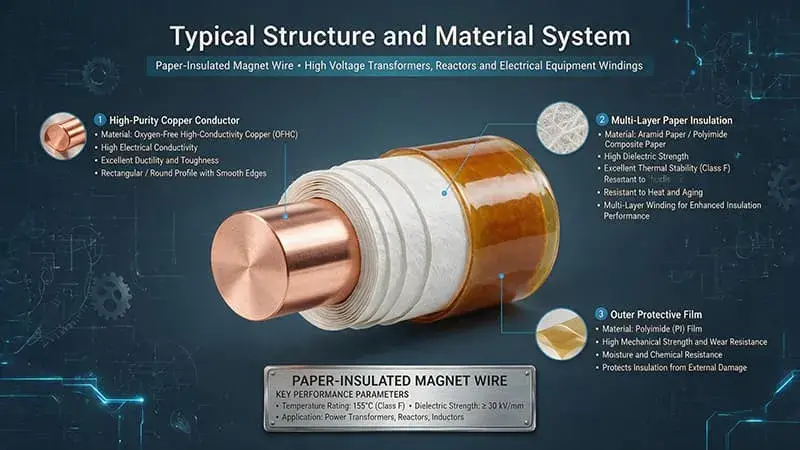
To make that structure concrete, the materials have to be examined across one common set of dimensions: structural characteristics, thermal class, mechanical properties, chemical resistance, cost, and applicable scenarios.
Cellulose Paper Family: Kraft Paper, Crepe Paper and Thermally Upgraded Paper
Ordinary kraft paper is a flat sheet made from electrical grade unbleached sulfate wood pulp, with a composition of approximately 90% cellulose, 6% to 7% hemicellulose, and 3% to 4% lignin. It has a flat structure and good directional strength, which suits it to applications needing geometric support such as interlayer and end insulation, but its elongation is extremely low.
Crepe paper is mechanically creased during the manufacturing process, forming micro-creases on its surface. While its chemical composition is close to that of kraft paper, yet its mechanical behavior is completely different. Typical electrical crepe paper reaches an elongation above 100%, while flat kraft paper typically manages only a few percent. That difference decides the functional division of labor: crepe paper can absorb the 0.2 to 0.5 percent axial thermal expansion a conductor undergoes between cold start and full load, whereas kraft paper absorbs almost none.
The standardized crepe paper parameters show the engineering magnitude of this difference:
| Parameter | 0.35 mm | 0.46 mm | 0.65 mm | 0.80 mm |
|---|---|---|---|---|
| Elongation (MD) | Not less than 100% | Not less than 100% | Not less than 100% | Not less than 80% |
| Tensile strength (MD) | Not less than 2.0 kg/15mm | Not less than 4.0 kg/15mm | Not less than 6.0 kg/15mm | Not less than 6.0 kg/15mm |
| Breakdown voltage (average) | Not less than 1.00 kV | Not less than 1.10 kV | Not less than 1.30 kV | Not less than 1.50 kV |
| Crepe density | Not less than 20 numbers per inch | Not less than 20 numbers per inch | Not less than 20 numbers per inch | Not less than 20 numbers per inch |
The creased structure of crepe paper brings two additional benefits: significantly improved wrapping conformity, making it less prone to wrinkling or edge lifting; and the channels formed between the micro-creases facilitate the penetration and flow of transformer oil, which has a positive effect on heat dissipation and impregnation quality.
One point deserves emphasis: NEMA MW 31 and MW 33 correspond precisely to the crepe paper product. The Essex Solutions technical specification sheet for the European market lists the standard correspondences for Crepe Paper Magnetape as NEMA MW 31 and MW 33, IEC 60317-27, and GB 7673.20 and 7673.30. That mapping nails “crepe paper equals 90 or 105″ at the standard level.
Thermally Upgraded Paper: The Only Thermal Endurance Path Within the Cellulose System
Thermally upgraded paper is cellulose paper that has been chemically modified to slow the rate of cellulose chain decomposition. The mainstream approach adds nitrogen-containing reagents such as dicyandiamide or melamine to the pulp, so that nitrogen replaces the oxidation-prone hydroxyl groups and inhibits oxidative degradation at high temperature.
Its life criterion is unambiguous: held at 110 degrees Celsius for 65,000 hours, it retains 50 percent of its tensile strength. Against the 98 degrees Celsius reference temperature of ordinary kraft paper, this permits a 12 K rise in hot-spot temperature and therefore a higher continuous loading capability.
Two misunderstandings recur around thermally upgraded paper. First, 110 degrees Celsius is a life criterion temperature while 105 degrees Celsius is the system thermal class; the two cannot be used interchangeably. Ordinary kraft paper corresponds to IEC 60085 Class A, i.e., the upper limit of 105 degrees Celsius. “Thermally upgraded paper” represents an incremental improvement on this level, not a leap to another classification system. Second, thermally upgraded paper has no independent designation in NEMA MW 1000. It is not a standard component procured by model number but a modification requirement placed on an existing paper covered wire material system. That gap in the standards directly shapes how the procurement specification and acceptance criteria have to be worded.
Aromatic Polyamide Paper: The Only Paper Route Into the High-Temperature Range
Aromatic polyamide paper uses a synthetic aromatic amide polymer as its base material, giving a highly stable molecular structure. It combines excellent dielectric, thermal, chemical, and mechanical properties, and it is the only route by which paper covered wire reaches the 220 thermal class.
Within the standards system, MW 60-A defines aromatic polyamide paper covered rectangular and square aluminum magnet wire, thermal class 220. The standard text states the material and construction requirements explicitly: the insulating material shall be an aromatic polyamide paper; the paper covering shall consist of one or more tapes, each wrapped firmly, closely, evenly, and continuously around the wire to form the specified number of paper tape layers; the covering shall contain at least two thicknesses of paper with not less than 40 percent overlap; and if an adhesive is used, that material shall perform in the applicable insulation system as required by Part 3, Clause 3.58.
The performance requirements follow: elongation of not less than 15 percent under Part 3, Clause 3.4; dielectric breakdown of not less than 300 V/mil (11800 V/mm) under Part 3, Clause 3.8.2 or 3.8.7, measured on the minimum thickness of the covering on one side, that is half the dimensional buildup; and adhesion and flexibility under Part 3, Clause 3.3.7.2, where the covering must not be noticeably loose or cracked open to expose the bare wire after bending around a mandrel six times the thickness of the bare wire.
Publicly available DuPont Nomex material data fills in the details the standard text leaves out. Nomex carries a UL 220°C material temperature rating, which means it retains effective performance for more than ten years under continuous exposure to that temperature, with short-term temperature resistance up to 240°C, and it holds UL 94 V-0 flame retardant certification. Calendered Nomex products withstand short-time field strengths of 18 to 40 kV/mm without secondary treatment by varnish or resin. This follows from its low dielectric constant, which also produces a more uniform electric field distribution between the insulation and the cooling medium. Chemically, Nomex is largely unaffected by most solvents, resists acids and alkalis, and is compatible with varnishes, adhesives, transformer liquids, lubricants, and refrigerants. In terms of environmental adaptability, Nomex retains 90% of its dielectric strength at 95% relative humidity. At the liquid nitrogen boiling point of 77 K, the tensile strength of T410 type insulating paper and 993 and 994 type pressboards actually exceeds its room-temperature value. Nomex also withstands a radiation dose of 8 megagray without significant degradation.
The grade choice also affects real-world performance. Nomex 410 is the standard calendered version; 411 is uncalendered, soft, and highly absorbent of oil; 414 resembles 410 but is more flexible, easier to form, has a more open surface, and absorbs more readily.
The Performance Gap Between Paper Covering and Polyimide Tape Covering
Within the family of covering forms, paper and tape follow two distinct material logics. MW 65 defines aromatic polyimide tape covered bare rectangular and square copper magnet wire, thermal class 240. The standard text specifies that the insulating material shall be an aromatic polyimide tape coated on one or both sides with an adhesive layer bonding the insulation to the bare conductor, that the covering shall be one or two tapes wrapped spirally around the wire, and that the tape shall be heat sealed after wrapping.
On performance, Part 3, Clause 3.6 requires no loss of adherence between tape and conductor or between layers of tape; Part 3, Clause 3.7.2 caps springback at 5.5 degrees; and Part 3, Clause 3.8.2 or 3.8.7 requires dielectric breakdown of not less than 1000 V/mil (39370 V/mm).
Placing the two side by side makes the difference immediate:
| Comparison Item | MW 60-A Aromatic Polyamide Paper | MW 65 Aromatic Polyimide Tape |
|---|---|---|
| Thermal class | 220 | 240 |
| Breakdown voltage requirement | Not less than 300 V/mil | Not less than 1000 V/mil |
| Elongation requirement | Not less than 15% | No corresponding lower limit |
| Springback requirement | Not separately specified | Not more than 5.5 degrees |
| Interlayer bonding method | Overlap of not less than 40%, adhesive optional | Heat sealed, no loss of adhesion permitted |
Both are covering constructions, yet aromatic polyamide paper relies on layer stacking and overlap to secure dielectric strength, while aromatic polyimide tape relies on heat sealing and bonding to hold the assembly together. One depends on overlap, the other on sealing, and they fail in entirely different ways.
Mica Paper and Paper/Glass Fiber Composite Systems
Mica paper excels in thermal applications; its inorganic structure prevents the cellulose-like chain scission that occurs at high temperatures, making it suitable for inter-turn insulation in high-temperature motors and special applications. Its mechanical properties, however, differ sharply from those of cellulose paper: it lacks flexibility, has weak tear resistance, and is prone to edge damage during wrapping. It is therefore seldom used as the primary covering material over long lengths of round wire, but combined with paper or glass fiber instead.
The paper/glass fiber composite system is another practical approach. In NEMA MW 1000, the polyester glass fiber covering type requires the glass fiber to be electrical-grade continuous filament glass fiber yarn, while the polyester fiber is derived from the linear polymerization of ethylene glycol and terephthalic acid, with the weight fraction of polyester fiber in the yarn not exceeding 50%. If a base film is present, that film insulation must be rated at least Class 155 and comply with the corresponding Part 2 specification. Composite structures balance mechanical strength against heat resistance, but their dielectric performance and breakdown voltage are not of the same order as those of all-paper coverings.
Acceptance Testing and Incoming Inspection
Because a thermally upgraded paper has no independent designation in NEMA MW 1000, it cannot be ordered against a model number, and that has a direct consequence for incoming inspection. A procurement specification has to define the acceptance test instead of the model designation, and the usual practice is to verify two things separately. The first is the paper itself, through tensile strength, elongation, and the retention of tensile strength after thermal aging, tested against the requirements the supplier declares for the thermally upgraded grade. The second is the completed wire, through the dielectric breakdown voltage, elongation, adhesion, and flexibility requirements that the applicable MW designation already specifies for the covered construction.
The two tests are not interchangeable. A wire can pass every requirement of MW 31 or MW 33 and still be built on ordinary kraft paper rather than thermally upgraded paper, because the breakdown and adhesion requirements of those designations do not distinguish the base paper. Only the paper-level aging test separates them. This is the practical reason why material class and wire designation have to be stated separately in the procurement document.
A Selection Decision Tree
For a specific project, the decision proceeds in the following order.
The first step establishes the cooling medium and the operating temperature range of the winding. The hot-spot temperature of an oil immersed winding is usually limited by the oil and the paper together; a dry-type winding is not immersed at all and the material alone carries the full insulation function; traction and converter transformers demand more in overload capability and thermal stability.
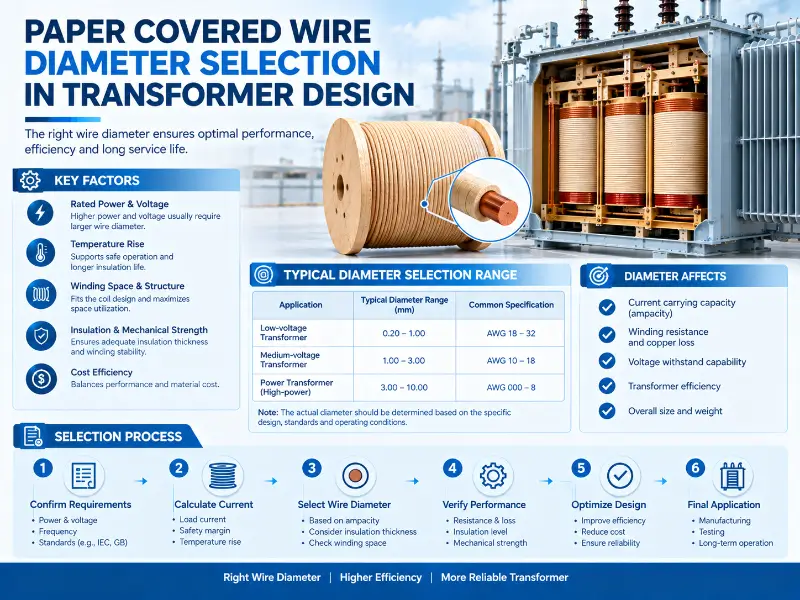
The second step is to fix the material class from the working temperature. For a conventional oil immersed distribution transformer working below 105 degrees Celsius, crepe paper covered wire is the most cost-effective choice, corresponding to MW 31 or MW 33. IEC 60317-27-1 is written specifically for paper tape covered round copper wire intended for oil immersed transformer winding coils, covering conductor diameters from 0.500 to 5.000 mm, and the paper tape material must comply with IEC 60554-1 and IEC 60554-3-5. If the working temperature needs to exceed 105 degrees Celsius, thermally upgraded paper must be introduced, the covering layer count and clearance design must be increased accordingly.
The third step covers the 155 to 200 degrees Celsius band. No standard paper covered wire designation exists in this band; the options are glass fiber covering or enamel insulation systems. If a paper-based structure must be retained, only a paper and glass fiber composite solution is available, executed under the NEMA MW 1000 polyester glass fiber covering clause.
The fourth step covers 220 degrees Celsius and above. Only aromatic polyamide paper is available here, corresponding to the MW 60-A or MW 61 series. If the temperature requirement is close to 240°C or the winding is in an extremely harsh environment, the design should switch directly to aromatic polyimide tape covering under the MW 65 series.
The fifth step refines the selection by conductor shape and duty cycle. Circular conductors suit the MW 31, MW 33, and MW 61 round wire series; rectangular and square conductors suit the corresponding rectangular and square series of MW 33, MW 60, and MW 65. On duty cycle, a distribution transformer running at continuous full load can be configured at the lower limit of the standard, while a traction transformer subject to frequent overload must be given hot-spot margin.
The sixth step checks the winding geometry. The dimensional buildup of the paper covered wire design directly affects slot fill factor, inter-turn spacing, and end winding geometry. In the IEC 60317 system, the magnet wire geometry of paper covered wire is governed by Part 3, Clause 3.2.2.2, while increments beyond the standard layer count or tape thickness are handled according to Clause 1.5.1.3. This point is most easily overlooked in non-standard designs.
The seventh step is to confirm impregnation system compatibility. Cellulose based materials have to coexist for decades with transformer oil or natural ester fluids. Research indicates that thermally upgraded paper performs better in natural ester than in a mineral oil system, but that work remains at conference abstract level and should not serve as the sole basis. Aromatic polyamide paper does not depend on the cellulose impregnation logic, yet it carries its own compatibility requirements for adhesives and impregnating varnishes.
Selecting Materials Backward from the Application
Distribution Transformers
This is the natural territory of crepe paper covered wire. The winding hot-spot temperature of this type of equipment is constrained by Class A systems, the operating point is stable, overload requirements are limited, and cost effectiveness carries the greatest weight. The high elongation of crepe paper provides irreplaceable value here—it absorbs conductor thermal expansion, ensuring the winding neither slackens nor is crushed by conductor elongation over long-term operation.
Traction Transformers and Furnace Transformers
Traction transformers withstand frequent overload and severe vibration, while furnace transformers face additional losses and hot-spot concentration caused by harmonic loading. These two scenarios demand significantly higher mechanical strength than conventional distribution transformers, and the winding has to withstand substantial electromagnetic forces. Therefore, material selection must consider both mechanical strength and thermal stability. Glass fiber covering systems are advantageous in this context, while paper-based materials require additional layers or composite structures to compensate for their strength.
HVDC Converter Transformers
Harmonic losses, winding temperature distortion caused by DC current, and long-term overvoltage stress all push the converter transformer insulation system toward higher classes. The insulation structure of a converter transformer typically employs high-temperature systems at the material level, which is precisely the application direction for aromatic polyamide paper.
Dry-Type Transformers and High-Voltage Instrument Transformers
Dry-type transformers do not rely on a liquid to remove heat; all of it leaves through the solid insulation structure, and the material itself provides the entire insulation function. This scenario places stringent requirements on the thermal class and flame retardancy of materials, where synthetic material systems have an advantage.
High-voltage instrument transformers present a different challenge: high voltage class, compact structure, large inter-turn potential difference, and stringent requirements on the dielectric strength and uniformity of the inter-turn insulation. The value of aromatic polyamide paper in such applications lies in its higher dielectric strength and lower dielectric constant, the latter producing a more uniform field distribution at the insulation-to-dielectric interface.
Rectifier Transformers and Core Windings
A rectifier transformer sees significant load waveform distortion, with harmonics causing additional losses; a core winding, by contrast, presents structural constraints unlike a conventional winding. In both cases the selection must be based on the actual temperature rise under harmonic conditions rather than on power frequency rated values.
Structural Differences in Cost and Risk
On cost, cellulose paper holds a clear advantage, with abundant raw material sources and mature processing technology. crepe paper covered wire is often the most cost-effective solution in conventional distribution transformers. Aromatic polyamide paper is significantly more expensive than cellulose paper, but when project requirements reach 220 thermal class, no practical alternative path exists—glass fiber and polyimide systems are also costly and unsuitable for certain structural requirements. Therefore, in applications requiring high-temperature ratings, aromatic polyamide paper cannot be simply considered “more expensive paper,” but rather the only viable option.
The difference in risk dimensions is more crucial. The failure mechanism of cellulose paper is a known chain scission process, and its lifespan can be quantitatively tracked using indicators such as degree of polymerization and furfural content, and non-destructive monitoring can be achieved through oil sample analysis. The failure mechanism of aromatic polyamide paper is different; it does not undergo the progressive chain scission characteristic of cellulose, and its service life is assessed instead through temperature index and accelerated thermal aging testing. The diagnostic logic and condemnation standards of these two methods are not interchangeable. Applying paper covered wire condition assessment methods to both materials without distinction will produce invalid diagnostic conclusions.
Conclusion
Selecting paper covered wire comes down to three judgments: where the product sits in the standards system, which material class the winding temperature and duty cycle point to, and whether that material is feasible within a given structural geometry.
Treating paper covered wire as one band on a continuous performance spectrum is a common starting point for selection errors. In the NEMA MW 1000 and IEC 60317 systems, paper covered wire occupies two extremes: the cellulose paper systems are locked at thermal classes 90 and 105, while the aromatic polyamide paper systems are anchored at thermal class 220. The intermediate 155, 180, and 200 bands are occupied by glass fiber and enamel insulation systems. Below grade 105, crepe paper wins on mechanical properties rather than thermal ones, and elongation is the fundamental reason it exists. Thermally upgraded paper is the only thermal endurance path inside the cellulose system, yet it has no independent designation in the standards. Aromatic polyamide paper, by contrast, crosses into a different material category altogether.
Understanding this structure means selection is no longer a trade-off among a list of parameters, but about making judgments within a clear boundary—which goals can be achieved, and what it takes to achieve them.