


Introduction
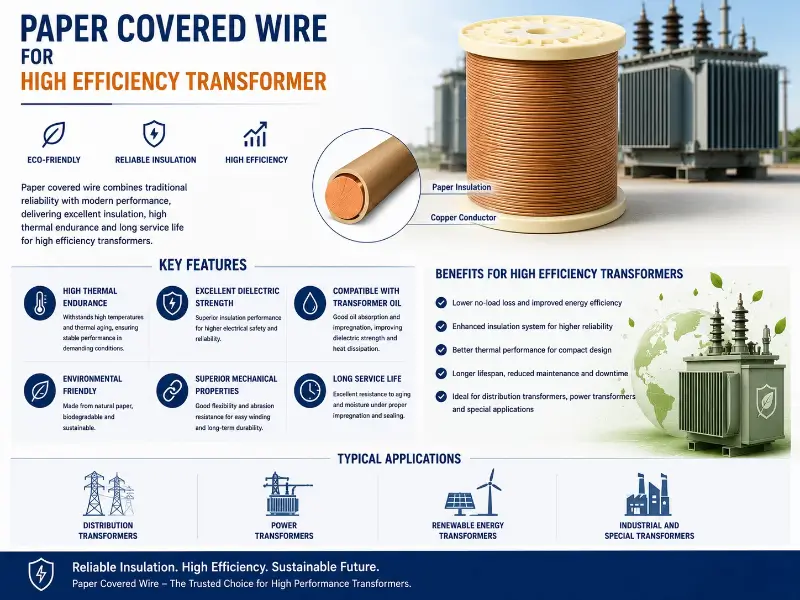
Paper-Covered Wire for Large-Capacity Transformers is a core topic concerning the application of winding insulation materials for large-capacity transformers in the power transformer manufacturing industry, ultra-high-voltage (UHV) and extra-high-voltage (EHV) transmission projects, and grid-integration projects for new-energy power generation. Large-capacity transformers—typically defined as power transformers rated at several hundred MVA or higher—are critical equipment within power systems; the performance of their winding insulation materials directly determines the transformer’s dielectric strength, short-circuit withstand capability, thermal stability, and long-term reliability. Paper-covered wire serves as the classic winding insulation material for large-capacity oil-immersed transformers and holds irreplaceable engineering value in such applications. Understanding the special requirements imposed on paper-covered wire by large-capacity transformers, its application domains within large-capacity transformers, key technologies for paper-covered wire intended for large-capacity transformers, and measures ensuring long-term reliability is of significant practical importance to manufacturers of large-capacity transformers, power grid engineers, procurement engineers for large transformers, and technical experts from power generation plants.
From the perspective of large-capacity transformer engineering practice, large-capacity transformers impose significantly higher requirements on winding insulation than medium- and small-capacity transformers. Due to their high voltage class, large capacity, elevated operating temperature, enormous short-circuit current, and extended service life, large-capacity transformers demand stringent dielectric strength, thermal endurance, mechanical strength, short-circuit resistance, and long-term reliability from winding insulation. The paper-oil composite insulation system has been applied in large-capacity transformers for over a century and remains the classic insulation solution for large-capacity oil-immersed power transformers.
The engineering implications of paper-covered wire for large-capacity transformers can be systematically elaborated from eight dimensions: the special requirements imposed by large-capacity transformers on paper-covered wire; application domains of paper-covered wire in large-capacity transformers; key technologies for paper-covered wire used in large-capacity transformers; critical performance requirements; winding structure and insulation coordination; application case studies; long-term reliability assurance; and quality control. This article provides a systematic engineering reference for manufacturers of large-capacity transformers, power grid engineers, procurement engineers for large transformers, and technical experts from power generation plants.
Special Requirements for Paper-Insulated Magnet Wire in Large-Capacity Transformers
Special requirements for paper-covered magnet wire in high-capacity transformers form the basis for selecting application-specific paper-covered magnet wire; understanding these requirements is critical to proper paper-covered magnet wire selection.
High Dielectric Strength Requirements
The voltage class of large-capacity transformers is typically 110 kV and above; for high-voltage, extra-high-voltage, and ultra-high-voltage large-capacity transformers, the voltage classes can reach 220 kV, 500 kV, and 1000 kV. Such high voltage classes require the paper-oil composite insulation system of paper-covered magnet wire to possess extremely high dielectric strength, capable of withstanding the combined effects of operating voltage, transient overvoltage, lightning impulse voltage, and switching impulse voltage.
High dielectric strength requirements for paper-wrapped magnet wire necessitate the use of multi-layer cable paper or multi-layer polyester film-paper composite materials, where multiple layers are stacked to achieve a composite insulation system with superior statistical breakdown strength. The number of insulation paper layers is determined by the voltage class: higher voltage classes require more layers. For ultra-high-voltage, high-capacity transformers, the paper-wrapped magnet wire may incorporate dozens of insulation layers, integrated with insulation cylinders, insulation pressboard, electrostatic shields, and molded insulation components to form a complete insulation system.
High-Temperature Resistance Requirements
Large-capacity transformers feature high capacity, high loss density, and elevated operating temperatures. The long-term operating temperature of large-capacity transformers can reach 105°C (standard operating temperature for oil-immersed transformers), while the hot-spot temperature may exceed 120°C. Such high operating temperatures require the paper-oil composite insulation system of paper-covered magnet wire to exhibit outstanding thermal aging resistance, maintaining dielectric strength and mechanical properties under prolonged high-temperature conditions.
High-temperature resistance requirements for paper-covered magnet wire necessitate the use of high-quality insulating paper. The thermal aging resistance of insulating paper is closely related to its fiber structure, purity, and additives. Premium cable paper exhibits excellent thermal aging resistance, maintaining stable performance for decades at a long-term operating temperature of 105°C. Polyester film–paper composite materials demonstrate even superior thermal aging resistance and are the preferred insulation material for high-temperature applications.
High Mechanical Strength Requirements
The short-circuit current in large-capacity transformers is extremely high (reaching tens to hundreds of kiloamperes), and the resulting electromagnetic force can reach several hundred kilonewtons. This electromagnetic force exerts a severe mechanical impact on the windings, constituting one of the primary causes of transformer insulation failure. High mechanical strength requirements mandate that the paper-oil composite insulation system of paper-covered magnet wire exhibit exceptional short-circuit resistance, enabling it to withstand the impact of short-circuit electromagnetic forces without insulation failure.
High mechanical strength requirements for paper-wrapped magnet wire necessitate the use of insulation paper with excellent mechanical strength, a multi-layer paper insulation structure, and overall impregnation of the winding with insulating varnish. The tensile strength, tear strength, and abrasion resistance of the insulation paper directly affect the mechanical strength of the paper-wrapped magnet wire. After impregnation with insulating varnish, the winding forms an integrated insulation structure, significantly enhancing the mechanical integrity and short-circuit resistance of the winding.
Large Conductor Cross-Section Requirements
Large-capacity transformers carry high currents and employ conductors with large cross-sectional areas. The low-voltage side current of large-capacity transformers can reach several thousand to tens of thousands of amperes, corresponding to conductor cross-sectional areas ranging from several hundred to several thousand square millimeters. Such large cross-sectional areas require paper-covered magnet wire to utilize rectangular conductors or large-diameter round conductors, with stringent dimensional tolerance requirements for conductor cross-sectional dimensions.
Flat paper-covered wire is a common conductor form used in high-capacity transformers. Due to its large cross-sectional area, high space factor, and excellent heat dissipation performance, flat wire is the preferred conductor form for windings in high-capacity transformers. The dimensional accuracy of the conductor’s cross-section in flat paper-covered wire directly affects the electromagnetic performance and insulation coordination of the winding, making it a critical control point in the manufacturing of high-capacity transformers.
Long-term reliability requirements
The design service life of large-capacity transformers is typically required to exceed 30 years, with some high-end large-capacity transformers requiring 40 years or longer. Long-term reliability is the core performance indicator for large-capacity transformers. This long-term reliability demands that the paper-oil composite insulation system of paper-covered magnet wire maintain stable performance over several decades, withstanding combined electrical, thermal, mechanical, and chemical stresses over extended periods.
Long-term reliability requirements for paper-wrapped magnet wire mandate the use of high-quality insulating paper and transformer oil, standardized oil impregnation processes, and strict control of critical parameters such as moisture content, gas content, and acid number. Circulating filtration, drying treatment, and periodic testing of transformer oil are key measures to maintain the long-term reliability of the paper–oil composite insulation system.
Application Areas of Paper-Insulated Magnet Wire in Large-Capacity Transformers
Paper-covered magnet wire is applied in various high-capacity transformers used in power systems, new energy, rail transit, and specialized industries.
High-Voltage Main Transformer Applications
High-voltage main transformers represent the most critical application segment for large-capacity transformers. Paper-covered magnet wire is widely used for winding insulation in 110 kV and 220 kV high-voltage main transformers. Due to their high voltage class, large capacity, and stringent requirements for insulation performance and long-term reliability, high-voltage main transformers traditionally employ a paper–oil composite insulation system as the standard solution.
Requirements for paper-covered wire used in high-voltage main transformers include high dielectric strength (meeting voltage classes of 110 kV to 220 kV), high mechanical strength (withstanding short-circuit electromagnetic forces), high long-term reliability (fulfilling a design service life exceeding 30 years), and excellent compatibility with transformer oil (suitable for long-term oil-impregnated operation). Paper-covered wire for high-voltage main transformers is typically manufactured using multi-layer cable paper wrapping, integrated with insulating cylinders, insulating pressboard, and other components to form a complete insulation system.
Application in Ultra-High-Voltage Main Transformers
Ultra-high-voltage (UHV) main transformers represent the high-end application segment of large-capacity transformers. Paper-covered magnet wire is commonly employed as winding insulation in 500 kV UHV main transformers. Due to their higher voltage class, greater capacity, and more complex insulation structures, UHV main transformers impose stringent requirements on paper-covered magnet wire regarding dielectric strength, thermal endurance, mechanical strength, and long-term reliability.
Requirements for paper-covered wire used in EHV main transformers include extremely high dielectric strength (meeting 500 kV voltage class), excellent corona resistance (withstanding prolonged operating voltage), outstanding short-circuit resistance (withstanding enormous short-circuit electromagnetic forces), and exceptional long-term reliability (fulfilling a design service life exceeding 40 years). Paper-covered wire for EHV main transformers is typically manufactured using multi-layer cable paper wrapping or polyester film-paper composite materials, integrated with a complete insulation system comprising insulated cylinders, insulating pressboard, electrostatic shields, and molded insulation components.
Application in Ultra-High-Voltage Main Transformers
UHV main transformers represent the ultimate application domain for high-capacity transformers. The 1000 kV UHV main transformer employs paper-covered magnet wire for winding insulation, constituting the pinnacle application scenario for high-capacity transformers. The voltage class of UHV main transformers is several times higher than that of conventional high-voltage transformers, with typical capacities exceeding 1000 MVA and extremely complex insulation structures.
Requirements for paper-covered wire used in UHV main transformers include ultimate dielectric strength (meeting the 1000 kV voltage class), extremely low dielectric loss (meeting UHV operational efficiency requirements), ultimate short-circuit resistance (withstanding enormous short-circuit electromagnetic forces), and ultimate long-term reliability (meeting a design service life of over 40 years). Paper-covered wire for UHV main transformers employs multi-layer cable paper or polyester film-paper composite materials, featuring an exceptionally high number of insulation layers, integrated with meticulously designed insulation cylinders, insulation pressboard, electrostatic shields, molded insulation components, and corner rings to form a complex, complete insulation system.
Special Applications for Large-Capacity Transformers
Special large-capacity transformers represent a specialized application segment of large-capacity transformers. Special large-capacity transformers—such as electric furnace transformers, rectifier transformers, and traction transformers—commonly employ paper-covered magnet wire for winding insulation. The unique operating environments, specific operating conditions, and distinctive electrical parameters of these special large-capacity transformers impose special requirements on paper-covered magnet wire.
Requirements for paper-covered winding wire used in electric furnace transformers include high overload capacity (withstanding frequent overload operation), high short-circuit resistance (withstanding electric furnace short-circuit impacts), and high mechanical strength (withstanding electromagnetic forces during short circuits). Requirements for paper-covered magnet wire used in rectifier transformers include high dielectric strength (withstanding harmonic voltage stress), high temperature resistance (withstanding heating caused by harmonic currents), and high long-term reliability (ensuring stable long-term operation). Requirements for paper-covered magnet wire used in traction transformers include high overload capacity (withstanding frequent start-stop overloads), high vibration resistance (withstanding vibrations from rail transit systems), and high long-term reliability (meeting a design service life of over 30 years).
Key Technologies for Paper-Insulated Magnet Wire Used in Large-Capacity Transformers
Key technologies for paper-covered wires used in large-capacity transformers encompass insulation paper technology, conductor technology, winding process, insulation structure, and oil impregnation process, among others.
Key Technologies of Insulating Paper
Key technologies for insulating paper used in paper-wrapped magnet wire for large-capacity transformers include the fiber structure, purity, thickness, density, oil absorption performance, and moisture content control of the insulating paper. The fiber structure of the insulating paper is primarily composed of sulfate wood pulp fibers, featuring moderate fiber length, moderate tensile strength, and excellent oil absorption performance. The purity of the insulating paper must be strictly controlled to prevent contamination by metal ions, conductive impurities, acidic substances, and other contaminants. The thickness of the insulating paper is determined according to voltage class and insulation requirements, and its density must be uniform and consistent.
Oil absorption performance of insulating paper is a critical parameter for paper-covered magnet wire used in large-capacity transformers. Insulating paper with excellent oil absorption performance can rapidly absorb transformer oil, forming a high-performance paper–oil composite dielectric medium. Moisture content control of insulating paper is a key process step in the manufacturing of large-capacity transformers; excessive moisture content significantly reduces the dielectric strength of the paper–oil composite insulation.
Key Conductor Technologies
Key conductor technologies for paper-covered wires used in large-capacity transformers include conductor material, conductor cross-sectional dimensions, conductor surface quality, and conductor mechanical properties. Conductor materials are primarily electrolytic-tough-pitch copper (ETP) and oxygen-free copper (OFC); high-end large-capacity transformers employ OFC to achieve higher electrical conductivity and corrosion resistance. Conductor cross-sectional dimensions must be strictly controlled; for rectangular conductors, width, thickness, and corner radius must comply with design specifications.
The surface quality of the conductor directly affects the adhesion between the paper layer and the conductor. The conductor surface must be clean, free of oxide layers, oil contamination, and impurities. Conductor surface treatment processes include chemical cleaning, mechanical polishing, and surface passivation. The conductor’s mechanical properties—including tensile strength, elongation, and bendability—must comply with the design requirements for large-capacity transformers.
Key Technologies in Winding Processes
Key winding process technologies for paper-covered magnet wire used in large-capacity transformers include control of the number of paper layers, paper layer tension, paper layer overlap ratio, and paper layer surface quality. Control of the number of paper layers is the core process for paper-covered magnet wire used in large-capacity transformers; an excessive number of paper layers results in overly thick insulation and reduced fill factor, whereas too few paper layers lead to insufficient dielectric strength.
Paper layer tension control directly affects the tightness of the paper layers and interlayer adhesion. Excessive tension causes insulation paper elongation and deformation, as well as paper layer damage; insufficient tension results in paper layer slackness and air entrapment between layers. Paper layer overlap ratio control directly impacts insulation integrity and dielectric strength. For high-end, large-capacity transformer paper-covered magnet wire, the winding process typically employs automated winding equipment equipped with an online inspection system to ensure consistent winding quality.
Key Technologies of Insulation Systems
Key technologies for the insulation structure of paper-covered magnet wire used in large-capacity transformers include longitudinal insulation design and transverse insulation design. Longitudinal insulation design encompasses turn-to-turn insulation, layer-to-layer insulation, and section-to-section insulation, ensuring internal insulation reliability of the winding. Transverse insulation design encompasses winding-to-ground, phase-to-phase, and winding-to-winding insulation, ensuring external insulation reliability of the winding.
Insulation structure design for large-capacity transformers must consider multiple factors, including electric field distribution, corona discharge, and insulation coordination. Uniform electric field distribution is a core technology in insulation design for ultra-high-voltage (UHV) and extra-high-voltage (EHV) large-capacity transformers; it is achieved through rational arrangement of insulation cylinders, insulating pressboard, electrostatic shields, and molded insulation components. Corona discharge suppression design requires selection of appropriate insulation materials and insulation structures to prevent localized electric field concentration that could trigger corona discharge.
Key Technologies of Oil Impregnation Process
Key technologies in the oil impregnation process for paper-covered wires used in large-capacity transformers include vacuum drying, vacuum degassing, vacuum oil impregnation, pressure oil impregnation, and depressurized oil drainage. The purpose of vacuum drying is to remove moisture from the insulating paper and windings; the purpose of vacuum degassing is to remove gases from the insulating paper and windings. The purpose of vacuum oil impregnation is to ensure thorough penetration of transformer oil into the interstitial spaces between the fibers of the insulating paper; the purpose of pressure oil impregnation is to further enhance oil penetration.
The oil impregnation process for large-capacity transformers requires specialized equipment, including large vacuum impregnation tanks, vacuum pump systems, pressurization systems, and oil treatment systems. Critical parameters of the oil impregnation process—vacuum level, temperature, time, and pressure—must be comprehensively determined based on the transformer’s capacity, voltage class, and insulation requirements. A standardized oil impregnation process is a key guarantee of insulation reliability for large-capacity transformers.
Key Performance Requirements
Key performance requirements for paper-covered wires used in large-capacity transformers encompass dielectric properties, thermal properties, mechanical properties, chemical properties, and other aspects.
Dielectric Property Requirements
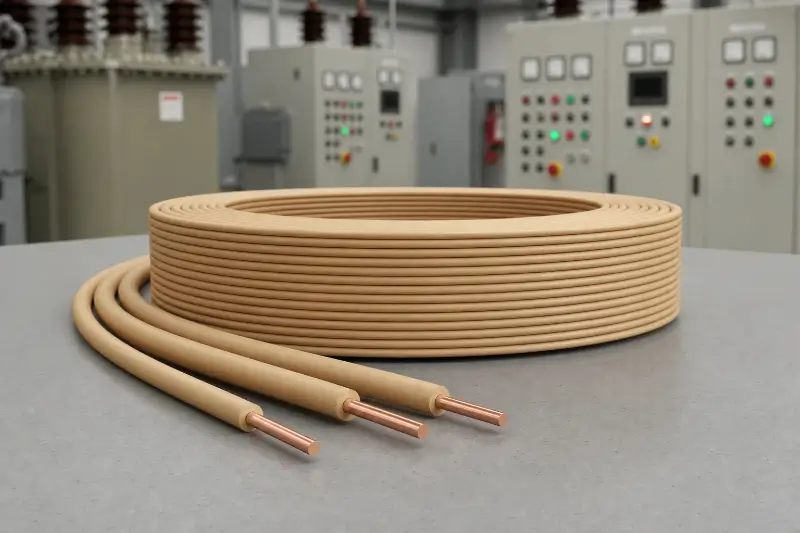
Dielectric performance is a core requirement for paper-covered magnet wire used in large-capacity transformers. Dielectric performance includes dielectric strength, dielectric loss, dielectric constant, and resistivity. Dielectric strength requires that the paper-oil composite insulation not experience breakdown under operating voltage, overvoltage, and impulse voltage. Dielectric loss requires that the dielectric loss tangent (tan δ) of the paper-oil composite insulation remain at a low level under operating voltage to ensure transformer operational efficiency.
Dielectric performance testing methods include power-frequency withstand voltage test, impulse voltage test, dielectric loss test, and partial discharge test. The dielectric performance of paper-covered winding wire for large-capacity transformers shall comply with the requirements of relevant standards such as IEC 60076 and GB/T 1094.
Thermal Performance Requirements
Thermal performance is a critical requirement for paper-covered magnet wire used in large-capacity transformers. Thermal performance encompasses heat aging resistance, thermal stability, and thermal cycling endurance. Heat aging resistance requires the paper-oil composite insulation to maintain dielectric strength and mechanical properties under prolonged high-temperature exposure; thermal stability requires the insulation not to degrade in performance at operating temperature and during transient temperature rises; and thermal cycling endurance requires the insulation not to degrade in performance under frequent load variations.
Thermal performance testing methods include accelerated aging tests, thermal shock tests, and thermal cycling tests. Accelerated aging tests are based on the Arrhenius kinetic model, wherein elevated test temperatures accelerate insulation aging to extrapolate the maximum operating temperature at standard service life.
Mechanical Property Requirements
Mechanical properties are critical performance requirements for paper-covered magnet wire used in large-capacity transformers. Mechanical properties include tensile strength, tear strength, abrasion resistance, and short-circuit resistance. Short-circuit resistance is a key mechanical performance indicator for paper-covered magnet wire used in large-capacity transformers, requiring the paper-oil composite insulation to withstand the electromagnetic forces generated during a short circuit without insulation failure.
Mechanical property testing methods include tensile strength testing, tear strength testing, bend testing, and short-circuit surge testing. Short-circuit surge testing is a critical test method for evaluating the short-circuit withstand capability of large-capacity transformers.
Chemical Property Requirements
Chemical resistance is a critical performance requirement for paper-covered magnet wire used in large-capacity transformers. Chemical resistance encompasses oil resistance, acid resistance, alkali resistance, and water resistance. Oil resistance requires the paper–oil composite insulation to maintain stable performance under long-term oil impregnation; acid resistance requires the insulation to maintain stable performance in acidic environments; alkali resistance requires the insulation to maintain stable performance in alkaline environments; and water resistance requires the insulation to maintain stable performance upon moisture ingress.
Chemical property testing methods include oil impregnation testing, acid/alkali immersion testing, and moisture content testing. The chemical properties of paper-covered magnet wire for large-capacity transformers must comply with the specific requirements of transformer design and operating environment.
Winding Structure and Insulation Coordination
Winding structure and insulation coordination are critical aspects in the design and manufacturing of large-capacity transformers.
Winding Structure Types
Winding configurations for large-capacity transformers include disc windings, continuous windings, helical windings, and interlaced windings. Disc windings are a common configuration for large-capacity transformers, comprising multiple disc coils connected in series, with each disc coil wound from multiple turns of rectangular wire. Continuous windings represent another common configuration for large-capacity transformers, consisting of continuously wound disc coils where inter-coil connections require no welding.
Helical winding is a common structure for the low-voltage side of large-capacity transformers; the winding consists of multiple parallel flat wires helically wound, offering a large cross-sectional area and excellent heat dissipation performance. Interleaved winding is a common structure for the high-voltage side of large-capacity transformers; the winding employs an interleaving process to increase inter-turn capacitance, thereby improving the impulse voltage distribution characteristics.
Longitudinal Insulation Design
Longitudinal insulation design is a core aspect of winding design for large-capacity transformers. The objective of longitudinal insulation design is to ensure insulation reliability within the winding—i.e., between turns, between layers, and between sections. Longitudinal insulation design must account for voltage distribution between turns, between layers, and between sections under operating voltage, lightning impulse voltage, and switching impulse voltage.
Longitudinal insulation design for large-capacity transformers requires technical measures such as interleaved windings, increased longitudinal capacitance, and graded insulation to improve impulse voltage distribution characteristics. Longitudinal insulation design must be coordinated with the insulation layer count of paper-covered magnet wire; the number of paper layers must satisfy the dielectric strength requirements of longitudinal insulation.
Cross-Insulation Design
Transverse insulation design is a critical aspect of winding design for large-capacity transformers. The objective of transverse insulation design is to ensure reliable insulation between windings and ground, between phases, and between windings. Transverse insulation design must account for electric field distribution under operating voltage, transient overvoltage, and lightning impulse voltage.
The transverse insulation design for large-capacity transformers requires a complete insulation system comprising insulating cylinders, insulating paperboard, electrostatic shields, molded insulation components, and corner rings. The transverse insulation design must be integrated with optimized electric field distribution to prevent insulation failure caused by electric field concentration.
Insulation Coordination Design
Insulation coordination design is a systematic engineering approach for winding design in large-capacity transformers. The objective of insulation coordination design is to harmonize the design of longitudinal insulation and transverse insulation, thereby ensuring that the overall insulation system is both economical and reliable. Insulation coordination design must be based on the transformer’s voltage class, capacity, application scenario, and reliability requirements, and must comprehensively evaluate various insulation design solutions.
Insulation coordination design for large-capacity transformers must consider multidimensional factors including safety margin, insulation aging, environmental conditions, and operating conditions. Insulation coordination design is one of the core technologies in the manufacturing of large-capacity transformers and requires extensive engineering experience and professional design tools.
Application Cases
Application cases help understand the practical application of paper-covered magnet wire for large-capacity transformers.
High-Voltage Main Transformer Case
A 220 kV high-voltage main transformer with a capacity of 240 MVA employs multi-layer cable paper-wrapped conductors for winding insulation. The low-voltage winding adopts a helical configuration using multiple parallel flat paper-wrapped conductors, while the high-voltage winding adopts an interlaced configuration using a single flat paper-wrapped conductor. The winding insulation system is completed by integration with insulating cylinders, insulating pressboard, electrostatic shields, and other components. The transformer is designed for a service life exceeding 30 years; long-term operational experience has fully validated the reliability of the paper-oil composite insulation system.
Ultra-High-Voltage Main Transformer Case Study
A 500 kV ultra-high-voltage main transformer with a capacity of 1,000 MVA employs multi-layer cable paper-wrapped conductors combined with polyester film-paper composite insulation for its windings. The low-voltage side uses helical windings or transposed conductor windings, while the high-voltage side adopts interlaced windings or internally shielded windings. The winding insulation, together with complex insulating cylinders, insulating pressboard, electrostatic shields, molded insulating components, and corner rings, forms a complete insulation system. The transformer is designed for a service life exceeding 40 years; operational experience with ultra-high-voltage main transformers fully validates the reliability of the paper-oil composite insulation system under high-voltage, high-capacity conditions.
UHV Main Transformer Case
A 1,000 kV ultra-high-voltage (UHV) main transformer, with a capacity ranging from 1,000 MVA to 4,000 MVA, employs a multi-layer composite insulation system comprising cable paper and polyester film paper for its windings. The insulation structure of UHV main transformers is extremely complex, featuring a large number of insulation layers, integrated with precisely engineered insulation cylinders, insulation pressboard, electrostatic shields, molded insulation components, and corner rings to form a sophisticated, fully integrated insulation system. The design service life of UHV main transformers exceeds 40 years, representing the most demanding application scenario for high-capacity transformers.
Long-term Reliability Assurance
Long-term reliability assurance is a core issue for large-capacity transformer applications.
Oil Impregnation Process Assurance
Oil impregnation is a critical process ensuring the long-term reliability of large-capacity transformers. A standardized oil impregnation process effectively removes moisture and gases from insulation paper and windings, ensuring the dielectric strength and long-term stability of the paper-oil composite insulation. Large-scale vacuum pressure impregnation (VPI) is the standard oil impregnation process for large-capacity transformers.
Key parameters of the oil impregnation process include vacuum level, temperature, time, and pressure. The vacuum level must reach a high value (typically above 100 Pa); the temperature must be determined based on the characteristics of the insulation paper and transformer oil; the time must ensure thorough impregnation; and the pressure must promote deep oil penetration. Strict adherence to the oil impregnation process specifications is critical to ensuring long-term reliability of large-capacity transformers.
Transformer Oil Quality Assurance
Transformer oil is a critical material for the long-term reliability of large-capacity transformers. The dielectric strength, chemical stability, and thermal stability of transformer oil directly affect the long-term reliability of paper-oil composite insulation. High-quality transformer oil must exhibit high dielectric strength, low water content, low gas content, low acid number, high chemical stability, and high thermal stability.
Quality control of transformer oil includes new oil acceptance, in-service oil monitoring, and oil processing and filtration. In-service oil monitoring is a critical measure for ensuring the long-term operation of transformers, involving periodic testing of key parameters such as dielectric strength, water content, gas content, acid number, and dissolved gases. Oil processing and filtration restore the performance of transformer oil and constitute an essential part of transformer maintenance.
Insulation Inspection and Maintenance
Insulation testing and maintenance are critical to ensuring the long-term reliability of large-capacity transformers. Insulation testing comprises electrical tests—including insulation resistance, polarization index (PI), dielectric loss factor (tan δ), and partial discharge—and chemical tests—including dissolved gas analysis (DGA) in oil, oil moisture content, and acid number. Insulation testing enables timely identification of insulation defects, thereby preventing insulation failure.
Operation and maintenance of transformers require the establishment of a comprehensive O&M system, including periodic testing, condition monitoring, fault diagnosis, and maintenance. Standardized operation and maintenance can extend transformer service life and ensure long-term reliable operation.
Online Monitoring Technology
Online monitoring technology is a modern approach to ensuring the long-term reliability of large-capacity transformers. Online monitoring technologies include online dissolved gas analysis (DGA) in oil, online partial discharge (PD) monitoring, online oil temperature monitoring, and online winding temperature monitoring. These technologies enable real-time detection of insulation hazards and provide early warnings of impending insulation failure.
High-end large-capacity transformers are equipped with comprehensive online monitoring systems. The application of online monitoring systems represents a key direction for intelligent operation and maintenance of large-capacity transformers, significantly enhancing transformer operational reliability and maintenance efficiency.
Quality Control
Quality control is a critical step in the application of paper-covered magnet wire for large-capacity transformers.
Raw Material Quality Control
Raw material quality control is the origin of quality control. Raw material quality control encompasses conductor material quality control, insulating paper quality control, and transformer oil quality control. Conductor materials must comply with design requirements for composition, purity, mechanical properties, and electrical conductivity. Insulating paper must comply with design requirements for fiber structure, purity, thickness, density, oil absorption performance, and dielectric properties. Transformer oil must comply with design requirements for dielectric strength, chemical stability, and thermal stability.
Manufacturing Process Quality Control
Manufacturing process quality control is a critical component of overall quality control. It encompasses conductor drawing and annealing quality control, paper-layer winding quality control, and in-process quality inspection. Conductor drawing and annealing must ensure compliance with specified requirements for cross-sectional dimensions, surface quality, mechanical properties, and electrical conductivity. Paper-layer winding must meet design specifications for number of paper layers, tension, overlap ratio, and visual appearance.
Finished Product Quality Inspection
Finished product quality inspection is the final stage of quality control. It encompasses visual inspection, dimensional inspection, electrical testing, mechanical testing, and chemical testing. Visual inspection includes paper layer integrity, paper layer uniformity, paper layer surface finish, and conductor surface quality. Dimensional inspection covers outer diameter, width, thickness, and ovality. Electrical testing includes dielectric strength, dielectric loss, and insulation resistance. Mechanical testing includes tensile strength, elongation, bendability, and paper layer adhesion. Chemical testing includes moisture content, acid number, and ash content.
After passing final quality inspection, the product is stored in the warehouse together with a Certificate of Conformance and Quality Certification Documents. The Quality Certification Documents must record raw material inspection data, in-process quality inspection data, and final product quality inspection data to ensure full product traceability.
Conclusion
The engineering implications of paper-covered wire for large-capacity transformers encompass eight core engineering dimensions: (1) special requirements of large-capacity transformers for paper-covered wire—namely, high dielectric strength, high thermal endurance, high mechanical strength, large conductor cross-sectional area, and long-term reliability; (2) application domains of paper-covered wire in large-capacity transformers—i.e., high-voltage main transformers, extra-high-voltage (EHV) main transformers, ultra-high-voltage (UHV) main transformers, and special large-capacity transformers; (3) key technologies for paper-covered wire used in large-capacity transformers—covering insulation paper technology, conductor technology, winding process technology, insulation structure technology, and oil-impregnation process technology; (4) critical performance requirements—dielectric performance, thermal performance, mechanical performance, and chemical performance; (5) winding structure and insulation coordination—including winding structure types, longitudinal insulation design, transverse insulation design, and insulation coordination design; (6) application cases—high-voltage main transformers, extra-high-voltage (EHV) main transformers, and ultra-high-voltage (UHV) main transformers; (7) long-term reliability assurance—oil impregnation process assurance, transformer oil quality assurance, insulation testing and maintenance, and online monitoring technology; and (8) quality control—raw material quality control, in-process manufacturing quality control, and finished-product quality inspection.
The paper–oil composite insulation system is a classic solution for winding insulation in large-capacity transformers and serves as a critical guarantee for the long-term reliable operation of high-voltage (HV), extra-high-voltage (EHV), and ultra-high-voltage (UHV) large-capacity transformers. Large-capacity transformers impose extremely stringent requirements on paper-covered magnet wire regarding dielectric strength, thermal endurance, mechanical strength, and long-term reliability; therefore, the selection, application, and quality control of paper-covered magnet wire must strictly comply with established specifications.
With the development of power systems, construction of ultra-high-voltage (UHV) and extra-high-voltage (EHV) transmission networks, and grid integration of new energy generation, the application of large-capacity transformers will continue to grow. Manufacturers of large-capacity transformers must continuously optimize paper-wrapped wire technology, deepen research on insulation structures, and enhance process control capabilities to deliver higher-performance, more reliable large-capacity transformer products for power systems.