

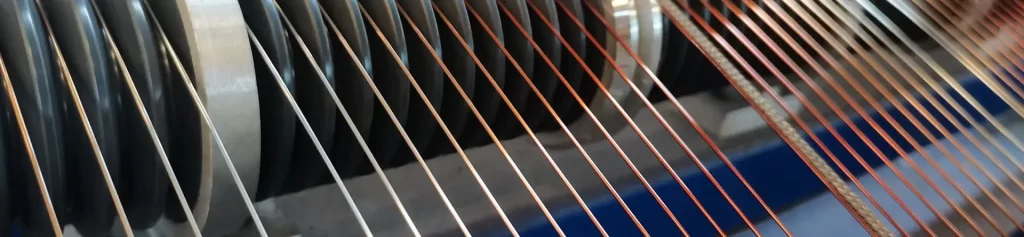
Oxygen Free Flat Enameled Copper Wire EV Drive System
I. Introduction
Electric vehicles (EV), as the core direction of transformation and upgrading in the automotive industry, have developed rapidly globally in recent years. The drive system, as the “heart” of electric vehicles, directly determines the vehicle’s power performance, energy efficiency level, and cruising range.
The drive motor is the core component of an electric vehicle’s drive system. Its power density, efficiency, and reliability are directly affected by the winding material. Oxygen free flat enameled copper wire, with its excellent electrical conductivity, superior thermal dissipation characteristics, and high fill factor advantages, has become the ideal choice for electric vehicle drive motor windings.
This article systematically elaborates on the basic concepts, technical advantages, specific applications in electric vehicle drive systems, and selection points of oxygen free flat enameled copper wire, providing professional reference for electric vehicle drive system design engineers and motor manufacturers.
II. Basic Concepts of Oxygen Free Flat Enameled Copper Wire
2.1 Definition
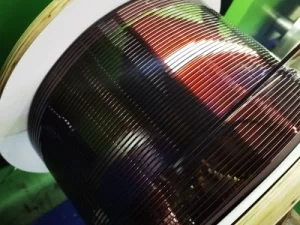
Oxygen free flat enameled copper wire is an enameled copper wire product formed into a flat cross-section through specific processes, using high-purity oxygen-free copper as the conductor material. The conductor purity is typically above 99.99%, with oxygen content below 10 ppm, ensuring excellent electrical conductivity.
The cross-section of flat enameled wire is rectangular or rounded rectangular. Compared with round enameled wire, it has a higher slot fill rate and better heat dissipation performance in specific applications.
2.2 Differences from Round Enameled Wire
| Comparison Items | Oxygen Free Flat Enameled Copper Wire | Round Enameled Copper Wire |
|---|---|---|
| Cross-Section Shape | Rectangular/rounded rectangular | Circular |
| Slot Fill Rate | Can reach over 90% | Typically 60% – 75% |
| Heat Dissipation Performance | Superior longitudinal heat dissipation channels | Heat dissipation depends on contact area |
| Skin Effect | More favorable at specific frequencies | Significant skin effect at high frequencies |
| Applicable Scenarios | Low-noise motors with regular slot shapes | General-purpose motor windings |
2.3 Advantages of Oxygen-Free Copper
- High Conductivity: The conductivity of oxygen-free copper can reach over 101% IACS, higher than ordinary electrolytic copper, reducing I²R losses.
- Low Oxygen Content: Oxygen content below 10 ppm reduces oxidation impurities and improves material purity.
- Excellent Ductility: Easy to process into flat cross-sections with good machining performance.
- Good Solderability: Clean oxygen-free copper surface makes welding quality easier to control.
III. Core Technical Advantages in EV Drive Systems
3.1 High Conductivity Improves Efficiency
Electric vehicle drive motors have extremely high efficiency requirements, directly affecting cruising range.
- Reduced Copper Loss: The high conductivity of oxygen-free copper can effectively reduce the I²R loss of motor windings, achieving higher efficiency at the same power.
- Reduced Heat Generation: Lower copper loss means less heat generation, helping to reduce motor temperature rise and extend insulation life.
- Improved Power Density: Under the same heat dissipation conditions, it can withstand greater current density, achieving higher power density.
3.2 Flat Structure Optimizes Design
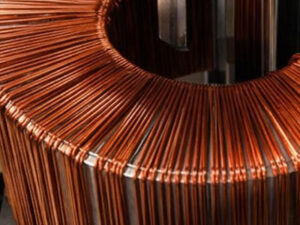
The unique structure of flat enameled wire brings significant advantages to electric vehicle drive motor design.
- Ultra-High Slot Fill Rate: Flat wire can more tightly fill motor slots, with slot fill rates reaching over 90%, an improvement of 15% – 25% compared to round wire.
- Reduced Motor Size: High slot fill rate allows more conductors to be placed in the same volume, or significantly reduces motor size while maintaining the same performance.
- Reduced Harmonic Loss: The skin effect of flat wire performs differently at different frequencies, which can reduce harmonic loss in certain designs.
3.3 Excellent Heat Dissipation Performance
Temperature rise control is a key challenge for drive motors operating at high speeds and frequent acceleration/deceleration conditions.
- Longitudinal Heat Dissipation Channels: The inter-layer channels formed by stacked flat wire provide effective flow paths for cooling media.
- Increased Heat Dissipation Area: The flat structure provides a larger conductor surface area to volume ratio, improving heat dissipation efficiency.
- Reduced Thermal Resistance: Optimized heat dissipation paths allow heat to transfer to the motor housing faster, reducing motor temperature rise.
3.4 High Temperature and Thermal Resistance
Electric vehicle drive motors typically require high power density output, placing higher demands on the thermal resistance of insulation materials.
Flat enameled wire can use Class F (155°C) or Class H (180°C) thermal class insulating varnish to meet the high-temperature operating environment requirements of drive motors.
Some high-end applications use Polyimide (PI) or Polyamide-Imide (PAI) insulation coatings, with thermal class reaching above 200°C.
IV. Key Parameter Requirements
4.1 Conductor Specification Parameters
| Parameter | Requirements | Description |
|---|---|---|
| Conductor Material | Oxygen-free copper, purity ≥99.99% | Ensure high conductivity |
| Oxygen Content | ≤10 ppm | Low oxygen standard |
| Conductivity | ≥101% IACS | Reduce copper loss |
| Cross-Section Size | Thickness 0.5 mm – 3.0 mm | Customizable |
| Cross-Section Width | 2.0 mm – 15.0 mm | Customizable |
| Tolerance | ±0.02 mm | High precision control |
4.2 Insulation Performance Parameters
| Parameter | Requirements | Description |
|---|---|---|
| Dielectric Strength | ≥100 kV/mm | Ensure insulation reliability |
| Dielectric Loss Factor | ≤0.015 (at 90°C) | Reduce dielectric loss |
| Insulation Resistance | ≥10¹² Ω·cm | Ensure isolation effect |
4.3 Thermal Class Selection
| Thermal Class | Temperature Limit | Recommended Applications |
|---|---|---|
| Class F | 155°C | Standard EV drive motors |
| Class H | 180°C | High power density motors |
| Class C | Above 200°C | Special high-temperature applications |
V. Specific Applications in EV Drive Systems
5.1 Drive Motor Windings
- Permanent Magnet Synchronous Motors (PMSM): The high slot fill rate of flat enameled wire can significantly improve power density, making it the mainstream choice for new energy vehicle drive motors.
- Induction Motors (IM): Widely used in high-power commercial vehicle drive motors, with the flat structure benefiting heat dissipation and copper loss reduction.
- Switched Reluctance Motors (SRM): Used in some special electric vehicles, with the flat structure helping to improve saliency ratio.
5.2 Power Electronics Components
- IGBT Module Heat Dissipation: Although not part of windings, oxygen-free copper materials are also used in power electronics heat dissipation.
- Bus Bars: Thick copper bars connecting battery packs and motor controllers require high-conductivity flat copper materials.
5.3 Auxiliary Motor Systems
- Electric Compressors: Vehicle electric air conditioning compressor motors use small-sized flat enameled wire.
- Power Steering Pumps: Electric power steering system motors.
- Cooling Fan Motors: Drive motor and battery thermal management system fan motors.
VI. Selection Guide
6.1 Selection Based on Power Level
| Power Level | Recommended Cross-Section Size | Thermal Class | Description |
|---|---|---|---|
| Micro-power (≤1 kW) | Thickness 0.5 mm – 1.0 mm | Class B/F | Small auxiliary motors |
| Medium-power (1 kW – 20 kW) | Thickness 1.0 mm – 2.0 mm | Class F | Passenger vehicle drive motors |
| High-power (20 kW – 200 kW) | Thickness 2.0 mm – 3.0 mm | Class F/H | Commercial vehicle drive motors |
| Ultra-high-power (>200 kW) | Thickness above 3.0 mm | Class H/C | Heavy trucks/special vehicles |
6.2 Selection Based on Slot Structure
- Low-Noise Design: Prioritize rounded rectangular cross-sections to reduce sharp corner discharge.
- High Slot Fill Rate Requirement: Choose rectangular cross-sections to maximize slot area utilization.
- Heat Dissipation Priority Design: Choose thin and wide cross-sections to increase heat dissipation area.
6.3 Selection Based on Environmental Conditions
- High-Temperature Environment: Choose Class H or higher thermal class.
- High-Vibration Environment: Choose insulation varnish types with good flexibility.
- High-Altitude Environment: Consider appropriately increasing insulation thickness.
VII. Conclusion
Oxygen free flat enameled copper wire, as a core winding material for electric vehicle drive motors, has become a key technical pathway for improving drive motor power density and efficiency with its three core advantages of high conductivity, ultra-high slot fill rate, and excellent heat dissipation performance.
With the increasing pursuit of high power density, high efficiency, and miniaturization in electric vehicle drive systems, the application of oxygen free flat enameled copper wire will become increasingly widespread. Upstream manufacturers should continuously improve the purity of oxygen-free copper materials and flat wire process levels to provide higher-performance product support for the electric vehicle industry.
Zhengzhou LP Industry Co., Ltd. is a professional manufacturer specializing in the R&D, production, and sales of magnetic wire for over 30 years. Our oxygen free flat enameled copper wire products use high-purity oxygen-free copper above 99.99%, with conductivity reaching 101% IACS. Cross-section sizes can be customized according to customer requirements, widely used in electric vehicle drive motors, power electronics equipment, and other fields.
Our factory is certified by ISO9001/ISO14001/ISO45001, and our products comply with IEC/GB/JIS/NEMA international standards, and have been exported to over 50 countries and regions worldwide.
Contact us for a professional quote:
Email: office@cnlpzz.com | WhatsApp: 0086-19337889070