


1 Introduction
The price of enameled copper wire is determined by a combination of factors, including conductor material cost, enamelled coating material cost, manufacturing process cost, and specifications premium. The price difference between ordinary enameled copper wire and high-temperature resistance enameled copper wire is primarily driven by three factors: the enamelled coating system, the heat rating, and the number of enamelled coating layers. Ordinary enameled copper wire typically uses polyurethane or polyester enamelled coating, with a heat rating of 130 to 155 degrees Celsius and a single-layer coating process; high-temperature resistance enameled copper wire typically uses high-end enamelled coatings such as polyester imide, polyamide-imide, and polyimide, with a heat rating of 180 to 240 degrees Celsius and a single or double-layer coating process.
Understanding the price differences between ordinary enameled copper wire and high-temperature resistance enameled copper wire is crucial for purchasing engineers, cost controllers, and technical decision-makers. This article, based on NEMA MW 1000-2018, IEC 60317 series, and raw material market conditions, systematically elucidates the price differences between ordinary enameled copper wire and high-temperature resistance enameled copper wire from five dimensions: the cost structure of the enameled system, the price spectrum of thermal grades, factors influencing price, the purchasing decision framework, and price risk management. This provides a systematic reference for purchasing parties and decision-makers.
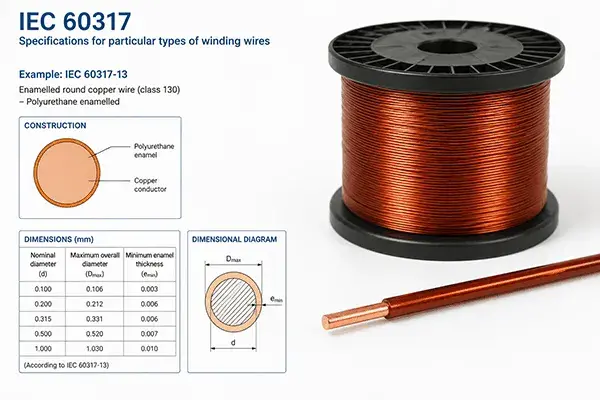
2. Cost Structure of the enamel coating System
2.1 Classification of enamel coating materials
Enamelled copper wire coating materials can be classified according to their chemical composition into polyurethane enamel, polyester enamel, polyester imide enamel, polyamide-imide enamel, and polyimide enamel, etc. The raw material costs of different enamel coating materials vary significantly, directly affecting the ex-factory price of enamelled copper wire.
Polyurethane coatings are synthesized by reacting polyols with isocyanates, resulting in lower raw material costs and making them the most affordable type of enameled wire coating. Polyurethane enameled wire coatings offer excellent solderability and low-temperature curing properties, making them the mainstream enameled wire coating for heat ranges of 130 to 155 degrees Celsius.
Polyester enamel coating is synthesized through the condensation reaction of polyols and polyacids, and its raw material cost is slightly higher than that of polyurethane enamel coating. Polyester enamel coating has good heat resistance, mechanical strength, and chemical stability, and is a commonly used enamel coating for 155°C heat-grade enameled wire.
Polyester-imine coatings incorporate an imine structure into polyester coatings, resulting in significantly higher raw material costs. Polyester-imine enamel coatings possess excellent heat resistance, mechanical strength, and thermal shock resistance, making them the mainstream enamel coating for 180°C heat-rated wires.
Polyamide-imide paint is synthesized by reacting diacid anhydrides and diamines, resulting in high raw material costs. Polyamide-imide coatings possess superior heat resistance, mechanical strength, chemical stability, and freezer resistance, making them a high-end coating suitable for 200-220 degree Celsius heat ratings and composite coating layers.
Polyimide enamel coating is synthesized by reacting pyromellitic phthalic anhydride with diamine, resulting in the highest raw material cost. Polyimide enamel coating possesses extremely excellent heat resistance, mechanical strength, radiation resistance, and chemical resistance, making it a dedicated enamel coating for wires with a heat rating of 240 degrees Celsius and above.
2.2 Price Gradient of enamel coating Materials
The market price gradient for enamel coating materials is roughly as follows:
Polyurethane varnish: This is the benchmark price level and the lowest priced variety among enameled wire and enamel coatings. The market price is approximately RMB 40 to 80 per kilogram, depending on the brand, specifications, and purchase quantity.
Polyester paint: 1.3 to 1.8 times the benchmark price. Market price is approximately RMB 60 to 130 per kilogram.
Polyester paint: 1.8 to 2.5 times the benchmark price. Market price is approximately RMB 80 to 200 per kilogram.
Polyamide-imide paint: 2.5 to 4 times the benchmark price. Market price is approximately RMB 120 to 320 per kilogram.
Polyimide paint: 4 to 8 times the benchmark price. Market price is approximately RMB 200 to 600 per kilogram, making it the most expensive type of enamel coating.
2.3 Cost Breakdown of enamel coating Material
The proportion of enamel coating material cost in the total cost of enameled copper wire depends on the enamel coating grade, the number of enamel coating layers, and conductor specifications.
Ordinary enameled copper wire: polyurethane or polyester enamel coating, the material cost of enamel coating accounts for 15% to 25% of the total cost of enameled copper wire.
Mid-range enameled copper wire: polyester imide enamel coating, the material cost of enamel coating accounts for 25% to 35% of the total cost of enameled copper wire.
High-end enameled copper wire: polyamide-imide or polyimide coating, the cost of which accounts for 30% to 50% of the total cost of enameled copper wire.
The main reason for the high price of high temperature resistance enameled copper wire is that the cost of enameled material accounts for a large proportion of the total cost, and the unit price of enameled material is also high.
3 Price Spectrum of Heat Grades
3.1 Correspondence between thermal level and enamel coating system
According to NEMA MW 1000-2018 and IEC 60317 standards, the standard correspondence between thermal rating and enamel coating system is as follows:
Grade 130, Class B: polyurethaneenamel coating or polyesterenamel coating, main standard numbers MW 24, MW 26, IEC 60317-1, IEC 60317-11.
155 Grade F: polyurethaneenamel coating, polyesterenamel coating or polyesterimineenamel coating, main standard numbers MW 79, MW 80, IEC 60317-20, IEC 60317-21, IEC 60317-35.
Grade 180, Class H: polyester imide enamel coating or polyamide-imide enamel coating, main standard numbers MW 26, MW 27, IEC 60317-8, IEC 60317-13.
Grade 200, Grade N: polyester imide-coated polyamide-imide composite enamel coating, main standard numbers MW 35, MW 36, IEC 60317-13.
220 Grade R: Polyamide-imide (enamel coating), main standard numbers MW 51, IEC 60317-15, IEC 60317-26.
Grade 240, Class C: Polyimide (enamel coating), main standard numbers MW 42, IEC 60317-7, IEC 60317-46.
3.2 Price Range for Each Heat Grade
Based on the 2026 bulk commodity market conditions, the price ranges for various heat-resistant enameled copper wires are roughly as follows:
Grade 130B: Benchmark price level, approximately RMB 70,000 to 90,000 per ton.
Grade 155, Grade F: 1.2 to 1.5 times the benchmark price, approximately RMB 85,000 to 135,000 per ton.
Grade 180 H: 1.5 to 2.0 times the benchmark price, approximately RMB 105,000 to 180,000 per ton.
Grade 200, Grade N: 2.0 to 3.0 times the benchmark price, approximately RMB 140,000 to 270,000 per ton.
Grade 220 R: 2.5 to 4.0 times the benchmark price, approximately RMB 175,000 to 360,000 per ton.
Grade 240, C: 4.0 to 8.0 times the benchmark price, approximately RMB 280,000 to 720,000 per ton.
The above price range is for reference only. Actual prices may fluctuate due to various factors such as conductor specifications, number of enamel coating layers, purchase volume, brand, and market supply and demand.
3.3 Analysis of Price Differences by Heat Grade
The core drivers of price differences based on heat grade include:
The cost of enamel coating materials increases with the heat rating. Polyimide enamel is 4 to 8 times more expensive than polyurethane enamel.
enamel coating Coating process cost: High-temperature enamel coating requires higher curing temperatures, longer curing times, and more precise process control, resulting in increasing process costs.
enamel coating thickness difference: High temperature enamel coating is usually thicker, enamel coating consumes more enamel coating material, and enamel coating cost per unit length is higher.
enamel coating Defect rate difference: The coating process of high temperature enamel coating is more difficult, the defect rate is slightly higher than that of ordinary enamel coating, and the pass rate is slightly lower.
quality inspection cost difference: High-temperature enamel coating requires more inspection items and stricter inspection standards, resulting in increased quality inspection costs.
For each level of thermal performance improvement, the price of enameled copper wire increases by approximately 20% to 50%, depending on the leap in the enamel coating system and technological barriers.
4 Factors Affecting Prices
4.1 Conductor Specifications Factors
Conductor specifications have a significant impact on the price of enameled copper wire. Conductor specifications include conductor diameter, conductor purity, and conductor shape.
Conductor diameter: The smaller the diameter, the more enamel coating material is consumed per unit length, and the higher the proportion of enamel coating material cost. For micro-enameled wires with diameters of 0.05 to 0.20 mm, the enamel coating material cost can account for 30% to 50%, resulting in a higher price.
Conductor purity: TU1 oxygen-free copper has a copper content of not less than 99.97%, and its price is higher than that of T2 ordinary electrolytic copper, which has a copper content of not less than 99.90%. TU1 oxygen-free copper is 5% to 15% more expensive than T2 ordinary electrolytic copper.
Conductor form: Flat enameled copper wire is 20% to 50% more expensive than round enameled copper wire due to the complex processing technology and difficulty in applying the rectangular cross-section.
4.2 Number of enamel coating layers
The number of enamel coating layers has a significant impact on the price of enameled copper wire. Double-layer enameled copper wire, due to the two coating and two curing processes, consumes approximately 1.5 to 2.0 times more enamel coating material, resulting in increased manufacturing costs.
The price of single-layer enameled copper wire is the base price. Double-layer enameled copper wire is 20% to 50% more expensive than single-layer enameled copper wire, depending on the enameled material composition and thickness ratio.
Composite enameled copper wire, i.e., double-layered with different enamel coatings, is significantly more expensive than double-layered enameled copper wire with the same enamel coating. The difference mainly lies in the cost of the surface layer enameled material.
4.3 Purchasing Quantity Factors
Purchase volume is a significant factor influencing the price of enameled copper wire. A manufacturer’s fixed costs, such as equipment depreciation, R&D investment, and management expenses, need to be allocated to each unit of product. The larger the purchase volume, the lower the allocation per unit, and the more favorable the price.
Small-batch purchases, with a single batch of less than 100 kg, usually do not offer price discounts.
For medium-volume purchases, a single batch of 100 to 1000 kilograms can usually get a price discount of 5% to 15%.
Bulk purchases, with single batches of 1000 kg or more, typically qualify for price discounts of 15% to 30%.
Strategic cooperation procurement, annual agreements, and stable orders typically offer price discounts of 20% to 40%.
4.4 Brand Factors
The brand of enameled copper wire has a significant impact on its price. Internationally renowned brands such as Heraeus (Germany), Essex (Japan), Furukawa (Japan), and LS (Korea) produce enameled copper wires that are significantly more expensive than those from ordinary brands.
The price of internationally renowned brand enameled copper wire is usually 1.5 to 3.0 times that of ordinary domestic brand enameled copper wire. The difference mainly lies in the brand premium, the quality stability premium, and the after-sales service premium.
The price of domestically produced high-end brand enameled copper wire falls between that of international brands and ordinary brands, offering relatively high cost-performance.
4.5 Market Supply and Demand Factors
The price of enameled copper wire is significantly affected by market supply and demand. Fluctuations in copper prices, enamel prices, energy prices, and transportation costs all influence the price of enameled copper wire.
Copper price is the core variable for enameled copper wire price. When copper price rises, enameled copper wire price rises accordingly; when copper price falls, enameled copper wire price falls accordingly. Under the commodity market conditions of 2026, copper price is approximately RMB 90,000 to 100,000 per ton, and enameled copper wire price is highly correlated with copper price.
Fluctuations in enamel prices are another important variable in the price of enameled copper wire. The market prices of polyurethane enamel, polyester enamel, and polyester imide enamel are affected by the prices of petrochemical raw materials. When oil prices rise, enamel prices rise, and consequently, enameled copper wire prices rise.
5 Price Characteristics of Ordinary Enameled Copper Wire
5.1 Definition of Ordinary Enameled Copper Wire
Ordinary enameled copper wire refers to standard enameled copper wire coated with polyurethane or polyester enamel, with a heat rating of 130 to 155 degrees Celsius, a single-layer coating process, and conductor diameters of 0.20 to 2.50 mm. Ordinary enameled copper wire is the mainstream choice for applications such as small and medium-sized motors, home appliances, and consumer electronics.
5.2 Price Range of Ordinary Enameled Copper Wire
Based on the 2026 commodity market conditions, the reference price range for ordinary enameled copper wire is as follows:
polyurethane enameled copper wire, grade 130: approximately RMB 70,000 to 85,000 per ton.
polyurethane enameled copper wire, grade 155: approximately RMB 80,000 to 100,000 per ton.
Polyester enameled copper wire, grade 155: approximately RMB 85,000 to 110,000 per ton.
polyester Imine enameled copper wire, grade 155, is at the low end of the H grade boundary: approximately RMB 100,000 to 130,000 per ton.
The prices listed above are reference prices for standard conductors, standard enamel coating thickness, and common domestic brands. Actual prices may vary depending on specifications, brand, purchase volume, and other factors.
5.3 Price Characteristics of Ordinary Enameled Copper Wire
The price characteristics of ordinary enameled copper wire include:
Price fluctuations are small: the market supply of polyurethane and polyester enamel is stable and the price fluctuations are small, while the price of ordinary enameled copper wire is relatively stable.
Intense price competition: The market for ordinary enameled copper wire has many participants, resulting in fierce price competition and low profit margins.
Low brand premium: Ordinary enameled copper wire has a relatively low brand premium, and the price difference between domestic ordinary brands and international brands is relatively small.
The premium is low: the price difference between regular enameled copper wire and ordinary copper wire is small, while special wires such as ultra-fine wire and micro-heavy duty wire have a certain premium.
6 {High Temperature Resistance} Enamelled Copper Wire Price Characteristics
6.1 Definition of high temperature resistance enameled copper wire
High-temperature resistance enameled copper wire refers to enameled copper wire coated with high-end enamel coatings such as polyester imide enamel, polyamide-imide enamel, or polyimide enamel, with a heat rating of 180 to 240 degrees Celsius, using single-layer or double-layer coating processes. High-temperature resistance enameled copper wire is the mainstream choice for applications such as large motors, traction motors, high-voltage transformers, and new energy vehicle drive motors.
6.2 Price Range of {High Temperature Resistance} Enameled Copper Wire
Based on the 2026 commodity market conditions, the reference price range for high temperature resistance enameled copper wire is as follows:
Polyester-coated copper wire, grade 180: approximately RMB 105,000 to 160,000 per ton.
polyester Imine-coated polyamide-imide enameled copper wire, grade 200: approximately RMB 140,000 to 220,000 per ton.
Polyamide-imide enameled copper wire, grade 220: approximately RMB 175,000 to 300,000 per ton.
Polyimide enameled copper wire, grade 240: approximately RMB 280,000 to 720,000 per ton.
The prices listed above are reference prices for standard conductors, double-coated processes, and ordinary domestic brands. Internationally renowned brands of enameled copper wire typically add a 50% to 100% brand premium to these prices.
6.3 Price Characteristics of {High Temperature Resistance} Enameled Copper Wire
The price characteristics of high-temperature-resistant enameled copper wire include:
Price fluctuations are significant: There are fewer participants in the high-end enamel coating material market, resulting in relatively large price fluctuations.
High technical barriers: The synthesis and application of high temperature resistanceenamel coating have high technical barriers, there are few qualified suppliers, and the market concentration is high.
High brand premium: Internationally renowned brands of high temperature resistance enameled copper wire command significant premiums, and their technical services also command higher premiums.
Significant premium for special high-temperature resistance enameled copper wires, such as fine high-temperature resistance wires and large-section high-temperature resistance wires.
Double coating premium: Double-coated (high temperature resistance) enameled copper wire is priced 20% to 50% higher than single-coated wire.
7 Procurement Decision Framework
7.1 Decision Factors
The purchasing decision between ordinary enameled copper wire and high temperature resistance enameled copper wire should be based on a comprehensive evaluation of the following factors:
Operating temperature: For actual operating temperatures below 130 degrees Celsius, use grade 130 wire; below 155 degrees Celsius, use grade 155 wire; below 180 degrees Celsius, use grade 180 wire; and above 200 degrees Celsius, use grade 200 wire or higher.
Reliability requirements: Ordinary household appliances and consumer electronics have medium reliability requirements and use ordinary wire; small and medium-sized motors and industrial control systems have high reliability requirements and use mid-range wire; large motors, traction motors, medical and military applications have high reliability requirements and use high-end wire.
Application Scenarios: The characteristics of the application environment determine the requirements for thermal rating, chemical properties, and mechanical properties of the enameled wire. For refrigerant environments, refrigerant-resistant enameled wire should be selected; for oil-based environments, oil-resistant enameled wire should be selected; and for high-frequency environments, low-loss enameled wire should be selected.
Economic cost: When the cost budget is sufficient, prioritize the use of high-end enameled wire with matching performance; when the cost budget is tight, prioritize the use of mid-range or low-end enameled wire with matching performance.
Supplier evaluation: A comprehensive assessment of supplier qualifications, production capacity, quality control, after-sales service, price level, etc.
7.2 Decision Matrix
Based on the above decision factors, a procurement decision matrix is established for ordinary enameled copper wire and high temperature resistance enameled copper wire:
Scenario 1: Motors for household appliances, air conditioners, refrigerators, and washing machines. Operating temperature below 130 degrees Celsius, moderate reliability requirements, cost sensitive. Decision: Use polyurethane enameled copper wire, grade 130 to 155.
Scenario 2: Small to medium-sized industrial motors, servo motors, and transformers. Operating temperature 130 to 155 degrees Celsius, high reliability requirements, and moderate cost. Decision: Use polyester or polyester imide enameled copper wire, grade 155 to 180.
Scenario 3: Large motors, traction motors, wind power, and new energy vehicle drive motors. Operating temperature 155 to 200 degrees Celsius, high reliability requirements, cost not critical. Decision: Use polyamide-imide enameled copper wire, grade 180 to 220.
Scenario 4: Extreme high-temperature scenarios, military, nuclear power, aerospace. Operating temperatures above 200 to 240 degrees Celsius, extremely high reliability requirements, and minimal cost sensitivity. Decision: Use polyimide enameled copper wire of grade 240 or higher.
7.3 Total Cost of Ownership Analysis
Purchasing decisions for enameled copper wire should be based on total cost of ownership (TCO) analysis, not just unit price comparison. TCO includes procurement costs, winding manufacturing costs, operation and maintenance costs, and failure loss costs.
While high-temperature-resistant enameled copper wire has a higher unit price, it may offer the following total cost of ownership advantages:
Improved winding reliability: The reliability of high temperature resistance enameled wire is significantly better than that of ordinary enameled wire, which can significantly reduce the probability of winding failure.
Extended winding life: The design life of the high temperature resistance enameled wire is longer, which can significantly extend the service life of the winding.
Reduced maintenance costs: The failure probability of high temperature resistance enameled wire is low, significantly reducing winding maintenance costs.
Reduced failure losses: high temperature resistanceenameled wire can significantly reduce equipment damage, production losses, safety accidents, etc. caused by winding failure.
Total cost of ownership analysis shows that, in applications requiring high temperature resistance, high reliability, and high safety, although the unit price of high temperature resistance enameled copper wire is higher, the total cost of ownership may be lower, making it a more economical choice.
8 Price Risk Management
8.1 Price Fluctuation Risk
The price of enameled copper wire is affected by various factors such as copper prices, enamel prices, energy prices, and transportation costs, and is subject to significant price fluctuation risks. Under the current market conditions in 2026, copper prices are expected to fluctuate by 5,000 to 15,000 RMB per ton, significantly impacting the price of enameled copper wire.
Price volatility risk management strategies include:
Long-term contract pricing: Sign long-term supply agreements with high-quality suppliers to lock in medium- to long-term prices for key enameled wire products.
Phased procurement strategy: Procurement in batches according to the production plan to avoid the price risk of large-scale single-batch procurement.
Hedging strategy: For companies with large copper consumption, copper price hedging can be carried out through the futures market to lock in copper price costs.
Price early warning mechanism: Establish a price early warning mechanism to monitor fluctuations in copper and paint prices and adjust procurement strategies in a timely manner.
8.2 Supplier Risks
Risks associated with enameled copper wire suppliers include supply disruption risk, quality fluctuation risk, and price default risk.
Supply disruption risk: A single supplier may cause supply disruptions; a multi-supplier system should be established.
Quality fluctuation risk: The quality of enameled wire may vary between different suppliers and different batches. A strict incoming material inspection system should be established.
Price default risk: Suppliers may default when prices fluctuate significantly, which should be addressed through contractual terms.
Supplier risk management strategies include:
Multi-supplier system: Establish a system of 2 to 3 qualified suppliers to avoid dependence on a single supplier.
Supplier tiering: Suppliers are tiered based on their qualifications, historical performance, and quality performance, with higher-quality suppliers receiving more orders.
Strategic partnerships: Establish strategic partnerships with 1 to 2 high-quality suppliers to obtain price advantages and supply guarantees.
Supplier audit: Regularly audit suppliers’ qualifications, production capacity, and quality control.
8.3 Quality Risks
The quality risks of enameled copper wire include conductor quality risks, enameled coating quality risks, and specifications compliance risks. Substandard enameled wire can lead to mass winding failures, causing significant economic losses.
Quality risk management strategies include:
Incoming material inspection: Establish strict incoming material inspection standards and conduct sampling inspections on each batch of enameled wire.
Type testing: Conduct full-scale type testing verification for new suppliers and new specifications.
Process inspection: Key process inspections are performed on the enameled wire winding manufacturing process.
Factory inspection: The enameled wire winding assembly undergoes final factory inspection before shipment.
Supplier audit: Regularly audit the supplier’s quality management system.
9 Market Conditions and Trends
9.1 Current Market Situation
Based on the 2026 bulk commodity market trends, the enameled copper wire market exhibits the following characteristics:
Copper prices remain high: In 2026, copper prices are expected to be around 90,000 to 100,000 yuan per ton, which is at a relatively high level historically.
Paint prices diverged: the prices of polyurethane and polyester paints remained relatively stable, while the prices of polyester imide and polyamide-imide paints rose slightly, and the price of polyimide paints increased significantly.
Supply and demand are basically balanced: the supply and demand of ordinary enameled copper wire are basically balanced, the demand for high temperature resistance enameled copper wire continues to grow, and the supply of some high-end varieties is tight.
Competitive landscape: Competition among domestic mainstream brands is fierce, domestic high-end brands are gradually rising, and international brands maintain their technological leadership.
9.2 Future Price Trends
Future price trend forecast for enameled copper wire:
Copper prices are expected to rise in the medium to long term: The rapid development of new energy vehicles, power grid construction, renewable energy and other fields is driving the growth in copper demand, and the medium to long term upward trend of copper prices is clear.
Paint prices are expected to rise moderately: Petrochemical raw material prices are expected to rise moderately, and paint prices are expected to rise moderately as well.
Demand for high temperature resistance enameled copper wire is growing: The rapid development of new energy vehicles, rail transit, wind power, aerospace and other fields is driving the continued growth in demand for high temperature resistance enameled copper wire.
Price divergence is widening: the price of ordinary enameled copper wire is relatively stable, while the price increase of high temperature resistance enameled copper wire is expected to be higher than that of ordinary enameled copper wire.
10 Conclusion
The price difference between ordinary enameled copper wire and high-temperature resistance enameled copper wire is mainly driven by three factors: the enameling system, the heat rating, and the number of enameling layers. The price gradient of enameling materials is roughly as follows: polyurethane enamel is at the base level, polyester enamel is 1.3 to 1.8 times more, polyester imide enamel is 1.8 to 2.5 times more, polyamide-imide enamel is 2.5 to 4 times more, and polyimide enamel is 4 to 8 times more. For each increase in heat rating, the price of enameled copper wire increases by approximately 20% to 50%.
Ordinary enameled copper wire, also known as polyurethane or polyester enameled coating, with a heat resistance of 130 to 155 degrees Celsius, costs approximately RMB 70,000 to 110,000 per ton and is the mainstream choice for small and medium-sized motors, household appliances, and consumer electronics. High-temperature resistance enameled copper wire, also known as polyester imide or higher-end enameled coating, with a heat resistance of 180 to 240 degrees Celsius, costs approximately RMB 105,000 to 720,000 per ton and is the preferred solution for high-end applications such as large motors, traction motors, high-voltage transformers, and new energy vehicle drive motors.
Procurement decisions should be based on a comprehensive evaluation across multiple dimensions, including operating temperature, reliability requirements, application scenarios, economic costs, and supplier assessments, and should be grounded in total cost of ownership analysis rather than just unit price comparisons. In applications requiring high temperature, high reliability, and high safety, while high-temperature resistance enameled copper wire may have a higher unit price, its total cost of ownership may be lower, making it a more economical choice.
Price risk management should establish a comprehensive system including long-term contract pricing, phased procurement strategies, hedging strategies, and price early warning mechanisms. It should also establish a multi-supplier system and a supplier hierarchical management mechanism to ensure a stable and reliable supply of enameled copper wire.
Contact information: E-mail office@cnlpzz.com, WhatsApp 0086-19337889070, Zhengzhou LP Industry Co., Ltd.
Contact Information:
- E-mail: office@cnlpzz.com
- WhatsApp: 0086-19337889070
- Zhengzhou LP Industry Co., Ltd.