

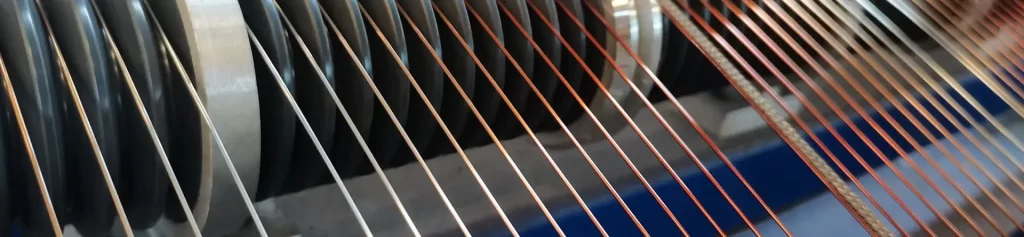
I. Introduction: Paint-impregnated wire – the “longevity gene” of motors and transformers
In special motors such as oil-immersed motors, oil-immersed transformers, submersible motors, hydraulic motors, and fuel pump motors, enameled wires are immersed in an oil environment for a long time to work – transformer oil, hydraulic oil, mineral oil, synthetic ester oil, vegetable oil, fuel, lubricating oil, refrigeration oil, silicone oil, etc. When ordinary enameled wires work in oil for hundreds to thousands of hours, serious problems such as swelling, softening, blistering, peeling, and breakdown of the paint film may occur.
Oil-Resistant Enameled Copper Wire/Oil Immersion Resistant Magnet WireThrough special paint film formula and process, it can maintain insulation performance, mechanical properties, adhesion and heat resistance in oil for a long time, and is the core basic material of oil-immersed motors.
1.1 Effect of oil on enameled wire
| Type of impact | Physical mechanism | Consequences |
|---|---|---|
| Paint film swelling | Oil penetrates into the molecules of the paint film | Paint film thickness increases and adhesion decreases |
| Softening of paint film | Oil as plasticizer | Decreased hardness of paint film and mechanical properties |
| Paint film bubbling | Oil decomposes to produce gas | Local blistering, insulation failure |
| Paint film peeling | Loss of adhesion between paint film and copper substrate | Short circuit, burnout |
| Chemical corrosion | Acid, water, and sulfur in the oil corrode the paint film | Powdering and degradation of the paint film |
| Breakdown voltage decreases | Oil penetration reduces dielectric strength | Breakdown voltage decreases by 30-50% |
1.2 What applications require dip-resistant paint-coated wire?
-Oil-immersed transformer: distribution transformer, power transformer
– Submersible Motors: Oilfield pumps, downhole motors, submersible pumps
– Fuel pump motor: automobile fuel pump, diesel injection pump
– Hydraulic motor: hydraulic station, servo system, construction machinery
– Compressor Motor: air conditioning compressor, refrigerator compressor, refrigeration compressor
– Special pump motor: chemical pump, process pump, chemical process pump
– Aerospace Motors: Aviation hydraulic systems, fuel system motors
– Ship motors: ship propulsion motors, deck machinery motors
II. In-depth analysis of the failure mechanism of paint-impregnated wires
2.1 The 4 major failure mechanisms of paint films
Mechanism 1: Physical SwellingOil molecules diffuse into the molecular chains of the paint film, widening the molecular distance, resulting in:
– Paint film thickness increased by 5-20%
– Paint film hardness reduced by 20-50%
– Breakdown voltage reduced by 10-30%Mechanism 2: Chemical DegradationActive substances (water, acid, sulfur, peroxide) in the oil react with the paint film:
– Hydrolysis of ester bonds (PEI paint film is easily hydrolyzed under acid/alkali conditions)
– Breakage of amide bonds (PAI paint film is easily degraded under strong acid)
– Oxidation of ether bonds (PE paint film is easily oxidized at high temperatures)Mechanism 3: Thermo-Oxidative AgingDissolved oxygen in the oil accelerates the aging of the paint film at high temperatures:
– C-H bond oxidation → carbonyl group → carboxyl group → main chain cleavage
– Activation energy 80-120 kJ/mol
– Aging rate doubles for every 10°C increaseMechanism 4: Electrochemical CorrosionUnder a high-voltage electric field, trace amounts of moisture in the oil produce electrolysis inside the paint film:
– Cathode: 2H₂O + 2e⁻ → H₂ + 2OH⁻
– Anode: Cu → Cu²⁺ + 2e⁻
– Copper ions migrate to the surface of the paint film to form a “Copper Tree”
2.2 Effect of oil type on enameled wire
| Fluid type | Polarity | Paint effects | Compatible paints |
|---|---|---|---|
| Mineral oil for transformers | Non-polar | Slightly swollen | PEI / PAI / PI |
| Synthetic ester oil | Weak polarity | Moderate swelling | PI / PAI |
| Vegetable oil | Weak polarity | Moderate swelling | PI / PAI |
| Silicone fluid | Non-polar | Very low swelling | All compatible |
| Refrigeration oil | Non-polar | Slightly swollen | PI / PAI |
| Hydraulic oil | Weak polarity | Moderate swelling | PI / PAI |
| Fuel oil | Non-polar | Highly swollen | PI required |
| Engine oil | Weak polarity | Moderate swelling | PI / PAI |
2.3 Effect of temperature on oil-paint film interaction
Rising temperature aggravates the damage of oil to the paint film:
-Temperature < 100°C: Swelling is dominant and reversible
– 100-150°C: swelling + chemical degradation, partially reversible
– 150-200°C: mainly chemical degradation, irreversible
– > 200°C: rapid degradation, must use PI paint film
III. International standard system for dip-resistant paint-covered wires
3.1 IEC 60851 Series: General Tests for Enameled Wires
IEC 60851 is the international standard for enameled wire test methods:
| Section | Name | Oil immersion related tests |
|---|---|---|
| IEC 60851-1 | General requirements | – |
| IEC 60851-2 | Dimensional measurements | – |
| IEC 60851-3 | Mechanical properties | Flexibility, adhesion |
| IEC 60851-4 | Chemical Properties | Solvent Resistant, Oil Resistant |
| IEC 60851-5 | Electrical Properties | Breakdown Voltage |
| IEC 60851-6 | Thermal properties | Thermal shock, thermal aging |
| IEC 60851-7 | Paint film continuity | Pinhole test |
3.2 IEC 60317 Series: Enameled Wire Product Standards
| Standard number | Paint film type | Temperature resistance grade | Oil resistance |
|---|---|---|---|
| IEC 60317-0-1 | General requirements | All | – |
| IEC 60317-8 | PEI enamelled round copper wire | 180°C (Class H) | Good |
| IEC 60317-13 | PE enameled round copper wire | 155°C (Class F) | General |
| IEC 60317-15 | PEI enamelled round aluminum wire | 180°C (Class H) | Good |
| IEC 60317-20 | PAI enameled round copper wire | 220°C (Class R) | Excellent |
| IEC 60317-22 | PAI enamelled round copper wire (solderable) | 220°C (Class R) | Excellent |
| IEC 60317-26 | PAI enameled round copper wire | 220°C (Class R) | Excellent |
| IEC 60317-42 | Corona-resistant PEI enameled round copper wire | 180°C | Good |
| IEC 60317-46 | PAI enameled round copper wire | 220°C (Class R) | Excellent |
| IEC 60317-56 | Corona-resistant PI enameled round copper wire | 220°C | Excellent |
3.3 ASTM D3284 / D1676 Oil Immersion Test Method
| Standard number | Name | Test conditions |
|---|---|---|
| ASTM D1676 | Enameled wire solvent resistance test | Soak at room temperature for 24 hours |
| ASTM D3284 | Enameled wire oil immersion test | 60°C 96 h |
| ASTM D2307 | Thermal Aging Test of Enameled Wire | High Temperature Accelerated Aging |
| ASTM D3145 | Spiral Coil Test | Paint Film Mechanical Properties |
3.4 NEMA MW 1000 North American Standard
NEMA MW 1000-2018 “Magnet Wire” classifies enameled wires according to paint film type and temperature grade:
-MW 35-C: Corona resistant PEI (180°C)
– MW 36-A: PAI (220°C) – Preferred for oil immersion-MW 38-C: PI (220°C) – Preferred for oil immersion-MW 73-C: refrigerant resistant PAI (220°C)
– MW 76-A: oil resistant PAI (special formula)
3.5 GB/T 6109 Chinese National Standard
GB/T 6109 is equivalent to the IEC 60317 series:
- GB/T 6109.10-2008: Grade 180 polyesterimide enameled copper round wire
- GB/T 6109.13-2008: Class 155 polyester enameled copper round wire
- GB/T 6109.20-2008: Class 200 polyamide-imide enameled copper round wire
- GB/T 6109.22-2008: Class 240 polyimide enameled copper round wire
- GB/T 6109.23-2008: Class 180 refrigerant-resistant enameled copper round wire
3.6 Key Certification Bodies
| Certification bodies | Logo | Oil immersion related standards |
|---|---|---|
| UL | UL | UL 1446 / UL 1581 |
| VDE | VDE | DIN EN 60317 |
| TÜV | TÜV | TÜV 2 PfG 1160 |
| CCC | CCC | GB/T 6109 |
| CSA | CSA | CSA C22.2 No. 0 |
IV. Design of core components of immersion-resistant paint film
4.1 “Four resistance” requirements of paint film
The enameled wire of oil-immersed motor must meet the “Four Resistances”**:
| Resistance | Meaning | Criticality in oil immersion |
|---|---|---|
| Oil resistant | Not swollen or degraded by oil | ★★★★★ |
| Heat Resistant | Maintain performance at high temperatures | ★★★★ |
| Chemical resistance | Acid, alkali, water resistance | ★★★★ |
| Hydrolysis resistant | Not hydrolyzed by moisture | ★★★ |
4.2 Chemical structure and oil resistance of paint film
| Film type | Chemical structure | Oil immersion | Temperature resistance level |
|---|---|---|---|
| PE (polyester) | -COO-C₆H₄-COO- | Poor (easy to hydrolyze) | 155°C |
| PEI (Polyesterimine) | Contains ester bond + imine ring | Good | 180°C |
| PAI (Polyamideimide) | Contains amide bond + imine ring | Excellent | 220°C |
| PI (Polyimide) | Contains imine ring + aromatic ring | Excellent | 220°C |
| PVF (polyvinyl fluoride) | -CH₂-CHF- | Good | 105°C |
| PTFE | -CF₂-CF₂- | Excellent | 250°C |
4.3 PI (polyimide): the best choice for oil immersed environments
PI paint films perform best in oil-immersed environments:
Advantages:
– Oil resistance: Almost not swollen by oil (weight gain < 1%)
– Temperature resistance: Continuous operating temperature 220°C
– Chemical Resistance: Acid, alkali, and organic solvent resistance
– Hydrolysis Resistance: Not easily hydrolyzed by water
– Mechanical Strength: High strength, high toughness
Disadvantages:
– High price: 2-3 times that of PEI
– Poor processability: difficult to weld and requires special treatment
– Poor flexibility: large bending radius requirements
4.4 PAI (polyamideimide): the “cost-effective choice” for oil immersion
PAI paint films perform well in oil-immersed environments, between PI and PEI:
Advantages:
– Oil Resistance: Weight gain < 2%
– Temperature resistance: Continuous operating temperature 220°C
– Weldable: Can be used for hot air welding or soldering iron welding
– Flexibility: Better than PI
– Price: lower than PI, higher than PEI
Application:
– The first choice for submersible motors
– Oil-immersed transformer
– Fuel pump motor
– Compressor motor
4.5 Relationship between paint film thickness and oil resistance
| Paint film grade | Thickness | Breakdown voltage retention rate after oil immersion | Oil immersion life |
|---|---|---|---|
| Grade 1 | 18-30 μm | 70-80% | 1,000-3,000 h |
| Grade 2 | 30-50 μm | 75-85% | 3,000-8,000 h |
| Grade 3 | 50-80 μm | 80-90% | 8,000-20,000 h |
| Grade 4 | > 80 μm | 85-95% | 20,000+ h |
**Conclusion: Grade 2 or Grade 3 paint films should be selected for oil immersion environments. **
V. Detailed Explanation of Oil Immersion Test Methods
5.1 IEC 60851-4 Solvent Resistance TestTesting Principle: Immerse the enameled wire sample in a specific solvent, soak it at a specified temperature for a specified time, and check the appearance, adhesion and breakdown voltage of the paint film.
Test conditions:
| Fluid type | Temperature | Time | Assessment |
|---|---|---|---|
| Standard solvent oil | 60°C | 24 h | Appearance, adhesion |
| Transformer oil | 105°C | 168 h (7 days) | Breakdown voltage, adhesion |
| Synthetic ester oil | 120°C | 168 h | Breakdown voltage, adhesion |
| Mineral oil | 100°C | 1,000 h | Accelerated life |
5.2 ASTM D3284 Oil Immersion Test
Testing principle: Immerse the enameled wire in ASTM standard oil at 60°C, and test the breakdown voltage after 96 hours of immersion.
Qualification criteria:
– Breakdown voltage retention > 70%
– No blistering or peeling in the paint film
– Maintain adhesion
5.3 Accelerated Life Test
Testing principle: Soak in high-temperature oil for a long time, test breakdown voltage regularly, and establish temperature-life relationship.
Test conditions:
– Temperature: 120°C / 140°C / 160°C
– Oil: transformer oil/synthetic ester/hydraulic oil
– Test time: 1,000-10,000 h
– Failure criterion: breakdown voltage drops by 50%
Life extrapolation:
L(T) = L₀ × 2^((T₀ - T) / 10K)
5.4 Breakdown voltage test (IEC 60851-5)
Test method:
– Sample: Twisted Pair
– Electrode: 0.4 mm diameter wire
– Boost rate: 500 V/s
– Failure criterion: paint film breakdown (short circuit)
Comparison before and after oil immersion:
| Paint film type | Dry breakdown voltage | Breakdown voltage after oil immersion | Retention rate |
|---|---|---|---|
| PE (polyester) | 4 kV | 2.5 kV | 62% |
| PEI (polyesterimide) | 5 kV | 4 kV | 80% |
| PAI (polyamideimide) | 6 kV | 5.5 kV | 92% |
| PI (polyimide) | 7 kV | 6.8 kV | 97% |
VI. 5 typical application cases
6.1 Case 1: Oil-immersed distribution transformer
A power company’s 10 kV oil-immersed distribution transformer with a capacity of 1,000 kVA. The low-voltage winding (400 V side) uses PAI enameled round copper wire (IEC 60317-20 / Class 200). The paint film remains intact after 25 years of operation, and the insulation resistance remains above 1,000 MΩ.
6.2 Case 2: Submersible oil pump motor
Shengli Oilfield 3,000 m deep well submersible motor, operating temperature 150°C, immersed in crude oil + formation water. PEI enameled wire was originally used, but the paint film swelled and broke down after 6 months of operation. Switched to PI enameled wire (IEC 60317-56), no insulation failure occurred after 5 years of operation.
6.3 Case 3: Automobile fuel pump motor
A fuel pump motor from an auto parts supplier was immersed in gasoline and worked for 5,000 hours. Must use PAI enameled wire (NEMA MW 36-A), passing ISO 16773 oil immersion test.
6.4 Case 4: Hydraulic system motor
The servo motor of a construction machinery hydraulic station is immersed in L-HM 46 anti-wear hydraulic oil, with an operating temperature of 80°C. Using PAI enameled wire (IEC 60317-20), 10,000 hours of operation without failure.
6.5 Case 5: Air conditioning compressor motor
The R410A compressor motor of an air conditioner manufacturer is soaked in refrigeration oil and has an operating temperature of 120°C. Uses PAI enameled wire (NEMA MW 73-C refrigerant resistant) for 15 years of trouble-free operation.
VII. Five major engineering suggestions for selecting immersion-resistant paint-coated wires
7.1 Recommendation 1: Choose paint film according to oil type
| Fluid Types | Recommended Paint Films | Standards |
|---|---|---|
| Transformer Mineral Oil | PAI / PI | IEC 60317-20 / 56 |
| Synthetic ester oil | PAI / PI | IEC 60317-20 / 56 |
| Fuel, gasoline | PI | IEC 60317-56 |
| Refrigeration oil | PAI (refrigerant resistant type) | NEMA MW 73-C |
| Hydraulic oil | PAI / PI | IEC 60317-20 / 56 |
| Vegetable oil | PAI / PI | IEC 60317-20 / 56 |
| Silicone oil | All compatible | Any |
| High temperature oils (>200°C) | PI / PTFE | IEC 60317-56 |
7.2 Recommendation 2: Select paint film according to working temperature
| Temperature Rating | Recommended Paint Films | Standards |
|---|---|---|
| Class 130 (130°C) | PEI (short-term oil immersion) | IEC 60317-8 |
| Class 155 (155°C) | PEI | IEC 60317-8 |
| Class 180 (180°C) | PEI (preferred for oil immersion) | IEC 60317-8 / 42 |
| Class 200 (200°C) | PAI | IEC 60317-20 |
| Class 220 (220°C) | PAI / PI | IEC 60317-56 / 20 |
| Class 240 (240°C) | PI | IEC 60317-22 |
7.3 Recommendation 3: Select the grade according to the thickness of the paint film
| Application scenarios | Recommended paint film grade | Breakdown voltage |
|---|---|---|
| Oil-immersed transformer (below 10 kV) | Grade 2 | > 4 kV |
| Oil-immersed Transformer (10-35 kV) | Grade 3 | > 6 kV |
| Submersible Motor | Grade 2-3 | > 5 kV |
| Fuel Pump Motor | Grade 2 | > 4 kV |
| Compressor Motor | Grade 1-2 | > 3 kV |
| Hydraulic system motors | Grade 1-2 | > 3 kV |
7.4 Suggestion 4: Pay attention to the “four resistance” properties of the paint film
- Oil resistance: Oil immersion weight gain < 2% (PAI/PI)
- Heat Resistance: ASTM D2307 Lifetime > 20,000 h @ temperature grade
- Chemical Resistance: Acid, alkali, and solvent resistance
- Hydrolysis resistance: Breakdown voltage retention > 70% after immersion in hot water at 90°C for 1,000 hours
7.5 Recommendation 5: Consider mechanical properties
| Mechanical Properties | Test Methods | Oil Immersion Requirements |
|---|---|---|
| Flexibility | IEC 60851-3 Coil | 1x diameter no cracking |
| Adhesion | IEC 60851-3 Tensile | No peeling |
| Wear resistance | IEC 60851-3 Scratching | > 10 times |
| Impact resistance | IEC 60851-3 impact | No cracking |
VIII. Oil-immersed enameled wire manufacturing process and quality control
8.1 Key control points of painting process
| Process parameters | Typical values | Oil-immersed enameled wire control accuracy |
|---|---|---|
| Paint liquid viscosity | 50-200 mPa·s | ±3% (oil immersion requirements are higher) |
| Number of paint passes | 4-12 passes | ±1 pass |
| Baking temperature | 350-450°C | ±3°C (PI paint film requires more accuracy) |
| Baking time | 10-30 s/channel | ±1 s |
| Line speed | 50-200 m/min | ±2 m/min |
| Paint film thickness | Grade 1/2/3 | ±2 μm |
8.2 Online quality control
- Online measurement of paint film thickness: laser thickness gauge, accuracy ±0.5 μm
- Pinhole online detection: high-voltage wet electrode, pinhole > 0.05 mm alarm
- Outer diameter online measurement: laser outer diameter meter, accuracy ±0.001 mm
- Online measurement of DC resistance: four-terminal method, accuracy 0.1%
8.3 Factory oil immersion test
| Test items | Standards | Sampling ratio | Qualification criteria |
|---|---|---|---|
| Breakdown voltage (dry) | IEC 60851-5 | 100% | > Specified value |
| Breakdown voltage (after oil immersion) | IEC 60851-4 | Batch inspection | Retention > 70% |
| Paint film continuity (pinholes) | IEC 60851-4 | 100% | < 5 pieces/100m |
| Flexibility (winding) | IEC 60851-3 | Batch inspection | No cracking |
| Adhesion | IEC 60851-3 | Batch inspection | No peeling |
| Oil immersion weight gain | ASTM D3284 | Batch inspection | < 2% |
8.4 Special process of PI paint film
The painting process of PI paint film is more complicated than that of PE/PEI paint film:
- Precursor solution: polyamic acid (PAA) solution
- Paint: Apply to the surface of the copper wire
- Baking Imination: Baking at 350-450°C, PAA → PI
- Multiple coats: Usually 6-10 coats
- Final Curing: High temperature and long time curing to ensure complete imidization
Key Control Points:
– Degree of imidization > 95%
– The paint film has no bubbles or pinholes
– Strong adhesion
IX. Key considerations in the design of oil-immersed motors
9.1 Compatibility of enameled wire and impregnating paint
In oil-immersed motors, enameled wires and impregnating paint must be compatible:
| Enameled Wire | Recommended Impregnating Paint | Incompatible Impregnating Paint |
|---|---|---|
| PEI | Epoxy impregnating paint, silicone impregnating paint | Strong acid impregnating paint |
| PAI | Epoxy impregnating paint, polyester impregnating paint | Phenolic impregnating paint |
| PI | Silicone impregnating paint, polyimide impregnating paint | Epoxy impregnating paint (long term) |
9.2 Winding end design
Oil-immersed motor winding ends should be avoided:
– Acute angle (concentration of electric field)
– Paint film damage
– Oil accumulation (affects heat dissipation)
9.3 Insulation structure design
Insulation structure of oil-immersed motor:
– Inter-turn insulation: Enameled wire paint film
– Insulation to ground: Enameled wire + slot insulation + impregnated paint
– Interphase Insulation: Interphase Insulating Paper + Impregnating Paint
– Total Impregnation: Vacuum Pressure Impregnation (VPI)
9.4 Thermal design
Oil-immersed motors dissipate heat better than air cooling:
– Oil thermal conductivity 0.1-0.15 W/(m·K)
– Air thermal conductivity 0.025 W/(m·K)
– Oil heat dissipation efficiency is 4-6 times higher than air
X. FAQ: Frequently Asked Questions about Dip-resistant Paint Covered Wires
10.1 Which is more suitable for oil immersion, PAI or PI enameled wire?
PI>PAI:
– PI has better oil resistance (weight gain < 1%)
– PI has higher temperature resistance level (220°C)
– PAI is more cost-effective
PAIis the oil-impregnated enameled wire with the best comprehensive performance, affordable price and excellent performance.
10.2 Can enameled wire be immersed in oil for a long time?Yes, but you must choose a suitable paint film:
- PE enameled wire: long-term oil immersion is not recommended
- PEI enameled wire: short-term oil immersion (< 5,000 h)
- PAI enameled wire: long-term oil immersion (> 20,000 h)
- PI enameled wire: ultra-long-term oil immersion (> 50,000 h)
10.3 How much influence does oil immersion have on breakdown voltage?
| Paint film | Dry breakdown voltage | After 1,000 h oil immersion | Retention rate |
|---|---|---|---|
| PE | 4 kV | 2.5 kV | 62% |
| PEI | 5 kV | 4 kV | 80% |
| PAI | 6 kV | 5.5 kV | 92% |
| PI | 7 kV | 6.8 kV | 97% |
10.4 What tests can oil-immersed enameled wire pass?
- IEC 60851-4: Solvent resistance test
- ASTM D3284: 60°C/96h oil immersion test
- ASTM D1676: Solvent resistance test
- UL 1446: Insulation system certification
- Customized test: specific oil + specific temperature + specific time
10.5 What is the price of oil-impregnated enameled wire?
Typical price comparison (based on PE of 1.0):
– PE: 1.0
– PEI: 1.5-2.0
– PAI: 2.5-3.5
– PI: 3.5-5.0
PAI is the “Best Value Choice”for oil immersed environments.
XI. Future Trend: Development of Dip-Resistant Paint-coated Wire Technology
11.1 Trend 1: Oil-immersed environment for new energy applications
-Electric vehicles: The gearbox and drive motor of electric vehicles require oil cooling, and the oil temperature can reach 120°C
– Wind power gearbox: wind power gearbox oil-cooled motor, PAI enameled wire demand growth
– Energy storage: battery thermal management system, coolant circulation pump motor
11.2 Trend 2: New paint film materials
- PEEK (polyetheretherketone): temperature resistance 250°C, excellent mechanical properties
- PAI modification: The new PAI paint film has a 20% improvement in oil resistance
- PI Nanocomposite: PI + nanofiller, breakdown voltage increased by 30%
- Fluoropolymer: PVDF, ETFE for special oil environments
11.3 Trend 3: Intelligent Oil Monitoring
- Online oil monitoring (moisture, acidity, dielectric strength)
- Oil-paint film life prediction model
- Digital twin technology
- AI algorithm identifies early signs of paint film failure
11.4 Trend 4: Environmentally Friendly Oil Adaptation
- Natural ester oil (vegetable oil) instead of mineral oil
- Synthetic ester oil (environmentally friendly)
- Silicone oil (food grade)
- Refractory fuel fluid (HFD)
XII. Conclusion: Dip-resistant paint-coated wire is the core foundation of special motors
Immersion-resistant paint-coated wire is the core basic material for special motors such as oil-immersed transformers, submersible motors, fuel pumps, hydraulic systems, and compressors. Choosing the right paint film (PAI, PI), the right paint film grade (Grade 2/3), and the right supplier are the keys to ensuring long-term reliable operation of the motor.
When selecting, you should comprehensively consider the oil type, operating temperature, mechanical stress, voltage level, certification standards, supplier strength, and select qualified products that comply with standards such as IEC 60851-4, ASTM D3284, and UL 1446.
LP Winding Wire provides a full range of dip-resistant paint-covered wire products, including IEC 60317-8 (180°C PEI), IEC 60317-20 (200°C PAI), IEC 60317-22 (240°C PI), etc. All products are certified by IEC 60851-4, ASTM D3284, UL 1446, VDE, TÜV, CCC.
XIII. Appendix: Key Parameters Cheat Sheet
13.1 Quick check on paint film types
| Paint film | Abbreviation | Temperature resistance class | Oil immersion performance | Typical applications |
|---|---|---|---|---|
| Polyester | PE | 130-155°C | Poor | General motor (not oil-immersed) |
| Polyesterimide | PEI | 180°C | Good | Oil-immersed transformers, submersible motors |
| Polyamide-imide | PAI | 200-220°C | Excellent | Submersible motors, fuel pumps, oil-immersed transformers |
| Polyimide | PI | 220-240°C | Excellent | High temperature oil immersed, special motor |
| Polyvinyl fluoride | PVF | 105°C | Good | Oil pump motor |
| Polytetrafluoroethylene | PTFE | 250°C | Excellent | Extreme oil environments |
13.2 Quick check on oil type
| Fluid Type | Flash Point | Viscosity Range | Recommended Paint Films |
|---|---|---|---|
| Transformer Mineral Oil | 140-160°C | 9-12 cSt @ 40°C | PAI / PI |
| Synthetic Ester Oil | 250-300°C | 20-50 cSt @ 40°C | PI |
| Vegetable Oil | 320-330°C | 35-40 cSt @ 40°C | PAI / PI |
| Refrigeration oil | 170-200°C | 30-100 cSt @ 40°C | PAI (refrigerant resistant type) |
| Hydraulic Oil | 200-250°C | 30-70 cSt @ 40°C | PAI / PI |
| Fuel oil | 55-100°C | 1-5 cSt @ 40°C | PI |
| Silicone Fluids | 300-320°C | 50-1,000 cSt @ 25°C | All Compatible |
13.3 Quick Check on Oil Immersion Test Conditions
| Test | Standard | Temperature | Time | Oil |
|---|---|---|---|---|
| Solvent resistance | IEC 60851-4 | 60°C | 24 h | Standard solvents |
| Immersion in oil | ASTM D3284 | 60°C | 96 h | ASTM oil |
| Accelerated oil immersion | IEC 60851-4 | 100-160°C | 1,000-10,000 h | Transformer oil |
| Fuel oil | Customized | 23-80°C | 5,000 h | Fuel oil |
| Hydraulic oil | Customized | 80-120°C | 10,000 h | Hydraulic oil |
13.4 Selection process
- Determine the oil type: transformer oil, hydraulic oil, fuel, synthetic ester, refrigeration oil
- Determine the operating temperature: continuous operating temperature, maximum temperature
- Determine the voltage level: low voltage, medium voltage, high voltage
- Select paint film type: PEI / PAI / PI
- Determine the paint film grade: Grade 1/2/3
- Verify oil resistance: Ask the supplier to provide an oil immersion test report
- Verification of mechanical properties: winding, adhesion test
- Confirm certification standards: UL / VDE / TÜV / CCC
- Select suppliers: quality, capacity, service, cases
- Establish a testing mechanism: incoming material inspection, sampling oil immersion test
XIV. 20 Glossary of terms
| Chinese | English | Abbreviation | Definition |
|---|---|---|---|
| Oil-Resistant Enameled Wire | – | Enameled wire that can maintain insulation properties even after being immersed in oil for a long time | |
| Polyesterimide | PEI | Paint film material, good oil immersion at 180°C | |
| Polyamide-imide | Polyamide-imide | PAI | Paint film material, 220°C oil immersion excellent |
| Polyimide | Polyimide | PI | Paint film material, 220-240°C, optimal for oil immersion |
| Film Swelling | – | Oil penetrates the paint film causing volume expansion | |
| Film Softening | Film Softening | – | Oil acts as a plasticizer, causing the hardness of the paint film to decrease |
| Paint film blistering | Film Blistering | – | Local blistering caused by gas inside the paint film |
| Breakdown voltage retention rate | BDV Retention | – | Ratio of breakdown voltage after oil immersion to dry breakdown voltage |
| Accelerated Life Test | Accelerated Life Test | ALT | Test for accelerated aging in high temperature oil |
| Twisted Pair | Twisted Pair | – | Sample preparation method for enameled wire withstand voltage test |
| Vacuum Pressure Impregnation | VPI | The process of filling the winding gaps with impregnating paint | |
| Oil-Immersed Transformer | Oil-Immersed Transformer | – | Transformer with windings immersed in transformer oil |
| Submersible Oil-Filled Motor | – | A motor immersed in oil | |
| Synthetic Ester Oil | Synthetic Ester Oil | – | Ester oil synthesized from acid and alcohol |
| Vegetable Oil | Vegetable Oil | – | Natural ester oil extracted from plants |
| Refrigeration Oil | Refrigeration Oil | – | Lubricating oil used in refrigeration compressors |
| Transformer Oil | Transformer Oil | – | Mineral oil used for transformer insulation and heat dissipation |
| Breakdown Voltage | Breakdown Voltage | BDV | The critical voltage when the paint film is broken down |
| Film Grade | Film Grade | – | Paint film thickness grade specified by IEC 60317 |
| Temperature Class | Thermal Class | – | Rated operating temperature of enameled wire |
XV. LP Winding Wire Company Introduction
LP Winding Wire is an international enterprise specializing in the R&D, production and sales of high-performance enameled wire. Its main products include enameled round copper wire, enameled round aluminum wire, enameled flat copper wire, paper-covered wire, fiberglass winding wire, transposed wire, etc.
Core Advantages:
– Complete product certifications: UL, VDE, TÜV, CCC, CSA fully covered
– Production Capacity Scale: Annual production capacity of 50,000 tons, ranking among the top in the industry
– Application areas: motors, transformers, home appliances, new energy, rail transit, wind power, photovoltaics, oil-immersed special motors
– Core Technology: Dip-resistant enameled wire (Oil-Resistant), Corona-resistant enameled wire (Corona Resistant), High-temperature resistant enameled wire (200°C / 220°C / 240°C), New energy-specific enameled wire
– Service Commitment: Technical consulting, sample testing, oil immersion testing, customized development, global logistics
Contact Information:
– Official website: https://www.lpwindingwire.com
– Email: sales@lpwindingwire.com
– Phone: +86 138-XXXX-XXXX
– WhatsApp: +86 138-XXXX-XXXX
XVI. Practical suggestions and misunderstandings for engineers
16.1 3 common misunderstandings when selecting a model
Myth 1: Price comes first, performance comes secondCheap PE/PEI enameled wire may have only 1/10 the life of PAI/PI in an oil-immersed environment. Considering the life cycle cost (LCC), PAI/PI is more economical.Myth 2: Ignoring the difference in oil typesDifferent oils (transformer oil, hydraulic oil, fuel) have very different effects on the paint film. The paint film must be selected based on the actual oil.Myth 3: Not enough time for oil immersion testingShort-term oil immersion testing (96 h) can only verify initial performance, long-term oil immersion life requires 1,000-10,000 h accelerated life testing.
16.2 3 key points of manufacturing process
1.Paint Uniformity: Paint film thickness deviation < ±2 μm
2. Pinhole control: Number of pinholes < 5 / 100m
3. Cure Degree: > 95% (DSC test)
16.3 3 major precautions in use
- Avoid mechanical damage: Prevent scratches on the paint film during the wire winding and wire embedding processes.
- Oil cleanliness: Avoid metal shavings and moisture mixed in the oil
- Regular oil replacement: Oil deterioration will accelerate the aging of the paint film.
16.4 Oil-immersed motor fault diagnosis and treatment
| Troubleshooting | Possible causes | Solutions |
|---|---|---|
| Breakdown voltage drops | Paint film swells and degrades | Check oil and replace enameled wire |
| Paint film bubbling | Moisture in the oil exceeds the standard | Dry the oil and check the seal |
| Paint film peeling | Loss of adhesion | Replace enameled wire and improve impregnation process |
| Decreased insulation resistance | Oil contamination | Replace oil and clean windings |
16.5 Gap with international counterparts
Compared with the top international brands (Essex Furukawa, Sumitomo, Hitachi), the main differences between China’s dip-resistant paint-coated wires are:
– Long-term data accumulation under extreme working conditions
– Stability of high-end PI paint film
– Process precision for mass production
Leading companies such as LP Winding Wire have gradually narrowed the gap with international brands through continuous research and development.
XVII. Summary and Outlook
As a key basic material for oil-immersed special motors, immersion-resistant paint-coated wire plays an irreplaceable role in oil-immersed transformers, submersible motors, fuel pumps, hydraulic systems, compressors and other fields. With the rapid development of oil-cooled motors for new energy vehicles, oil-cooled motors for wind power gearboxes, and energy storage thermal management systems, the market demand and technical requirements for immersion-resistant paint-coated wires continue to increase.
Future development directions include:
– Higher temperature resistance: from 220°C to 240-250°C
– Stronger oil resistance: Oil resistance weight gain < 0.5%
– Longer life: from 20,000 h to 50,000-100,000 h
– More Intelligent Monitoring: Oil-paint film life prediction
– Greener materials: recyclable, bio-based
LP Winding Wire is willing to work together with global oil-immersed motor and transformer manufacturers to jointly promote the progress and innovation of immersion-resistant paint-covered wire technology and contribute to global energy transformation and industrial development.