


Introduction
NEMA Standards for Magnet Wire is a standard system for magnet wire (winding wire, enameled wire) developed by the National Electrical Manufacturers Association (NEMA). It is one of the most authoritative standard systems in the global magnet wire industry. Its core standard, NEMA MW 1000-2018 “Magnet Wire Standard,” covers all magnet wire specifications, test methods, technical information, and judgment rules required by the magnetic components industry. It is the fundamental technical document for the design, production, procurement, testing, and certification of magnet wire products in the North American market.
From an industrial practice perspective, the engineering implications of NEMA Standards for Magnet Wire extend far beyond the “standard text” itself. It serves as a technical language and quality benchmark jointly followed by magnet wire manufacturers, application engineers, procurement engineers, and third-party certification bodies, and is the fundamental guarantee for global magnet wire supply chain collaboration and product compliance. Any magnet wire product claiming to conform to NEMA standards must systematically meet the conductor requirements, enamel coating requirements, testing requirements, and judgment rules specified in the standards.
The NEMA MW 1000-2018 standard system, along with the IEC 60317 series and GB/T 6109 series standards, forms the three major global magnetic wire standard systems. Understanding the structure, specifications numbering, enamel coating system, thermal classification, testing methods, and correspondence with other standards of NEMA MW 1000-2018 is essential basic knowledge for engineers and purchasing personnel entering the North American magnetic components market.
The engineering implications of NEMA Standards for Magnet Wire Explained can be systematically explained from ten dimensions: standard system architecture, specification numbering system, conductor classification, enamel coating classification, thermal rating system, detailed explanations of commonly used specifications, testing method system, international standard correspondence, typical application areas, and quality assurance and certification. This article provides a systematic engineering reference for North American market purchasing engineers, transformer and coil design engineers, magnetic component manufacturers, UL/CSA certification engineers, and standardization engineers.
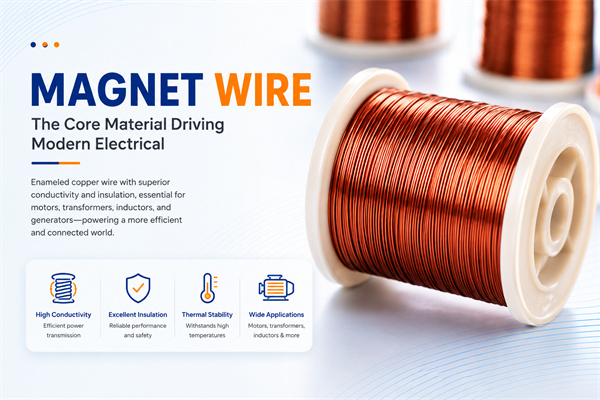
NEMA MW 1000-2018 Standard Framework
NEMA MW 1000-2018 is the core standard of the NEMA Standards for Magnet Wire system, and its structural design follows a three-in-one architecture of “general requirements + test methods + technical information”.
NEMA Standards Development Organization
NEMA (National Electrical Manufacturers Association) is the American electrical manufacturers association, founded in 1926 and headquartered in Rosslyn, Virginia. NEMA is the core industry association for the electrical products manufacturing industry in North America, with members covering a wide range of manufacturing sectors including electrical equipment, electronic components, lighting products, and medical devices.
The NEMA Magnet Wire Section is an internal technical department within NEMA dedicated to the development and maintenance of magnet wire standards. Composed of technical experts from major North American magnet wire manufacturers, it is responsible for the drafting, revision, publication, and updating of the MW 1000 standard. The NEMA Magnet Wire Section maintains close collaboration with standards organizations such as the International Electrotechnical Commission (IEC), Underwriters Laboratories (UL), and the American Society for Testing and Materials (ASTM) to ensure the harmonization and consistency of NEMA standards with international and UL standards.
Standard Structure of MW 1000-2018
The NEMA MW 1000-2018 standard is divided into three main parts, forming a complete specification matrix:
Part 1 General Requirements: This section specifies the basic definition, conductor requirements, enamel coating requirements, geometric parameters, and judgment rules for magnet wire products. Part 1 serves as the fundamental threshold for magnet wire products to enter the market, covering the general technical requirements common to all specifications.
Part 2 Test Methods specifies the detailed operating procedures for dozens of test methods, including breakdown voltage, enamel coating continuity, enamel coating thickness, elongation, thermal shock, softening breakdown, solderability, and chemical resistance. Part 2 is the core specification of the magnet wire testing methodology.
Part 3 Technical Information: Provides engineering reference information on the selection, application, and design of magnet wire, including conductor resistance, thermal grade temperature, enamel coating thickness grade, and specifications reference table, etc.
The three parts form a complete system of “standards-methods-information”, which not only ensures the rigor of technical specifications, but also provides engineers with convenient reference tools.
Standard Version and Evolution
The NEMA MW 1000 standard is continuously updated. MW 1000-2018 is the current release, reflecting the latest advancements and market demands in magnet wire technology. The NEMA Magnet Wire Section regularly revises the standard to incorporate developments in new materials, processes, and applications.
The key revisions to the NEMA MW 1000 standard reflect the evolution of magnetic wire technology: from the early polyester enamel coating (PEW) to the inclusion of high-performance enamel coating systems such as polyurethane enamel coating (UEW), polyester imide enamel coating (PEI), polyamide-imide enamel coating (PAI), and polyimide enamel coating (PI); from single conductor materials (copper) to multi-conductor materials (copper, aluminum, copper-clad aluminum); and from round wire to flat wire and square wire. Each revision reflects the technological progress of the magnetic wire industry.
Specification Coding System
The NEMA MW 1000-2018 specification numbering system is key to understanding NEMA Standards for Magnet Wire.
Specification Number Format
NEMA MW 1000-2018 specifications uses the encoding format “MW + number + -C”:
“MW” stands for Magnet Wire, which is the NEMA standard’s unified prefix for products of the Magnet Wire category.
The “number” is a specification number, a consecutive number from 1 to 80 or higher. Each number corresponds to a specific enamel coating system, thermal rating, enamel coating thickness grade, and conductor material combination. The specification number is like an identification number for the magnet wire product, identifying its complete technical definition.
“-C” is a version identifier, indicating the current revision (C is the latest version). Earlier versions used identifiers such as “-A” and “-B”.
Common Specification Number Examples
The NEMA MW 1000-2018 standard covers nearly one hundred specifications, with commonly used specifications including:
MW 24-C: Single-layer polyurethane/enamel-coated round copper wire, Class 155. MW 28-C: Single-layer polyurethane/enamel-coated round copper wire, Class 130. MW 35-C: Heavy-build polyurethane/enamel-coated round copper wire, Class 155. MW 36-C: Triple-build polyurethane/enamel-coated round copper wire, Class 155. MW 41-C: Single-layer polyester/enamel-coated round copper wire, Class 155. MW 50-C: Single-layer polyamide-imide/enamel-coated round copper wire, Class 200. MW 60-C: Single-layer polyimide/enamel-coated round copper wire, Class 220. MW 75-C: Single-layer polyester-imide enamel-coated round copper wire, Class 180. MW 76-C: Single-layer polyamide-imide enamel-coated round copper wire, Class 200.
Aluminum Magnet Wire Specifications
NEMA MW 1000-2018 covers a variety of aluminum magnetic wire specifications. Commonly used aluminum magnetic wire specifications include:
MW 31-C: Single-layer polyurethane/enamel coated round aluminum wire, Class 155. MW 33-C: Single-layer polyurethane/enamel coated round aluminum wire, Class 130. MW 35-A, C, etc.: Some specifications may correspond to aluminum wire variants (refer to the standard for details).
In the North American market, aluminum is used in applications such as transformers, motors, and reactors, and is particularly suitable for lightweight design requirements.
Conductor and Material Classification
NEMA Standards for Magnet Wire provide clear specifications for conductor materials and geometry.
Conductor Materials
The conductor materials covered by the MW 1000-2018 standard mainly include:
Copper: Electrolytic Tough Pitch Copper (ETP), conforming to standards such as ASTM B3. Copper is the mainstream conductor material for NEMA standard magnet wire, with excellent electrical conductivity and good machinability.
Aluminum: Electrical grade pure aluminum or aluminum alloy, conforming to ASTM B230, B233, and other standards. Aluminum has applications in lightweight design, transformers, and motors.
Copper-Clad Aluminum (CCA): A copper-clad aluminum conductor, it’s a metallurgical combination of a copper layer and an aluminum core, combining the connectivity of copper with the lightweight advantages of aluminum. Copper-clad aluminum (magnet wire) offers cost and weight advantages in specific applications.
Conductor Geometry
NEMA Standards for Magnet Wire cover a variety of conductor geometries:
Round wire: An enameled wire with a circular cross-section, its diameter ranges from extremely fine wire (for precision coils) to heavy-duty wire (for large motors) across a wide range of specifications. Round wire is the mainstream form of NEMA standard magnet wire.
Rectangular Wire (flat wire): An enameled wire with a rectangular cross-section; the width-to-thickness ratio can be customized. Flat wire has important applications in transformers, high-power motors, and drive motors (Hairpin Wire) for new energy vehicles.
Square Wire: A enameled wire with a square cross-section, which has a duty cycle advantage in certain applications.
Conductor Diameter Tolerance
Conductor diameter tolerance control is an important aspect of NEMA Standards. Different conductor diameter ranges correspond to different tolerance grades, and the accuracy of the conductor diameter directly affects the consistency of the enamel coating thickness and the uniformity of the electric field distribution. The tolerance grades for conductor diameter are clearly specified in MW 1000-2018 Part 1.
Enamel System and Film Classification
The enamel coating system is the core of NEMA Standards for Magnet Wire, covering all the mainstream enamel coating systems required by the magnetic components industry.
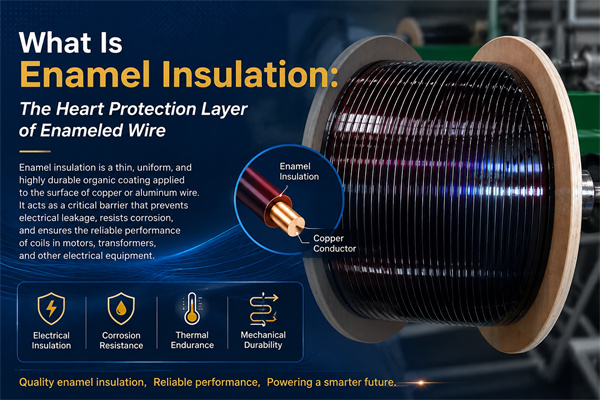
Common Enamel Systems
The NEMA MW 1000-2018 standard covers the following enamel coating systems:
Polyurethane (UEW, polyurethane enamel coating): A polymer coating formed by the reaction of blocked isocyanate and polyol. Key characteristics: direct solderability, low-temperature curing, low dielectric loss, and excellent high-frequency performance. Common specifications: MW 24-C, MW 28-C, MW 35-C, MW 36-C. Typical thermal grades: Class 130, 155.
Polyester (PEW, enamel coating): A polymer coating formed by the reaction of terephthalic acid and polyol. Key characteristics: Good mechanical strength and low cost. Common specifications: MW 41-C, etc. Typical thermal grades: Class 130, 155.
Polyesterimide (PEI, enamel coating): Introduces imine bonds into the polyester base, significantly improving thermal stability. Key properties: Excellent thermal stability, high mechanical strength, and good dielectric properties. Common specifications: MW 75-C, etc. Typical thermal rating: Class 180.
Polyamide-imide (PAI, enamel coating): Offers superior thermal stability and dielectric strength. Key characteristics: high temperature resistance, high dielectric strength, and resistance to chemical media. Common specifications: MW 50-C, MW 76-C, etc. Typical thermal rating: Class 200.
Polyimide (PI, polyimide coating): possesses extremely high thermal stability and dielectric strength. Key characteristics: resistance to extreme temperatures, radiation, and chemical media. Common specifications: MW 60-C, etc. Typical thermal grades: Class 220, 240.
Film Thickness Grades
NEMA MW 1000-2018 specifies the thickness rating system for magnet wireenamel coating:
Single Build: Standard enamel coating thickness level, suitable for most applications. Heavy Build: Thicker enamel coating thickness level, providing higher dielectric strength. Triple Build: Thicker enamel coating thickness level, providing the highest dielectric strength.
The selection of enamel coating thickness grade needs to take into account engineering factors such as electrical strength, duty cycle, heat dissipation performance, and processing performance.
Thermal Class System
Thermal class is a classification standard of NEMA Standards for Magnet Wire enamel coating for long-term operating temperature.
Thermal Class Definition
NEMA MW 1000-2018 adopts the UL 1446 and IEC 60085 standard systems to define thermal ratings. Thermal rating indicates the upper limit of the long-term operating temperature of the enamel coating and is a core indicator of the thermal stability of the enamel coating. Common thermal ratings include:
Class 105, Class 130, Class 155, Class 180, Class 200, Class 220, Class 240, etc. Each thermal class corresponds to a specific temperature index and temperature rating for the enamel coating.
Temperature Index Determination
The temperature index is determined based on the accelerated aging test method specified in IEC 60216. By measuring the failure time of the enamel coating at multiple temperature points (usually more than three), the highest operating temperature of the enamel coating under the standard life (e.g., 20,000 hours) is extrapolated based on the Arrhenius kinetic model, which is the temperature index.
The relationship between thermal class and temperature index: Class 155 (enamel coating) has a temperature index of 155°C, Class 180 (enamel coating) has a temperature index of 180°C, Class 200 (enamel coating) has a temperature index of 200°C, and so on.
Thermal Class and Application Matching
Different application scenarios have different requirements for thermal levels:
Class 130: Suitable for general low-voltage motors, household appliances, relays, etc. Class 155: Suitable for control transformers, precision coils, small and medium-sized motors, etc. Class 180: Suitable for Class F insulated motors, high-voltage motors, traction motors, etc. Class 200: Suitable for Class H insulated motors, new energy vehicle drive motors, wind turbines, etc. Class 220: Suitable for Class C insulated motors, special high-temperature applications, etc.
Test Methods System
NEMA MW 1000-2018 Part 2 Test Methods specifies a complete system of test methods for magnet wire.
Conductor Tests
Conductor testing items include: conductor diameter, conductor resistance, conductor elongation, and conductor surface quality.
Film Electrical Tests
Electrical testing items for enamel coating include: breakdown voltage, enamel coating continuity, dielectric loss tangent (tan δ), and DC withstand voltage.
Film Mechanical Tests
Mechanical testing items for enamel coating include: flexibility, adhesion, abrasion resistance, cutting temperature, and coefficient of friction.
Film Thermal Tests
The thermal testing items for enamel coating include: thermal shock, softening breakdown, temperature index, and aging life.
Film Chemical Tests
The chemical testing items for enamel coating include: solderability, solvent resistance, chemical resistance, oil resistance, and hydrolysis resistance.
The specific operational procedures of the test method are highly consistent with IEC 60317 and GB/T 6109. The three major standard systems form a global magnet wire test method system that corresponds to and complements each other.
International Standards Cross-Reference
NEMA Standards for Magnet Wire have corresponding equivalent or equivalent standards in the international standards system.
IEC 60317 Cross-Reference
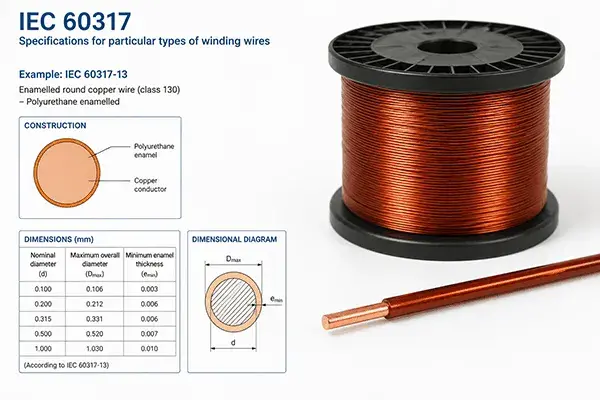
The IEC 60317 series is a set of standards for winding wires developed by the International Electrotechnical Commission (IEC). Example of the correspondence between NEMA MW 1000-2018 and the IEC 60317 series:
NEMA MW 24-C ↔ IEC 60317-20 (155 grade single-layer polyurethane enameled round copper wire). NEMA MW 35-C ↔ IEC 60317-20 (155 grade heavy-build polyurethane enameled round copper wire). NEMA MW 75-C ↔ IEC 60317-8 (180 grade single-layer polyester imide enameled round copper wire). NEMA MW 76-C ↔ IEC 60317-13 (200 grade single-layer polyamide-imide enameled round copper wire). NEMA MW 60-C ↔ IEC 60317-7 (220 grade single-layer polyimide enameled round copper wire).
Chinese National Standards Cross-Reference
The GB/T 6109 series comprises Chinese national standards for test methods of enameled wire. An example of the correspondence between NEMA MW 1000-2018 and the GB/T 6109 series is provided below.
NEMA MW 24-C ↔ GB/T 6109.10 (Grade 155 direct-soldering polyurethane enameled round copper wire, Grade 1). NEMA MW 35-C ↔ GB/T 6109.10 (Grade 155 direct-soldering polyurethane enameled round copper wire, Grade 2). NEMA MW 75-C ↔ GB/T 6109.5 (Grade 180 polyester-imide enameled round copper wire). NEMA MW 76-C ↔ GB/T 6109.6 (Grade 200 polyamide-imide enameled round copper wire).
Global Market Application Strategy
Understanding the correspondence between NEMA MW 1000-2018 and IEC 60317 and GB/T 6109 is crucial for global supply chain management. In the North American market, NEMA MW 1000-2018 specifications are preferred; in Europe, Asia, and South America, IEC 60317 series specifications can be used; and in the Chinese market, GB/T 6109 series specifications can be used. While these three standards are highly consistent in their technical content, there may be subtle differences in specific testing methods, judgment limits, and documentation requirements.
For cross-border procurement of enameled wire products, specific standard requirements, test items, judgment limits, and certification requirements (such as UL certification, CSA certification, CE certification, etc.) should be clearly specified in the procurement specifications to avoid product acceptance disputes due to standard differences.
Quality Assurance and Certification
The NEMA Standards for Magnet Wire quality assurance and certification system is the core support for product compliance.
UL System Integration
UL 1446 is a safety standard for insulation materials and systems of magnetic components, used in conjunction with NEMA MW 1000-2018. UL 1446 specifies the evaluation methods for insulation systems of magnetic components, including the overall insulation reliability assessment of magnetic components such as motors, transformers, and relays.
Once a magnet wire product obtains UL certification, its corresponding file number can be found in the UL database (Product iQ). The UL Recognized Component Mark is a key reference for procurement in the North American market.
Third-Party Certification Ecosystem
The NEMA Standards for Magnet Wire product certification system includes: UL certification (Underwriters Laboratories), CSA certification (Canadian Standards Association), C-UL certification (Canada UL joint certification), CE certification (Conformité Européenne), RoHS certification (Restriction of Hazardous Substances), REACH certification (Registration, Evaluation, Authorization and Restriction of Chemicals), etc.
The manufacturer’s quality management system certifications include: ISO 9001 (Quality Management System Certification), ISO 14001 (Environmental Management System Certification), ISO 45001 (Occupational Health and Safety Management System Certification), and IATF 16949 (Automotive Industry Quality Management System Certification).
Manufacturer Quality System
Manufacturers of magnet wire should establish a complete quality management system:
The testing center is equipped with core equipment including: breakdown voltage tester, enamel coating continuity tester, micrometer, enamel coating thickness microscope, universal testing machine, thermal shock test chamber, softening breakdown tester, soldering furnace, DC bridge, etc.
Batch traceability: Each batch of magnet wire should be accompanied by a complete Mill Test Certificate (MTC) upon leaving the factory, including specifications, models, batch number, conductor material, enamel coating type, thermal rating, measured values and judgment limits for each test item, test date, tester, and quality inspection stamp.
Continuous improvement: Based on methods such as statistical process control (SPC), failure mode and effects analysis (FMEA), and quality management system audits, we continuously improve product quality.
Typical Application Domains
NEMA Standards for Magnet Wire have wide applications in many magnetic component fields.
Small and Medium Transformer Applications
Small and medium-sized transformers are the primary application area for NEMA standard magnetic wire. NEMA standard magnetic wire is widely used in the windings of control transformers, isolation transformers, electronic transformers, and power transformers. The direct solderability of polyurethane enamel coating (UEW) makes the lead wire connection process of transformer windings highly efficient; the high dielectric strength of polyester imide enamel coating (PEI) and polyamide-imide enamel coating (PAI) meets the insulation requirements of Class 180 and 200 transformers.
Motor Manufacturing Applications
The motor manufacturing industry is a core application area for NEMA standard magnetic wire. Small and medium-sized general-purpose motors, household appliance motors, automotive motors, and wind turbines all use NEMA standard magnetic wire. Class 130, 155, and 180 enamel coatings are suitable for most motor applications, while Class 200 and 220 enamel coatings are suitable for high-temperature and high-power-density applications.
Relay and Solenoid Applications
Relays and solenoids are major applications of NEMA standard magnetic wire. The direct solderability of Class 130 and 155 polyurethane enamel coating (UEW) makes the manufacturing process of relay coils efficient and reliable. The windings of automotive relays, home appliance relays, and communication relays extensively use NEMA MW 24-C and MW 35-C specifications.
Coil and Inductor Applications
Coils and inductors are important application areas for NEMA standard magnetic wire. The windings of magnetic components such as RF coils, power inductors, energy storage inductors, and filter inductors widely adopt NEMA standard magnetic wire. The dielectric and mechanical properties of Class 155 and 180 enamel coatings meet the requirements of most coil and inductor applications.
Sensor and Detector Applications
Sensors and detectors are emerging application areas for NEMA standard magnet wire. The windings of magnetic components such as inductive sensors, Hall effect sensors, current transformers, and voltage transformers can use NEMA standard magnet wire.
Special Application Scenarios
Specialized applications include: aerospace (Class 220 polyimide coating), nuclear power (radiation resistant coating), marine engineering (salt spray resistant coating), and rail transportation (Class 200 and 220 high-reliability coatings). NEMA MW 1000-2018 meets these specialized application requirements through the diversity of its specifications.
Future Development Trends
NEMA Standards for Magnet Wire are constantly evolving, and their future development covers multiple dimensions.
Material Innovation Integration
The evolution of NEMA Standards keeps pace with material innovation. The emergence of new enamel coating resin systems (modified polyurethane, nanocomposite enamel coatings, organic-inorganic hybrid enamel coatings) will drive the inclusion of new specifications and testing methods in NEMA standards. The diversification of new conductor materials (high-purity oxygen-free copper, aluminum alloys, copper-clad aluminum) will further refine the conductor material classification in NEMA standards.
Smart Manufacturing and Quality Control Integration
The evolution of smart manufacturing and quality control technologies will drive the incorporation of new testing methods and quality control requirements into NEMA Standards. The application of new technologies such as online quality monitoring, non-destructive testing, big data analytics, and machine learning-assisted quality prediction will be reflected in future versions of NEMA standards.
Global Standard Harmonization
The harmonization and unification of the three major standard systems—NEMA Standards, IEC 60317, and GB/T 6109—is the development direction of the global magnetic wire industry. Harmonization among these three standard systems in areas such as specification numbering, testing methods, and judgment rules will contribute to the collaboration of the global magnetic wire supply chain and the improvement of product compliance.
Sustainability and Environmental Standards Integration
Sustainability and environmental standards are new directions for NEMA Standards. Environmental regulations such as the RoHS Directive (Restriction of Hazardous Substances), REACH Regulation (Registration Assessment of Chemicals), carbon emission controls, and recycling requirements will drive NEMA Standards to incorporate corresponding environmental compliance requirements.
Conclusion
The engineering scope of NEMA Standards for Magnet Wire encompasses the standard system architecture (Parts 1, 2, and 3 of NEMA MW 1000-2018), the specification number coding system (MW number-C format), conductor classification (copper/aluminum/copper-clad aluminum, round wire/flat wire/square wire), enamel coating classification (PEW/UEW/PEI/PAI/PI, etc.), thermal rating system (Class 105 to Class 240), detailed explanations of commonly used specifications (MW 24-C/35-C/75-C/76-C/60-C, etc.), test method system (conductors/electrical/mechanical/thermal/chemical categories), international standard compliance (IEC 60317, GB/T 6109), typical application areas (transformers/motors/relays/coils/sensors), and quality assurance and certification (UL 1446, ISO 9001, IATF). 16949) Multiple engineering dimensions.
NEMA Standards for Magnet Wire serve as the technical language and quality benchmark for the North American magnetic components market, and are the fundamental guarantee for global magnetic wire supply chain collaboration and product compliance. For procurement engineers in the North American market, a deep understanding of NEMA Standards is the foundation for accurately defining procurement specifications, assessing supplier capabilities, and ensuring product compliance. For transformer and coil design engineers, NEMA Standards are the technical basis for product design, material selection, and performance verification. For magnetic component manufacturers, NEMA Standards are the core specifications for product quality control, third-party certification, and market access.
With the continuous advancement of new materials, new processes, new applications, intelligent testing, global standard harmonization, and sustainable development, NEMA Standards for Magnet Wire will continue to evolve, providing a solid technical foundation for the high-end, intelligent, sustainable, and global development of the magnetic components industry.
About the Author
Zhengzhou LP Industry Co., Ltd. is a source manufacturer of enameled wire with 30 years of export experience. With a modern 60-acre production base, it specializes in manufacturing copper/aluminum/copper-clad aluminum enameled round wire, flat wire, and square wire, offering a full range of heat treatment grades. Certified by ISO 9001/14001/45001, UL, REACH, and RoHS, its products are exported to over 50 countries.
Contact Information: – 📧 Email:<office@cnlpzz.com> – 📱 WhatsApp: 0086-19337889070 – 🌐 Website:<https://lpenamelwire.com/>