

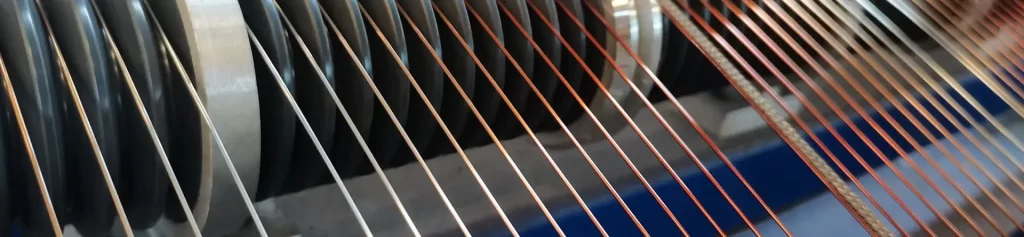
Mechanical strength is a key performance indicator for aluminum wire as electrical winding material, directly affecting the conductor’s processing performance, winding quality, and operational reliability. Aluminum wire experiences various mechanical loads during winding, assembly, and operation. Insufficient mechanical strength may lead to conductor fracture, coating damage, and winding failure. Aluminum’s mechanical strength differs significantly from copper. Understanding aluminum’s strength characteristics, influencing factors, and improvement methods is crucial for proper selection and application of aluminum wire windings.
Basic Concepts of Mechanical Strength
Stress-Strain Curve
Metal material behavior under tensile load is described through the stress-strain curve. Stress is the load per unit area, and strain is the relative deformation amount. Stress (σ) = F / A₀, where F is the load and A₀ is the original cross-sectional area. Strain (ε) = ΔL / L₀, where ΔL is the elongation and L₀ is the original gauge length. A typical stress-strain curve includes the elastic stage, yield stage, strengthening stage, and necking stage. Different stage characteristics reflect different mechanical properties of the material.
Elastic Modulus
Elastic Modulus (E) is the ratio of stress to strain in the elastic range, reflecting the material’s ability to resist elastic deformation. Aluminum’s elastic modulus is approximately 70 GPa, while copper’s elastic modulus is approximately 110-130 GPa. This means aluminum is more prone to elastic deformation than copper, producing greater deformation under the same force. Elastic modulus is an inherent property of material, mainly determined by interatomic bonding forces. Alloying, temperature, etc. have relatively small effects on it.
Yield Strength
Yield Strength (σs or σ₀.₂) is the stress value at which the material begins to undergo significant plastic deformation. For materials without obvious yield points (such as aluminum), conditional yield strength is usually used, that is, the stress value (σ₀.₂) when 0.2% permanent deformation occurs. Aluminum’s yield strength varies by state. Annealed pure aluminum yield strength is approximately 20-35 MPa. Cold-work hardened aluminum yield strength can reach 100-150 MPa.
Tensile Strength
Tensile Strength (σb) is the maximum stress value the material can withstand in a tensile test. Aluminum’s tensile strength varies by material state. Annealed pure aluminum tensile strength is approximately 60-90 MPa. Half-hard aluminum tensile strength is approximately 100-150 MPa. Hard aluminum tensile strength can reach 150-200 MPa. Through alloying and cold working, aluminum’s tensile strength can be significantly improved. Some high-strength aluminum alloys have tensile strength exceeding 500 MPa.
Elongation
Elongation (δ) is the plastic deformation degree when the material fractures, reflecting material ductility. Aluminum’s elongation varies by state. Annealed pure aluminum elongation can reach 25%-35%. Half-hard aluminum elongation is approximately 5%-15%. Hard aluminum elongation decreases significantly, approximately 1%-5%. Elongation and tensile strength are often inversely related. When strength increases, elongation correspondingly decreases.
Comparison of Mechanical Strength Between Aluminum and Copper
Key Performance Comparison
| Property | Pure Aluminum (O) | Pure Copper (O) | Ratio |
|---|---|---|---|
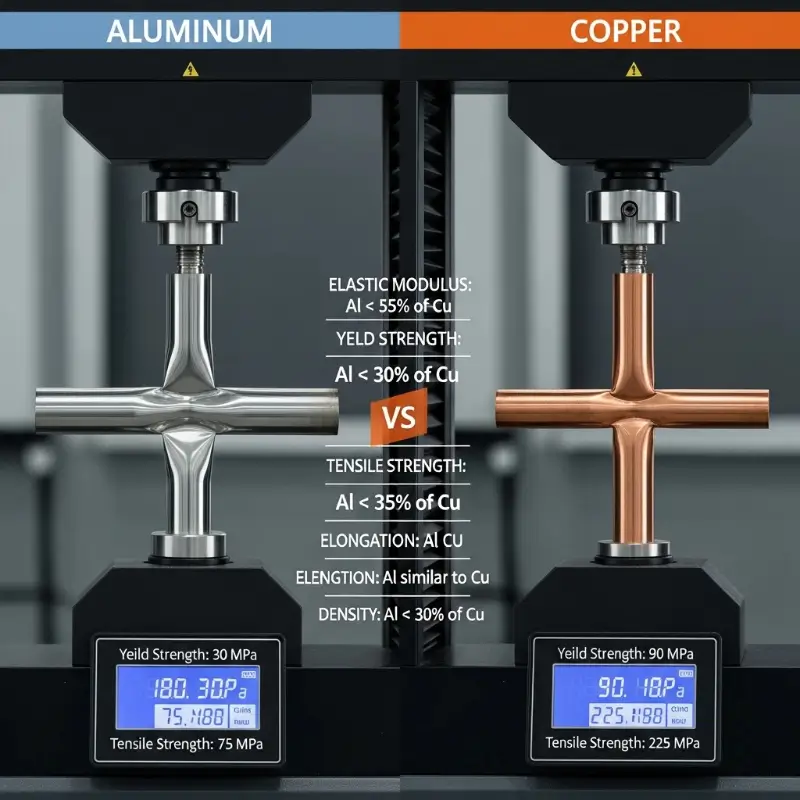
| Elastic Modulus (GPa) | 70 | 110-130 | Al ≈ 55% |
| Yield Strength (MPa) | 20-35 | 70-100 | Al ≈ 30% |
| Tensile Strength (MPa) | 60-90 | 200-250 | Al ≈ 35% |
| Elongation (%) | 25-35 | 30-50 | Al similar |
| Density (g/cm³) | 2.7 | 8.9 | Al ≈ 30% |
Specific Strength Advantage: Aluminum’s specific strength (tensile strength/density) is approximately 22-33 kNm/kg. Copper’s specific strength is approximately 22-28 kNm/kg. For weight-sensitive applications (such as aerospace, electric vehicles), aluminum’s lightweight advantage remains significant in terms of specific strength.
Engineering Significance
Engineering significance of aluminum wire applications need to pay attention to mechanical strength characteristics. Under the same outer diameter, aluminum wire’s load-bearing capacity is lower than copper wire. Under the same current carrying capacity, aluminum wire diameter usually needs to be larger. Aluminum wire needs smaller tension during winding to avoid tensile fracture. Aluminum wire windings have relatively weaker short circuit impact resistance.
Factors Affecting Mechanical Strength of Aluminum Wire
Chemical Composition
Aluminum’s chemical composition significantly affects mechanical strength. Pure aluminum has lower strength, and alloying is the main way to improve aluminum strength. Common alloying elements for electrical aluminum include: Magnesium (Mg) improves strength and corrosion resistance; Silicon (Si) improves casting performance; Manganese (Mn) improves strength and heat resistance; Iron (Fe) improves high-temperature strength. 1350 electrical aluminum composition requirements: Al content ≥99.5%, other element content strictly controlled. Fewer impurity elements mean better conductivity but also lower strength.
Cold Work Hardening
Cold working is an important method to improve aluminum wire mechanical strength. During drawing, aluminum grains undergo deformation and dislocation multiplication, producing work hardening. Hard aluminum wire’s tensile strength can reach 2-3 times that of annealed state. However, elongation decreases significantly, and material becomes more brittle. Aluminum conductors for enameled wire typically use annealed state (O temper) to balance strength and elongation.
Heat Treatment
Annealing treatment is the key process to control aluminum wire mechanical properties. Annealing causes work-hardened aluminum to recrystallize, restoring plasticity. Full annealing (O temper) gives aluminum the lowest strength and highest elongation. Intermediate annealing (partial annealing) can obtain different strength-plasticity combinations. Annealing temperature and time need precise control. Too low temperature or too short time means incomplete recrystallization. Too high temperature or too long time means grain coarsening and performance degradation.
Temperature Factors
Temperature has a significant effect on aluminum wire mechanical strength. As temperature increases, aluminum’s strength decreases and elongation increases. At room temperature, aluminum’s strength is highest. At 100-200°C, strength decreases by 10-20%. At 300-400°C, strength decreases by more than 50%. Approaching the melting point (660°C), strength drops sharply. Strength changes of enameled aluminum wire at operating temperatures need to be considered in design.
Wire Diameter Influence
Mechanical strength of aluminum wire of different diameters may differ. Fine wire experiences more thorough deformation during drawing, potentially having higher strength. Coarse wire strength is usually close to the material’s bulk strength. Quality control needs to pay attention to consistency between different diameter batches.
Coating Influence
The coating, as an insulation layer, affects the overall mechanical performance of aluminum wire. The coating’s strength and adhesion to the conductor affect overall performance. Polyamide-imide (AIW) coating has excellent scrape resistance and tensile adhesion. Polyester (PEW) coating has moderate mechanical performance. Polyurethane (UEW) coating has relatively lower mechanical performance.
Aluminum Wire Mechanical Strength Standards
IEC Standard
IEC 60317 series standards specify mechanical performance requirements for various enameled aluminum wires. Standards specify minimum values for tensile strength, elongation, etc. for different diameters. Typical requirements include: 0.25-1.0mm diameter aluminum magnet wire, elongation ≥15%. 1.0-2.5mm diameter aluminum magnet wire, elongation ≥20%.
NEMA Standard
NEMA MW1000-2018 standard has clear specifications for aluminum magnet wire mechanical performance. Standards provide tensile strength and elongation requirements for different specifications.
China Standard
China GB/T 6109 series standards basically correspond to IEC standards. Standards specify requirements for aluminum magnet wire elongation, tensile strength, and other properties.
Actual Production Level
Premium aluminum magnet wire mechanical performance usually exceeds standard requirements. Advanced production processes can ensure product performance stability and consistency.
Mechanical Strength Testing Methods
Tensile Strength Testing
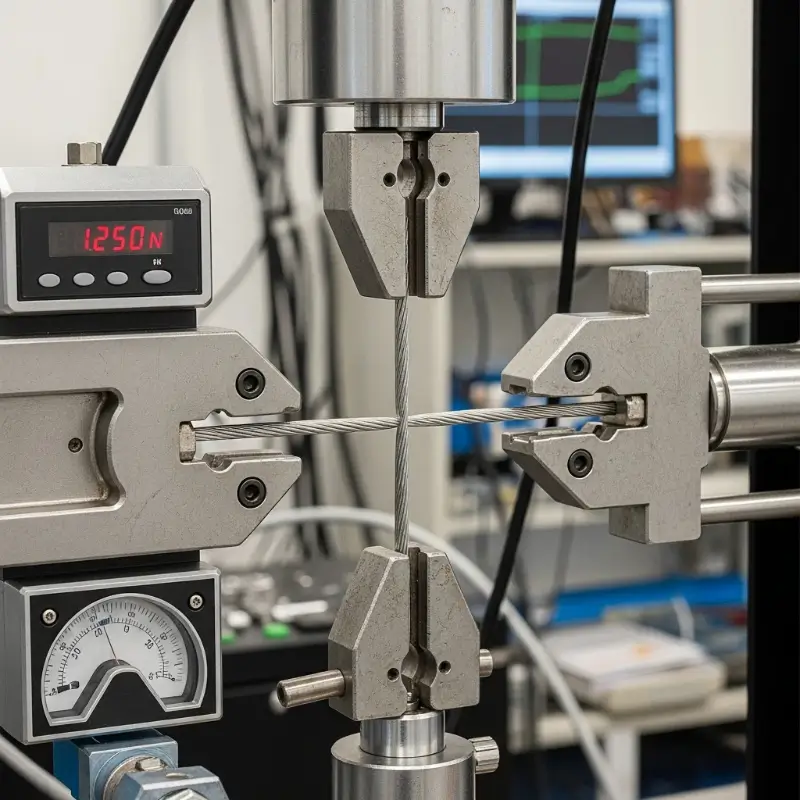
Tensile strength testing usually uses a universal material testing machine. The specimen is clamped on the testing machine, and tensile load is applied until fracture. The load-displacement curve is recorded during testing, and tensile strength, yield strength, and elongation are calculated. Testing should comply with corresponding standard requirements.
Elongation Testing
Elongation testing is performed simultaneously with tensile strength testing. After specimen fracture, measure the gauge elongation and calculate elongation. Elongation is an important indicator reflecting material plasticity and has important significance for winding wire processability.
Scrape Testing
Scrape testing is a unique test item for enameled wire, used to evaluate coating mechanical damage resistance. During testing, a steel needle scrapes the coating surface, and the number of times or force required to scrape through the coating is recorded. Polyamide-imide (AIW) coating has the most excellent scrape resistance, with scrape counts reaching dozens or even hundreds of times.
Bend Testing
Bend testing evaluates coating integrity of enameled wire in bent state. The specimen is bent around a mandrel of specific diameter, and the coating is checked for cracking. Bend testing is an important method to evaluate enameled wire processability.
Springback Angle Testing
Springback angle testing measures the springback angle of enameled wire after bending, reflecting conductor flexibility and elasticity. Smaller springback angle indicates the conductor is easier to form, beneficial for winding processing.
Impact of Mechanical Strength on Applications
Winding Process
| Application | Mechanical Strength Requirement |
|---|---|
| Winding Process | Tensile strength, elongation, coating strength |
| End Forming | Bending performance and elongation |
| Temperature Cycling | Adapt to thermal stress |
| Vibration Environment | Fatigue strength |
| Short Circuit Impact | Resistance to deformation and fracture |
End Forming
End forming of motors and transformers requires the conductor to undergo complex bending. Conductors with insufficient mechanical strength are prone to fracture during end forming. Winding end forming has high requirements for aluminum wire’s bending performance and elongation.
Temperature Cycling
Temperature cycling during electrical equipment operation produces thermal stress. Aluminum wire with good mechanical strength can better adapt to thermal cycling. Temperature cycling testing is an important method to evaluate aluminum wire winding reliability.
Vibration Environment
Vibration environment produces periodic mechanical loads on windings. Aluminum wire with high mechanical strength is more reliable under vibration. Fatigue strength under vibration environment is an important factor for aluminum wire selection.
Short Circuit Impact
Short circuits cause windings to experience huge electromagnetic forces. Insufficient mechanical strength may lead to conductor deformation, fracture, or insulation damage. Short circuit withstand capability is a key indicator for evaluating winding mechanical performance.
Engineering Application Selection
Selection Based on Winding Method
| Equipment Type | Tensile Strength Requirement |
|---|---|
| Small Motors | 80-120 MPa |
| Large Industrial Motors | 100-150 MPa |
| Transformer Windings | Moderate |
| Vibration Environment Equipment | High tensile strength + high elongation |
Different winding methods have different mechanical strength requirements. Automatic winding: requires higher tensile strength and moderate elongation. Manual winding: relatively lower requirements. Embedded windings: require high elongation and good flexibility.
Selection Based on Equipment Type
Different equipment has different mechanical strength requirements for aluminum wire. Small motors: usually require tensile strength 80-120 MPa. Large industrial motors: require 100-150 MPa. Transformer windings: require moderate levels. Vibration environment equipment: require high tensile strength and high elongation.
Selection Based on Operating Environment
Harsh operating environments require higher mechanical strength. Normal temperature stable environment: standard mechanical strength is sufficient. Temperature cycling environment: need to consider high-temperature strength attenuation. Vibration environment: need high fatigue strength. Extreme environments: need specially formulated aluminum alloys.
Methods to Improve Mechanical Strength
Material Selection
Selecting high-strength aluminum alloys is the fundamental way to improve mechanical strength. Al-Mg-Si alloys (6000 series) have a good strength-plasticity balance. Al-Mg alloys (5000 series) have good weldability.
Process Optimization
Optimizing drawing process parameters can improve mechanical performance. Appropriate drawing speed, deformation amount, and intermediate annealing processes can obtain the best strength-plasticity combination.
Heat Treatment
Precise control of heat treatment processes is the key to improving mechanical performance. Full annealing obtains high plasticity, intermediate annealing obtains balanced performance, solution treatment + aging obtains high strength.
Coating Selection
Selecting coatings with excellent mechanical performance can improve overall performance. Polyamide-imide (AIW) coating has the best mechanical protection capability.
Quality Control and Testing
Raw Material Inspection
Aluminum conductor raw materials need to inspect chemical composition and mechanical performance. Raw materials meeting standards are the foundation for producing qualified products.
Process Control
Production processes need to control key process parameters such as drawing, annealing, and coating. Online detection equipment can monitor product quality in real time.
Finished Product Testing
Finished products need to undergo multiple tests such as tensile strength, elongation, scrape testing, and bend testing. Ensure products meet standard requirements.
Quality Traceability
A complete quality traceability system helps problem analysis and continuous improvement. Full-process quality records from raw materials to finished products are effective means of quality management.
Future Development Trends
High-Performance Aluminum Alloys
New aluminum alloy research is dedicated to further improving strength. Al-Mg-Sc alloys, Al-Li alloys, etc. have higher specific strength.
Refined Manufacturing
Refined manufacturing processes can further improve product mechanical performance consistency. Progress in precision drawing, uniform annealing, and other processes drives product quality improvement.
Intelligent Testing
Intelligent testing technology improves quality control levels. AI and machine vision applications in enameled wire inspection enable more accurate quality assessment.
Summary
Mechanical strength is a key performance indicator of aluminum wire, involving multiple aspects such as elastic modulus, yield strength, tensile strength, and elongation. Aluminum’s overall mechanical strength is lower than copper, but it has advantages in specific strength. Aluminum wire’s mechanical strength is affected by multiple factors including chemical composition, cold work hardening, heat treatment, temperature, wire diameter, and coating. IEC, NEMA, China, and other standards have clear requirements for aluminum wire mechanical performance. Engineering applications need to comprehensively consider mechanical strength requirements based on winding method, equipment type, and operating environment. Material selection, process optimization, heat treatment, and coating selection are effective ways to improve mechanical strength. With continuous progress in material science and manufacturing processes, aluminum wire’s mechanical performance will further improve, providing higher quality winding material choices for the electrical industry.