

Introduction
Definition and Industrial Context of Magnet Wire for Industrial Motors
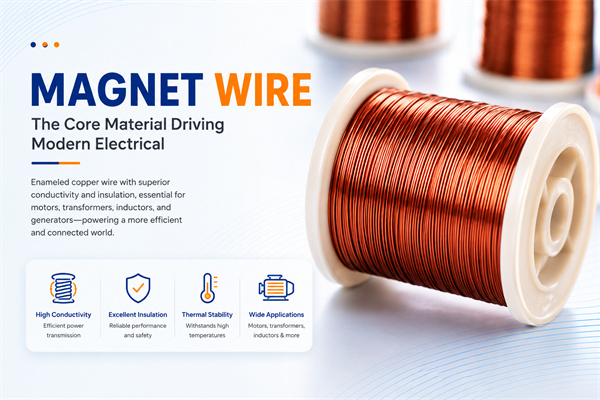
Magnet wire for industrial motors refers to enameled wire, wrapped wire, rectangular (flat) wire, and other types of magnet wire used in windings of industrial motors, covering stator windings, rotor windings (wound-rotor type), field windings, and compensating windings. As core power equipment for industrial production and infrastructure, industrial motors rely on magnet wire selection to directly determine motor efficiency, power density, operating temperature rise, service life, and maintenance intervals. Typical application areas include pumps, fans, compressors, cranes, machine tools, process industries, and explosion-proof hazardous environments.
Key Differences Between Magnet Wire for Industrial Motors vs. Consumer Electronics/Automotive Motors
Fundamental distinctions exist between magnet wire for industrial motors and that for consumer electronics or automotive motors. In terms of power rating, industrial motors range from 0.1 kW to over 10 MW—significantly exceeding consumer electronics (typically < 100 W) and automotive traction motors (50 kW to 400 kW). Regarding operating environment, industrial motors endure more severe conditions—including higher vibration, mechanical shock, thermal cycling, humidity, oil contamination, and chemical corrosion. In reliability requirements, industrial motors are typically designed for a service life of 20 to 30 years; maintenance cycles often necessitate rewinding capability. For energy efficiency standards, industrial motors must comply with IEC 60034-30-1 IE1–IE5 efficiency classes or NEMA Premium specifications.
Scope and Target Audience of This Document
This document focuses on material systems, performance requirements, wire geometry specifications, application scenarios, energy-efficiency-based selection criteria, design considerations, and quality inspection methods for magnet wire in industrial motors. It covers applications of round enameled wire, rectangular (flat) wire, glass-filament-wrapped wire, paper-wrapped wire, and Litz wire in industrial motor windings. Target readers include motor design engineers, winding manufacturing engineers, motor maintenance engineers, technical evaluators for industrial equipment procurement, and motor controller (variable-frequency drive, VFD) engineers.
Material System for Industrial Motor Magnet Wire
Copper-Based Magnet Wire
Copper-based magnet wire is the mainstream magnet wire product for industrial motors, including pure copper enameled wire and enamel-coated copper-clad aluminum (ECCA) wire. Pure copper enameled wire uses oxygen-free copper C11000 or high-purity copper C10200 (copper content ≥ 99.95%) as the conductor, with electrical conductivity ranging from 100% to 101% IACS and excellent mechanical strength; it is the most widely applied magnet wire type in industrial motors. ECCA wire features a three-layer composite structure consisting of an aluminum core clad with a copper layer; 10/90-ratio ECCA enameled wire weighs only 40% of equivalent pure copper enameled wire and reduces cost by 30% to 50%, expanding its application in weight- and cost-sensitive scenarios such as industrial fans and air-conditioning motors.
Aluminum-Based Magnet Wire
Aluminum-based magnet wire uses pure aluminum grades 1050 or 1060 as the conductor, with electrical conductivity approximately 61% IACS and density 2.70 g/cm³—30% the weight of copper. In industrial motors, aluminum-based magnet wire is primarily employed in stator windings of large motors (> 100 kW), offering advantages of low weight, low cost, and superior winding heat dissipation performance. However, welding and termination processes for aluminum-based magnet wire are comparatively complex, requiring specialized fluxes or copper–aluminum transition connectors, limiting its use in maintenance and rewinding applications.
Enamel Systems
Enamel systems for industrial motor magnet wire include polyester, polyurethane, polyester-imide, polyamide-imide, and polyimide. Polyester enamel provides thermal class B (130°C) resistance, low cost, and good adhesion. Polyurethane enamel offers thermal classes B to high F (155°C) and possesses self-bonding capability (“direct-solder” enamel), making it suitable for automated winding and soldering in industrial motors. Polyester-imide enamel delivers thermal classes F (155°C) to H (180°C) and represents the most commonly used enamel system for thermal class requirements in industrial motors. Polyamide-imide enamel provides thermal classes H to N (200°C) and is frequently applied as a topcoat over polyester-imide enamel. Polyimide enamel achieves thermal class R (220°C) and is used in high-temperature industrial motors.
Thermal Class and Temperature Index (TI)
Thermal classes for industrial motor magnet wire, per IEC 60085, are classified as Class B (130°C), Class F (155°C), Class H (180°C), Class N (200°C), and Class R (220°C). Selection of thermal class shall be based on the industrial motor’s operating ambient temperature, load type, and cooling conditions. Standard industrial motors commonly employ Class F (155°C) enamel with Class B (130°C) temperature rise design; high-efficiency industrial motors typically utilize Class H (180°C) enamel with Class F (155°C) temperature rise design. The Temperature Index (TI) shall exceed the motor’s operating temperature by a sufficient margin (typically ≥ 10°C to 20°C) to ensure long-term operational reliability.
Key Performance Requirements for Magnet Wire Used in Industrial Motors
Dielectric Strength and Partial Discharge Characteristics
The dielectric strength of industrial motor magnet wire determines its ability to withstand power-frequency voltage and impulse voltage. The dielectric breakdown voltage of round enameled wire is evaluated per IEC 60851; for a 30 μm enamel thickness, the dielectric breakdown voltage shall be no less than 5 kV. Under variable-frequency drive (VFD) operating conditions, the risk of partial discharge (PD) induced by high dv/dt pulses increases significantly. Industrial motor magnet wire must be optimized for PD resistance under VFD conditions, commonly achieved via incorporation of inorganic nano-fillers, multilayer composite enamel systems, or corona-resistant enamel coatings.
Thermal Class and Thermal Life
The thermal life of industrial motor magnet wire is governed by the chemical stability of the enamel coating and follows an exponential decay relationship under the Arrhenius model. Class H (180°C) enamel exhibits a design life of typically 20,000 hours at 180°C; achieving a 20- to 30-year design life for industrial motors requires continuous operating temperatures below 155°C. Similarly, Class F (155°C) enamel has a design life of 20,000 hours at 155°C. Class N (200°C) and Class R (220°C) enamels are intended for high-temperature industrial motor applications. Thermal life evaluation shall be conducted per IEC 60216 via accelerated aging tests to establish an Arrhenius regression curve.
Tensile Strength and Winding Processability
The tensile strength and elongation of industrial motor magnet wire influence winding manufacturing processes. Round enameled wire typically exhibits tensile strength in the range of 220 MPa to 280 MPa and elongation of 5% to 15%, enabling compatibility with high-speed winding machines subject to drawing and bending stresses. For rectangular (hairpin) wire, tensile strength correlates with the aspect ratio of the rectangular cross-section; thin rectangular profiles must maintain adequate tensile strength and elongation to satisfy winding process requirements. Industrial motor winding processes impose strict constraints on minimum bending radius; winding parameters must therefore be optimized based on wire dimensions and enamel characteristics.
Chemical and Oil Resistance
Industrial motor magnet wire is exposed to chemical agents—including oils, acids, alkalis, and solvents—in industrial environments. Enamel chemical resistance primarily depends on the molecular structure of the enamel system: polyester-imide enamel offers superior oil resistance compared to polyester enamel, while polyimide enamel exhibits excellent overall chemical resistance. Additionally, during motor winding impregnation processes, magnet wire must withstand chemical exposure from impregnating varnishes; the enamel must demonstrate good compatibility with the impregnating varnish to prevent swelling, lifting, or delamination post-impregnation.
Soldering and Termination Reliability
Soldered and terminated connections of industrial motor magnet wire must endure prolonged vibration, temperature cycling, and humid environments. Termination methods for round enameled wire include tin soldering, copper brazing, crimping, and wrapping; for rectangular (hairpin) wire, termination methods include TIG welding, laser welding, resistance welding, and ultrasonic welding. Under VFD conditions, termination points are subjected to high-frequency pulse voltages and mechanical vibration; solder joint reliability directly impacts motor service life. Termination processes for industrial motor magnet wire shall comply with IEC 60068 vibration environmental test standards and be validated through comprehensive environmental testing—including thermal cycling, damp heat cycling, and mechanical vibration.
Wire Types and Specifications for Industrial Motor Magnet Wire
Round Enamelled Wire
Round enamelled wire is the most widely used type of magnet wire in industrial motors, with diameters ranging from 0.1 mm to 6.0 mm. It is primarily employed in stator windings, rotor windings, and field windings of medium- and low-voltage motors (< 1000 V). Insulation classes range from Class B to Class R; enamel film thickness is adjusted according to thermal class and dielectric strength requirements. Advantages of round enamelled wire include mature manufacturing processes, simple winding procedures, and ease of maintenance; disadvantages include low slot fill factor (typically 0.40–0.50) and limited power density.
Rectangular Enamelled Wire / Hairpin Wire
Rectangular enamelled wire (flat wire) features an insulated conductor with a rectangular cross-section, achieving slot fill factors of 0.70–0.80, thereby significantly enhancing motor power density and efficiency. Applications in industrial motors include large high-voltage motors (> 1000 V), IE4/IE5 ultra-high-efficiency motors, and variable-frequency drive (VFD)-dominant industrial motors. Hairpin flat wire refers to U-shaped flat wire terminations, commonly used in high-efficiency industrial motors and new-energy vehicle traction motors. Insulation classes for rectangular enamelled wire span Class F to Class R, with typical enamel film thicknesses of 30 μm to 100 μm.
Glass-Fibre-Wrapped Wire and Mica-Tape-Wrapped Wire
Glass-fibre-wrapped wire employs a composite insulation structure comprising alkali-free E-glass fibre braiding and impregnated varnish curing, achieving thermal classes from Class F (155°C) to Class R (220°C). It is primarily applied in high-voltage industrial motors (> 1000 V) and large motors (> 100 kW). Mica-tape-wrapped wire utilizes a composite insulation structure of mica tape and glass fibre, attaining thermal classes from Class F to Class R, with operating voltage ranges of 6 kV to 35 kV. Both glass-fibre-wrapped wire and mica-tape-wrapped wire are deployed in industrial motors for high-voltage motors, explosion-proof motors, and traction motors.
Paper-Insulated Wire
Paper-insulated wire uses multiple layers of cable paper or thermally upgraded kraft paper as the insulation layer, mainly applied in oil-immersed industrial motors. Operating temperature is determined by both oil temperature and paper substrate: cable paper—105°C, thermally upgraded kraft paper—130°C, aramid paper—220°C. Oil-immersed industrial motors offer superior heat dissipation and extended service life (> 30 years), but suffer from high weight, inconvenient maintenance, and potential oil contamination.
Litz Wire
Litz wire consists of multiple individually insulated fine strands (diameters 0.04 mm to 0.2 mm) twisted together, effectively reducing skin effect and proximity effect losses under high-frequency AC conditions. Primary applications include high-frequency industrial motors (> 1 kHz), variable-frequency drive motors, induction heating equipment, and ultrasonic motors. Although litz wire accounts for a smaller share of industrial motor applications compared to round enamelled wire, it offers irreplaceable advantages in high-frequency applications.
Typical Applications of Magnet Wire for Industrial Motors
Pumps and Fans Motors
Pumps and fans motors represent the largest volume application segment among industrial motors, including process pumps, HVAC fans, process industry fans, mine dewatering pumps, irrigation pumps, etc. These motors typically operate at constant speed (IE2/IE3) or variable-frequency drive (VFD) operation (IE3/IE4), with power ratings ranging from 0.5 kW to 500 kW. Magnet wire selection is typically F-class (155°C) polyester-imide enameled round wire (0.5 mm to 2.0 mm) or rectangular (flat) wire.
Compressors Motors
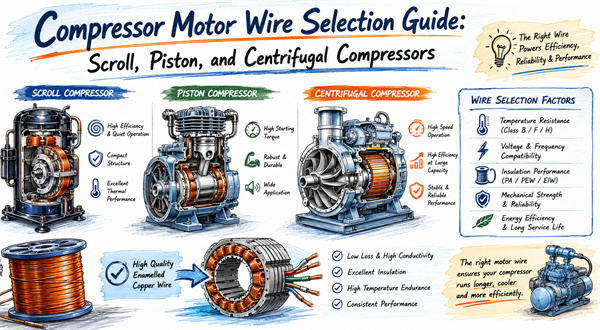
Compressor motors include air compressors, refrigeration compressors, gas compressors, screw compressors, etc. Compressor motors typically operate at constant speed or VFD control, with power ratings ranging from 0.5 kW to 1000 kW. Refrigeration and air compressors undergo frequent start-stop cycles; thus, the magnet wire must exhibit excellent thermal shock resistance and vibration resistance. Magnet wire selection is typically F-class or H-class polyester-imide enameled round wire (0.5 mm to 3.0 mm).
Conveying and Lifting Motors
Conveying and lifting motors include conveyor belt motors, crane motors, elevator motors, and AGV motors. These motors experience frequent start-stop cycles, VFD control, and overload operation; therefore, the magnet wire must provide superior thermal shock resistance, vibration resistance, and serviceability. Magnet wire selection is typically F-class or H-class enameled round wire (0.5 mm to 2.5 mm) or rectangular (flat) wire. Crane and elevator motors require high rewinding capability; AGV motors demand high power density and commonly employ hairpin-type rectangular (flat) wire.
Machine Tool and Servo Motors
Machine tool and servo motors include spindle motors, servo drive motors, gearmotor reducers, etc. These motors impose stringent requirements on precision, dynamic response, and efficiency, and are frequently implemented as IE4/IE5 ultra-high-efficiency motors. Magnet wire selection is predominantly rectangular (flat) hairpin wire, enabling high slot fill factor, high power density, and high efficiency. Machine tool motors endure high-frequency forward/reverse rotation and abrupt load changes; thus, the enamel coating must exhibit excellent thermal shock resistance and fatigue resistance.
Process Industry Motors
Process industry motors are deployed in chemical, metallurgical, mining, and papermaking industries, operating under harsh conditions (e.g., high temperature, humidity, corrosive gases, oil contamination). Power ratings range from 1 kW to 10 MW. Magnet wire must demonstrate exceptional thermal endurance, chemical resistance, and corrosion resistance. Magnet wire selection is typically F-class or H-class enameled wire; specialized applications may employ glass-fiber-covered wire or mica-tape-wrapped wire for enhanced insulation.
Explosion-Proof and Hazardous-Condition Motors
Explosion-proof motors are used in petroleum, natural gas, chemical, and coal mining industries—environments prone to flammability and explosion—and must comply with ATEX, IECEx, UL, and other explosion-protection certification standards. The magnet wire insulation must satisfy explosion-protection requirements, including thermal endurance limits and surface temperature restrictions (typically < 200°C). Magnet wire selection is typically F-class or H-class polyester-imide enameled round wire (0.3 mm to 2.0 mm), with increased enamel thickness compared to standard motors.
Energy Efficiency Standards for Industrial Motors and Selection of Magnet Wire
IEC 60034-30-1 Energy Efficiency Classification
IEC 60034-30-1 is the international energy efficiency classification standard for industrial motors, defining four efficiency classes: IE1 (Standard Efficiency), IE2 (High Efficiency), IE3 (Premium Efficiency), and IE4 (Super Premium Efficiency). IE5 (Ultra Premium Efficiency) is the latest efficiency class, published in 2017. The IE3 class requires a minimum efficiency of 93.0% for 7.5 kW industrial motors, while the IE4 class requires a minimum efficiency of 94.3% for 7.5 kW industrial motors. Different IE classes impose distinct performance requirements on magnet wire; IE3/IE4 high-efficiency motors demand magnet wire with lower resistive losses, higher slot fill factor, and superior thermal conductivity.
NEMA Premium Class and Magnet Wire Matching
NEMA Premium is the North American energy efficiency certification standard for industrial motors, equivalent to the IEC IE3 class. The NEMA Premium class mandates higher efficiency levels for industrial motors ranging from 1 HP to 500 HP compared to conventional NEMA classes. Magnet wire selection must be optimized for NEMA Premium compliance, focusing on conductor resistance, enamel coating thickness, and winding tightness.
Special Magnet Wire Requirements for IE3/IE4 High-Efficiency Motors
Special magnet wire requirements for IE3/IE4 high-efficiency motors include: low resistive losses; high slot fill factor (achieved via hairpin-shaped rectangular wire or optimized round-wire packing); low current density (to reduce I²R losses); and high thermal margin (achieved using Class F or Class H enamel coatings).
Magnet Wire Selection Strategy for High-Efficiency Motors
The magnet wire selection strategy for high-efficiency motors includes: prioritizing oxygen-free copper C11000 or high-purity copper C10200 round enameled wire with Class F or Class H polyester-imide enamel; adopting hairpin-shaped rectangular enameled wire for IE4/IE5 ultra-high-efficiency motors; specifying corona-resistant enamel for variable-frequency drive (VFD) applications; utilizing glass-fiber-covered wire or mica-tape-wrapped wire for high-voltage industrial motors; and selecting ECCA enameled wire for weight-sensitive applications. Magnet wire selection for high-efficiency motors must comply with IEC 60034-30-1 and NEMA Premium requirements.
Design and Selection of Magnet Wire for Industrial Motors
Slot Fill Factor and Winding Design
The slot fill factor is a critical parameter in magnet wire selection for industrial motors, influencing winding conductivity, heat dissipation efficiency, and mechanical strength. The slot fill factor for round enameled wire typically ranges from 0.40 to 0.50, whereas that for rectangular (hairpin) wire can reach 0.70 to 0.80. An excessively low slot fill factor increases winding resistance and reduces efficiency; an excessively high value complicates coil insertion and raises the risk of enamel damage. Optimal slot fill factor must be determined based on motor rated power, efficiency class (e.g., IE2/IE3 or IE4/IE5), and coil insertion process. Round enameled wire is suitable for IE2/IE3 motors, while rectangular (hairpin) wire is preferred for high-efficiency IE4/IE5 motors.
Skin Effect and Variable-Frequency Drive (VFD) Operating Conditions
Under variable-frequency drive (VFD) operation, industrial motor magnet wire is subjected to dv/dt pulses (typically 3 kV/μs to 10 kV/μs) and high-frequency sinusoidal voltages. dv/dt pulses induce voltage stress concentration across turn-to-turn insulation, while the skin effect increases current density at the conductor surface, leading to localized enamel overheating. Corona-resistant enamel—incorporating inorganic fillers such as TiO₂, SiO₂, and Al₂O₃—significantly enhances partial discharge (PD) resistance. Magnet wire selection for VFD-operated industrial motors shall comply with NEMA MG-1 Part 31.
Thermal Field Distribution and Magnet Wire Thermal Margin
Thermal field distribution in industrial motors is non-uniform, with stator winding end-windings and hot spots typically operating at higher temperatures than the average winding temperature. Magnet wire thermal margin shall be determined based on hot-spot temperature and enamel thermal class rating. F-class 155°C enamel is commonly applied in B-class 130°C temperature-rise designs (average winding temperature: 130°C; hot-spot temperature: 145°C), while H-class 180°C enamel is used for F-class 155°C temperature-rise designs. A thermal margin of 25°C to 35°C represents typical design practice for industrial motors.
Vibration Resistance and Impact Resistance
Industrial motors are subjected to operational vibration, start/stop shock loads, and vibration induced by VFD operation. Magnet wire must exhibit robust vibration and impact resistance, with enamel possessing both elasticity and toughness. Impact resistance of round enameled wire is ensured by combined enamel thickness and enamel toughness; impact resistance of rectangular (hairpin) wire relies on end-welding process quality and end-winding fixation structure. Vibration and impact resistance of magnet wire shall be verified per IEC 60068 environmental vibration testing.
Maintenance Interval and Rewindability
The design service life of industrial motors is typically 20 to 30 years, during which one to two rewinding maintenance cycles may be required. Rewindability demands stable enamel performance throughout wire removal, cleaning, and re-coiling processes. F-class and H-class enamels—offering superior thermal endurance and toughness—are well-suited for rewinding applications, whereas B-class enamel exhibits lower thermal capability. Round enameled wire demonstrates better rewindability than rectangular (hairpin) wire, whose complex end-welding structure results in higher rewinding maintenance cost.
Quality Inspection of Magnet Wire for Industrial Motors
Dielectric Breakdown and tanδ Testing
Dielectric breakdown voltage testing of industrial motor magnet wire is conducted in accordance with IEC 60851; at ambient temperature, the dielectric breakdown voltage for a 30 μm enamel coating shall be no less than 5 kV. The tanδ test is performed at 1 kHz frequency; the dielectric loss factor tanδ reflects the stability of the enamel coating’s dielectric performance. Typical tanδ values for different enamel systems: Class B polyester enamel: 0.020 to 0.040; Class F polyester-imide enamel: 0.015 to 0.025; Class H polyamide-imide enamel: 0.010 to 0.020; Class R polyimide enamel: 0.005 to 0.015. Under high-temperature testing (155°C or 180°C), the reduction in dielectric breakdown voltage shall not exceed 30%, and the increase in tanδ shall not exceed 50%.
Tensile Strength and Elongation
Tensile strength and elongation testing of industrial motor magnet wire is conducted in accordance with ASTM B3 or IEC 60851. For pure copper enameled wire, ambient-temperature tensile strength ranges from 220 MPa to 280 MPa, with elongation from 5% to 15%; for aluminum enameled wire, ambient-temperature tensile strength ranges from 70 MPa to 110 MPa, with elongation from 8% to 20%; for ECCA enameled wire, ambient-temperature tensile strength ranges from 80 MPa to 130 MPa, with elongation from 10% to 25%. High-temperature tensile strength degradation of magnet wire must comply with motor winding manufacturing process requirements.
Thermal Life and Accelerated Aging
Thermal life evaluation of industrial motor magnet wire follows IEC 60216, establishing an Arrhenius regression curve via accelerated aging tests. Design life for Class B enamel is no less than 20,000 hours at 130°C; for Class F enamel, no less than 20,000 hours at 155°C; for Class H enamel, no less than 20,000 hours at 180°C. Accelerated aging tests shall be conducted at three temperature levels, with multiple samples placed at each level and key parameters—dielectric strength, strip strength, and enamel adhesion—measured periodically. Temperature index (TI) and lifetime curves are derived through Arrhenius regression analysis.
Solderability and Termination Reliability
Solderability testing of industrial motor magnet wire complies with IEC 60851, covering solder wettability, solder joint strength, and contact resistance after soldering. Round enameled wire termination testing typically employs dip soldering (350°C solder bath); flat wire termination testing utilizes TIG welding, laser welding, or resistance welding followed by evaluation. Solder joint strength must meet the tensile strength requirements specified for the magnet wire grade, and contact resistance must be below 1 mΩ. Termination reliability under VFD (variable-frequency drive) operating conditions must be validated through comprehensive environmental testing, including thermal cycling, damp heat cycling, and mechanical vibration.
AC Withstand Voltage and Impulse Withstand Voltage Testing
AC withstand voltage and impulse withstand voltage testing of industrial motor magnet wire simulates voltage stress during motor operation. AC withstand voltage testing is performed at frequencies from 1 kHz to 10 kHz, with test voltage typically set at 2.5 to 3 times rated voltage. Impulse withstand voltage testing simulates lightning and switching surge voltages, with voltage rise time of 1.2 μs to 5 μs and peak voltage of 5 to 10 times rated voltage. Magnet wire must pass AC and impulse withstand voltage tests per IEC 60851 to verify enamel reliability under dynamic voltage stress.
Conclusion
Industrial motor magnet wire is the core material for industrial motor windings, encompassing various types including copper-based magnet wire, aluminum-based magnet wire, glass-filament-covered wire, mica-tape-wrapped wire, paper-covered wire, and Litz wire. The thermal class, dielectric strength, mechanical properties, and termination reliability of magnet wire directly determine the efficiency, power density, service life, and maintenance intervals of industrial motors. IE3/IE4 high-efficiency industrial motors impose stricter requirements on magnet wire for low losses and high slot fill factor; flat (hairpin) wire enamel technology has become a critical enabler for IE4/IE5 high-efficiency motors.
Selection of industrial motor magnet wire must be based on a comprehensive assessment of motor application scenarios, energy efficiency class, and operating environment. IEC 60034-30-1 energy efficiency classes and NEMA Premium classes serve as the primary reference standards for industrial motor magnet wire selection.
Engineering design and procurement must adopt a scientific selection approach grounded in the material characteristics, performance limits, and application limits of industrial motor magnet wire to ensure long-term safe, reliable operation and high energy efficiency performance.