


What is magnet wire?
If you open up any motor or transformer, you can see it—thin copper or aluminum wire with a layer of colored or transparent enamel on the outside.
This enamel insulation allows each conductor to be isolated from others, while being tightly wound into coils in compact spaces to produce strong electromagnetic effects.
Magnet wire is one of the most fundamental and critical materials in modern electrical industry.
Today, let’s thoroughly explain the definition, principle, classification, and application of “magnet wire.”
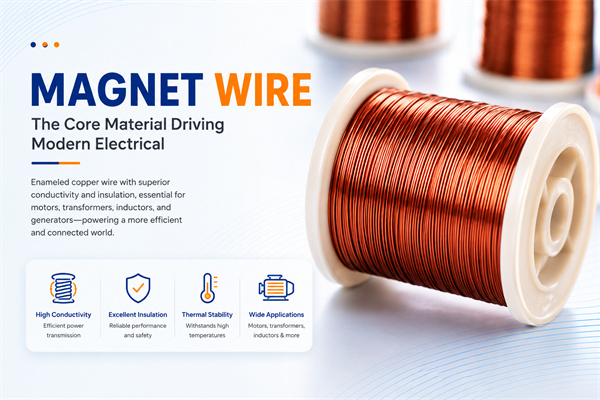
I. What Is Magnet Wire?
Magnet Wire, also known as “Enameled Wire” or “Enamelled Wire,” is a metal conductor coated with insulating enamel film on the surface.
It is commonly used to manufacture coils, windings, electromagnets, and other electrical components.
Most Common English Names:
- Magnet Wire — Mainstream American English term
- Enameled Wire — IEC standard system term
- Enamelled Wire — British English spelling
- Winding Wire — Application-level term
- Coil Wire — Use-level term
NEMA MW 1000-2018 Complete Definition:
“American National Standard for Magnet Wire”
IEC 60317 Series Standards Definition:
“Insulated round and rectangular wires for windings”
Core Essence:
Magnet wire = Metal conductor + Insulating enamel film
Its core mission is: To produce maximum electromagnetic effects in the smallest space.
II. Core Structure of Magnet Wire
1. Metal Conductor
Common Conductor Materials:
| Conductor Material | Features | Typical Applications |
|---|---|---|
| Copper (Cu) | Best conductivity, high mechanical strength | General motors, transformers |
| Aluminum (Al) | Light weight, low cost | Lightweight applications, high power |
| Copper Clad Aluminum (CCA) | Combines copper and aluminum advantages | Medium performance, cost-sensitive |
| Copper Clad Steel | High strength, high tensile | Special applications |
Conductor Shape Classification:
- Round Wire: Most common, rich specifications
- Flat Wire / Rectangular Wire: For high power density motors
- Square Wire: Special applications
- Foil: For high power transformers
2. Insulation Enamel
The insulating layer coated on the outside of the conductor is the key feature of magnet wire.
Common Enamel Materials:
| Enamel | Abbreviation | Thermal Class |
|---|---|---|
| Polyvinyl Acetal | PVF / PVAc | 105°C / 120°C |
| Polyurethane | UEW | 130°C |
| Polyester | PEW | 130°C / 155°C |
| Polyesterimide | EIW | 180°C |
| Polyesterimide/Polyamide-imide Composite | EIW/AIW | 200°C |
| Polyamide-imide | AIW | 220°C |
| Polyimide | PI | 240°C |
3. Enamel Structure
Single Coating Structure:
- Conductor → Single layer enamel
- Suitable for low voltage, dense winding
Double Coating Structure:
- Conductor → Primer → Top coat
- Good comprehensive performance, most common
Three-layer or Composite Structure:
- Conductor → Multiple enamel layers
- Suitable for high temperature, high reliability applications
III. Key Properties of Magnet Wire
1. Electrical Properties
- Breakdown Voltage: 1500-5000V+
- Insulation Resistance: ≥ 10^8 Ω·cm
- Dissipation Factor: Low
2. Mechanical Properties
- Tensile Strength: 20-300 MPa
- Elongation: 10-40%
- Abrasion Resistance: Grade 1/2/3
3. Thermal Properties
- Thermal Class: 105°C – 240°C
- Heat Shock: ≥ 150°C
- Softening Temperature: ≥ 200°C
4. Chemical Properties
- Solvent Resistance: Resistant to alcohol, ketone, aromatic hydrocarbons
- Hydrolysis Resistance: Resistant to moisture
- Acid/Alkali Resistance: Stable in most media
IV. Classification of Magnet Wire
1. By Conductor Material
- Enameled Copper Wire
- Enameled Aluminum Wire
- Enameled CCA Wire
2. By Conductor Shape
- Round Enameled Wire — Most common
- Rectangular Enameled Wire (Flat wire)
- Square Enameled Wire
3. By Insulation Material
- Polyester Enameled Wire (PEW)
- Polyurethane Enameled Wire (UEW)
- Polyesterimide Enameled Wire (EIW)
- Polyamide-imide Enameled Wire (AIW)
- Polyimide Enameled Wire (PI)
- Composite Coating Enameled Wire
4. By Thermal Class
| Class | Temperature | IEC Marking | Typical Enamel |
|---|---|---|---|
| E | 120°C | Class 120 | PVF, PEW |
| B | 130°C | Class 130 | UEW, PEW |
| F | 155°C | Class 155 | PEW, EIW |
| H | 180°C | Class 180 | EIW |
| C | 200°C | Class 200 | EIW/AIW |
| C+ | 220°C | Class 220 | AIW |
| C++ | 240°C | Class 240 | PI |
5. By Enamel Thickness Grade (IEC Standard)
- Grade 1: Thin enamel, dense winding
- Grade 2: Standard enamel, general purpose
- Grade 3: Thick enamel, high voltage
6. By Special Application
- Solderable Enameled Wire
- Self-Bonding Enameled Wire
- Corona-Resistant Enameled Wire
- High-Strength Enameled Wire
- Inverter-Duty Magnet Wire
V. International Standards for Magnet Wire
1. IEC Standards (International Universal)
IEC 60317 series is the most core international standard for magnet wire:
- IEC 60317-0-1: General requirements for enameled round copper wire
- IEC 60317-0-2: General requirements for enameled round copper stranded wire
- IEC 60317-0-3: General requirements for enameled round aluminum wire
- IEC 60317-1: Polyvinyl acetal enameled round copper wire (Class 120)
- IEC 60317-13: Polyester enameled round copper wire (Class 130)
- IEC 60317-25: Polyesterimide enameled round aluminum wire (Class 180)
- IEC 60317-26: Polyamide-imide enameled round aluminum wire (Class 200)
- IEC 60317-27: Paper covered enameled round aluminum wire
2. NEMA Standard (USA)
NEMA MW 1000: American National Magnet Wire Standard, detailing technical requirements for various magnet wires, widely adopted in North America and globally.
3. GB/T Standard (China)
GB/T 6109: National standard series for enameled round wire, equivalent to IEC 60317.
4. JIS Standard (Japan)
JIS C 3202: Japanese Industrial Standard for enameled wire.
VI. Application Fields of Magnet Wire
1. Motors
Most Widely Used:
- Home Appliance Motors: Refrigerators, air conditioners, washing machines
- Industrial Motors: Servo motors, inverter motors
- New Energy Vehicles: Drive motors
- Micro Special Motors: Vibration motors, stepper motors
Typical Usage: An automotive starter motor uses approximately 1-3kg of magnet wire per unit.
2. Transformers
- Power Transformers: Distribution transformers
- Dry-Type Transformers: Buildings, hospitals, subways
- High-Frequency Transformers: Switching power supplies, UPS
3. Generators
- Wind generators
- Hydro generators
- Steam turbine generators
- Small household generators
4. Electromagnets
- Lifting electromagnets
- Solenoid valves
- Relays
- Contactors
5. Communication Equipment
- High-frequency coils
- Inductors
- Transformers
6. Home Appliances
- Air conditioner compressors
- Refrigerator compressors
- Washing machine motors
- Microwave oven transformers
7. Medical Equipment
- MRI Magnetic Resonance
- CT scanning
- Medical instruments
VII. Working Principle of Magnet Wire
1. Electromagnetic Induction Principle
When magnet wire is wound into a coil and current passes through:
- Current produces magnetic field
- Magnetic field strength is proportional to turns × current
- This is the foundation of motor and transformer operation
2. Necessity of Insulation
If the conductor has no insulation layer:
- Adjacent conductors contact directly → Short circuit
- Cannot wind multi-turn coils
- Cannot achieve efficient electromagnetic conversion
The enamel of magnet wire solves this fundamental problem:
- Isolates conductors from each other
- Enables multi-turn dense winding
- Produces strong magnetic fields in small space
3. Key Role of Magnet Wire
Bridge for Energy Conversion:
- Motor: Electrical energy → Mechanical energy
- Generator: Mechanical energy → Electrical energy
- Transformer: Electrical energy → Electrical energy (voltage transformation)
Magnet wire serves as the key carrier in these processes.
VIII. Manufacturing Process of Magnet Wire
1. Conductor Drawing
Thick copper/aluminum rod → Multi-stage die drawing → Fine wire, with intermediate annealing to restore flexibility.
2. Enamel Coating
- Felt Method: Small batch, multi-variety
- Die Method: Mass production, high precision
- Electrostatic Spraying: Special applications
3. Baking Curing
- 400-600°C high temperature baking
- Enamel crosslinking curing
- Forms tough enamel film
4. Spooling and Packaging
Precise tension control, spool to standard wire spool, inspection and packaging.
5. Inspection Items
- Appearance (enamel uniformity)
- Dimension (conductor diameter, enamel thickness)
- Electrical (breakdown voltage, insulation resistance)
- Mechanical (tensile, elongation, abrasion)
- Thermal (heat shock, softening)
IX. Magnet Wire vs Ordinary Wire
| Comparison | Magnet Wire | Ordinary Wire |
|---|---|---|
| Insulation Method | Enamel (thin) | Plastic/rubber sheath (thick) |
| Application | Coil winding | Power transmission |
| Diameter | Thin | Thicker |
| Breakdown Voltage | 1500-5000V | Depends on insulation thickness |
| Flexibility | High | Medium |
| Long-term Working Temperature | 105-240°C | 60-90°C |
| Key Standards | IEC 60317, NEMA MW 1000 | IEC 60227, IEC 60245 |
X. Development History of Magnet Wire
1. Early Stage (19th Century – 1930s)
Natural silk, cotton yarn insulation → Oil-based enamel insulation (linseed oil) → Polyvinyl acetal enamel appears (1930s)
2. Modern Stage (1950s – 1990s)
Polyester, polyurethane enamel (1950s-1960s) → Polyesterimide, polyamide-imide (1970s-1980s) → Polyimide, high temperature enamel (1990s)
3. Contemporary Trends (2000s – Present)
- Thin film insulation: Reduce enamel thickness
- Corona resistance: Cope with inverter applications
- High slot fill rate: Improve power density
- Eco-friendly enamel: Water-based, solvent-free
- Smart manufacturing: Online inspection, AI quality control
XI. Magnet Wire Selection Guide
1. Clarify Application Requirements
- Use: Motor/transformer/electromagnet?
- Working Temperature: Normal/high/ultra-high?
- Electrical Requirements: Low/medium/high voltage?
- Mechanical Requirements: Tensile/abrasion resistance?
2. Select Conductor Material
- Copper: High performance, high reliability
- Aluminum: Light weight, low cost
- Copper Clad Aluminum: Balanced choice
3. Select Enamel Material
| Working Temperature | Recommended Enamel |
|---|---|
| ≤130°C | PEW / UEW |
| 155°C | PEW / EIW |
| 180°C | EIW |
| 200°C | EIW/AIW |
| 220°C | AIW |
| 240°C | PI |
4. Select Enamel Grade
- Grade 1: Dense winding
- Grade 2: General purpose
- Grade 3: High voltage
5. Verify Supplier
- Quality Certifications: ISO 9001, IATF 16949
- Product Certifications: UL, CQC, IEC
- Production Capability: Specification range, capacity
- Technical Support: Application experience, problem solving
XII. FAQ
Q: What is the difference between magnet wire, enameled wire, and winding wire?
A: These three terms usually refer to the same product in daily use, but named from different perspectives:
- Magnet Wire: Emphasizes use (for generating magnetic field)
- Enameled Wire: Emphasizes structure (with enamel)
- Winding Wire: Emphasizes application (for windings)
Q: Why is magnet wire called “magnet”?
A: Because its core use is to manufacture coils that generate magnetic fields when current passes through. This is the foundation of all electromagnetic devices such as motors, transformers, and electromagnets.
Q: Can magnet wire and ordinary wire be interchanged?
A: No. Magnet wire is specifically designed for coil windings and cannot be used for power transmission. Ordinary wire also cannot be used for windings (insulation is too thick, dense winding is not possible).
Q: What does “Magnet” mean? Why is it not magnetic material?
A: “Magnet” here refers to “electromagnetic.” Magnet Wire means “conductor used to generate electromagnetism,” not “magnetic conductor.” This is an easily confusing naming convention.