

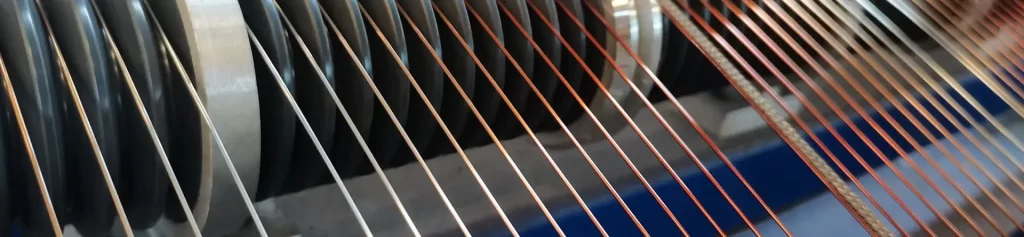
Enameled wire coating is not a single coating, but a “gradient structure” that has been coated and baked multiple times.Understanding the mechanism of aging is the first step in understanding why life is here.
1.1 Basic structure of enameled wire coating
Modern enameled wire coatings are typically single-layer, double-layer, or triple-layer structures:
| Number of layers | Typical structure | Single layer thickness | Breakdown voltage | Typical applications |
|---|---|---|---|---|
| Single Layer | 1 × Paint Film | 18–35 μm | 1.5–4 kV | Low Voltage Motors, Relays, Electronic Transformers |
| Double Layer | 2 × Paint Film | 30–60 μm | 4–8 kV | Medium Voltage Motor, Appliance Motor, Air Conditioning Compressor |
| Triple Layer | 3 × Paint Film | 50–100 μm | 8–15 kV | High Voltage Motor, Traction Motor, Transformer |
1.2 Chemical composition of paint film
| Film Materials | Abbreviations | Temperature Rating | Key Features | Typical Applications |
|---|---|---|---|---|
| Polyurethane | PU | 130°C (Class B) | Direct soldering, high-frequency performance | Electronic transformers, relays, watch coils |
| Polyester | PE | 155°C (Class F) | High mechanical strength and low cost | General motors, home appliance motors |
| Polyesterimide | PEI | 180°C (Class H) | Heat Resistant + Flexible Balance | Industrial Motors, Automotive Motors |
| Polyamideimide | Pai | 200°C (Class N) | High temperature and refrigerant resistance | Air conditioning compressors, power tools |
| Polyimide | PI | 220°C (Class R) | Top Heat Resistance, Radiation Resistance | Traction Motors, Aerospace, Nuclear Power Plants |
| Polyvinyl formaldehyde | PVF | 120°C (Class E) | Highest mechanical strength | Oil-immersed transformers, motor windings |
1.4 Paint film CTE and Tg: the physical basis of aging resistance
The glass transition temperature (Tg) and coefficient of thermal expansion (CTE) of the paint film determine aging resistance:
| Coating Material | Tg (°C) | CTE (× 10 °C) | Ageing Resistance |
|---|---|---|---|
| PU | 80–120 | 70–90 | Low |
| PE | 130–150 | 60–80 | Medium |
| PEI | 200–250 | 50–70 | Medium-High |
| Pai | 280–320 | 40–60 | High |
| PI | > 360 | 30–50 | Very High |
Rule of thumb: The higher the Tg of the paint film (PI > 360 °C), the lower the CTE (PI 30-50 × 10 °C), the stronger the aging→ resistance and the → longer the working life.
II. International standard system for thermal aging testing: IEC/NEMA/ASTM/GB/JIS
2.3 Key Certification Bodies
| Certification Body | Standards | Regions |
|---|---|---|
| UL (US Underwriters Laboratory) | UL 1446 | North America |
| VDE (Association of German Electrical Engineers) | VDE 0340 | EU |
| TÜV (Technical Supervisory Association of Germany) | TÜV Certification | European Union |
| CCC (China Compulsory Certification) | GB/T 6109 | China |
| CSA (Canadian Standards Association) | C22.2 No. 0 | Canada |
Rule of thumb: sell in China GB/T 6109; export to EU/Southeast Asia IEC 60317 + VDE; export to North America NEMA MW 1000 + UL 1446.
III. ASTM D2307 Twisted Pair: Core Test Method
ASTM D2307 is the “gold standard” for long-term aging testing of enameled wires – using Twisted Pair samples, accelerated aging by high temperature, equivalent life extrapolated according to the Arrhenius model.
3.1 Test principle
Twist the two enameled wires into a twisted pair according to the specified tension and heat them continuously in an aging oven.Take out the sample every preset time (e.g. 168h/500h/1,000h) and measure the breakdown voltage.When the breakdown voltage drops to 1 kV (or 50% of the initial value), it is recorded as End-of-Life Criterion.
3.2 Test parameters
| Parameters | Typicals |
|---|---|
| Sample preparation | 2 enameled wire strands (125 mm long, 6 turns) |
| Tension | 0.5–1.0 N (by wire diameter) |
| Aging temperature | 3 temperature points (T1 < T2 < T3) |
| Ageing duration | 168h/500h/1,000h/5,000h/10,000h/20,000h |
| Breakdown Voltage Endpoint | 1 kV (ASTM D2307) |
| Test Equipment | Aging Oven + High Voltage Breakdown Tester |
3.3 Design Principles for Aging Temperature Points
The core of 3-point accelerated aging is temperature selection:
| Principles | Description |
|---|---|
| Minimum Temperature T1 | ≥ Life Expectancy Temperature + 20°C |
| Maximum temperature T3 | ≤ Film Tg – 20°C (avoid nonlinear failure) |
| Midpoint T2 | (T1 + T3)/2 + 10°C |
| Typical interval | T3 – T1 = 30–40°C |
Example (PEI Class 180 enameled wire):
| Temperature Point | Temperature Value | Test Duration |
|---|---|---|
| T1 | 200°C | 5,000 h |
| T2 | 220°C | 1,000 h |
| T3 | 240°C | 200 h |
3.4 Failure criteria
Failure judgment according to ASTM D2307:
| Failure Type | Criteria |
|---|---|
| Electrical failure | Breakdown voltage < 1 kV |
| Mechanical failure | ≥ 3 cracks in the paint film after winding |
| Chemical failure | Powdered, erasable paint film |
When any failure occurs, the test at that temperature point is terminated, and the failure time is recorded as Time-to-Failure.
IV. ASTM D3145 Helical Coil: Another Perspective of Film Heat Life
ASTM D3145 (Helical Coil Method) is a “complementary test” to ASTM D2307 – using a helical coil sample for Insulation Varnish and magnetic wires with coating.
4.1 Helical coil method vs. twisted pair method
| Dimensions | ASTM D2307 (twisted pair) | ASTM D3145 (helical coil) |
|---|---|---|
| Sample morphology | 2 wires twisted | 1 wire wound into a spiral |
| Aging | Thermal Oxygen Aging | Thermal Oxygen Aging (closer to true winding) |
| Breakdown Testing | Step-by-Step Boosting | Voltage Fixing (1 kV) |
| Failure Determination | Breakdown Voltage < 1 kV | Breakdown Time |
| Advantages | Simple and repeatable | Real-world simulated windings |
| Applicable | Enameled wire thermal durability rating | Lacquer + Enameled wire |
4.2 Preparation of spiral coil samples
| Step | Parameters |
|---|---|
| Wire Diameter | 0.5–2.0 mm |
| Spindle Diameter | 6–10 mm |
| Laps | 5–8 laps |
| Tension | 0.5 N |
4.3 ASTM D3145 Test Process
Sample preparation → High temperature aging (168 h/500 h/1,000 h) → 1 kV Voltage monitoring → Breakdown time recording → Arrhenius extrapolation
Typical expiration time range:
| Temperature | Spiral coil failure time (PEI Class 180) |
|---|---|
| 200°C | 4,500–5,500 h |
| 220°C | 1,200–1,500 h |
| 240°C | 250–400 h |
V. Mandrel Test: Critical Assessment of Bending Aging
Mandrel Test is an assessment of the enameled wire’s tolerance under bending + aging dual stresses – real-world conditions that simulate the winding process of a motor winding.
5.1 Winding test principle
Wrap the enameled wire tightly around the Mandrel of the specified diameter, then age at the specified temperature for the specified length of time, and finally check the paint film for cracks, delamination or breakdown.
5.2 Winding test parameters
| Parameters | Typicals |
|---|---|
| Spindle Diameter | 1 ×/2 ×/3 ×/4 × Wire Diameter |
| Number of Winding Loops | 5–10 loops |
| Aging Temperature | Class Temperature – 20°C |
| Ageing duration | 168 h (short term)/1,000 h (long term) |
5.3 NEMA MW 1000 Winding Aging Test Terms
| Test Terms | Content |
|---|---|
| Part 3.3.1 | Heat Shock after Mandrel Wrap |
| Part 3.5 | Aging after Mandrel Wrap |
| Part 3.59 | Mandrel Wrap after Aging |
5.4 Winding Aging Typical Failure Mode
| Failure Mode | Reason |
|---|---|
| Paint film radial cracks | Bending stress + aging embrittlement |
| Film stripping | Interface CTE mismatch + aging |
| Breakdown voltage drops | Cracks lead to electric field concentration |
| Decreased adhesion | Paint-Copper Interface Aging Degradation |
VI. Test temperature point design: 3-point accelerated aging engineering practice
6.1 “3 approximate bundle” of temperature points
The 3-point temperature design must meet 3 approximate bundles:
| Constraints | Description |
|---|---|
| Minimum temperature T1 | ≥ life expectancy temperature + 20°C (ensure acceleration) |
| Maximum temperature T3 | ≤ Film Tg – 20°C (avoid nonlinear failure) |
| Temperature interval ΔT | 10–15°C (to ensure Arrhenius linearity) |
6.2 Typical Test Temperatures for Different Temperature Ratings
| Film Grade | T1 | T2 | T3 | Life Expectancy Temperature |
|---|---|---|---|---|
| Class 130 (PU) | 150°C | 165°C | 180°C | 130°C |
| Class 155 (PE) | 180°C | 195°C | 210°C | 155°C |
| Class 180 (PEI) | 200°C | 220°C | 240°C | 180°C |
| Class 200 (Pai) | 220°C | 240°C | 260°C | 200°C |
| Class 220 (PI) | 240°C | 260°C | 280°C | 220°C |
| Class 240 (PI/Pai Composite) | 260°C | 280°C | 300°C | 240°C |
6.3 Temperature point selection common misunderstandings
| Misunderstandings | Consequences |
|---|---|
| T3 is too high (> Tg) | The paint film enters the rubber state, Arrhenius fails, and life is underestimated |
| T1 too low (= expected temperature) | Test time too long (> 20,000 h), uneconomical |
| 3-point temperature too close (ΔT < 10°C) | Large data dispersion, large regression error |
| The 3-point temperature is too dispersed (ΔT > 50°C) | The aging mechanism may change, Arrhenius is no longer applicable |
VII. Arrhenius diagram: A core tool for extrapolating hot life
7.1 Arrhenius formula
Enameled wire aging follows the Arrhenius equation:
log (t) = a + b/T
Where:
– t = expiration time (hours, h)
– T = absolute temperature (K, °C + 273.15)
– a = intercept (material constant)
– b = slope (related to activation energy Ea, b = Ea/2.303R)
7.2 Arrhenius Drawing
Horizontal axis = 1/T (absolute temperature reciprocal), vertical axis = log (t) (log of failure time).The test data of 3 temperature points should be approximated on a straight line.
Example (PEI Class 180):
| Temperature T (°C) | 1/T (× 10 ³ ³ K ² ¹) | Expiration time t (h) | log (t) |
|---|---|---|---|
| 200 | 2.114 | 5,000 | 3.699 |
| 220 | 2.032 | 1,200 | 3.079 |
| 240 | 1.954 | 280 | 2.447 |
7.3 Arrhenius Linear Regression
Fitting 3 points to a straight line using least squares yields:
log (t) = 12.5 - 4280/T
Extrapolating to the expected life temperature (e.g. 180°C = 453 K) gives:
log (t) = 12.5 - 4280/453 = 12.5 - 9.45 = 3.05
t = 10 ^ 3.05 ≈ 1,120h
Note: This is an indicative value, and it actually needs to be extrapolated to 20,000 h to qualify.
VIII. Temperature Index TI and Half-Life: Core Indicators of Long Life
8.1 Temperature Index TI Definition
Temperature Index (TI) refers to the failure temperature value of the enameled wire after 20,000 hours (i.e. 20,000 h equivalent life temperature).
Example:
| Film Grade | Temperature Index TI | Meaning |
|---|---|---|
| Class 130 | 130°C | 20,000 h available at 130°C (~2.3 years) |
| Class 155 | 155°C | 20,000 h available at 155°C |
| Class 180 | 180°C | 20,000 h available at 180°C |
| Class 200 | 200°C | 20,000 h available at 200°C |
8.2 Relative Temperature Index RTI
RTI (Relative Temperature Index) is relative to known TI materials such as PEI 180:
RTI_unknown = T_unknown (same life failure temperature)
8.3 Half-Life
Time required for the paint film to decay to 50% of its initial value at a certain temperature.
| Paint film | 180°C half-life | 200°C half-life | 220°C half-life |
|---|---|---|---|
| PU | 800h | 200h | 50h |
| PE | 3,000 h | 800 h | 200 h |
| PEI | 8,000 h | 2,500 h | 800 h |
| Pai | 15,000 h | 5,000 h | 1,800 h |
| PI | 30,000 h | 12,000 h | 5,000 h |
IX. 10K rule and activation energy Ea: fast life estimation
9.1 10K Rules
The 10K Rule is the most commonly used quick estimation tool in engineering – for every 10°C increase in temperature, the life of the paint film is halved.
t (T +10°C) ≈ t (T)/2
Example:
| Temperature | PEI Class 180 Life |
|---|---|
| 180°C | 20,000 h |
| 190°C | 10,000 h |
| 200°C | 5,000 h |
| 210°C | 2,500 h |
| 220°C | 1,250 h |
9.2 Activation energy Ea
Activation Energy (Ea) reflects the “energy barrier” of aging of the paint film – the higher the Ea, the more resistant the paint film is to aging.
| Paint Film | Ea (kJ/mol) | Aging Sensitivity |
|---|---|---|
| PU | 60–80 | High |
| PE | 80–100 | Medium |
| PEI | 100–130 | Medium-Low |
| Pai | 120–150 | Low |
| PI | 140–180 | Very Low |
Relationship between 10K rules and Ea:
10K rule corresponds to Ea ≈ 100 kJ/mol
The higher the Ea, the greater the deviation of the → 10K rule (60% per 10°C lifetime instead of 50%)
9.3 Boundaries of application of the 10K rule
| Applicable Scenarios | Not Applicable Scenarios |
|---|---|
| Rough Life Estimation | Accurate Life Assessment |
| Class 130/155/180 paint film | PI > 240°C long-term aging |
| Leading thermo-oxygen degradation | Leading hydrolysis (high humidity environment) |
| Anaerobic environment | Radiation + heat combined aging |
Warning: Apply the 10K rule in PEI (Ea ≈ 120 kJ/mol) with a margin of error of approximately 10%; in PI (Ea ≈ 150 kJ/mol) with a margin of error of up to 20%.The exact lifetime must be regressed with Arrhenius.
X. Comparison of equivalent life of different temperature resistance levels
10.1 Class 130-240 Equivalent Life Checklist
20,000 h End of life as per ASTM D2307:
| Temperature rating | Paint film combination | Equivalent lifetime (20,000 h) temperature | Typical applications |
|---|---|---|---|
| Class 130 (Y) | PU | 130°C | Watch coils, low-voltage appliances |
| Class 155 (F) | PE/PE + PVF | 155°C | Appliance motors |
| Class 180 (H) | PEI/PEI + PVF | 180°C | Industrial motors |
| Class 200 (N) | Pai | 200°C | Air conditioning compressors, power tools |
| Class 220 (R) | PI | 220°C | Traction motors, aerospace |
| Class 240 | PI + Pai Composite | 240°C | Nuclear, Military |
10.2 Equivalent life at typical temperatures
Extrapolation by 10K rule:
| Lacquer Film | 180°C Life | 200°C Life | 220°C Life |
|---|---|---|---|
| PU | 800h | 200h | 50h |
| PE | 3,000 h | 800 h | 200 h |
| PEI | 20,000 h | 5,000 h | 1,200 h |
| Pai | 50,000 h | 15,000 h | 4,500 h |
| PI | 120,000 h | 40,000 h | 13,000 h |
10.3 Accelerated Aging Temperature Point Typical Test Duration
| Paint film | Temperature point 1 | Temperature point 2 | Temperature point 3 |
|---|---|---|---|
| Class 130 (PU) | 150°C/5,000h | 165°C/1,500h | 180°C/400h |
| Class 180 (PEI) | 200°C/5,000h | 220°C/1,000h | 240°C/200h |
| Class 220 (PI) | 240°C/5,000h | 260°C/1,500h | 280°C/500h |
Eleven, 3 real cases: engineering lessons from long-term aging failure
Case 1: The paint film fails after 5,000 h of the new energy drive motor
Problem: A new energy vehicle manufacturer drives the motor, using Class 180 PEI enameled wire, and runs a short circuit between some windings after 5,000 hours.
Cause analysis:
| Factors | Actuals | Expectations | Deviations |
|---|---|---|---|
| Operating Temperature | 195°C | ≤ 180°C | +15°C |
| Temperature margin | Insufficient | ≥ 20°C | Insufficient |
| Film Grade | Class 180 | Class 180 | — |
| Life expectancy | — | 20,000h | — |
| Actual life | 5,000 h | — | 75% reduction |
According to the 10K rule: the actual operating temperature is 75% shorter than the rated → life of 15°C.
Solution: Upgrade to Class 200 Pai or Class 220 PI + add cooling system.
Case 2: Traction motor paint film local aging peeling
Problem: A certain rail transit traction motor, using Class 220 PI enameled wire, partially peeled off the paint film at part of the notch after 8 years of operation (about 20,000 hours).
Cause analysis:
| Factor | Description |
|---|---|
| Notch Location | Vibration + Bending Stress Overlay |
| Temperature | Peak 230°C (short overload) |
| PI Paint Film CTE | 30–50 × 10 °C |
| Copper CTE | 17 × 10 φ/°C |
| CTE mismatch | Stress concentration → paint film microcrack → failure |
Solution: Use PEI + Pai double coating (CTE gradient matching) at the notch position + reduce peak overload temperature to ≤ 220°C.
Case 3: Thermal life of the distribution transformer is exhausted after 15 years
Issue: A distribution transformer, using Class 155 PE enameled wire, insulated from breakdown after 15 years of operation (~ 50,000 h).
Cause analysis:
| Factors | Actuals | Expectations | Deviations |
|---|---|---|---|
| Operating Temperature | 145°C | ≤ 130°C | +15°C |
| Film Grade | Class 155 | Class 155 | — |
| Life Expectancy | — | 20,000h (Class 130) | — |
| Actual life | 50,000 h | — | Meeting expectations |
| Causes of Breakdown | Long-Term Thermal Oxygen Degradation + Copper Ion Migration | — | — |
Solution: Upgrade to Class 180 PEI with a temperature margin of ≥ 25°C.
Twelve, 5 practical suggestions for engineers
Recommendation 1: Selection leaves a temperature margin of ≥ 20°C
Rule: Enameled wire temperature rating – actual operating temperature ≥ 20°C
Example: The actual operating temperature of the motor winding is 160°C → Class 180 (PEI) instead of Class 155 (PE).
Recommendation 2: Temperature measured at key operating conditions
Do not trust the “nominal temperature resistance” —— measured temperature of the hottest point of the winding (including 10% measurement error).
Tip 3: Prefer double or triple coating
| Coating Structure | Aging Resistance |
|---|---|
| Single-layer PEI | Medium |
| Double PEI + Pai | High (gradient CTE) |
| Triple PEI + Pai + PI | Very High (Optimal Combination) |
Recommendation 4: Storage Condition Control
| Parameters | Recommended |
|---|---|
| Temperature | 10–30°C |
| Humidity | < 60% RH |
| Avoid | Direct sunlight, chemical exposure |
Storage period: ≤ 12 months (≤ 6 months after unpacking).
Tip 5: Choose a fully certified vendor
| Certification | Necessity |
|---|---|
| UL 1446 | Export to North America |
| VDE 0340 | Export to EU |
| CCC | China |
| IEC 60317 | Worldwide |
| NEMA MW 1000 | North America |
XIII. FAQ: Frequently Asked Questions
Q1: Does the long-term aging test of enameled wire have to be 20,000 h?
No. ASTM D2307 20,000 h equivalent life by 3-point accelerated aging (200 h/1,000 h/5,000 h) + Arrhenius extrapolation.Actual test duration is usually 200–5,000 h, no need to actually do 20,000 h.
Q2: Is PI enameled wire more resistant to aging than PEI enameled wire?
Yes. Tg for PI > 360 °C, CTE 30-50 × 10 °C, Tg 200-250 °C for PEI, CTE 50-70 × 10 °C.The life of PI under 200°C + long-term aging is 3–5 times that of PEI.
Q3: How accurate is the 10K rule?
Error ± 15%. Accurate in the Class 130–180 film, 180-220°C range; PI up to 20% error at 240°C +.Accurate assessment must be regressed with Arrhenius.
Q4: How can I tell if the paint film has started to age?
3 Early Signals:
– Breakdown voltage drop > 30%
– Insulation resistance (IR) drop > 1 order of magnitude
– Loss of elasticity (micro-cracks after bending)
Q5: How long are enameled wires typically stored?
12 months (sealed package + 10-30°C + < 60% RH).It is recommended to use it within 6 months after opening the package.
XIV.20 Glossary of Terms + About LP Winding Wire
14.3 Long Aging Life vs. Shelf life: what engineers need to know
Long-term aging life (20,000 h @ Class temperature) and shelf life (12 months) are two different concepts:
| Dimension | Long Aging Life | Shelf Life |
|---|---|---|
| Temperature | Class Temperature (130-240°C) | Room Temperature (10–30°C) |
| Time | 20,000 h (~2.3 years) | 12 months |
| Failure mechanism | Thermal oxygen degradation, paint film aging | Moisture absorption, oxidation, slow degradation |
| Impact | Motor life | Incoming quality, Availability after unpacking |
14.4 Effect of film thickness on long-term aging life
| Film Thickness | Class 180 Life | Applicable Scenarios |
|---|---|---|
| Grade 1 (Thin Paint Film 18–25 μm) | 15,000 h | Small Motors, Relays |
| Grade 2 (thick paint film 30–45 μm) | 20,000 h | General Motors, Transformers |
| Grade 3 (thickened film 50–70 μm) | 25,000 h | High voltage motors, traction motors |
| Triple Build (third floor 70–100 μm) | 35,000 h | Extreme conditions |
14.5 Enameled wire vs. Enameled aluminium wire: long-term aging differences
Enameled wires of aluminum conductors behave differently from copper in long-term aging:
| Dimension | Enameled copper wire | Enameled aluminum wire |
|---|---|---|
| Class 180 Life | 20,000 h | 18,000 h (-10%) |
| Copper/Aluminum CTE | 17 × 10 φ/°C | 23 × 10 φ/°C |
| Interface stability | Excellent | Medium (alumina layer affects adhesion) |
| Weight | Heavy | Light (-30%) |
| Cost | High | Low (-50%) |
| Applicable | High-performance motors, transformers | Wind power, transformers, oversized motors |
14.6 Top 5 Acceleration Factors for Enameled Wire Life Validation
The Acceleration Factor (AF) of the accelerated aging test reflects the acceleration effect:
AF = t_use/t_test = exp [Ea/R × (1/T_use - 1/T_test)]
Example (PEI Class 180, Ea = 120 kJ/mol):
| T_test | T_use = 180°C | AF |
|---|---|---|
| 200°C | 20,000 h | AF = 4.0 |
| 220°C | 20,000 h | AF = 16.0 |
| 240°C | 20,000 h | AF = 58.0 |
This means that 5,000 h ≈ actual use 20,000 h at 200°C (AF = 4).
14.7 5 common myths about long-term aging testing
| Misunderstandings | Consequences |
|---|---|
| Single point temperature extrapolation | Large error, 3 points should be used |
| T3 exceeds Tg | Arrhenius fails, life is underestimated |
| Ignoring Copper Ion Migration | PI Life Decay at High Voltage 30–50% |
| Not tested after storage | 10–30% reduction in enameled wire adhesion over 18 months of storage |
| No combined electro-thermal testing | 33–60% reduction in actual operating life |
14.9 Differences in the aging life of enameled wires of different conductor diameters
| Conductor Diameter | Class 180 Life | Why |
|---|---|---|
| < 0.1 mm (fine line) | 15,000 h | Poor film thickness uniformity, defective |
| 0.1–0.5 mm | 20,000 h | Standard working conditions |
| 0.5–1.5 mm | 22,000 h | Film heat dissipation |
| > 1.5 mm (thick wire) | 25,000 h | Film thickness, heat dissipation |
14.10 Effect of enameled wire aging on motor efficiency
Long-term aging leads to a decrease in the insulation performance of the paint film and a decrease in the efficiency of the motor: