

As a core power component in industrial production, transportation, and home appliances, the weight of electric motors directly affects the overall energy efficiency and operating characteristics of the system. In new energy vehicle drive motors, every 1 kg reduction can improve battery range efficiency by approximately 0.5–0.8 Wh/kg; in industrial servo motors, a reduction in rotational inertia can improve dynamic response speed and reduce mechanical wear; in aerospace motors, every 1 kg reduction can bring life-cycle benefits of hundreds of dollars. These demands have driven the evolution of motor winding wires from pure copper to various lightweight material systems. Starting from the engineering driving factors of lightweighting, this article systematically elaborates on the main technical routes, material systems, specifications selection, process key points, and reliability considerations for lightweight motor winding wires.
Driving Factors for Lightweight Motor Winding Wires
The weight of motor winding wires typically accounts for 20%–40% of the total weight of the motor, making it the main source of mass besides the core and housing. The weight of the winding wire is directly related to the density and cross-sectional area of the material. Copper, with a density of 8.96 g/cm³ and an electrical conductivity of 100% IACS, is the de facto standard material for traditional motor windings. Aluminum, with a density of 2.70 g/cm³, is only 30.2% of copper, and its electrical conductivity is approximately 61% of copper’s IACS. From a purely mass perspective, aluminum has significant advantages as a winding material.
The engineering factors contributing to lightweighting of drive motors are mainly reflected in four aspects. First, energy efficiency. In new energy vehicles and electric aviation applications, the total mass of the vehicle or aircraft directly affects the energy consumption of the battery or fuel; reducing the weight of the windings has a multiplier effect. Second, power density. Reducing the mass of the stator windings can reduce the rotational inertia of the motor rotor, improving acceleration and dynamic response. Third, thermal management. Lighter windings for the same power output usually mean less copper consumption and higher efficiency. Fourth, cost control. In a market environment with volatile copper prices, aluminum has a price advantage as an alternative material.
There are three main technical approaches to lightweight winding wires: The first is to replace pure copper with pure aluminum, including enameled aluminum round wire and enameled aluminum flat wire; the second is to use composite materials such as copper-clad aluminum (CCA) to reduce weight while retaining some of the properties of copper; the third is to use new aluminum alloys or aluminum-based composite materials to further improve the strength and thermal class of the aluminum conductor.
Intrinsic Comparison of Copper and Aluminum Conductors
Understanding the intrinsic differences between copper and aluminum is fundamental to the rational selection of winding wire materials. In terms of conductivity, copper (C11000) has a conductivity of 100% IACS, while aluminum (1350 industrial pure aluminum) has approximately 61% IACS, meaning that under the same cross-sectional area, the resistance of the aluminum conductor is 1.6 times that of the copper conductor. Under the same resistance conditions, the cross-sectional area of an aluminum conductor needs to be increased by approximately 1.56 times, corresponding to a wire diameter increase of approximately 25% (i.e., 1.27 times). However, since aluminum’s density is only 30.2% that of copper, the weight of an aluminum conductor is still about 47%–50% lighter than that of a copper conductor under the same resistance conditions.
In terms of mechanical properties, annealed pure copper has a tensile strength of approximately 220 MPa and an elongation of 30%–40%. Annealed pure aluminum has a tensile strength of approximately 70–100 MPa and an elongation of 20%–30%. Aluminum’s strength is significantly lower than copper’s, making it prone to plastic deformation when winding small-diameter coils. However, this drawback can be mitigated through alloying, annealing processes, and aluminum alloy systems.
Regarding the coefficient of thermal expansion, aluminum has a coefficient of thermal expansion of approximately 23 × 10⁻⁶/K, while copper has a coefficient of thermal expansion of approximately 17 × 10⁻⁶/K. During motor operation, the winding wires undergo temperature cycles from room temperature to above 150°C. The significant thermal expansion of aluminum may cause stress concentration and end deformation in the insulation layer, which needs to be considered in the structural design.
Regarding corrosion resistance, copper slowly forms cuprous oxide and copper oxide in air, forming “verdigris,” but its resistivity has limited impact. Aluminum rapidly forms a 2–5 nm thick aluminum oxide (Al₂O₃) film in air. This film is dense and self-healing, protecting the substrate, but significantly increasing contact resistance at the contact points.
In terms of connection reliability, copper is superior to aluminum in terms of weldability, crimping, and mechanical connection stability. Direct contact between aluminum and copper in humid environments leads to electrochemical corrosion, with contact resistance increasing significantly over time. This problem is particularly prominent in motor end connections, necessitating the use of copper-aluminum transition joints or specialized processes.
Pure Aluminum Winding Wire Technology System
Industrial pure aluminum winding wire mainly uses 1350 aluminum alloy, with an aluminum content of not less than 99.5%, an electrical conductivity of approximately 61% IACS, a density of 2.71 g/cm³, and a tensile strength of 70–110 MPa. 1350 aluminum wire can achieve an elongation of over 20% in the annealed state, making it suitable for winding motor coils. Pure aluminum winding wire has been used in industrial motors, household appliance motors, fans, water pumps, and other fields for over 50 years, demonstrating high technological maturity.
The insulation system is a core element of enameled aluminum winding wire. The IEC 60317 series of standards provides specific requirements for enameled aluminum wire: IEC 60317-0-3 specifies general requirements; IEC 60317-25 specifies grade 200 polyester imide/polyamide-imide enameled aluminum round wire; and IEC 60317-26 specifies grade 200 polyamide-imide enameled aluminum round wire. These standards specify requirements for enamel coating thickness, thermal class, mechanical properties, electrical properties, adhesion, and thermal shock resistance.
The NEMA MW 1000-2018 standard also includes several specifications for aluminum enameled wire: MW 35-A and MW 35-C specify aluminum enameled round wire at a thermal rating of 200°C; MW 36 specifies aluminum enameled rectangular wire at 200°C; and MW 75-C specifies polyurethane aluminum enameled round wire at 130°C. These standards have a high correlation with IEC standards in terms of technical parameters, but the testing methods and certification systems differ.
The main application areas for aluminum wire wound motors are concentrated in the following areas. Household appliances: Enameled aluminum round wire is commonly used in air conditioner compressors, refrigerator compressors, washing machine motors, and fan motors. Industrial motors: Enameled aluminum wire is widely used in small and medium-sized three-phase asynchronous motors, hoisting and metallurgical motors, and fan and water pump motors. Transformers: Enameled aluminum flat wire is widely used in oil-immersed power distribution and rectifier transformers. Special Applications: Aluminum windings are also used in some traction motors, marine motors, and mining motors.
Copper-Clad Aluminum Winding Wire Technology System
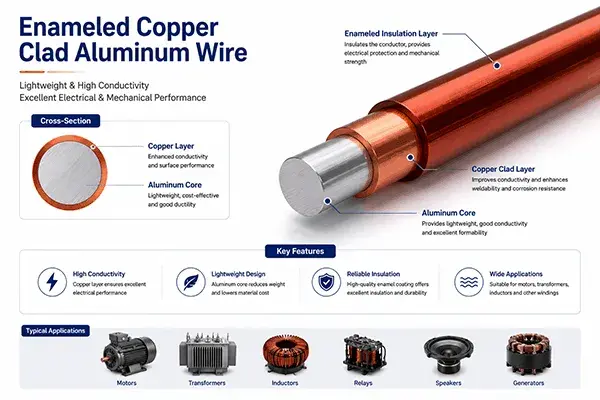
Copper-clad aluminum (CCA) wire is a bimetallic conductor with an aluminum core and a copper cladding. The ASTM B566 standard specifies four grades of CCA wire: Class 10A (10 vol% copper, annealed), Class 15A (15 vol% copper, annealed), Class 10H (10 vol% copper, hard), and Class 15H (15 vol% copper, hard). This standard sets specific requirements for the tensile strength, elongation, resistivity, density, and copper layer integrity of CCA wire.
The electrical conductivity of CCA wire is directly related to the volume percentage of copper. Class 10A has a conductivity of approximately 65% IACS, and Class 15A has approximately 70% IACS. Compared to pure aluminum wire, copper-clad aluminum wire exhibits significantly improved end solderability, allowing for connection to copper terminals using conventional soldering processes—one of its most significant engineering advantages.
The weight of copper-clad aluminum wire is 30%–40% less than that of pure copper wire. The density of Class 10A is approximately 3.94 g/cm³ (based on a copper-aluminum volume ratio of 10:90), and its weight under equivalent resistance conditions is approximately 60%–65% of that of pure copper wire. At high frequencies above 5 MHz, the AC conductivity of copper-clad aluminum wire is close to that of pure copper because the skin depth of high-frequency current is less than the thickness of the copper layer, and the current is primarily conducted within the copper layer.
There are two main manufacturing processes for copper-clad aluminum wire. Cladding: Copper strip is wrapped around an aluminum core, and the two metals are metallurgically bonded through heating and pressure. Electroplating: A copper layer is electrodeposited on the surface of the aluminum core; this method is less expensive but the interfacial bonding strength is relatively weaker. High-quality copper-clad aluminum wire should be free of delamination, seams, and discontinuous copper layers.
The main applications of copper-clad aluminum wire include inner conductors of radio frequency coaxial cables, grounding and shielding of electronic devices, windings for special motors, and high-frequency components in home appliances and consumer electronics. In motor winding applications, copper-clad aluminum wire is mainly used in small motors where high reliability of end welding is required, but weight must also be considered.
High-Strength Aluminum Alloys and Aluminum-Based Composites
Traditional pure aluminum has relatively low strength, posing a risk of mechanical stress in high-speed applications such as high-speed motors, wind turbines, and aero-engines. In recent years, significant progress has been made in the application research of aluminum-based composites and high-strength aluminum alloys in motor winding wires.
Aluminum-cerium alloy (Al-Ce) is a novel material that has been extensively studied in recent years. The addition of cerium, a rare earth element, to aluminum can significantly improve the material’s strength, heat resistance, and creep resistance. An Al-Ce die-casting alloy reported in a Springer academic paper has been specifically developed for electric vehicle powertrains and can withstand the high-temperature and vibration environments of motor windings.
Aluminum-zirconium alloy (Al-Zr) and aluminum-scandium alloy (Al-Sc) also exhibit good comprehensive performance. Al-Sc alloys offer 30%–50% higher strength than traditional 1350 aluminum while maintaining good conductivity. These material systems show promise in applications where both weight and strength are critical, such as high-speed motors, aerospace motors, and compact drives.
Aluminum Conductor Composite Core (ACCC) is a composite material with an aluminum matrix reinforced with ceramic or carbon fibers. ACCC achieves strength comparable to copper while maintaining lightweight advantages. However, ACCC is currently mainly used in high-voltage transmission lines, and its application in motor winding wires is still in the research stage.
Flat Wire and Hairpin Winding Technologies
The power density requirements of new energy vehicle drive motors continue to increase. The slot fill factor (the volume ratio of copper to slot space) of traditional round wire windings is typically between 40% and 50%, limiting further increases in power density. Flat wire winding technology, by using winding wires with rectangular cross-sections, can increase the slot fill factor to 60%–70%, significantly improving the torque and power density of the motor.
Hairpin winding is a typical implementation of flat wire winding. The term “hairpin” refers to a flat wire pre-bent into a U-shape, inserted into a slot at one end of the stator core, and then unfolded at the other end and welded to the adjacent flat wire. This process is widely used in mainstream electric vehicle drive motors such as the Tesla Model 3, BYD Han, and Huawei DriveONE.
Currently, copper is the mainstream hairpin winding material, primarily due to its high conductivity, mature welding process, and ample reliability data. However, copper hairpins are still relatively heavy, constituting a significant portion of the drive motor’s total weight. Research on aluminum hairpins has been ongoing for many years, with the main challenges focusing on three aspects: aluminum connection processes (welding aluminum is much more difficult than copper), aluminum-copper electrochemical corrosion (particularly prominent at end connections), and the risk of cracking due to aluminum’s low strength during large-diameter bending.
The technical specifications for aluminum enameled flat wire are defined in IEC 60317-0-3 and IEC 60317-29. Typical specifications for flat wire cross-sections are a thickness of 1.5–4 mm and a width of 4–10 mm, with a width-to-thickness ratio typically between 4:1 and 8:1. The enamel coating thickness varies from 30–80 μm depending on the thermal rating.
Enamel Coating and Insulation System
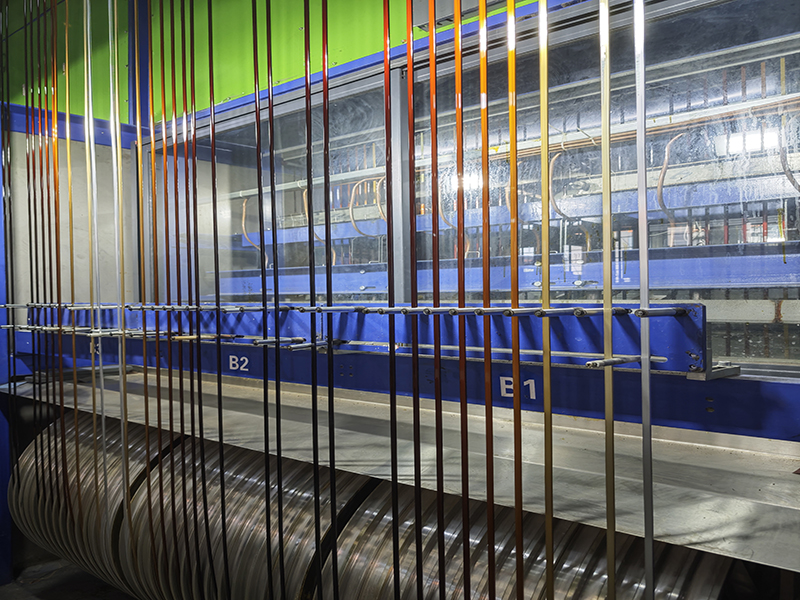
The insulation performance of enameled wire is primarily determined by the enamel coating. For lightweight aluminum windings, the enamel coating technology needs to provide reliable insulation protection without significantly increasing weight and volume.
Polyester-imide (PEI) is the primary insulation material for 180°C thermal rating enameled wire, offering good heat resistance, mechanical strength, and electrical properties. Polyamide-imide (PAI) is a preferred material for thermal ratings of 200°C and above, often used as a topcoat in conjunction with polyester imide primer. Polyimide (PI) is a material for thermal ratings of 220°C–240°C, primarily used in aerospace and high-temperature motors.
Dual coatings, through the combination of primer and topcoat, can balance cost and performance. A typical combination is polyester imide primer + polyamide-imide topcoat, combining the flexibility of PEI with the chemical resistance of PAI. Single coatings are less expensive and are mainly used in household appliance motors below 130°C.
Special functional enamel coatings are also becoming increasingly important in lightweight winding wires. Corona-resistant enamel coatings are used in inverter-driven motors to withstand partial discharges caused by high-frequency voltage spikes. Surge-resistant enamel coating, similar to corona-resistant enamel coating, targets the rapid transient voltages generated by IGBT switching. Solderable enamel coating is primarily used in applications requiring direct soldering, eliminating the need for end-plate coating.
Aluminum Winding End Connection Technology
Connecting aluminum windings at the motor ends is a key challenge in engineering implementation. While traditional copper wire motor ends can achieve reliable connections using soldering or resistance welding, aluminum winding end connections require specialized processes.
Capacitor Discharge Welding (CDW) is the mainstream process for connecting aluminum winding ends. This method uses the heat generated by the instantaneous discharge of a capacitor to complete the welding in a very short time, with a small heat-affected zone, making it particularly suitable for connecting thin aluminum wires. The joint strength of CDW can reach over 80% of the base material, and the joint resistance is extremely low.
Ultrasonic welding is another connection method suitable for aluminum windings. This method uses high-frequency vibration to generate frictional heat at the contact surface, allowing aluminum to bond in a solid state. Ultrasonic welding requires no flux and is insensitive to aluminum oxide film, making it a clean connection process.
Cold crimping uses specialized tools to mechanically crimp aluminum wire to copper terminals, avoiding the heat effects associated with welding. Cold crimping requires specialized copper-aluminum transition terminals, with the aluminum side of the terminal crimped to the aluminum wire and the copper side connected to external copper conductors.
Copper-aluminum transition joints are key components for connecting aluminum windings to external circuits. Common transition methods include: flash welding, which combines copper and aluminum through instantaneous high-current heating and pressure; friction welding, which uses mechanical frictional heat to achieve metallurgical bonding; and copper-aluminum bi-metal strip, which is pre-fabricated into composite strips using explosion welding or roll welding processes and then processed into transition joints.
Thermal Management and Reliability of Aluminum Winding Motors
The thermal management of aluminum winding motors differs significantly from that of copper winding motors. The temperature coefficient of resistance of aluminum is approximately 0.0043/°C (copper is approximately 0.00393/°C), meaning that under the same temperature rise, the resistance of aluminum increases more significantly. This means that the copper loss of aluminum windings increases more rapidly at high temperatures, which needs to be considered in thermal design.
The thermal conductivity of aluminum windings is approximately 237 W/(m·K), while copper is approximately 397 W/(m·K). Aluminum’s thermal conductivity is lower than copper’s, and for applications with high heat dissipation requirements (such as high-power motors and traction motors), this needs to be compensated by optimizing winding structure and improving the thermal conductivity of insulation enamel coating.
The life assessment of aluminum winding motors needs to consider the following factors: insulation aging (depending on enamel coating material and operating temperature), mechanical fatigue (depending on aluminum wire strength and vibration environment), contact reliability (depending on connection process and corrosion protection), and thermal cycling (depending on thermal expansion coefficient and temperature cycle amplitude).
The common failure modes of aluminum winding motors include: end connection resistance increase (caused by improper connection process or corrosion), insulation breakdown (enamel coating defects or overvoltage), winding open circuit (mechanical vibration causing fracture), and stator slot short circuit (enamel coating damage). These failure modes are similar to those of copper winding motors, but the statistical distribution differs, with end connection failures accounting for a higher proportion in aluminum windings.
Weight Comparison and Comprehensive Analysis
Comparing the weights of different material systems under equivalent resistance conditions provides an intuitive view of the lightweighting potential. Taking a 1-meter long winding wire with 0.5 Ω resistance as a reference:
- Pure copper wire (100% IACS): diameter approximately 1.18 mm, weight approximately 9.8 g
- Pure aluminum wire (61% IACS): diameter approximately 1.50 mm, weight approximately 5.1 g (48% reduction)
- Class 10A copper-clad aluminum wire (65% IACS): diameter approximately 1.45 mm, weight approximately 5.6 g (43% reduction)
- Class 15A copper-clad aluminum wire (70% IACS): diameter approximately 1.40 mm, weight approximately 5.9 g (40% reduction)
From the weight data, pure aluminum wire shows the most significant weight reduction, reaching 48%. However, the end connection reliability of pure aluminum wire is relatively poor, limiting its application in high-end motors. Class 15A copper-clad aluminum wire strikes a good balance between weight reduction and connection reliability and is a common engineering compromise.
The cost comparison is also worth noting. The material cost of pure aluminum wire is approximately 25%–35% that of pure copper wire, and Class 10A copper-clad aluminum wire is approximately 40%–50% that of pure copper wire. However, considering processing costs (aluminum processing requires specialized processes, increased connection costs, higher enamel coating requirements) and the increase in reliability verification costs, the savings in total life-cycle costs are smaller than the savings in material costs.
Selection Decision Points
The lightweight selection of motor winding wires should comprehensively consider performance, reliability, cost, and application scenarios.
Application scenario is the primary constraint. For cost-sensitive applications such as household appliance motors, industrial motors, and fan/water pump motors, pure aluminum wire should be prioritized. For applications with high power density requirements but also requiring reliability, such as new energy vehicle drive motors and rail transit traction motors, Class 10A or Class 15A copper-clad aluminum wire can be selected. For extreme environment applications such as aerospace motors and military motors, high-strength aluminum alloys (Al-Ce, Al-Sc) or aluminum-based composite conductors can be considered.
Power density and speed requirements determine the specific wire type. Low-power-density, low-speed motors can accept the end connection process of pure aluminum wire; high-power-density, high-speed motors require more reliable end connections, with copper-clad aluminum wire or pure copper hairpin being more appropriate.
Operating temperature and life requirements determine the insulation system. For applications at 130°C and below, polyester or polyurethane enamel coating can be used; for applications at 155°C–180°C, polyester imide enamel coating can be used; for applications at 200°C and above, polyamide-imide or polyimide enamel coating should be used.
End connection process and compatibility with existing production lines are also practical considerations for selection. The existing production line for pure copper wire cannot directly produce aluminum windings; new aluminum wire specialized equipment, aluminum wire welding equipment, and aluminum wire enamel coating equipment need to be added. Copper-clad aluminum wire is similar to pure copper wire in end welding, and has better compatibility with existing production lines.
Conclusion
The lightweighting of motor winding wires is a key technical path to improve motor power density, efficiency, and overall performance. Different technical routes—pure aluminum wire, copper-clad aluminum wire, high-strength aluminum alloys, and aluminum-based composite materials—each have their own advantages and limitations in terms of weight, reliability, cost, and processability. The development of hairpin winding technology and flat wire winding is driving the application of aluminum windings in new energy vehicle drive motors. Understanding the intrinsic properties of different material systems, mastering end connection processes, and standardizing selection decisions are the foundation for the successful implementation of motor winding lightweighting.