


Fiberglass‑covered wire (FG/FGW) is a composite insulated electromagnetic wire formed by continuously winding alkali‑free electrical‑grade glass fiber yarn (E‑glass, with extremely low alkali oxide content and excellent electrical insulation performance) in an overlapping or half‑overlapping manner around the outer surface of round copper (or aluminum) conductors, enameled round copper wire, enameled flat copper wire, paper‑wrapped wire, or enameled aluminum wire, followed by impregnation and curing with insulating varnishes (alkyd resin, polyester, polyester imide, polyimide, silicone resin) or waterborne coatings. Its temperature classes span the full range from Class 130 to Class 220, aligning with the NEMA MW 41‑C rating system (M 41/42/43/44 corresponding to single‑layer, double‑layer, enamel‑plus‑fiberglass, and double‑fiberglass‑plus‑varnish films, respectively) and the IEC 60317‑48 international standard; breakdown voltages increase with the number of structural layers, from single‑ to double‑layer configurations. The GB/T 7672 series of national standards provides specific stipulations for fiberglass‑wrapped wire (GB/T 7672.3 for round copper wire and GB/T 7672.4 for flat copper wire), establishing a mutually recognized tripartite standardization framework among China, the United States, and Europe. The product’s core value lies in its three‑layer composite structure, combining the mechanical strength of fiberglass, the chemical protection of the varnish film, and the weather resistance of silicone resins. Consequently, it has become an indispensable type of electromagnetic wire in critical applications involving high temperatures, fire safety, and vibration resistance, such as oil‑immersed power transformers, dry‑type transformers, traction transformers, high‑voltage motors, wind power, nuclear power, and traction motors. From an industrial ecosystem perspective, fiberglass‑wrapped wire represents the intersection of the two dominant technical approaches—“enameled wire + wound‑over wire”—within commercial electromagnetic wire systems. Compared with single‑layer enameled wire, it offers significantly higher temperature ratings; compared with single‑layer paper‑wrapped wire, it exhibits markedly improved short‑circuit withstand capability, making it a key insulating material for the winding systems of high‑end electrical equipment.
Core Positioning and Procurement Evaluation Framework for Fiberglass‑Wrapped Magnet Wire
In the electromagnetic wire procurement system, fiberglass‑wrapped magnet wire serves a triple function: high‑temperature resistance, fire protection, and mechanical reinforcement. Its core procurement value is structured around four dimensions. The first dimension concerns the coupling between thermal class and service life: the wire’s temperature rating directly determines the upper operating temperature limit and system lifetime; each increase in Class rating allows for a corresponding rise in winding operating temperature and an extension of the system’s design life. The second dimension involves the composite enhancement of mechanical strength: as an inorganic fiber material, fiberglass yarn exhibits tensile strength far exceeding that of a single enamel coating, enabling it to maintain structural integrity under severe mechanical conditions such as vibration, impact, and short‑circuit electromagnetic forces—making it particularly well suited to dynamic load applications in rail transit, wind power, nuclear power, and similar fields. The third dimension focuses on the synergistic optimization of dielectric performance: the composite dielectric constant and dielectric strength formed by the three layers—fiberglass, enamel coating, and insulating oil—simultaneously optimize turn‑to‑turn and ground insulation, thereby increasing overall insulation margins. The fourth dimension addresses environmental compliance and recyclability: modern fiberglass‑wrapped magnet wire employs halogen‑free fiberglass and water‑based enamel systems, meeting the RoHS 2.0 and REACH SVHC restriction requirements and facilitating export and high‑end applications.
Based on these four dimensions, the procurement evaluation framework should center on eight primary factors: conductor specifications and materials, temperature rating and enamel system, number of insulation layers and overlap ratio, breakdown voltage and dielectric strength, mechanical properties, thermal life curves and Arrhenius extrapolation, regulatory compliance and certifications, and commercial terms and supply chain considerations. These eight factors constitute a comprehensive decision tree; when refined according to specific application scenarios, they form the horizontal procurement evaluation system presented in subsequent sections. The guiding principle for procurement decisions is “first define the application scenario, then determine the temperature rating, and finally finalize the commercial terms,” thereby avoiding price‑centric approaches that overlook technical compatibility. In practice, procurement teams are advised to establish an integrated review mechanism combining a technical specification checklist, a commercial terms checklist, and a supplier evaluation checklist, with cross‑departmental collaboration to ensure that procurement outcomes meet both technical reliability and commercial rationality. At the same time, attention should be paid to the latest technological trends in the industry—such as nano‑modified fiberglass, low‑dielectric‑constant enamels, and intelligent online monitoring—and their implications for procurement specifications, so as to keep procurement standards current and aligned with evolving needs.
Procurement Criteria for Power/Distribution Transformers (35 kV–1000 kV)
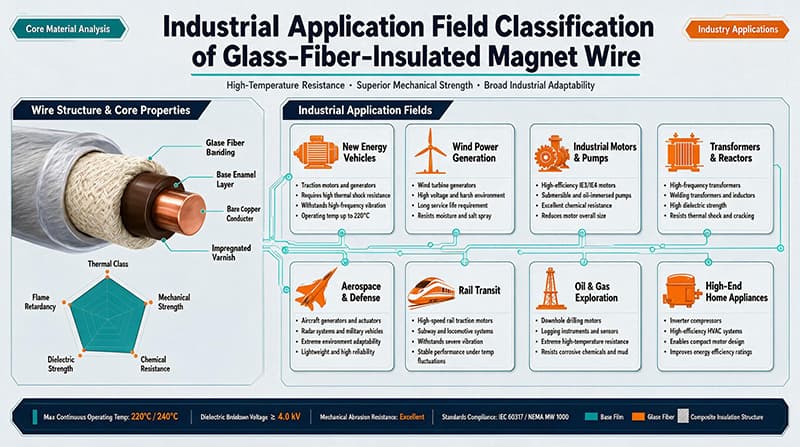
Power transformers—ranging from 35 kV distribution to 1000 kV ultra-high-voltage oil‑immersed units—represent the largest application segment for glass‑fiber‑wrapped wire. Key areas of use include high‑voltage winding leads, electrostatic shields, on‑load tap‑changer lead connections, bushing CT secondary windings, neutral point leads, and zero‑sequence current transformer leads. These applications share the common characteristic of enduring the combined effects of high electric field strength, mechanical stress, and oil‑immersion aging, thereby imposing the most stringent requirements on the comprehensive performance of glass‑fiber‑wrapped wire. The principal procurement factors span nine dimensions: First, conductor specifications and material selection; based on current capacity and mechanical strength needs, a balance should be struck between round and flat conductors, with high‑purity electrolytic copper preferred to ensure both conductivity and mechanical consistency. Second, temperature rating and oil compatibility; the appropriate class should be chosen in accordance with the design temperature rise recommended by the IEEE C57.91 Loading Guide, ensuring compatibility with various insulating media such as mineral oil, synthetic esters, and natural esters. Third, insulation layer count and overlap ratio; for high‑voltage windings, a double‑layer structure is standard, while a triple‑layer configuration is employed in ultra‑high‑ and extra‑high‑voltage applications. Fourth, breakdown voltage must comply with IEC 60317‑48 and GB/T 7672.3 and meet the winding power‑frequency withstand test specifications. Fifth, mechanical properties, including elongation and springback angle, shall conform to NEMA MW 41‑C’s AWG‑specific grading. Sixth, oil resistance requires that, following accelerated aging in the insulating medium, breakdown voltage degradation remain within an acceptable range and that acid number increase be kept under control. Seventh, short‑circuit withstand capability is a critical parameter for large transformers; glass‑fiber reinforcement significantly enhances margin against short‑circuit forces. Eighth, the bending radius of tap‑changer lead connections must prevent glass‑fiber cracking. Ninth, compliance certifications should encompass the IEC 60076 series, the GB/T 1094 series, and ASTM D2307 thermal life extrapolation. When procuring large power transformers, particular attention should also be paid to the corona resistance of glass‑fiber–polyimide composite systems and to the long‑term co‑aging assessment of oil–paper–glass fiber under ultra‑high‑voltage conditions, so as to ensure reliability throughout a design life exceeding 30 years.
Procurement Factors for Traction/Railway Transformers (27.5/55 kV)
Traction transformers are used in applications such as electrified railway catenary systems, subway traction substations, main transformers for urban rail, AT transformers for intercity EMUs, and maglev traction transformers. Their procurement criteria differ significantly from those of power transformers, primarily due to the more stringent requirements for vibration, shock, fire protection, and combined thermal–cyclic conditions. The defining characteristics of these applications are the continuous dynamic loads imposed by train operation and the stringent fire‑safety demands within the enclosed tunnel environment; consequently, the environmental robustness and flame‑retardant performance of fiberglass‑wound windings become decisive factors. Key procurement considerations span eight dimensions: First, fire‑resistance rating is the primary constraint in traction transformer applications, requiring compliance with the EN 45545‑2 HL3 highest fire‑protection standard, with oxygen index, smoke density, and smoke toxicity meeting the specified thresholds; China’s TB/T 3230 also aligns with HL3‑level requirements. Second, vibration resistance must satisfy IEC 61373 Category 1 Class B for railway locomotives, covering typical railway vibration spectra and power spectral densities. Third, shock resistance shall conform to IEC 60068‑2‑27 for railway shock severity, ensuring no insulation failure under transient impacts during train starting, braking, and switch crossings. Fourth, thermal‑cycling capability must meet the rapid temperature‑change tests specified in IEC 60068‑2‑14, simulating the substantial temperature fluctuations encountered in train operation. Fifth, conductor specifications should predominantly use round wire, with flat wire employed only in limited quantities for reactors. Sixth, the number of insulation layers and lap ratio must address the additional demands of high‑vibration environments, favoring a double‑layer structure combining fiberglass and varnish films. Seventh, insulating oil compatibility should encompass both mineral oils and synthetic esters, satisfying the relevant requirements of TB/T 3230 and GB/T 25123. Eighth, electromagnetic compatibility performance must comply with railway EMC standards, with composite shielding of fiberglass and copper foil providing the necessary suppression of high‑frequency interference. Traction transformer suppliers shall furnish complete third‑party test reports, vibration power spectral density data, thermal‑cycling curves, and short‑circuit withstand reports. The procurement technical agreement should clearly specify pre‑shipment tests for factory‑acceptance, including power‑frequency withstand voltage, partial discharge, and lightning impulse tests, to ensure safe and reliable operation throughout the railway system’s entire service life.
Procurement Criteria for Dry-Type Transformers (≤35 kV, Class F/H/C)
Dry-type transformers—covering Class F, H, and C insulation classes with voltage ratings up to 35 kV—typically use fiberglass‑wrapped wire for low‑voltage windings, lead-outs, shielding layers, and grounding shields. The defining characteristic that distinguishes dry-type transformers from oil‑immersed types is their oil‑free, self‑extinguishing, maintenance‑free design; consequently, higher requirements are placed on the flame retardancy, smoke density, and mechanical integrity of the fiberglass‑wrapped wire. Key procurement factors span seven dimensions: First, the choice of insulation class should be based on the designed temperature rise and expected service life; Class F is suitable for general commercial distribution, Class H for heavy industrial loads, and Class C for high‑end applications such as data centers, subway traction systems, and nuclear power plants in Safety‑Class 1E environments, with ceramic fiber composites capable of meeting even more stringent thermal demands. Second, conductor specifications predominantly employ enameled round wire with an outer layer of glass fiber to form a composite insulation system. Third, insulation thickness must strike a balance between electrical strength and heat dissipation, with single‑ and double‑layer constructions tailored to different voltage levels. Fourth, flame‑retardant performance shall comply with UL 94 V‑0 and IEC 60695‑11‑10, achieving specified oxygen index and self‑extinguishing time thresholds. Fifth, smoke density is subject to strict limits in enclosed or semi‑enclosed environments such as subways and data centers, requiring compliance with NES 713 and EN 45545‑2 R1/HL2. Sixth, mechanical properties must meet the elongation, abrasion resistance, and rebound angle requirements of IEC 60851‑3. Seventh, thermal life shall be verified through accelerated aging per IEC 60172 and extrapolation according to ASTM D2307, with an appropriate safety margin built in. In dry‑type transformer applications, particular attention should be paid to UL 1446 insulation system certification (file numbers OBJY2/OBJS2); a single fiberglass‑wrapped wire cannot independently satisfy system certification and must be integrated with impregnating varnish (applied via VPI vacuum pressure impregnation), Nomex 410 aramid paper, Kapton CR polyimide film, and other components to form a complete insulation system, embodying an insulation design philosophy of “material combination + process synergy.”
Procurement Criteria for High-Voltage Motors (6/10 kV Class H)
High‑voltage motors—covering voltage ratings from 6 kV to 10 kV and Class H temperature capability—are the second-largest application segment for fiberglass‑wrapped wire, primarily used in stator windings, rotor pole coils, high‑voltage terminal boxes, and auxiliary windings. The key characteristics of these motors are their high operating voltage, concentrated insulation stress, and severe PWM pulse stress under variable‑frequency drive (VFD) conditions, which place comprehensive demands on the dielectric strength, corona resistance, and VPI process compatibility of the fiberglass‑wrapped wire. The critical procurement factors span eight dimensions: First, conductor specifications should select either enamel‑coated flat copper wire or round wire based on power output and slot fill factor, with an outer layer of fiberglass forming a composite insulation that complies with NEMA MW 41‑C and IEC 60317‑48; second, the temperature class is predominantly Class 180, compatible with solvent‑free epoxy or polyester resin VPI impregnation; third, the breakdown voltage and PDIV must meet the requirements of IEC 60034‑18‑41 for VFD stress testing, addressing turn‑to‑turn stress under PWM pulses; fourth, corona resistance is crucial for PWM drive applications above 6 kV, with nano‑modified enamel coatings or internal shielding layers representing effective pathways to enhance corona performance; fifth, thermal life must satisfy the motor insulation system requirements of IEC 60034‑1; sixth, mechanical properties must conform to the elongation and abrasion resistance stipulations of IEC 60851‑3; seventh, moisture resistance must meet the damp heat test requirements of IEC 60068‑2‑78; and eighth, VPI process compatibility requires the fiberglass yarn to exhibit an appropriate resin absorption rate, ensuring no air bubbles or localized resin voids after vacuum impregnation, with process parameters (vacuum level, pressure, and dwell time) within acceptable ranges. The technical specification for high‑voltage motor procurement should explicitly require that each batch be accompanied by thermal life curves and partial discharge test reports, and should specify PPAP Level 4 documentation along with initial process capability index (Cpk) requirements to ensure consistency and traceability in mass production.
Procurement Considerations for Traction Motors
When procuring glass-fiber‑wrapped enameled wire for traction motors—covering railway locomotives, metro vehicles, new‑energy mining locomotives, AGV mobile platforms, and electric forklift drive motors—the primary concerns are the severe vibrations of railway operating conditions, stringent fire‑retardancy requirements, and the electrical stress imposed by variable‑frequency traction. The operational environment of traction motors is characterized by four key features: high‑frequency vibration, large temperature swings, frequent start‑stop cycles, and compact packaging, placing extremely high demands on the overall reliability of the insulation system. Key procurement factors span seven dimensions: First, conductor geometry—round or flat wire—should be selected based on motor power and speed to meet high current density and thermal management needs; second, the insulation’s temperature class should typically be Class H or Class C to withstand the elevated temperature rise in traction motor operation; third, flame‑retardant performance must comply with EN 45545‑2 for rail vehicle materials; fourth, vibration resistance must satisfy the severity levels specified in IEC 61373 for railway locomotives; fifth, shock resistance should adhere to IEC 60068‑2‑27 for railway shock testing; sixth, corona resistance must ensure tolerance to PWM‑induced stress under variable‑frequency traction; and seventh, the insulation structure should employ a composite of glass fiber and polyimide film, or glass fiber and aramid, to mitigate partial discharge risks under high dv/dt transients from PWM drives. Typical applications of traction motors include DC traction motors, AC traction motors, high‑speed EMU traction motors, and mining locomotive traction motors. During procurement, it is essential to verify that suppliers hold either IRIS certification for the railway industry or the dual IATF 16949 and AEC‑Q200 certifications for the automotive sector, ensuring their quality management systems meet industry‑specificaccess criteria. Representative projects involve supply to major domestic OEMs, underscoring the robust demand for fiberglass covered wire across the traction motor value chain.
Procurement Considerations for Specialized Applications in Wind, Offshore Wind, and Nuclear Power
Onshore and offshore wind power, as well as nuclear power, represent high-end application scenarios for fiberglass‑insulated magnet wire, placing extremely stringent demands on weather resistance, salt‑mist corrosion resistance, seismic performance, and long service life—essentially defining the technological upper limit of electromagnetic wire in extreme environments. In wind‑power applications, the primary challenges are long‑term outdoor exposure and offshore salt‑mist corrosion; in nuclear‑power settings, the dual requirements are robust seismic resistance and a 60‑year design life. Key procurement factors span eight dimensions: First, weathering performance must meet the wide temperature‑cycle requirements of onshore wind and the salt‑mist testing criteria for offshore wind; second, salt‑mist resistance must comply with IEC 60068‑2‑60’s composite corrosion test for offshore wind; third, vibration resistance must satisfy IEC 60068‑2‑6’s durability test for wind turbines; fourth, seismic performance must pass the seismic response spectrum assessment specified in IEEE 344 for nuclear plants; fifth, service life requirements are 25 years for onshore wind, 30 years for offshore wind, and 60 years for nuclear power, with Arrhenius‑extrapolated thermal life ensuring ample safety margins; sixth, the insulation system should employ Class 220 polyimide‑glass or aramid‑glass composites; seventh, dielectric loss must be kept low to minimize heat buildup during prolonged operation; eighth, compliance frameworks must encompass IEC 61400‑1, GB/T 25390, and DNV GL certifications for wind power, as well as IEEE 323/344/383, RCC‑E, NB/T 20040, ASME AG‑1, and other standards for nuclear power. Suppliers for wind and nuclear applications should provide seismic test response spectra and long‑life thermal life extrapolation reports; for nuclear projects, they must also furnish containment LOCA accident‑scenario simulation reports (where applicable), underscoring the comprehensive requirements these extreme environments impose on suppliers’ technical capabilities and quality assurance systems.
General Commercial Terms and Supplier Risk Management
Commercial procurement terms and supplier risk management are the key soft competencies for the successful procurement of fiberglass‑wrapped magnet wire. Once the technical specifications are met, the rigor of the commercial terms and the robustness of the supply chain become decisive factors in the project’s success or failure. The critical procurement factors span nine dimensions: First, pricing terms should be aligned with Incoterms 2020, with appropriate selection among trade terms such as FOB, CIF, and EXW; unit prices are directly correlated with specification grades. Second, payment terms should be chosen from options like T/T advance, sight letter of credit, or open‑account credit terms, taking into account both parties’ creditworthiness and cash flow needs. Third, minimum order quantities vary significantly depending on product specifications and the degree of customization. Fourth, delivery lead times must differentiate between standard products, customized specifications, and certified items. Fifth, packaging must comply with IEC 60264 requirements for wire spools and incorporate necessary moisture‑proofing and anti‑oxidation measures. Sixth, shipping marks and the traceability system must ensure that each spool can be traced back to its raw material batch and production personnel. Seventh, force majeure provisions should clearly delineate responsibilities and outline alternative arrangements in the event of earthquakes, pandemics, port strikes, and other unforeseen circumstances. Eighth, claims and arbitration clauses should specify deadlines for notifying quality defects and the dispute‑resolution body. Ninth, long‑term agreements should establish price‑linkage mechanisms to mitigate the risk of raw material price volatility. Procurement risk‑management strategies also include a dual‑supplier approach, quarterly unannounced plant inspections, monthly PPM reporting, on‑time‑delivery monitoring, and annual supplier evaluations. For high‑reliability applications such as nuclear power, medical devices, and aerospace, procurement technical agreements should further specify additional requirements—such as embargo‑list compliance, anti‑terrorism certifications, and export‑control adherence—reflecting a comprehensive risk‑management philosophy across the entire high‑end supply chain. It is recommended that procurement teams develop a supplier performance dashboard to track in real time core metrics related to delivery, quality, service, and cost, and that they conduct quarterly business reviews to continuously improve supplier relationships, fostering a long‑term, mutually beneficial supply‑chain ecosystem.
Acceptance Testing and Quality Assurance
The acceptance testing system for fiberglass‑wrapped wire is divided into seven major categories, comprehensively covering dimensions such as appearance and geometry, mechanical performance, electrical performance, thermal performance, environmental resistance, combustion performance, and system compatibility. The first category, appearance and geometry inspection, shall comply with the dimensional and visual requirements specified in IEC 60851‑3, ensuring that the product’s basic specifications meet order requirements. The second category, mechanical performance testing, includes metrics such as elongation, rebound angle, abrasion resistance, and flexibility, assessed by AWG size tiers in accordance with NEMA MW 41‑C and IEC 60851‑3. The third category, electrical performance testing, encompasses key parameters like dielectric breakdown voltage, insulation resistance, dielectric loss, and PDIV, ensuring that dielectric properties satisfy design margins. The fourth category, thermal performance testing, covers softening breakdown, thermal shock, and thermal life, with the ASTM D2307 thermal life extrapolation test serving as the core method for evaluating long‑term reliability. The fifth category, environmental resistance testing, addresses scenarios such as oil resistance, moisture resistance, and chemical resistance, simulating the combined aging factors of real‑world operating conditions. The sixth category, combustion testing, includes UL 94 flame‑retardancy ratings, EN 45545‑2 fire‑resistance classifications, and oxygen index, to ensure product safety in fire‑hazard environments. The seventh category, system compatibility testing, comprises UL 1446 insulation system certification, UL 1581 combustion testing, and ASTM D2303 corona resistance testing, verifying the synergy between fiberglass‑wrapped wire and associated insulation materials. The acceptance process should be structured across four stages: incoming material inspection, in‑process inspection, factory‑outgoing inspection, and third‑party witnessing, with each batch accompanied by a complete evidentiary chain including material certificates, third‑party test reports, PPAP documentation, and RoHS/REACH compliance reports. Key quality assurance indicators should include PPM defect rate, on‑time delivery rate, process capability index, and annual return rate, with clearly defined sampling ratios and AQL acceptance criteria. For nuclear power and medical‑grade procurement, additional requirements such as a quality assurance outline, nuclear quality assurance culture certification, and relevant regulatory compliance statements are necessary, reflecting the highest demands placed on supplier quality systems in high‑reliability applications. It is recommended that the procurement team establish a digital quality management platform to enable end‑to‑end quality traceability from order placement to delivery, enhancing transparency and responsiveness in quality management and progressively advancing toward intelligent procurement and smart quality.
Summary: Procurement of fiberglass‑wrapped wire is a systematic undertaking spanning technology, compliance, and commerce. The procurement team should take application scenarios as its starting point, technical specifications as its core, compliance certifications as its baseline, and commercial terms as its safeguard, while integrating supplier performance management and the development of long‑term partnerships to build a robust and reliable supply chain for fiberglass‑wrapped wire, thereby supporting the high‑quality development of advanced electrical equipment.