

Introduction
Definition and Industrial Context of ECCA Enameled Wire
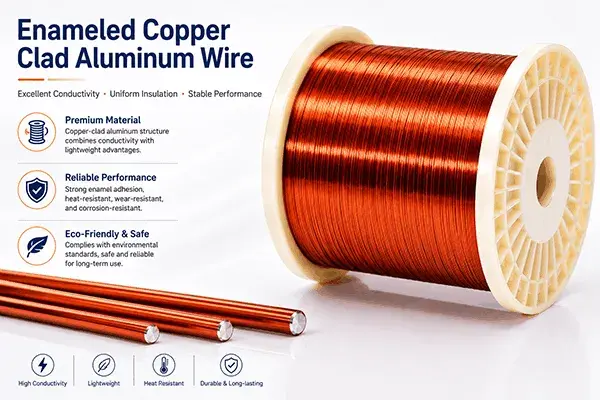
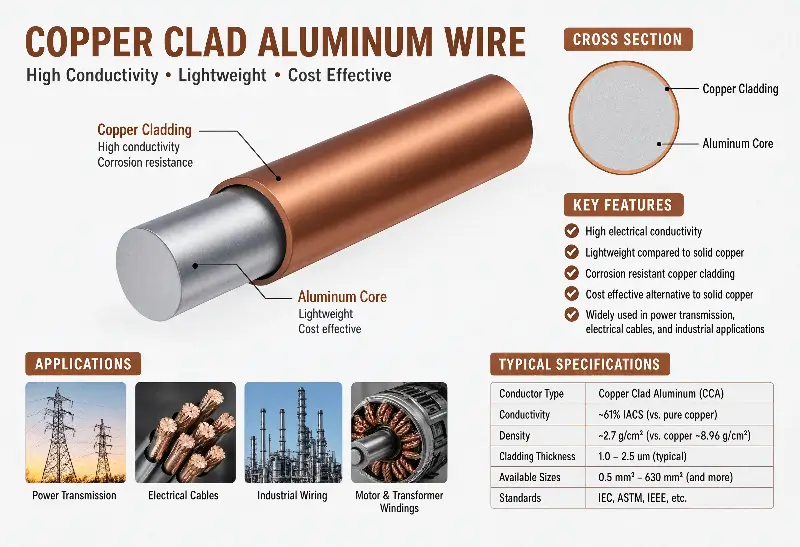
ECCA enameled wire (Enamel-Coated Copper-Clad Aluminum Wire) is an electromagnetic wire product featuring a bimetallic composite structure with an insulating enamel coating. Structurally, it comprises three layers: an aluminum core, a copper cladding, and an enamel insulation layer. The aluminum core delivers light weighting and cost advantages; the copper cladding ensures reliable electrical contact surfaces and solderability; and the enamel layer provides inter-turn electrical insulation and mechanical protection. ECCA enameled wire retains the cost benefits of the aluminum core while overcoming the deficiencies of pure aluminum enameled wire in contact reliability and solderability through its copper cladding.
Fundamental Differences Between ECCA Enameled Wire, Pure Copper Enameled Wire, Pure Aluminum Enameled Wire, and Bare CCA Wire
ECCA enameled wire differs fundamentally from pure copper enameled wire, pure aluminum enameled wire, and bare CCA wire. Compared to pure copper enameled wire, ECCA replaces the copper core with an aluminum core to achieve weight and cost reduction—weight is reduced by approximately 50% to 60%, and material cost is reduced by approximately 30% to 50%. Compared to pure aluminum enameled wire, the copper cladding of ECCA ensures electrical contact reliability and solderability, and termination processes are compatible with those used for pure copper enameled wire. Compared to bare CCA wire, ECCA adds an insulating enamel layer, enabling direct use in winding applications.
Scope and Target Audience of This Document
This document focuses exclusively on ECCA enameled wire, systematically addressing its material structure and manufacturing process, key performance parameters, comprehensive comparison with pure copper and pure aluminum enameled wires, typical application areas, design and selection considerations, influence of manufacturing processes on performance, and quality testing and reliability evaluation. It aims to provide an engineering-referenceable technical framework for high-frequency switch-mode power supply design engineers, motor design engineers, home appliance engineers, audio engineers, and procurement technical evaluators.
Material Structure and Manufacturing Process of ECCA Wire
Three-Layer Structure Principle
ECCA enameled wire features a three-layer composite structure comprising an aluminum core, a copper cladding layer, and an enamel coating. The aluminum core is typically fabricated from pure aluminum grades 1050 or 1060, or aluminum–magnesium alloy 5005, with diameters ranging from 0.20 mm to 6.00 mm. The copper cladding layer employs oxygen-free copper C11000, with copper layer thickness typically constituting 5% to 15% of the aluminum core diameter. The enamel coating utilizes polyester, polyurethane, polyester-imide, or polyamide-imide resin systems. An intermetallic compound transition layer forms at the aluminum–copper interface, ensuring high interfacial bond strength.
Engineering Significance of the Copper-to-Aluminum Ratio
The copper-to-aluminum ratio constitutes one of the most critical engineering parameters for ECCA enameled wire. The 10/90 ratio represents the most widely adopted standard configuration, yielding a composite density of approximately 3.63 g/cm³, a weight equivalent to 40% of that of solid copper wire, and a composite electrical conductivity reaching 65% to 70% of that of pure copper. The 15/85 ratio is employed in applications demanding higher electrical conductivity. The 20/80 ratio is optimized for high-frequency applications. The 30/70 ratio approaches the electrical conductivity of pure copper but offers diminished cost advantages. Ratio selection must be based on a comprehensive trade-off among conductivity requirements, weight constraints, cost limitations, and high-frequency skin depth effects.
CCA Wire Manufacturing Processes
CCA (Copper-Clad Aluminum) wire manufacturing processes primarily include casting, electroplating, and clad welding. In the casting process, copper is solidified onto the aluminum core via continuous casting, forming a metallurgical bond at the interface—resulting in high bond strength and stable electrical performance. In the electroplating process, copper is deposited onto the aluminum core surface via electrodeposition; although copper layer thickness is precisely controllable, interfacial bond strength is lower than that achieved by casting. The clad welding process offers greater flexibility but compromises long-term reliability due to weld interface characteristics. ECCA enamelled wire CCA base wire is predominantly manufactured using either the casting or electroplating process.
Enamel Coating Application Process
The enamel coating application process for ECCA enameled wire is identical to that used for conventional enameled wire and comprises felt coating, die coating, and electrostatic coating. Following application, the enamel film undergoes baking and curing; baking temperature and dwell time are determined by the specific resin system. Polyester enamel films require baking at 250°C to 350°C; polyester-imide enamel films at 280°C to 400°C; and polyamide-imide enamel films at 300°C to 420°C. Enamel thickness is typically controlled within the range of 10 μm to 70 μm, depending on wire diameter and thermal class requirements (e.g., B-class/F-class/H-class).
Key Performance Parameters of ECCA
Volume Resistivity and Conductivity
The volume resistivity of ECCA magnet wire lies between that of pure copper and pure aluminum, depending on the copper-clad aluminum ratio. For 10/90-ratio ECCA magnet wire, the volume resistivity ranges from approximately 2.74 μΩ·cm to 2.80 μΩ·cm, with conductivity ranging from approximately 62% IACS to 64% IACS. For 15/85-ratio ECCA magnet wire, the volume resistivity ranges from approximately 2.45 μΩ·cm to 2.50 μΩ·cm, with conductivity ranging from approximately 69% IACS to 71% IACS. For 20/80-ratio ECCA magnet wire, the volume resistivity is approximately 2.20 μΩ·cm, with conductivity approximately 76% IACS. The conductivity of ECCA magnet wire decreases linearly with increasing temperature. At ambient temperature, the conductivity of 10/90-ratio ECCA magnet wire is approximately 65% that of pure copper magnet wire—this parameter serves as a core reference for ECCA selection.
Tensile Strength and Elongation
The mechanical properties of ECCA magnet wire are dominated by the aluminum core. At ambient temperature, the tensile strength of 10/90-ratio ECCA magnet wire ranges from 80 MPa to 130 MPa, with elongation ranging from 10% to 25%. Compared with pure copper magnet wire (tensile strength: 220 MPa to 280 MPa), ECCA magnet wire exhibits significantly lower tensile strength; however, it is slightly higher than that of pure aluminum magnet wire (70 MPa to 110 MPa). The elongation of ECCA magnet wire exceeds that of pure copper magnet wire (5% to 15%), ensuring excellent winding processability.
Density and Weight Advantage
The density advantage of ECCA magnet wire constitutes its primary driver for industrial applications. The density of 10/90-ratio ECCA magnet wire is approximately 3.63 g/cm³, compared with 8.96 g/cm³ for pure copper magnet wire and 2.70 g/cm³ for pure aluminum magnet wire. At identical wire diameters, ECCA magnet wire weighs approximately 40% that of pure copper magnet wire. In winding-weight-sensitive applications, this density advantage enables direct reduction of winding weight by 40% to 60%, thereby enhancing equipment power density and efficiency.
Solderability and Termination Reliability
ECCA magnet wire exhibits superior solderability compared with pure aluminum magnet wire and performance comparable to pure copper magnet wire. The copper cladding provides a reliable solderable surface; conventional tin-lead or lead-free solders achieve good wetting at temperatures between 350°C and 380°C. Termination reliability depends on copper layer integrity, uniformity of copper layer thickness, and precise control of soldering temperature and time. Excessively thin copper layers (below 30 μm) may dissolve during soldering. Engineering practice recommends a minimum copper layer thickness of 50 μm to ensure soldering reliability.
Thermal Class Rating and Enamel System
The thermal class rating of ECCA magnet wire is determined by the thermal endurance of its enamel system. Class B (130°C) systems employ polyester enamel; Class F (155°C) systems employ polyester-imide or modified polyester enamel; Class H (180°C) systems employ polyamide-imide or polyimide enamel. Enamel thickness is adjusted according to thermal class and mechanical strength requirements: Class B enamel thickness ranges from 15 μm to 30 μm; Class F enamel thickness ranges from 20 μm to 40 μm; Class H enamel thickness ranges from 30 μm to 60 μm. Enamel system selection must be based on the overall thermal class requirements of the insulation system.
ECCA versus Pure Copper Enamel-Coated Wire versus Pure Aluminum Enamel-Coated Wire
Electrical Conductivity Comparison
Pure copper magnet wire exhibits 100% IACS conductivity; pure aluminum magnet wire exhibits approximately 61% IACS conductivity; 10/90 ECCA magnet wire exhibits approximately 62%–64% IACS conductivity. At identical wire diameters, pure copper magnet wire delivers the highest current-carrying capacity, while pure aluminum and 10/90 ECCA magnet wires exhibit comparable current-carrying capacities. ECCA magnet wires with 15/85 and 20/80 copper-to-aluminum ratios demonstrate superior current-carrying capacity relative to pure aluminum magnet wire. In high-frequency applications, skin effect confines current flow predominantly within the copper layer; thus, the current-carrying capacity of ECCA magnet wire approaches that of pure copper magnet wire. Considering both high-frequency skin depth and cost-effectiveness, ECCA magnet wire offers significant advantages within the 10 kHz–100 kHz frequency range.
Mechanical Performance Comparison
Pure copper magnet wire exhibits tensile strength of 220–280 MPa and elongation of 5%–15%. Pure aluminum magnet wire exhibits tensile strength of 70–110 MPa and elongation of 8%–20%. 10/90 ECCA magnet wire exhibits tensile strength of 80–130 MPa and elongation of 10%–25%. Regarding mechanical strength: pure copper > ECCA > pure aluminum. Regarding elongation: ECCA > pure aluminum > pure copper. During winding processes, ECCA magnet wire demonstrates excellent winding performance in complex coil geometries. Under vibration and impact conditions, pure copper magnet wire’s higher tensile strength renders it more reliable.
Cost-Efficiency Comparison
Pure copper magnet wire incurs the highest material cost; pure aluminum magnet wire incurs the lowest material cost; 10/90 ECCA magnet wire material cost is approximately 50%–70% that of pure copper magnet wire. ECCA magnet wire cost savings derive from the low-cost aluminum core combined with minimal copper cladding usage. Accounting for total costs—including manufacturing, enamel coating, transportation, and installation—ECCA magnet wire total cost is approximately 55%–70% that of pure copper magnet wire. Cost advantages are most pronounced in high-volume, large-diameter applications.
Weight and Light weighting Benefits
At identical wire diameters, ECCA magnet wire weighs approximately 40% that of pure copper magnet wire. In transformer windings, substituting ECCA magnet wire reduces total transformer weight by 12%–20%. In motor windings, ECCA magnet wire reduces total motor weight by 15%–25%. As new-energy vehicle (NEV) traction motors are highly weight-sensitive, ECCA magnet wire delivers significant light weighting benefits in NEV applications.
Soldering and Termination Process Comparison
Soldering processes for pure copper magnet wire are the most mature and widely established. Soldering pure aluminum magnet wire is complex, requiring specialized fluxes, proprietary solder alloys, or ultrasonic welding. ECCA magnet wire leverages its copper cladding to provide a reliable soldering interface, ensuring full compatibility with standard pure copper magnet wire soldering processes. Regarding ease-of-use and reliability in termination processes, ECCA magnet wire significantly outperforms pure aluminum magnet wire.
Corrosion Resistance and Service Life Comparison
Pure copper magnet wire readily forms copper oxide on its surface under high-temperature, high-humidity conditions. Pure aluminum magnet wire spontaneously forms a dense, protective aluminum oxide film in ambient air. The copper cladding of ECCA magnet wire remains stable against oxidation under normal temperature and pressure conditions; however, oxidation may occur at elevated temperatures (>150°C) or under high-humidity environments. The enamel insulation layer protects the copper cladding and retards oxidation kinetics. ECCA magnet wire service life is primarily governed by enamel lifetime, which matches that of pure copper magnet wire per standards such as IEC 60216, GB/T 6109, UL 1446, NEMA MW 35-C, and ISO 9001.
Typical Application Areas of ECCA Wire
High-Frequency Switching Power Supplies and Inductor Windings
ECCA magnet wire is most widely applied in high-frequency switching power supplies and inductor windings. Switching power supplies operate at frequencies ranging from 20 kHz to 500 kHz; due to the skin effect, current flows predominantly within the copper cladding layer, enabling ECCA magnet wire to achieve current-carrying capacity comparable to that of pure copper magnet wire—while simultaneously reducing winding weight and cost. Primary application areas for ECCA magnet wire include PFC inductors, Boost/Buck inductors, resonant inductors, and transformers.
Telecommunications Power Supplies and UPS Windings
Telecommunications power supplies and UPS systems impose stringent requirements on winding reliability, efficiency, and weight. ECCA magnet wire replaces pure copper magnet wire in main transformers, PFC inductors, and output filter inductors for telecommunications power supplies, reducing power module weight by 20% to 30%. Inverters transformers and boost inductors in UPS systems are likewise well-suited for ECCA magnet wire.
Audio Voice Coils
ECCA magnet wire plays a critical role in audio voice coils. A voice coil—the core actuating component of a loudspeaker—must move rapidly within a magnetic field, demanding simultaneous lightweight construction and high electrical conductivity. An ECCA voice coil weighs only 40% of an equivalent pure copper voice coil, significantly reducing moving mass and thereby enhancing speaker transient response and frequency characteristics. ECCA magnet wire voice coils are widely adopted across home audio systems, automotive audio systems, and professional audio systems.
Household Appliance Motors
Household appliance motors—highly sensitive to cost and weight—are one of the primary application areas for ECCA magnet wire. For example, outer-rotor motors used in air-conditioning compressors operate under variable-frequency drive conditions where the skin effect is negligible; substituting ECCA magnet wire for pure copper magnet wire reduces material costs by 30% to 40%.
Small- and Medium-Sized Motors
Small- and medium-sized motors (power range: 100 W to 10 kW) represent another key application domain for ECCA magnet wire. Winding wire diameters typically range from 0.3 mm to 2.0 mm, with applications including water pump motors, fan motors, compressor motors, and power tool motors. In these applications, ECCA magnet wire reduces winding cost by 30% to 50% while maintaining full motor performance.
Solenoid Valves and Electromagnetic Shielding
Solenoid valve windings and electromagnetic shielding windings also present demand for ECCA magnet wire. Solenoid valve windings generally operate under DC or low-frequency conditions. Electromagnetic shielding windings require high conductivity and low eddy-current losses; the copper cladding layer of ECCA magnet wire ensures effective shielding performance.
Design and Selection Considerations
Skin Effect and High-Frequency Applications
The skin effect is a core consideration in ECCA enameled wire selection for high-frequency applications. When alternating current flows through a conductor, current density decays exponentially from the conductor surface toward its center; the characteristic parameter is the skin depth δ. Skin depth is inversely proportional to the square root of frequency f and directly proportional to the square root of the product of material resistivity and magnetic permeability. At room temperature, the skin depth of copper is approximately 0.66 mm at 10 kHz, ~0.21 mm at 100 kHz, and ~0.066 mm at 1 MHz. For ECCA enameled wire used in high-frequency applications, the copper layer thickness shall be at least twice the skin depth to ensure efficient current conduction.
Relationship Between Skin Depth and Copper Layer Thickness
The copper layer thickness of ECCA enameled wire is directly correlated with operating frequency. For 10/90-ratio ECCA enameled wire, the copper layer thickness is approximately 10–15% of the wire radius. At an operating frequency of 10 kHz, the skin effect is insignificant, and the aluminum core carries part of the current. At 100 kHz, part of the current flows through the aluminum core. At 500 kHz, current flows almost exclusively through the copper layer. For high-frequency applications above 100 kHz, ECCA enameled wire with a 15/85 or 20/80 copper-to-aluminum ratio is recommended to ensure the copper layer covers at least twice the skin depth.
Impact of Copper Layer Integrity on Long-Term Reliability
Copper layer integrity is a critical factor governing the long-term reliability of ECCA enameled wire. Localized copper layer defects—including missing areas, non-uniform thickness, interfacial flaws, or copper layer delamination—can lead to failure modes such as localized excessive current density, localized overheating, and interfacial corrosion. During ECCA enameled wire manufacturing, copper layer integrity is influenced by multiple factors, including CCA (copper-clad aluminum) rod production processes, pre-coating surface pretreatment, and enamel baking temperature. Under prolonged high-temperature and high-humidity service conditions, Kirkendall effect voids may form at the copper–aluminum interface, compromising interfacial bond strength. ECCA enameled wire design and selection must strictly control copper layer thickness uniformity (tolerance ≤ ±10%).
Termination Process Design
Termination process design constitutes a key selection criterion for ECCA enameled wire. Soldering is the most common termination method; the copper cladding thickness shall be no less than 50 μm to ensure solder joint reliability—excessively thin copper layers risk dissolution by molten solder during soldering, resulting in aluminum core exposure. Crimp termination relies on mechanical pressure to establish hermetic contact between the copper cladding and terminal, demanding high copper layer thickness and uniformity. Wrap termination is suitable for fine-wire applications. Bolted connection termination is employed in high-current applications. Engineering selection of the appropriate termination process shall be based on application-specific parameters, including current density, vibration conditions, and thermal environment.
Standards and Certifications
ECCA enameled wire design and procurement shall conform to relevant standards. NEMA MW 35-C specifies nomenclature, dimensional requirements, and performance criteria for copper-clad aluminum enameled wire. The IEC 60851 series defines test methods for winding wires. The GB/T 6109 series specifies technical requirements for enameled round wire. UL 1446 establishes evaluation methods for thermal classes of electrical insulation systems. When procuring, users are advised to request the supplier’s material data sheets, UL files, IEC test reports, and ISO 9001 certification.
Impact of Manufacturing Process on Performance
CCA Manufacturing Process Differences
The manufacturing process of CCA wire significantly influences the performance of ECCA magnet wire. In the continuous casting method, a copper layer solidifies onto an aluminum core, forming an intermetallic compound transition layer at the interface; this yields high interfacial bond strength and stable electrical conductivity, making it suitable for mass production of high-quality ECCA magnet wire. In the electroplating method, copper is deposited onto the aluminum core surface via electrodeposition, enabling precise control of copper layer thickness; however, interfacial bond strength is lower than that achieved by continuous casting. In the cladding-welding method, a composite structure is formed by wrapping and welding copper strip; although this method offers process flexibility, weld interface quality impacts long-term reliability.
Copper Layer Uniformity and Interfacial Bond Strength
Copper layer uniformity is a critical quality control parameter for ECCA magnet wire. Copper layer thickness tolerance shall be controlled within ±10%; the copper layer must be fully continuous with no localized deficiencies. Interfacial bond strength is evaluated via peel or pull-out tests: for continuously cast CCA, typical interfacial bond strength ranges from 30 N/cm to 50 N/cm; for electroplated CCA, it ranges from 20 N/cm to 35 N/cm. Insufficient interfacial bond strength may cause delamination between the copper layer and aluminum core under bending, vibration, or thermal cycling conditions.
Pre-Coating Surface Treatment
Pre-coating surface treatment critically affects both paint film adhesion and dielectric performance of ECCA magnet wire. Such treatment includes cleaning, annealing, and surface activation. Cleaning removes oils, oxides, and contaminants from the copper layer surface. Annealing relieves internal stresses induced in the CCA base wire during drawing, thereby improving elongation and bendability of the final ECCA magnet wire. Surface activation—via chemical or physical means—increases surface energy of the copper layer to enhance paint film adhesion.
Enamel Coating Thickness and Uniformity Control
Enamel coating thickness and uniformity are key control parameters governing the electrical and mechanical performance of ECCA magnet wire. Coating thickness shall be designed according to thermal class rating (e.g., B-class/F-class/H-class) and required mechanical strength. Thickness tolerance shall be maintained within ±10%; the enamel coating must be continuous, uniform, free of pinholes and edge lifting. Insufficient coating thickness compromises dielectric strength and may lead to turn-to-turn insulation failure; excessive thickness increases overall wire diameter and reduces winding space utilization.
Quality Inspection and Reliability Assessment
Copper Layer Thickness and Volume Ratio Measurement
Copper layer thickness and volume ratio measurement is a core inspection item for ECCA enameled wire. Measurement methods include metallographic cross-section observation, X-ray fluorescence spectroscopy (XRF), eddy current method, and density method. Metallographic cross-section observation is the arbitration method—highly accurate but destructive. XRF is a non-destructive method suitable for high-volume in-line production testing. The eddy current method measures copper layer thickness indirectly based on electromagnetic induction principles. The density method calculates the copper-clad aluminum ratio by measuring the density of the ECCA enameled wire.
Interface Bond Strength Testing
Interface bond strength testing evaluates the adhesion strength between the copper layer and the aluminum core. Test methods include peel testing, tensile testing, and bend testing. Peel testing involves separating the copper layer from the aluminum core and recording the peel force per unit width. Tensile testing subjects the entire ECCA enameled wire to uniaxial tension until fracture, assessing both fracture location and ultimate tensile strength. Bend testing repeatedly bends the ECCA enameled wire through a specified angle to observe whether the copper layer delaminates or lifts. Interface bond strength testing shall be conducted both under normal conditions and after accelerated aging. The acceptance criterion is typically that the interface bond strength degradation does not exceed 30% of its initial value.
Enamel Film Dielectric Strength and tanδ Testing
Enamel film dielectric strength and dielectric loss factor (tanδ) are core electrical performance evaluation parameters for ECCA enameled wire. Dielectric breakdown voltage testing is performed per IEC 60851; at ambient temperature, the dielectric breakdown voltage of ECCA enameled wire with a 30 μm enamel thickness shall be no less than 5 kV. tanδ testing is conducted at 1 kHz frequency: B-class enamel shall exhibit tanδ < 0.020, F-class < 0.015, and H-class < 0.010. High-temperature testing shall be carried out at the rated thermal class temperature; dielectric strength reduction shall not exceed 30%, and tanδ increase shall not exceed 50%.
Accelerated Aging and Thermal Life Evaluation
Accelerated aging and thermal life evaluation constitute the core methodology for predicting the long-term reliability of ECCA enameled wire. Test temperatures are typically selected at three levels; multiple ECCA enameled wire samples are placed at each temperature and key parameters measured periodically. Data analysis follows IEC 60216 using Arrhenius regression to determine the Temperature Index (TI) and lifetime curve of the ECCA enameled wire. The design lifetime of B-class, F-class, and H-class ECCA enameled wire at their respective rated temperatures shall be no less than 20,000 hours.
Solderability and Contact Resistance Testing
Solderability and contact resistance testing evaluate the reliability of ECCA enameled wire terminations. Solderability testing includes solder wettability testing, solder joint strength testing, and contact resistance testing. Solder wettability testing immerses the ECCA enameled wire end into a 350 °C solder bath and observes solder wetting behavior. Solder joint strength testing applies tensile load to the soldered ECCA enameled wire using a tensile tester. Contact resistance testing measures the resistance across the solder joint, which shall be below 1 mΩ.
Conclusion
ECCA magnet wire is an electromagnetic wire product featuring a three-layer composite structure comprising an aluminum core, a copper cladding layer, and an enamel coating. It combines the contact reliability of copper with the lightweight nature and cost advantages of aluminum. In terms of conductivity, ECCA magnet wire performs comparably to pure aluminum magnet wire; however, it exhibits significantly superior contact reliability and solderability relative to pure aluminum magnet wire. ECCA magnet wire weighs approximately 40% of equivalent pure copper magnet wire and costs approximately 55% to 70% of pure copper magnet wire, delivering substantial combined benefits in cost reduction and weight savings.
Typical application domains for ECCA magnet wire include high-frequency switching power supplies, telecom power supplies, UPS windings, audio voice coils, motors for household appliances, small- and medium-sized motors, solenoid valves, and electromagnetic shielding. In high-frequency applications, the skin effect confines current flow predominantly within the copper cladding layer, enabling ECCA magnet wire to achieve current-carrying capacity approaching that of pure copper magnet wire. In low-frequency applications, its current-carrying capacity is slightly lower than that of pure copper magnet wire, yet its cost and weight advantages remain pronounced.
Selection of ECCA magnet wire must be based on a comprehensive evaluation of copper-to-aluminum volume ratio, thermal class rating (e.g., B-class/F-class/H-class), wire gauge specifications, and termination processes. Copper layer integrity, interfacial bond strength, and enamel quality constitute the core determinants of long-term reliability. Purchasers shall request material data sheets, UL files, IEC test reports (e.g., IEC 60851, IEC 60216), and ISO 9001 certification.
Engineering application and procurement require scientifically informed selection grounded in the performance boundaries and application boundaries of ECCA magnet wire. ECCA magnet wire offers distinct advantages in scenarios demanding high frequency, high current, and stringent weight reduction. However, in specialized applications involving ultra-high frequency, ultra-high reliability requirements, or elevated operating temperatures, careful assessment of ECCA magnet wire suitability is essential—pure copper magnet wire or alternative solutions may be required.