

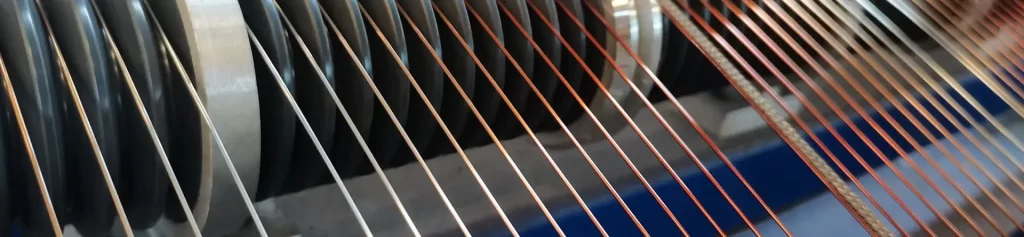
The enameled wire in the insulation layer thickness is an important physical parameter of enameled wire. It has a direct impact on a load breakdown voltage, a temperature resistance, a winding concentration and a use scope.
So today, we are going to deep dive into the world of enameled wire insulation thickness.
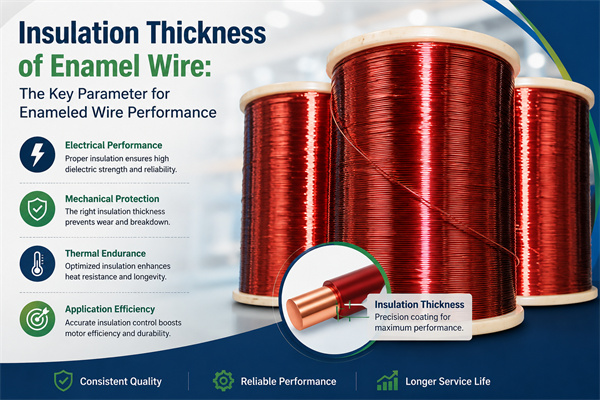
Determining the insulation thickness of a wire with an enameled coating.
Basic Definition:
Enameled wire insulation thickness ¼= Total overall outer diameter of enameled wire80= Conductor diameter279;
Typical Thickness Range:
Single coating enameled wire: 10-30 m
Enameled wire double coating: 20-50 m
Triple insulated enameled wire: 50-100 m
Why is “thickness” so important:
Insufficient breakdown voltage due to too thin => Insulation failure
Too heavy -> Takes much space -> Difficult to be wound densely
Unevenis local weak pointscompl. Oa premature failure
Three Major Functions of Insulation Thickness
1. Electrical Insulation
Enamel thickness directly determines breakdown voltage: greater thickness → higher breakdown voltage; more uniform thickness → more stable electrical performance
2. Mechanical Protection
Too thin → Easy to scratch; Too thick → Affects flexibility; Moderate → Balanced protection and winding performance
3. Space Occupation
Thin enamel → High slot fill rate → High power density; Thick enamel → More space occupied → Lower slot fill rate
IEC Standard Insulation Thickness Grades
Grade 1 (Thin Enamel)
- Enamel thickness: Relatively thin
- Minimum enamel thickness: about 0.01mm
- Breakdown voltage: ≥1500V
- Features: Good flexibility, high slot fill rate
- Applications: Dense winding, small coils, high-frequency transformers
Grade 2 (Standard Enamel)
- Enamel thickness: Medium
- Minimum enamel thickness: about 0.02mm
- Breakdown voltage: ≥3000V
- Features: Balanced comprehensive performance
- Applications: General motors, transformers (most commonly used grade)
Grade 3 (Thick Enamel)
- Enamel thickness: Relatively thick
- Minimum enamel thickness: about 0.03mm
- Breakdown voltage: ≥4000V
- Features: High insulation strength, good reliability
- Applications: High voltage motors, high reliability applications
Insulation Thickness Standards for Different Wire Diameters
IEC 60317-1 (Polyvinyl Acetal Enameled Round Copper Wire)
| Conductor Diameter (mm) | Grade 1 (mm) | Grade 2 (mm) | Grade 3 (mm) |
|---|---|---|---|
| 0.250 | 0.015 | 0.027 | 0.040 |
| 0.500 | 0.018 | 0.032 | 0.048 |
| 1.000 | 0.026 | 0.045 | 0.065 |
| 2.000 | 0.045 | 0.075 | 0.105 |
| 2.500 | 0.055 | 0.090 | 0.125 |
IEC 60317-13 (Polyester Enameled Round Copper Wire)
| Conductor Diameter (mm) | Grade 1 (mm) | Grade 2 (mm) | Grade 3 (mm) |
|---|---|---|---|
| 0.500 | 0.024 | 0.040 | 0.060 |
| 1.000 | 0.035 | 0.060 | 0.085 |
| 2.000 | 0.055 | 0.090 | 0.125 |
| 2.500 | 0.065 | 0.105 | 0.145 |
Note: Thickness standards for different enamel materials vary slightly.
Relationship Between Insulation Thickness and Breakdown Voltage
| Enamel Thickness | Breakdown Voltage (Typical Value) |
|---|---|
| 10 μm | About 500V |
| 20 μm | About 1000V |
| 30 μm | About 1500V |
| 50 μm | About 2500V |
| 80 μm | About 4000V |
| 100 μm | About 5000V |
Relationship Characteristics:
- Within a certain range, breakdown voltage and enamel thickness are approximately linear
- When thickness is too thick, breakdown voltage growth slows down
- Uneven thickness significantly reduces overall breakdown voltage
Factors Affecting Insulation Thickness
1. Enamel Material
Different enamel materials have different thickness requirements:
| Enamel | Thickness Characteristics |
|---|---|
| Polyester (PEW) | Wide thickness range |
| Polyurethane (UEW) | Thin enamel mainly |
| Polyesterimide (EIW) | Medium enamel |
| Polyamide-imide (AIW) | Thicker enamel |
| Polyimide (PI) | Thicker enamel |
2. Coating Process
Coating methods affect enamel uniformity:
- Felt Method: Average enamel uniformity
- Die Method: Good enamel uniformity
- Multiple Coatings: More uniform enamel
3. Conductor Surface
Conductor surface state affects enamel adhesion:
- Smooth conductor surface → Uniform enamel
- Rough conductor surface → Enamel thickness fluctuation
- Aluminum conductors require special treatment
4. Baking Curing
Baking process affects enamel quality:
- Temperature too high → Enamel may burn
- Temperature too low → Insufficient enamel curing
- Speed too fast → Uneven enamel
Methods for Measuring Insulation Thickness
1. Microscopic Measurement Method
The most commonly used method: slice then measure with microscope, high precision up to ±0.001mm, suitable for laboratory testing
2. Micrometer Method
Measure total outer diameter of enameled wire, subtract conductor diameter to get enamel thickness, simple and fast
3. Eddy Current Thickness Gauge
Non-contact measurement, suitable for production line online detection, slightly lower precision
4. Laser Diameter Gauge
High precision non-contact measurement, suitable for automated production lines, higher cost
Insulation Thickness Standard Systems
1. IEC Standards (International Universal)
- IEC 60317-0-1: General requirements for enameled round copper wire
- IEC 60317-1: Polyvinyl acetal enameled round copper wire
- IEC 60317-13: Polyester enameled round copper wire
- IEC 60317-8: Polyesterimide enameled round copper wire
- IEC 60317-26: Polyamide-imide enameled round copper wire
2. NEMA Standards (USA)
NEMA MW 1000: Comprehensive standard for enameled wire, with separate volumes detailing various enameled wires
3. GB Standards (China)
GB/T 6109: National standard series for enameled round wire, equivalent to IEC 60317
4. JIS Standards (Japan)
JIS C 3202: Japanese industrial standard for enameled wire
How to Select Appropriate Insulation Thickness?
1. According to Working Voltage
| Working Voltage | Recommended Grade |
|---|---|
| <300V | Grade 1 or Grade 2 |
| 300-600V | Grade 2 |
| 600-1000V | Grade 2 or Grade 3 |
| >1000V | Grade 3 |
2. According to Winding Requirements
- High slot fill rate requirements → Grade 1
- General requirements → Grade 2
- High reliability requirements → Grade 3
3. According to Mechanical Stress
- Higher stress → Grade 3
- Medium stress → Grade 2
- Lower stress → Grade 1
4. Balance Considerations
- Greater thickness → Higher safety, but more space occupied
- Smaller thickness → Higher slot fill rate, but less electrical margin
- Recommend comprehensive evaluation based on specific applications
Common Issues with Insulation Thickness
1. Uneven Enamel Thickness
Causes: Unstable coating process, enamel viscosity fluctuations, uneven baking temperature
Solutions: Improve coating process, control enamel parameters, optimize baking curve
2. Enamel Thickness Too Large
Problems: Occupies space, difficult to wind densely, poor heat dissipation
Solutions: Adjust coating parameters, reduce coating times, select thin enamel products
3. Enamel Thickness Too Small
Problems: Insufficient breakdown voltage, inadequate mechanical protection, premature failure
Solutions: Increase coating times, select thick enamel products, switch to double-coating structure
4. Enamel Thickness and Tolerance
- IEC standards have clear tolerance requirements for enamel thickness
- Usually minimum thickness is required, maximum thickness is limited
- Suppliers need to provide enamel thickness test reports
Procurement Considerations
1. Clarify Specifications
Need to clarify when procuring:
- Conductor diameter
- Enamel grade (Grade 1/2/3)
- Enamel material
- Tolerance requirements
2. Inspection Requirements
- Require suppliers to provide enamel thickness reports
- Conduct sampling inspection if necessary
- Pay attention to minimum thickness (not average thickness)
3. Standard Reference
- Confirm execution standards (IEC/NEMA/GB)
- Confirm grade classification
- Confirm testing methods
4. Application Matching
- Evaluate working voltage
- Evaluate mechanical stress
- Evaluate space limitations
FAQ
Q: Which grade (Grade 1, Grade 2, Grade 3) is most commonly used?
A: Grade 2 is most commonly used, suitable for most general motors and transformers. Grade 1 is for dense winding, Grade 3 is for high voltage applications.
Q: Is thicker enamel always better?
A: Not necessarily. While thicker enamel provides higher insulation strength, it also occupies more space, affecting slot fill rate and winding density. Should be selected based on actual needs.
Q: How to determine the enamel grade of enameled wire?
A: Check the product specifications or information provided by the supplier. You can also measure the total outer diameter of the enameled wire minus the conductor diameter to determine.
Q: Is enamel thickness the same for different wire diameters?
A: No, it’s different. The larger the wire diameter, the larger the enamel thickness. IEC standards have corresponding enamel thickness requirements for different wire diameters.
Q: What is considered qualified enamel thickness deviation?
A: Usually per IEC standards, the minimum thickness must reach the specified value, and the maximum thickness cannot exceed 1.5 times the specified value. Specific reference to relevant standards is required.
Q: Is enamel thickness of enameled aluminum wire the same as enameled copper wire?
A: Basically the same. IEC standards require basically the same enamel thickness for enameled aluminum wire and enameled copper wire of the same diameter.